Free Distance Bounds for Protograph-Based Regular LDPC Convolutional Codes
In this paper asymptotic methods are used to form lower bounds on the free distance to constraint length ratio of several ensembles of regular, asymptotically good, protograph-based LDPC convolutional codes. In particular, we show that the free dista…
Authors: David G. M. Mitchell, Ali E. Pusane, Norbert Goertz
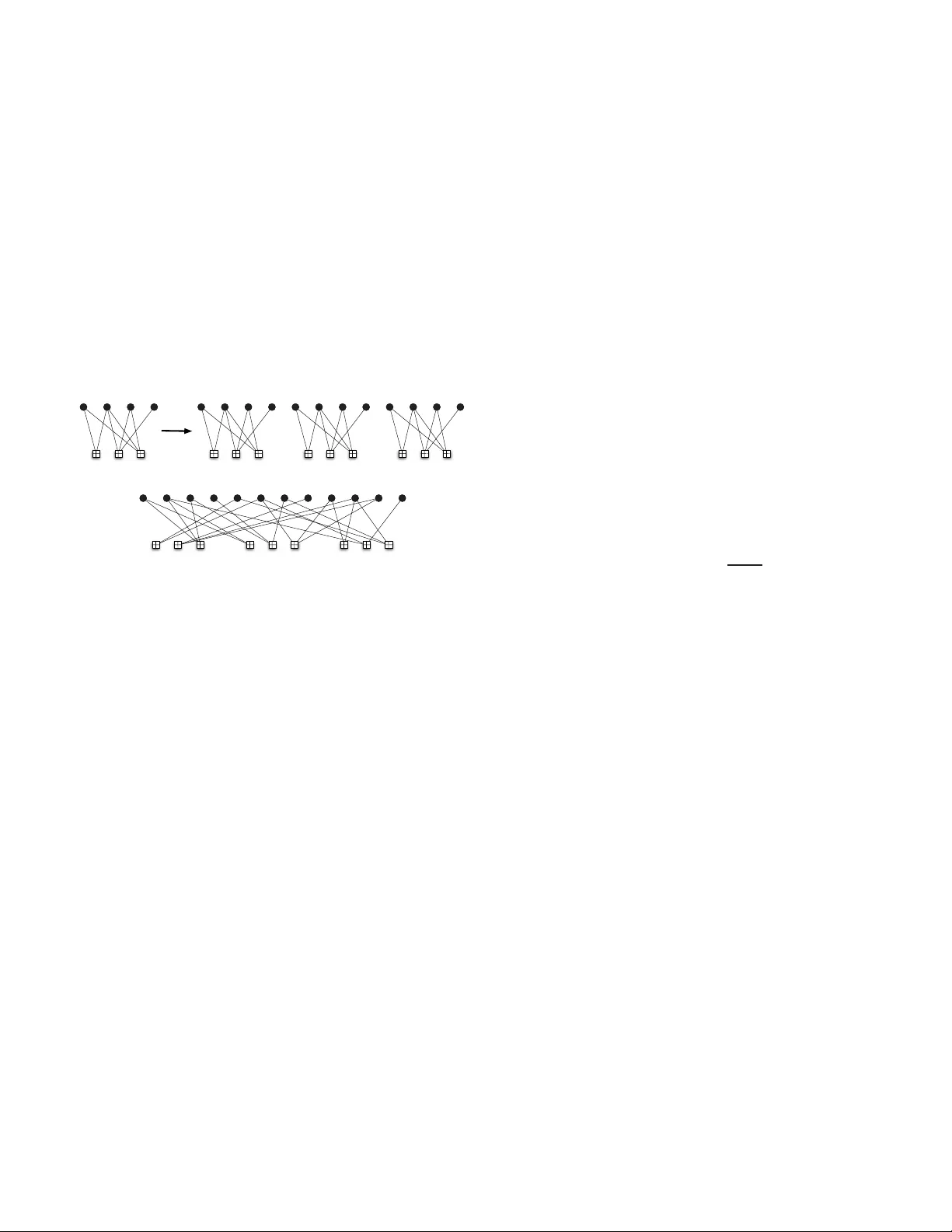
Free Distance Bounds for Protograph-Based Re gular LDPC Con v olutional Codes David G. M. Mitchell ∗ , Ali E. Pusane † , Norbert Goertz ∗ , and Daniel J. Co stello, Jr . † ∗ Joint Research Institute for Signal & I mage Pro cessing, The University of Edinburgh, S cotlan d, { David.Mitchell, Norber t.Goertz } @ed.ac .uk † Dept. of Electrical Engin eering, Uni versity of Notre D ame, Notre Dame, I ndiana, USA, { apusane, d costel 1 } @nd.e du Abstract — In this paper asym ptotic methods ar e used to f orm lower bound s on the free distance to constrain t l ength ratio of sev eral ensembles of r egular , asymptotically goo d, protograph- based LDPC con volutional codes. In particular , we show that the fr ee distance to constraint length ratio of the regular LDPC con volutional codes exceeds th at of the min imum distance to block length ratio of the corresponding LDPC block codes. I . I N T R O D U C T I O N LDPC con volutional co des, the con volutional counterp arts of LDPC block co des, were in troduced in [1], and they have been sh own to h a ve cer tain advantages comp ared to L DPC block cod es of th e sam e comp lexity [2], [3]. In this p aper , we use en sembles of ( J, K ) regular tail-biting LDPC conv o- lutional c odes deri ved from a proto graph- based ensemb le of LDPC block codes to obtain a lo wer bound on the free distance to constraint length ratio of unterminated, asymptotically good, periodically time-varying regular LDPC convolutional code ensembles, i.e., ensembles that have the pr operty o f f ree distance gr owing linearly with co nstraint len gth. In the pr ocess, we show that the minimum d istances o f ensembles of tail-biting LDPC conv olution al codes (intro- duced in [4]) approac h the free d istance o f an associated untermin ated, pe riodically time-varying LDPC con volutional code ensemble as the b lock length o f the tail-biting en sem- ble increases. W e show that, for rate 1 / 2 p rotogra ph-based ensembles with regular degree d istributions, the f ree distance bound s are consistent with those recently derived for more general regular LDPC con volutional code ensembles in [5] and [6]. Furth er , the relatively low complexity requ irements of computin g the bou nd allows us to calcu late ne w free distance bound s that grow linear ly with constraint length for v alues of J and K that have no t been p reviously consider ed in the literature. W e show , fo r all the ( J , K ) -regular ensem bles considered , that the free distance to con straint length ratio exceeds th e minimum distance to block length r atio of the correspo nding block cod es. The paper is structured as follo ws. In Section II, we br iefly introdu ce LDPC co n volutional codes. Section III summa rizes the techniqu e pro posed b y Di vsalar to analyze the asymptotic distance growth behavior of protog raph-b ased LDPC block codes [7]. In Section IV, we discuss metho ds of fo rming regular conv olutional codes from regular protographs. W e th en describe the co nstruction of tail-b iting LDPC conv olutio nal codes as well a s correspo nding untermina ted, period ically time-varying LDPC conv olutiona l co des in Section V. In addition, we show that the free d istance of a p eriodically time- varying LDPC co n volutional code is lower bo unded by the minimum distance of the bloc k co de form ed by terminating it as a tail-biting LDPC con volutional c ode. Finally , in Section VI we present lower b ounds on the free distan ce of ensembles of regular L DPC conv olution al codes based o n pro tograph s. I I . L D P C C O N VO L U T I O N A L C O D E S W e start w ith a brief definition of a rate R = b/c binary LDPC conv olutio nal code C . (A m ore detailed d escription can be f ound in [1].) A code sequen ce v [0 , ∞ ] satisfies the equ ation v [0 , ∞ ] H T [0 , ∞ ] = 0 , (1) where H T [0 , ∞ ] is the synd rome form er matrix and H [0 , ∞ ] = H 0 (0) H 1 (1) H 0 (1) . . . . . . . . . H m s ( m s ) H m s − 1 ( m s ) . . . H 0 ( m s ) H m s ( m s + 1) H m s − 1 ( m s + 1) . . . H 0 ( m s + 1) . . . . . . . . . is the parity-chec k matrix of the conv olution al code C . The submatrices H i ( t ) , i = 0 , 1 , · · · , m s , t ≥ 0 , are binary ( c − b ) × c sub matrices, given by H i ( t ) = h (1 , 1) i ( t ) · · · h (1 ,c ) i ( t ) . . . . . . h ( c − b, 1) i ( t ) · · · h ( c − b,c ) i ( t ) , (2) that satisfy the following proper ties: 1) H i ( t ) = 0 , i < 0 and i > m s , ∀ t . 2) There is a t such that H m s ( t ) 6 = 0 . 3) H 0 ( t ) 6 = 0 and has full rank ∀ t . W e call m s the syn drome for mer mem ory and ν s = ( m s + 1) · c the decoding constraint length. These par ameters determine the width of th e nonzer o diag onal region of H [0 , ∞ ] . The sparsity of the parity -check matrix is en sured by de manding that its rows hav e very lo w Hamming weight, i.e., w H ( h i ) << ( m s + 1) · c, i > 0 , where h i denotes the i -th r ow o f H [0 , ∞ ] . T he code is said to be r egular if its parity- check matrix H [0 , ∞ ] has exactly J ones in e very column and, starting from row ( c − b ) m s + 1 , K ones in ev ery row . The other entries are zero s. W e refer to a code with these properties as an ( m s , J, K ) -r egular LDPC conv olution al code, and we note th at, in g eneral, the code is time-varying and has rate R = 1 − J/K . A rate R = b/ c , ( m s , J, K ) -r egular time- varying LDPC conv olutional code is period ic with pe riod cT if H i ( t ) is p eriodic, i.e., H i ( t ) = H i ( t + T ) , ∀ i, t , and if H i ( t ) = H i , ∀ i, t , the code is time-inv ariant. I I I . P R OT O G R A P H W E I G H T E N U M E R A T O R S Suppose a given p rotogra ph has n v variable nodes and n c check no des. An ensem ble of protog raph-b ased LDPC b lock codes can be created using the co py-and-pe rmute o peration [8]. The T anner graph obtained for o ne member of an ensemble created with this m ethod is illustrated in Fig . 1. 0 1 2 3 0 1 2 3 0 1 2 3 0 1 2 3 0 1 2 3 0 1 2 3 0 1 2 3 A B C A B C A B C A B C A B C A B C A B C Fig. 1. The cop y-and-permute operation for a protograph . The parity -check matrix H correspon ding to the en semble of proto graph- based LDPC block cod es can be obtained by replacing ones with N × N permu tation matrices and ze ros with N × N all zero matrices in the underlying pr otograp h parity-ch eck matrix P , where the permutation m atrices are chosen ran domly and indepen dently . The pr otograp h p arity- check matrix P correspondin g to the protog raph given in Figure 1 can be written as P = 1 1 0 0 0 1 1 1 1 1 1 0 , where we note that, since the row and column weights o f P ar e not constant, P rep resents th e p arity-chec k matrix of an irregu lar LDPC cod e. For a ( J, K ) r egular LDPC co de, the protog raph contains n c = J che ck nodes and n v = K variable nod es, where each variable no de is con nected to all J check nodes, i.e., P is an “all-one” matrix 1 . T he sparsity condition o f an LDPC parity-check matrix is thus satisfied for large N . The code created by a pplying the copy-and- permute operation to an n c × n v protog raph p arity-check matrix P has block length n = N n v . In addition, the code has the same 1 It is also possible to consider protograph parity-check matrices P wit h larg er integ er entries, which represent parallel edges in the the base proto- graph. In this case, the corresponding block in H consists of a sum of N × N permutat ion matri ces. See [8] for details. rate and degree distribution for each of its variable and check nodes as the u nderlyin g protograp h co de. Combinator ial methods of calcu lating ensemble average weight enumerators ha ve been pr esented in [ 7] and [9]. W e now briefly descr ibe the m ethods presen ted in [ 7]. A. E nsemble weight enumerators Suppose a p rotogra ph con tains m variable nod es to be transmitted over th e channel and n v − m p uncture d vari- able nodes. A lso, sup pose that each of the m tra nsmitted variable nodes has an associated weigh t d i ∈ { 0 , 1 } . Le t S d = { ( d 1 , d 2 , . . . , d m ) } b e the set of all possible weight distributions such that d 1 + . . . + d m = d , and let S p be the set of all possible weight distributions f or the remaining punctured nodes. The ensemble weigh t enu merator for th e protograph is then given by A d = X { d k }∈ S d X { d j }∈ S p A d , (3) where A d is the average number of codewords in the ensemble with a particular weight d istribution d = ( d 1 , d 2 , . . . , d n v ) . B. A symptotic weight enumerators The no rmalized logarithm ic asympto tic weig ht distribu- tion of a cod e ensemble can be wr itten as r ( δ ) = lim n →∞ sup r n ( δ ) , where r n ( δ ) = ln ( A d ) n , δ = d/ n , d is the Hamm ing weight, n is the block length, an d A d is the ensemble average weight d istribution. Suppose the first zer o crossing of r ( δ ) occurs at δ = δ min . If r ( δ ) is n egati ve in th e range 0 < δ < δ min , then δ min is called the minimum distance gr owth r ate of the code ensemble. By co nsidering the proba bility P ( d < δ min n ) = δ min n − 1 X d =1 A d , it is clear that, as th e b lock len gth n grows, if P ( d < δ min n ) << 1 , then we c an say with high probab ility tha t the majority o f co des in the ensemb le have a m inimum distan ce that g rows lin early with n and that the distanc e growth rate is δ min . I V . F O R M I N G C O N V O L U T I O NA L C O D E S F RO M P R OT O G R A P H S In this section, we pre sent methods to form c on volutional parity-ch eck matrices f rom the pa rity-check matr ix of a p ro- tograph . A. Un wrapping a pr otograph with gcd ( n c , n v ) > 1 Suppose that we have an n c × n v protog raph parity -check matrix P , where g cd ( n c , n v ) = y > 1 . W e then pa rtition P as a y × y block m atrix as follows: P = P 1 , 1 . . . P 1 ,y . . . . . . P y , 1 . . . P y ,y , where each blo ck P i,j is of size n c /y × n v /y . P can now be separated into a lower triangu lar part, P l , a nd an up per triangular p art minu s the leading diago nal, P u . Ex plicitly , P l = P 1 , 1 P 2 , 1 P 2 , 2 . . . . . . . . . P y , 1 P y , 2 . . . P y ,y and P u = P 1 , 2 . . . P 1 ,y . . . . . . P y − 1 ,y , where blank spaces corr espond to ze ros. This operatio n is called ‘cu tting’ a protog raph parity-che ck matrix. Rearrangin g the p ositions o f these two triangula r matr ices and repeating them indefin itely results in a parity-ch eck matrix H cc of an un terminated, periodically time-varying conv olu- tional code with decoding constraint length ν s = n v and period T = n v giv en by H cc = P l P u P l P u P l . . . . . . . (4) Note that the u nwrappin g procedu re described above preserves the row and colum n w eights of the p rotogr aph parity- check matrix. B. Un wrapping a pr otograph with gcd ( n c , n v ) = 1 If gcd ( n c , n v ) = 1 , w e cann ot f orm a squ are block matrix larger than 1 × 1 w ith equal size block s. In this case, P l = P and P u is the all zero matrix o f size n c × n v . This trivial cut results in a c on volutional code with sy ndrom e former m emory zero, with repeating block s of the o riginal protog raph on the leading diagonal. W e now pr opose two methods of dea ling with th is structu re. 1) F orm an M -cover: Here, we create a larger pro tograph parity-ch eck matrix by usin g the co py and per mute operatio n on P . This results in an M n c × M n v = n ′ c × n ′ v parity-ch eck matrix f or some sma ll integer M . The n ′ c × n ′ v protog raph parity-ch eck matrix can then be cut following the procedure outlined above. In effect, the M × M p ermutation matrix creates a min i ensemble of block codes that can be be unwrapp ed to an ensemble of con volutional codes. The re- sulting unter minated, p eriodically time-varying co n volutional code has decoding con straint length ν s = M n v and p eriod T = M n v . 2) Use a nonu niform cut: When gcd ( n c , n v ) = 1 , we can still form a co n volutional cod e by u nwrappin g the protog raph parity-ch eck matrix using a nonuniform cu t. Let the p rotogr aph parity-ch eck matrix be written as P = p 1 , 1 . . . p 1 ,n v . . . . . . p n c , 1 . . . p n c ,n v . W e defin e a vector ξ consisting of n c step para meters ξ = ( ξ 1 , ξ 2 , . . . , ξ n c ) , wh ere 0 ≤ ξ 1 < ξ n c ≤ n v , an d each ξ i − 1 < ξ i for i = 2 , . . . , n c . As in the previous case, we form n c × n v matrices P l and P u as fo llows • for each ξ i , i = 1 , . . . , n c , the entries p i, 1 to p i,ξ i are copied into the equiv alent position s in P l ; • entries p i,ξ i +1 to p i,n v are copied , if they exist, into the equiv alent positions in P u ; • the r emaining po sitions in P l and P u are set to zero. W e now fo rm the parity-check m atrix H cc of an untermi- nated, p eriodically time-varying conv olutional cod e as in (4). Nonunif orm cuts do n ot ch ange th e row a nd column weights of the par ity-check matrix P . Further, th e decoding constrain t length remain s constant. An L DPC co n volutional co de derived from an LDPC blo ck code using a nonu niform cu t can be encoded and decoded using conv entio nal encoding an d d ecoding method s with mi- nor m odifications. For an L DPC co n volutional code obtained using the n onunifo rm cut ξ = ( ξ 1 , . . . , ξ n c ) , the maximum step wid th ξ max for th e cut is given by ξ max = ma x i =2 ,...,n c { ξ 1 , ξ i − ξ i − 1 } . ξ max − ξ i columns of zero s are then app ended imm ediately to the left of the columns in th e o riginal protograph parity- check ma trix P cor respondin g to the steps ξ i , i = 1 , 2 , . . . , n c , to form a modified protogr aph parity-ch eck matrix P ′ . This process is dem onstrated for a (3 ,4)-regular protograph with the nonun iform cut ξ = (2 , 3 , 4 ) below: P = 1 1 1 1 1 1 1 1 1 1 1 1 P ′ = 1 1 0 1 0 1 1 1 0 1 0 1 1 1 0 1 0 1 ⇒ . LDPC conv olutional codes unwrap ped from P ′ can be en- coded by a co n ventional LDPC conv olutiona l encoder with the condition th at inform ation symb ols are not assigned to the all- zero co lumns. Thus, these columns co rrespond to punctu red symbols, and the co de rate is not af fected. At the decoder, a con ventional pipeline decoder can be employed to decod e the received sequ ence. No special treatment is necessary for the symbo ls cor respondin g to the all-zer o co lumns, since the column weight of zero insures that they are not included in any parity-ch eck equation s, i.e. , th e belief-prop agation decod ing algorithm ig nores the correspo nding symbols. V . F R E E D I S TA N C E B O U N D S W e n ow introduce the notion o f tail-biting convolutional codes by d efining an ‘unwrappin g factor’ λ as the numb er of times the sliding con volutional structure is re peated. For λ > 1 , the parity -check matrix H ( λ ) tb of the de sired tail-biting conv olutional code can be written as H ( λ ) tb = P l P u P u P l P u P l . . . . . . P u P l λn c × λn v . Note that the tail-b iting con volutional code for λ = 1 is simp ly the original block code. A. A tail-b iting LDPC co n volutio nal code ensemble Giv en a protog raph parity-ch eck matrix P , we gener ate a family of tail-bitin g conv olutio nal codes with in creasing block len gths λn v , λ = 1 , 2 , . . . , using the p rocess described above. Since tail-biting con volutional codes are themselves block codes, we can tr eat the T an ner grap h o f H ( λ ) tb as a protog raph f or each value of λ . Replacing the entr ies of th is matrix with either N × N permutation matrices or N × N all zero matrices, as d iscussed in Section III, cr eates an ensemb le of LDPC codes w ith block len gth n = λN n v that can be analyzed asympto tically as N goes to infinity , where the sparsity cond ition of an LDPC co de is satisfied for large N . Each tail-b iting LDPC code ensemble, in tu rn, can be unwrapp ed and repeated in definitely to fo rm a n ensem ble o f untermin ated, pe riodically time-varying LDPC con volutional codes with deco ding constrain t length ν s = N n v and period T = λN n v . Intuitively , as λ increases, the tail-biting code become s a better representation of the associated u nterminate d co n volu- tional c ode, with λ → ∞ cor respondin g to the un terminated conv olutional cod e itself. This is r eflected in th e weig ht enumera tors, and it is shown in Section VI that incr easing λ provides us with distance growth rates that converge to a lower bound on th e free distance growth rate of the u nterminated conv olutional code. B. A free distance b ound T ail-bitin g co n volutional codes ca n be used to establish a lower bou nd on the free distance of an associa ted un - terminated, period ically time-varying conv olution al code by showing that the free distance of the u nterminated code is lower bounded by the min imum distance of any of its tail- biting version s. Theor em 1 : Con sider a r ate R = ( n v − n c ) /n v unter- minated, periodically time-varying conv olutiona l c ode with decodin g constraint length ν s = N n v and period T = λN n v . Let d min be the m inimum distance of the associated tail-bitin g conv olutional co de with length n = λN n v and unwrapp ing factor λ > 0 . Th en the fr ee distance d f r ee of the u ntermi- nated co n volutional co de is lo wer bounded by d min for a ny unwrapp ing factor λ , i.e ., d f r ee ≥ d min , ∀ λ > 0 . (5) Sketch of p r oof. It can be shown that any codeword in a rate R = ( n v − n c ) /n v untermin ated, pe riodically time- varying conv olution al co de with co nstraint leng th ν s = N n v and per iod T = λN n v can be w rapped back to a codew or d in a tail-b iting conv olutiona l c ode of length n = λN n v , for any λ . The ‘wrapping back ’ proced ure consists of di vidin g the conv olutional codeword into segments of leng th λN n v and superimpo sing these segmen ts th rough a m odulo summatio n. The Hamming weight of the resulting codew ord in th e tail- biting co de m ust be equal to o r less than that o f the cod ew ord in the unterm inated cod e. Th e result is the n ob tained by wrapping back the u nterminated codeword with minim um Hamming weigh t. For a forma l proof, see [6]. A trivial corollary of the above th eorem is that the minimu m distance of a p rotograp h-based LDPC blo ck code is a lower bound on the fre e distance of the associa ted unterm inated, periodically time-varying LDPC co n volutional cod e. This can be ob served by setting λ = 1 . C. The fr ee distance gr owth rate The distance growth rate δ min of a block co de ensemble is defined as its minim um distance to block length r atio. For the pro tograph- based tail-biting LDPC conv olu tional cod es defined in Section V -A, this ratio is ther efore giv en as δ min = d min n = d min λN n v = d min λν s . (6) Using (5) we obtain δ min ≤ d f r ee λν s , (7) where d f r ee is the free distance of the associated unterminated, periodically tim e-varying LDPC co n volutional code. It is im- portant to n ote th at, for con volutional c odes, the length of the shortest codew ord is equal to the encoding constraint length ν e , which in gen eral differs from the decoding con straint leng th ν s . Assuming minim al encoder and sy ndrome former ma trices, the relation between ν e and ν s can be expressed as ν e = 1 − R R ν s , (8) which implies that, for code rates less than 1 / 2 , the en coding constraint len gth is larger than the decod ing constraint le ngth. Combining (7 ) and (8) gi ves us the desired bound on the free distan ce growth rate δ f r ee ≥ R 1 − R λδ min , (9) where δ f r ee = d f r ee /ν e is the conv olutional c ode free distance growth rate 2 . 2 If the syndrome former matrix is not in mini mal form, (8) result s in an upper bound on ν e , which implies that δ f r ee is underestimate d in this case. V I . B O U N D C O M P U T A T I O N S W e now present free distance growth rate results for en - sembles of asympto tically go od, regular , LDPC c on volutional codes ba sed o n pro tograph s. W e c onsider all the regular ensembles origina lly co nsidered by Gallager [1 0], and for each we calculate a lower bound o n the free distance to constraint leng th ratio δ f r ee . W e begin by considerin g th e regular ensembles with gcd ( n c , n v ) > 1 . Then we conside r the m ethods pro posed in Section I V -B for regular ensembles with gcd ( n c , n v ) = 1 . R esults for these ensembles are then presented and discussed. A. R e gular Ensemble s with gc d ( n c , n v ) > 1 Example 1 : Consid er the rate R = 1 / 2 , (3 , 6) -regular LDPC code en semble based on the following proto graph: . For this example, the minim um distance gr owth rate is δ min = 0 . 023 , as o riginally compu ted by G allager [ 10]. A family of tail-biting (3 , 6) -regular LDPC convolutional code ensembles can be gen erated according to the following cut: P = 1 1 1 1 1 1 1 1 1 1 1 1 1 1 1 1 1 1 . For λ = 2 , 3 , . . . , 8 , the minimu m d istance g rowth ra te δ min was calculated for the tail-b iting LDPC conv olutional co de ensembles using the approach outlined in Sectio n V -A. Th ese growth rates are shown in Fig. 2, alon g with the cor respond ing lower bound on the free distance growth rate δ f r ee of the as- sociated ensemb le of un terminated, period ically time-varying LDPC conv olutio nal code s. For this r ate R = 1 / 2 ensemble, the lower bou nd on δ f r ee is simply δ f r ee ≥ R 1 − R λδ min = λδ min , since R 1 − R = 1 in this ca se. 1 2 3 4 5 6 7 8 0 0.01 0.02 0.03 0.04 0.05 0.06 0.07 0.08 0.09 Lower bound on the convolutional growth rate δ free Tail−biting growth rates δ min Distance growth rates for δ min and δ free Protograph unwrapping factor λ Fig. 2. Distanc e gro wth rates for Example 1 . W e observe th at, o nce the unwrapp ing factor λ of the tail- biting con volutional co des e xceed s 3 , the lo wer bound on δ f r ee lev els off at δ f r ee ≥ 0 . 086 , which agrees with th e results presented in [5] and [6] an d rep resents a sign ificant in crease over the value of δ min . In this case, the min imum weight codeword in the unterm inated conv olu tional code also appe ars as a codeword in the tail-biting co de 3 . Example 2 : Consid er the rate R = 1 / 3 , (4 , 6) -regular LDPC code ensemb le. The min imum distance growth rate for th is ensemble is δ min = 0 . 128 [10]. W e for m a pr otograp h in the usual fashion, creating 4 ch eck nodes, each of which conn ect to all 6 variable n odes, and we o bserve that gcd (4 , 6) = 2 . T he protog raph parity-ch eck matrix and defined cu t are displayed below: . For this rate R = 1 / 3 ensemble, the lo wer bound on δ f r ee is δ f r ee ≥ R 1 − R λδ min = 1 2 λδ min . W e observe that, as in Example 1 , the min imum distance g rowth rates calculated for increasing λ provide us with a lower bound δ f r ee ≥ 0 . 1 97 on the free d istance growth rate o f the co n volutional code ensemble, which exceeds the value of δ min . Example 3 : Consid er the rate R = 1 / 2 , (4 , 8) -regular LDPC code ensemb le. The min imum distance growth rate for th is ensemble is δ min = 0 . 063 [10]. Th e protog raph parity -check matrix is cut along the diagonal in steps of 1 × 2 . For this rate R = 1 / 2 ensemble, th e lower boun d on δ f r ee is δ f r ee ≥ R 1 − R λδ min = λδ min , and we ob tain the lower bound δ f r ee ≥ 0 . 191 on the free distance growth rate of the co n volutional code en semble, which is again significantly larger than δ min . B. R e gular Ensemble s with gc d ( n c , n v ) = 1 W e now p resent r esults f or the two m ethods of unwrapp ing a protogra ph w ith gcd ( n c , n v ) = 1 introdu ced i n Section IV -B. Example 4 : Consider the rate R = 2 / 5 , (3 , 5) -regular en- semble. The minim um distance growth r ate for this ensemb le is δ min = 0 . 0 45 [1 0]. For this rate R = 2 / 5 en semble, the lower bound on δ f r ee is δ f r ee ≥ R 1 − R λδ min = 2 3 λδ min . The first appro ach was to form a two-cover of the regular protog raph. The resu lting m ini-ensemble has 2 n v n c = 2 15 members. Fifty distinct members were chosen rand omly . The resulting lower bou nds calculated fo r δ f r ee are shown in a bo x plot in Fig. 3 . W e ob serve a fairly large spread in results from th e mini- ensemble. T he me dian fro m the fifty trials is δ f r ee = 0 . 09 7 . W e also o bserve that the smallest lower bo und found is statistically a outlier as it lies reasonably far a way from the lower quartile. Note that this sma llest lower boun d ( δ f r ee ≥ 0 . 069 ) is larger tha n the blo ck code gr owth rate δ min = 0 . 045 . Also, the best lower bound, δ f r ee ≥ 0 . 10 8 , is sign ificantly larger than δ min . 3 Example 1 was pre viously presented in [11]. 0.07 0.075 0.08 0.085 0.09 0.095 0.1 0.105 Lower bounds on δ free Results of 50 trials from the mini−ensemble Lower quartile Median Upper quartile Outlier Fig. 3. Free distance growth rates for 50 mini-ensemble members. W e now consider the nonu niform cut case. Consider th e following two nonu niform cuts of the standard p rotograp h parity-ch eck matrix for the regular (3 , 5) ensemble: and , with cor respondin g cutting vectors ξ 1 = (2 , 4 , 5 ) and ξ 2 = (1 , 2 , 3) . W e calculate a lower boun d o f δ f r ee ≥ 0 . 119 for cut one an d δ f r ee ≥ 0 . 111 for cut two. Both no nunifo rm cuts give larger lower bou nds on δ f r ee than the mini-en semble method. For th e remaining regular ensemb les with g cd ( n c , n v ) = 1 , we used the no nunifo rm cut metho d. T he r esulting boun ds are giv en in the table b elow . Ensemble Cut ξ δ min [10] L ower boun d on δ f r ee (3 , 4) (2 , 3 , 4) 0 . 112 0 . 177 (4 , 5) (2 , 3 , 4 , 5) 0 . 210 0 . 266 (5 , 6) (2 , 3 , 4 , 5 , 6) 0 . 254 0 . 317 For each e nsemble considered, the lo wer bound on δ f r ee is significantly larger than δ min for the b lock co de ensem ble. This is illustrated in Fig. 4, where the distance g rowth rates of each regular LDPC code ensemble are com pared to the correspo nding bound s for gen eral block and conv olutional codes. V I I . C O N C L U S I O N S In this paper , asymptotic meth ods were used to calculate a lower bou nd on fr ee distance that grows lin early with con- straint len gth f or several ensembles of r egular , untermin ated, protog raph-b ased pe riodically time-varying LDPC con volu- tional codes. It was shown that the free distan ce growth r ates of the regular LDPC co n volutional code ensemb les exceed the minimum distance growth rates of the corr esponding regular LDPC block co de en sembles. When gcd ( n c , n v ) = 1 , we propo sed two n ew methods of unwra pping the pro tograph parity-ch eck m atrix in or der to obtain the best possible lower bound on δ f r ee . The results suggest that we typically obtain better lower bou nds by p erformin g nonunifo rm c uts. 0 0.05 0.1 0.15 0.2 0.25 0.3 0.35 0.4 0.45 0.5 0 0.1 0.2 0.3 0.4 0.5 0.6 0.7 0.8 0.9 1 (3,6) (3,6) (4,8) (4,8) (3,5) (3,5) (4,6) (4,6) (3,4) (3,4) (4,5) (4,5) (5,6) (5,6) Gilbert−Varshamov bound Costello bound Rate d min / n or d free / ν e Block code growth rate δ min Lower bound on the convolutional growth rate δ free Fig. 4. Comparison of calculate d gro wth rate s with the Gilbe rt-V arshamov bound for block code minimum distanc e growth rate s and the Costello bound for con voluti onal code free distance growth rates. A C K N O W L E D G E M E N T This work was partially supp orted by NSF Gr ants CCR02- 05310 an d CCF05-1 5012 and N ASA Grant NN X07AK536 . In addition, the au thors acknowledge the supp ort of the Sco ttish Funding Council fo r the Joint Research In stitute with the Heriot-W att University , whic h is a part of the Edinburgh Research Partnership . R E F E R E N C E S [1] A. J im ´ enez Felstr ¨ om and K. Sh. Zigangi rov , “Time-v arying periodic con vol utional codes with lo w-density parity-ch eck matric es”, IEEE T rans. Inform. Theory , IT -45 , pp.2181-2191, Sept. 1999. [2] D. J. Costello, Jr ., A. E. Pusane, S. Bate s, and K. Sh. Zigangi rov , “ A comparison betwee n LDPC block and con volutiona l codes”, Pr oc. Informatio n Theory and Applicat ions W orkshop , San Diego, CA, USA, Feb . 2006. [3] D. J. Costello, Jr ., A. E. Pusane, C. R. Jones, and D. Divsalar , “ A com- parison of ARA- and protogra ph-based LDP C block and con volutio nal codes”, Pr oc. Information Theory and Applications W orkshop , San Diego, CA, USA, Feb. 2007. [4] M. T av ares, K. Sh. Zigangirov , and G. Fettweis, “T ail-Bi ting LDPC Con- volu tional Cod es”, P r oc. IEEE International Symposium on Information Theory , Nice, France, June 2007. [5] A. Sridharan, D. Truhache v , M. Lentmaier , D. J. Costell o, Jr ., and K. Sh. Zigangiro v , “Distanc e bounds for an ensemble of LDPC con volutio nal codes”, IEEE T rans. Inform. Theory , IT -53, pp. 4537-4555, Dec. 2007. [6] D. Truhache v , K. Sh. Z igangi rov , and D. J. Costello, Jr ., “Distance bounds for periodi c LDPC con volutiona l codes and ta il-biting con volution al codes”, IEEE T rans. Inform. Theory (submitted), Jan. 2008. [7] D. Divsa lar , “Ensemble W eight Enumerators for P rotogra ph L DPC Codes”, Proc . IE EE Internatio nal Symposium on Information The ory , Seattl e, W A, Jul. 2006. [8] J. T horpe, “Lo w-Density Parity-Chec k (L DPC) codes construct ed from protograp hs”, JPL INP Pro gre ss Report , V ol. 42-154, Aug. 2003. [9] S. L . Fogal , R. McEliece, and J. Thorpe, “Enumerators for protograph ensembles of LDPC codes”, Pr oc. IEEE International Symp osium on Informatio n Theo ry , Adelaide, Australia, Sept. 2005. [10] R. G. Galla ger , “Lo w-density parity-che ck codes”, IRE T rans. Inform. Theory , IT -8: 21-28, Jan. 1962. [11] D. G. M. Mitchell , A. E. Pusane, K. Sh. Zigangiro v , and D. J. Costell o, Jr . , “ Asymptotica lly Good LDPC Con voluti onal Codes Based on Protographs”, 200 8 IEE E International Symposium o n Information Theory (accepted) .
Original Paper
Loading high-quality paper...
Comments & Academic Discussion
Loading comments...
Leave a Comment