McShanes identity, using elliptic elements
We introduce a new method to establish McShane's Identity, based upon the fact that elliptic elements of order two in the Fuchsian group uniformizing the quotient of a fixed once-punctured hyperbolic torus act so as to exclude points as being highest…
Authors: Thomas A. Schmidt, Mark Sheingorn
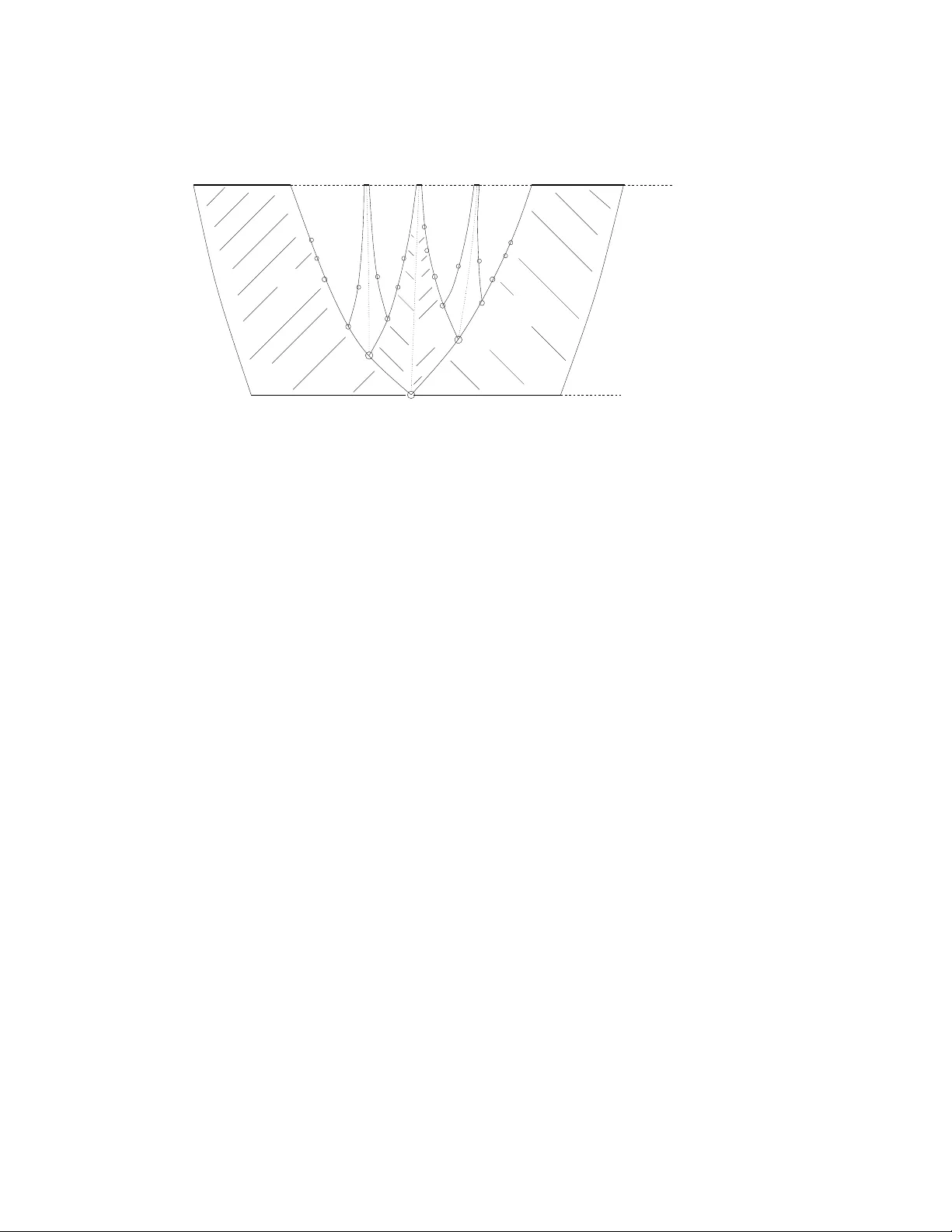
MCSHANE’S IDENTITY, USING ELLIPTIC ELEMENTS THOMAS A. SCHMIDT AND MARK SHEINGORN Abstract. W e introduce a new metho d to establish McShane’s Identit y . Elliptic elements of order tw o in the F uc hsian group uniformizing the quotient of a fixed once-punctured h yperb olic torus act so as to exclude points as b eing highest p oints of geo desics. The highest points of simple closed geodesics are already given as the appropriate complement of the regions excluded by those elemen ts of order tw o that factor hyperb olic elemen ts whose axis pro jects to be simple. The widths of the intersection with an appropriate horo cycle of the excluded regions sum to give McShane’s v alue of 1 / 2. The remaining points on the horo cycle are highest points of simple open geo desics, w e sho w that this set has zero Hausdorff dimension. 1. Introduction In his 1991 Ph.D. dissertation, G. McShane prov ed the striking iden tit y X γ 1 1 + e ` ( γ ) = 1 2 , where the sum is taken ov er all simple closed geo desics of any fixed hyperb olic once-punctured torus, and ` ( γ ) is the length of the geo desic. This has b een reprov ed in v arious wa ys: [Mc3], [B], [GSR]; and generalized v ariously: [Mc], [Mc2], [AHS], [TWZ]. The identit y has had deep applications due to Mirzakhani [M] (see also [R]), [M2], [M3]. W e give a pro of of the original identit y that is, in a sense, intermediate to McShane’s original pro of and Bo wditch’s pro of by Markoff triples [B]: it is geometric; but lengths of geodesics do not enter directly . Similar to [GSR], we take a classical approac h; ours in volv es a uniformizing F uchsian group. W e av oid McShane’s in v o cation of a deep result of Birman and Series; in its place, we show directly that the appropriate complementary set is of Hausdorff dimension zero, and thus certainly of Leb esgue measure zero, as the identit y itself requires. This Can tor set is the set of ap exes of simple op en geo desics that achiev e their height. In the follo wing t wo paragraphs, w e sketc h the proof. It is related most directly to the singular punctured sphere that is the quotien t of the punctured h yp erb olic torus by its elliptic in volution. The simple closed geo desics on the torus and this sphere are in 1–1 corresp ondence (and more). On the sphere, each simple closed geo desic b ounces b et ween tw o elliptic fixed p oints; thus, any h yp erbolic element of the uniformizing F uchsian group whose axis pro jects to the simple closed geo desic can b e factored as a pro duct of elliptics. But, our first lemma shows that an y elliptic elemen t of order t w o increases radii of circles whose ap exes lie within its uplift r e gion , b ounded b y Euclidean hyperb olas, in the Poincar ´ e upp er half plane, H . It is w ell known (from the w ork of H. Cohn and others) that there is a lo w est horo cycle (th us, informally , lo op ab out the cusp) on the h yp erbolic torus b ey ond whic h no simple geo desic p enetrates; this is true as well for the quotient orbifold. The appropriate tree of simple closed geo desics’ elliptic factorizations gives a set of uplift regions (suitably trimmed) that fit together Date : 18 F ebruary 2008. 2000 Mathematics Subject Classific ation. 57M50, 20H10. 1 2 THOMAS A. SCHMIDT AND MARK SHEINGORN so as to raise all ap exes (b elo w the lift of the fundamental horo cycle) other than those of simple closed geo desics’ highest lifts. These regions meet the lift of the fundamen tal horo cycle in disjoin t in terv als, our excision intervals , indexed by the tree of simple closed geodesics. One easily shows that the union of the excision interv als lies in a finite interv al; the complement of their union is a Cantor set. W e show that along all but coun tably many branches of the tree, the limit of the ratios of excised interv al to ambien t interv al is 1. The Cantor set thus has Hausdorff dimension zero. It in particular has Leb esgue measure zero; but, the length of each excised in terv al is a m ultiple of a corresp onding 1 1 + e ` ( γ ) , and the full interv al has length one-half this multiple, McShane’s Identit y follows. 1.1. F urther Remarks. The Can tor set in our construction is the set of ap exes of lifts of those op en simple geo desics that hav e a highest ap ex lift. The endp oin ts of our excision interv als corresp ond to geo desics that spiral ab out a simple geo desic, the remaining p oin ts corresp ond to ‘irrational laminations’. These facts can easily be verified b y using [H] (see especially Prop osition 18 there) or the more recen t [BZ]. Whereas our excision interv als lie along the fundamental horo cycle, [Mc3] finds his gaps along an y fixed horocycle closer to the cusp than the fundamental horo cycle. Our approach relies in part on replacing F rick e’s equation (in trace co ordinates on the T e- ic hm ¨ uller space): a 2 + b 2 + c 2 = abc by an adjusted equation: x 2 + y 2 + z 2 = axy z . In the modular case of a = b = c = 3, it w as Cohn’s [C] recognition that the adjusted equation is the classical Mark off equation that led him to in v estigate the geodesy of the corresp onding once-punctured h yp erbolic torus. Our approac h should recov er results of [TWZ2] in the setting of a h yp erbolic torus with geo desic b oundary . Generalizations to higher genus must b e carefully pursued: [BLS] shows that there are non-simple geodesics whose self-intersections are not caused b y parab olic elements; suc h geo desics must then b e low in the corresp onding height sp ectrum and thus of highest lifts of ap ex exterior to all uplift regions. It w ould b e interesting to generalize our tec hniques to h yp erbolic surfaces with more general conical singularities, see [DN] and [TWZ]. Finally , w e men tion that our approac h of trees of triples of order tw o elemen ts is strongly rem- iniscen t of work of L. Y u. V ulakh on the Mark off and Lagrange sp ectra and their generalizations, see for example [V]. 1.2. Outline of P ap er. Section 2 provides background material. In § 3 we define and give basic results on the basic tool, the uplift regions. In Section 4 we normalize by using w ork of A. Sc hmidt so as to combine our earlier w ork on triples of elliptic elements with standard results on trees of simple closed geo desics on h yp erbolic tori. W e finish the pro of in § 5. 1.3. Notation. W e use X + iY to denote points in H . W e call a geodesic of H with its standard h yp erbolic metric an h-line . T o increase legibilit y , all h-lines mentioned are non-vertical (in the Euclidean sense) except as explicitly stated. 1.4. Thanks. W e thank Y. Cheung for con v ersation related to this work. W e also thank the referee for suggestions and references. 2. Back ground 2.1. T ori, Simple Closed Geo desics and Automorphisms. Eac h hyperb olic once-punctured torus has a W eierstrass inv olution. The quotient of this torus by its inv olution gives a singular punctured sphere. Indeed, there is a one-to-one correspondence b et w een the sets of uniformizing groups: F uc hsian groups of signature (0; 2 , 2 , 2 , ∞ ) and F uchsian groups of signature (1; ∞ ), see MCSHANE’S IDENTITY, USING ELLIPTIC ELEMENTS 3 B AB −2 AB AB 2 2 A B A B 2 −1 A B 2 −1 −1 AB −2 AB A B 2 −1 A B 2 −1 AB 2 2 A B B A ν λ λ ρ ρ ρ ~ ~ ~ λ ~ λ ~ ~ ~ ~ ~ ρ ρ ~ AB λ ~ A AB −1 Figure 1. Equiv alence classes of toral generators and dual graph of triples. sa y [Sch]. F urthermore, the simple closed geo desics of each suc h pair are also in one-to-one cor- resp ondence, see say [Sh] (here one finds that a simple closed geo desic on a h yp erb olic punctured sphere with three elliptic order t wo singularities actually bounces back and forth betw een tw o of the singularities); indeed, the lengths of corresp onding simple closed geo desics are the same: in fact, there is a common elemen t (primitive in each of the groups) whose axis pro jects to b oth geo desics. W e refer the reader to Section 2 of [JM] for a particularly nice discussion of the structure of the graph of generators of a group of signature (1; ∞ ), see the left side of Figure 1. Here, vertices represen t group elements, up to inv erses and conjugation. Edges connect pairs that generate the group (which is a free group on tw o elements); one calls either element in such a pair a gener ating element . Any generating element has axis pro jecting to a simple closed geo desic; its in v erse and any conjugate elements give the same curve (up to orientation). Thus, our vertices can b e seen as corresp onding to the simple closed geo desics of the torus uniformized by the group. As Bowditc h (see esp ecially the discussion on p. 49 of [BMR]) p oin ted out, the dual graph is particularly helpful when discussing F rick e triples, see the right side of Figure 1. (Each no de of the resulting tree corresp onds to a triple of simple closed geo desics such that a triple of corresp onding op en simple “cusp ed” geo desics is mutually disjoint.) 2.2. F ric ke’s Equation and Explicit Groups. W e are interested in explicit lifts of simple closed geo desics. F or this, we use a v ariation of A. Schmidt’s application [Sch] of work of F rick e. Supp ose that p ositiv e real a, b, c satisfy the F rick e equation (1) a 2 + b 2 + c 2 = abc , the elements T 0 := 0 − a/c c/a 0 , T 1 := a/c ∗ b/a − a/c , T 2 := a − b/c ∗ 1 − a + b/c (of determinant one) generate a group of signature (0; 2 , 2 , 2; ∞ ). Note that T 2 · T 1 · T 0 = S a : z 7→ z + a 4 THOMAS A. SCHMIDT AND MARK SHEINGORN is the fundamental translation of this group. A full set of orbit representativ es under the action of the T eichm¨ uller group is giv en when one tak es 2 < a ≤ b ≤ c < ab/ 2; this can be deduced from [Sc h], see also [W]; we will alwa ys assume that our F rick e triples ( a, b, c ) satisfy this restriction. Note that the mo dular case of Γ 3 \H corresp onds to a = b = c = 3 and in this case T j is the conjugate of T 0 b y the translation z 7→ z + j . (Note that our T 0 is not that of [Sch].) 2.3. Fixed Poin t T riples and F undamental Domains. F or ease of presen tation, in [SS1] w e restricted to the mo dular case. How ev er, as w e noted, our arguments extend to the full T eichm¨ uller case. Prop osition 1. [SS1] L et the signatur e (0; 2 , 2 , 2; ∞ ) -orbifold U = Γ \H c orr esp ond to the F ricke triple ( a, b, c ) . Each simple close d ge o desic has a highest lift which is the axis of S a E , wher e E ∈ Γ is el liptic of or der two. Ther e is a factorization of S a E = GF as the pr o duct of el liptic elements such that a highest lifting se gment of this simple ge o desic joins the fixe d p oint f of F to the fixe d p oint g of G . L et e b e the fixe d p oint of E . A fundamental domain for Γ is given by the hexagon of vertic es: ∞ , e , f , F ( e ) , g , a + e . In p articular, { E , F , G } gener ates Γ . Giv en a fixed F rick e triple ( a, b, c ), w e hav e the corresp onding adjuste d F ricke e quation (2) x 2 + y 2 + z 2 = a xy z . Note that when a = 3 the adjusted F rick e equation is exactly Markoff ’s equation. Recall that the imaginary part, Y , of a point X + iY is its height . The factorization S E = GF can b e used to show that the hyperb olic GF , whose axis pro jects to a simple closed geo desic on the surface, has trace az , where 1 /z is the height of the fixed p oin t of E . One can show that there is such a factorization for every simple closed geo desic, and since the adjusted F rick e equation is satisfied by the traces of appropriate triples of simple h yp erbolic elements, one finds the following result. Corollary 1. [SS1] L et E , F , G b e as ab ove. Then the fixe d p oints of E , F, G have r esp e ctive heights 1 /z , 1 /y, 1 /x , whose inverses give a triple satisfing the adjuste d F ricke Equation, and with z = max { x, y , z } . F urthermor e, the simple close d ge o desic that lifts to the axis of S a E has height r a ( z ) = p a 2 / 4 − 1 /z 2 . The close d ge o desic that lifts to the axis of E S a E S − a has height R a ( z ) = p a 2 / 4 + 1 /z 2 . Pr o of. This follo ws from Theorems 2 and 3 (and their pro ofs) of [SS2], where we give detailed pro ofs in the mo dular case. The only asp ect of the pro of given there that do es not hold in general is that by use of the map w 7→ − ¯ w , in the mo dular case one can further assume that y ≥ x . Corollary 2. [SS1] L et E , F , G b e as ab ove. Then ther e is a r e al tr anslation c onjugating the triple E , F , G to E 0 = 0 ∗ z 0 , E 1 = x/z ∗ y − x/z , E 2 = ax − y /z ∗ x − ax + y /z . Pr o of. This follows as in the pro of of Theorem 2 of [SS2]. 3. Basic Tool: Uplift Regions The following elementary result is k ey to our approach. Lemma 1. If A = α β γ − α is in SL (2 , R ) , then A incr e ases the height of any h-line with ap ex ( X, Y ) satisfying | ( X − α/γ ) 2 − Y 2 | < 1 /γ 2 . MCSHANE’S IDENTITY, USING ELLIPTIC ELEMENTS 5 isometric circle of A X + − U U 8 α/γ = A( ) α/γ γ α/γ γ γ α ( + i)/ α/γ (X− )^2 − Y^2 = 1/ ^2 (X− )^2 − Y^2 = 1/ ^2 γ (X− )^2 − Y^2 = −1/ ^2 Figure 2. Order t wo A increases heights of h-lines with ap ex in uplift region U ( A ) = U − ( A ) ∪ U + ( A ) . Pr o of. W e first note that T 0 : z 7→ − 1 /z takes C ( c, r ), the circle of real center c and radius r , to C ( − c/ ( c 2 − r 2 ) , r / | c 2 − r 2 | ). Thus, this element increases radii whenever | c 2 − r 2 | < 1. No w, an h-line of ap ex ( X 0 , Y 0 ) has center X 0 and radius Y 0 . Thus, the element T 0 increases heigh ts for all h-lines of ap ex of co ordinate ( X , Y ) with | X 2 − Y 2 | < 1. The fixed p oin t of A is w = ( α + i ) /γ . Since w 7→ γ w − α on H resp ects relative size, A increases radii for h-lines of ap ex w = X + iY with | ( X − α/γ ) 2 − Y 2 | < 1 /γ 2 . 3.1. Uplift Regions Defined. Definition 1. F or A = α β γ − α in SL(2 , R ), the uplift r e gion of A , U ( A ), is the subset of ( X, Y ) ∈ H such that | ( X − α/γ ) 2 − Y 2 | < 1 /γ 2 . W e let U − ( A ) denote the elemen ts of the uplift region of A with X < α/γ , and U + ( A ) denote the remaining elements. Finally , we call • { ( X, Y ) | ( X − α/γ ) 2 − Y 2 = − 1 /γ 2 } the upp er b oundary of U ( A ), and • { ( X, Y ) | ( X − α/γ ) 2 − Y 2 = 1 /γ 2 } the lower b oundary of U ( A ) . See Figure 2. Recall that the isometric cir cle of an element of α β γ δ ∈ SL(2 , R ) with γ 6 = 0 is the circle of center − δ /γ and radius 1 / | γ | . The isometric circle of an order tw o elliptic element A (as ab o ve) is inscrib ed in the uplift region, with p oints of intersection at the fixed p oin t of A and at t w o (ideal) p oin ts on the real axis. The elliptic A acts so as to send its isometric circle to itself, b y reflection through the vertical line passing through the fixed p oin t. Lemma 2. Supp ose that A = α β γ − α is in SL (2 , R ) and ` is an h-line. Then A pr eserves the height of ` if and only if ` either p asses thr ough the fixe d p oint of A , or else ` me ets p er- p endicularly the isometric cir cle of A . In the first of these c ases, the ap ex of ` lies on the upp er b oundary of U ( A ) ; in the se c ond, this ap ex lies on the lower b oundary. Pr o of. F rom Lemma 1, th e heigh t is preserv ed exactly for ` of apex on the boundary of U ( A ). T o iden tify the geometry asso ciated to ap exes on the comp onen ts of this b oundary , it again suffices to treat the sp ecial case of A = T 0 . This is then a straightforw ard exercise, easily p erformed using at most elementary calculus. 6 THOMAS A. SCHMIDT AND MARK SHEINGORN ap (AB) 8 A( ) 8 B( ) Figure 3. Tw o order tw o elements: h-line joining fixed p oin ts and bicorn region. 3.2. Uplift Regions and T ranslations. Our main application of uplifting is in the setting of triples of elliptic elements of order tw o whose pro duct is a translation. Prop osition 2. Supp ose that A , B and C ar e distinct el liptic elements of or der two such that the pr o duct AB C is a tr anslation. Then the axis of AB me ets p erp endicularly the isometric cir cle of C . Pr o of. W e first show that C fixes the height of the axis of AB . Supp ose w lies on this axis, then B Aw do es as well. Now, C ( B Aw ) = ( AB C ) − 1 w and thus we find that the image of the axis of AB under C is simply a translation of itself. The axis of AB passes through the fixed p oin t of each of A and of B . If it also passes through the fixed p oin t of C , then eac h of A , B and C send this axis to itse lf. But, the translation AB C cannot send any h-line to itself. Therefore, in fact the axis of AB cannot pass through the fixed p oin t of C . Since C fixes the height of the axis of AB , but this axis do es not pass through the fixed p oin t of C , b y Lemma 2 we conclude that the axis of AB meets p erpendicularly the isometric circle of C . Definition 2. If A, B ∈ SL(2 , R ) are elliptic elements of order tw o, let ap( AB ) denote the ap ex of the h-line passing through their fixed p oin ts. (Note that ap( AB ) = ap( B A ), an ambiguit y that causes no harm in what follows.) F or ease of discussion, we will say that uplift regions of tw o order tw o elements bifur c ate at a p oin t p if the upp er b oundaries of these regions intersect at p . Thus, with A, B as ab o ve, their uplift regions bifurcate at ap( AB ). Corollary 3. Supp ose that A , B and C ar e distinct el liptic elements of or der two such that the pr o duct AB C is a tr anslation. Then ap ( B C ) lies on the interse ction of the lower b oundaries of the uplift r e gions of A and of C B AB C . Pr o of. That ap( B C ) lies on the intersection of the low er boundary of the uplift region of A follo ws by taking in verses and applying Prop osition 2 and Lemma 2. T o show that this ap ex lies on the low er b oundary of the uplift region of C B AB C , we can rep eat the ab o v e, after replacing A by C B AB C and B C by its inv erse C B . MCSHANE’S IDENTITY, USING ELLIPTIC ELEMENTS 7 + − r(c) Y = R(c) Y = r(c) A Y = a / 2 S A S a − a + r(c) α/γ a α/γ Figure 4. Bicorn region for A and S a AS − a meets Y = a/ 2 in Excis ion Interv al of A . 3.3. T ranslates of Uplift Regions. Definition 3. Fix a real num b er a > 0. F or z > 2 /a , let r a ( z ) = p a 2 / 4 − 1 /z 2 and R a ( z ) = p a 2 / 4 + 1 /z 2 . The final statement of the follo wing Lemma strengthens Corollary 3 in this setting. Lemma 3. Supp ose A ∈ SL (2 , R ) , with A = α β γ − α and S a is the tr anslation by a > 0 . Then the lower b oundaries of U + ( A ) and U − ( S α AS − α ) me et at ( X , Y ) = ( a/ 2 + α/γ , r a ( γ ) ) , while their upp er b oundaries me et at ( X , Y ) = ( a/ 2 + α/γ , R a ( γ ) ) . F urthermor e, if S a A is hyp erb olic, then the ap ex of its axis lies at the p oint of interse ction of the lower b oundaries of U + ( A ) and U − ( S a AS − a ) ; similarly, ap ( S a AS − a A ) = ( a/ 2 + α/γ , R a ( γ ) ) . Pr o of. This is a trivial computation. (Note that the closures of these uplift regions also meet at t w o p oints of Y -co ordinate p a 2 / 4 + 1 /γ 4 .) See Figure 4. Definition 4. With notation as abov e, we call the intersection of Y = a/ 2 with the union of U + ( A ) and U − ( S a AS − a ) the excision interval of A . Lemma 4. With notation and hyp otheses as ab ove, the excision interval of A has width w a ( A ) = a − 2 r a ( γ ) . Pr o of. This is also a trivial computation. See Figure 4. 4. Fricke-Indexed Fundament al Domains Con v ention F or the remainder of the pap er, unless otherwise stated, we fix a F ric k e triple ( a, b, c ). Note that the fundamental translation length is th us a . In [SS1] and [SS2], w e sho w ed that Γ 3 \H admits particularly nice fundamen tal domains indexed by solutions to the original Mark off equation. Here w e summarize this and its direct generalization to the general hyperb olic orbifold of signature (0; 2 , 2 , 2 , ∞ ). 8 THOMAS A. SCHMIDT AND MARK SHEINGORN (x, y, z) a S F E F S −a a −a S F S a −a S E S S E S a −a a S EFE S −a a S F G F S −a ν G FEF (y, x, a x y − z) F FEF G E F E G EFE (x, z, a x z − y) S E S a −a F G F F G (z, y, a y z − x) ρ λ Figure 5. Mo ving through the adjusted F rick e tree. 4.1. F undamen tal Domains, Relating Uplift Regions. Definition 5. F or any ( E , F, G ) as in Corollary 1, we define the following maps to triples of elliptic elements of order tw o. ν : ( E , F, G ) 7→ ( F E F , G, S a F S − a ) ρ : ( E , F, G ) 7→ ( F GF , F , S a E S − a ) λ : ( E , F, G ) 7→ ( E F E , E , G ) . The following is a straightforw ard computation, compare with Figure 1. Lemma 5. Fix some triple E , F , G as ab ove; let A = E F and B = F E F G . F or a homomor- phism φ : Γ → Γ , let ˜ φ denote the induc e d homomorphism on the unique index two sub gr oup of Γ that is of signatur e (1; ∞ ) applie d to or der e d triplets of elements of this sub gr oup. Then ˜ ν ( A, B , AB ) = ( B , B − 1 A − 1 B , A − 1 B ) ˜ ρ ( A, B , AB ) = ( AB , B , AB 2 ) ˜ λ ( A, B , AB ) = ( A, AB , A 2 B ) . With the abov e iden tifications, the triple of simple cusp ed geo desics paired to the triple ( A, B , AB ) (mentioned in the final sentence of subsection 2.1) as seen on Γ \H is nothing other than the pro jection of the rays emanating v ertically up from the fixed p oin ts of E , F and G . Prop osition 3. L et ( E , F , G ) b e as ab ove. Then e ach of ν ( E , F, G ) , λ ( E , F , G ) , and ρ ( E , F , G ) is a gener ating triple of Γ . F or e ach of these triples, the c orr esp onding triple of fixe d p oints gives rise to a solution of the adjuste d F ricke e quation, by taking inverses of heights, as indic ate d in Figur e 5. F urthermor e, if z ≥ max { x, y } then the analo gous ine quality holds up on applying either of λ or ρ . MCSHANE’S IDENTITY, USING ELLIPTIC ELEMENTS 9 a −a F S E S FGF ap(GF) ap(GE) Y= r(z) ap(GEFE) G EFE E a −a Y= a / 2 ap(S FGF S F) ap(S E S F) a −a Figure 6. Uplift regions and ap exes: Subtree generated by λ and ρ ; (cross- hatc hed) trident of Lemma 6; some excision interv als. Pr o of. That each of these triples also generate Γ is easily chec ked. By use of the translated v ersion of the matrices giv en in Lemma 2, one v erifies that the triples of m ultiplicativ e inv e rses of the heights of the fixed points of each of the elements inv olved in ν ( E , F, G ) , λ ( E , F, G ), and ρ ( E , F, G ) are as indicated in Figure 5. Our hypotheses on a imply that F GF has the lo west fixed p oin t of the triple ρ ( E , F , G ) and similarly for E F E and λ ( E , F, G ). Definition 6. F or ( E , F , G ) as ab o ve, w e call the union of U − ( G ) and U + ( F ) the asso ciated uplift bic orn r e gion . See Figure 3. Figure 6 indicates regions discussed in the following tw o results. In particular, the cross- hatc hed region of the figure shows the once-punctured triden t formed by the union of the bicorn regions of ( E , F , G ), ρ ( E , F , G ) and λ ( E , F, G ) for one triple ( E , F , G ) . Eac h non-horizontal dotted curve indicates the splitting of a region into a union of some U + ( A ) and U − ( S a AS − a ) . Lemma 6. L et ( E , F , G ) b e as ab ove, with z ≥ max { x, y } . The interse ction of r a ( z ) ≤ Y < a/ 2 with the union of the bic orn r e gions of ( E , F, G ) , λ ( E , F, G ) and ρ ( E , F , G ) has the form of a onc e-punctur e d trident. The single punctur e o c curs at ap ( GF ) ; the bifur c ations of the trident ar e at ap ( GE ) and ap ( F S a E S − a ) . Pr o of. F rom the original triple we ha ve that GF has axis pro jecting to a simple closed geo desic; applying ρ , the same is true for F S a E S − a ; applying λ , also for GE . Lemma 2 shows that ap( GF ) lies on the upp er b oundary of the uplift regions of G and F . F urthermore, since b y construction, the h-line segment joining the fixed p oints of F and G is a highest lifting segment of the simple geo desic, and these respective fixed points satisfy < ( f ) < < ( g ), w e conclude that the union of U − ( G ) and U + ( F ) bifurcates at ap( GF ). Similar roles are play ed b y ap( GE ) and ap( F S a E S − a ). By Lemma 3 w e ha v e that ap( GF ) lies on the lo wer boundary of b oth U + ( E ) and U − ( S a E S − a ); furthermore, these regions meet for Y b et ween the heigh t of ap( GF ) and a v alue greater than a/ 2. The result follows by now considering the union. Definition 7. F or ( E , F , G ) as ab o ve, let T λ,ρ ( E , F, G ) denote the tree formed b y applying to the triple all finite comp ositions (including the identit y) of λ and ρ to ( E , F, G ), and let U λ,ρ ( E , F, G ) denote the union of all of the corresp onding bicorn regions. 10 THOMAS A. SCHMIDT AND MARK SHEINGORN Prop osition 4. L et ( E , F, G ) b e a triple as ab ove, with z ≥ max { x, y } . Then U λ,ρ ( E , F, G ) me ets the strip r a ( z ) < Y < a/ 2 in an infinitely punctur e d domain b ounde d by the lower b oundary of U − ( G ) and the lower b oundary of U + ( F ) . Pr o of. Since λ and ρ preserv e the property z ≥ max { x, y } , w e can rep eatedly inv ok e the previous lemma. W e thus need only sho w that successive “generations” of uplift triples ov erlap appropri- ately . But, as e ac h of λ and ρ retains one of F or G in its original p osition and promotes either E or S a E S − a to the other, this also easily follows. 4.2. T ree of T riples and Simple Closed Geo desics. F or each F rick e equation, a unique minim um (with resp ect to the sum of the x , y and z ) solution exists as [Sch] p. 352 deduces from his Theorem 3.1 (see also [B]); this thus also holds true for the adjusted F rick e equations and [Sc h] implies that this minim um solution is giv en b y the m ultiplicativ e in v erses of the heights of the T i . All solutions (up to cyclic ordering of x, y , z ) are deriv ed from this minimal solution b y sequences of ν , λ and ρ . W e form a tree completely analogous to that of [Sch], see his p. 351. Definition 8. Let T ν λ,ρ denote the tree formed by joining T λ,ρ ( T 0 , T 1 , T 2 ) to T λ,ρ ( ν ( T 0 , T 1 , T 2 ) ) with an edge (lab eled by ν ). The uplift c onfigur ation is the union of the bicorn regions of the no des of this tree: U ν λ,ρ := U λ,ρ ( T 0 , T 1 , T 2 ) ∪ U λ,ρ ( ν ( T 0 , T 1 , T 2 ) ) . The normalize d uplift c onfigur ation is giv en b y replacing U + ( T 2 ) in U ν λ,ρ with its horizontal translation by − a . Definition 9. Let C denote the set of all simple closed geo desics on Γ \H . Figure 6 indicates some of the geometry of the following result. Theorem 1. Fix an adjuste d F ricke e quation. The normalize d uplift c onfigur ation me ets the strip r a (1) ≤ Y < a/ 2 in an infinitely punctur e d (half-op en) domain. L et P b e the set of these punctur es. Then P is in one-to-one c orr esp ondenc e with C : e ach p ∈ P is the ap ex of a highest lift of some element of C and e ach element of C has a highest lift with ap ex in P . Pr o of. F or ease of notation, let ( x, y , z ) denote the solution to the adjusted F rick e equation as- so ciated to ( T 0 , T 1 , T 2 ). Since this is a minimal solution, ν sends ( T 0 , T 1 , T 2 ) to a triple whose lo w est fixed point is giv en b y its E -entry , T 1 T 0 T 1 . Let w b e the corresponding en try in the result- ing solution to the adjusted F ric k e equation. Now, Prop osition 4 shows that U λ,ρ ( ν ( T 0 , T 1 , T 2 ) ) meets the horizon tal op en strip r a ( w ) < Y < a/ 2 in an infinitely punctured domain whose righ t hand b oundary is the righ t hand b oundary of U + ( T 2 ) and whose left hand b oundary is that of U − ( S a T 1 S − a ). But, by Lemma 3, this left hand b oundary is contained in U + ( T 1 ) for r a ( y ) < Y < a/ 2. Th us, U λ,ρ ( ν ( T 0 , T 1 , T 2 ) ) and U λ,ρ ( T 0 , T 1 , T 2 ) hav e non-trivial intersection. The union, U ν λ,ρ th us meets the strip r a ( z ) < Y < a/ 2 in an infinitely punctured domain. The normalization simply replaces U + ( T 2 ) by U + ( S − a T 2 S a ); due to Lemma 3, the intersection with the strip remains an infinitely punctured domain. F rom Lemma 6, eac h of U λ,ρ ( T 0 , T 1 , T 2 ) and U λ,ρ ( ν ( T 0 , T 1 , T 2 ) ) contributes elements to P that are ap exes. That the lifts in question are highest lifts of simple closed geo desics follows by observing the geometry of the fundamen tal domains (each of which has a single ideal vertex). There are exactly t w o remaining elements of P : one introduced by taking the union of U λ,ρ ( T 0 , T 1 , T 2 ) and U λ,ρ ( ν ( T 0 , T 1 , T 2 ) ); the second an artifact of our normalization. The first is the puncture lying on the in tersection of the low er boundaries of U + ( T 1 ) and U − ( S a T 1 S − a ). By Lemma 3 this is the ap ex of the axis of S a T 1 . Similarly , our normalization introduces the puncture given by apex of the axis of T 2 S − a . No w, ap( S a T 1 ) lies on Y = r a ( y ) which is lies MCSHANE’S IDENTITY, USING ELLIPTIC ELEMENTS 11 ab o ve or is the line Y = r a ( x ), the horizontal line up on which lies ap( T 2 S − a ); this as x = 1 is the minimum of the triple of inv erse of heights of the fixed p oin ts of T 0 , T 1 and T 2 . These tw o ap exes lie on highest lifts of the simple closed geodesics (seen by using conjugation and taking in v erses) that are the pro jections of the axes of B = T 1 T 0 T 1 T 2 and A = T 0 T 1 , resp ectively . Finally , b y the discussion in the previous subsection, replacing each no de ( E , F , G ) of T ν λ,ρ b y the triple ( E F , F E F G, F G ) gives the tree of all triples of asso ciated simple closed geo desics on the canonical hyperb olic once punctured torus double (ramified) cov ering Γ \H . But, the bicorn region at each no de of T ν λ,ρ giv es the element ap( F G ) ∈ P . That is, asso ciated to each no de of this tree, is the ap ex of a highest lift of the simple closed geo desic whose face in the dual graph has (directed) edges lab eled b y ˜ λ and ˜ ρ emanating from the giv en no de ( E F, F E F G, F G ). Since our initial no de is ( T 0 , T 1 , T 2 ), w e conclude that these elements of P are the ap exes of highest lifts for all elemen ts of C other than the pro jection of the axes of A and B (as defined ab ov e). But, w e hav e already seen that the remaining p oints of P account exactly for these tw o simple closed geo desics. W e thus conclude that P is exactly in one-to-one equiv alence with C , by asso ciating ap exes to pro jections of corresp onding h-lines. 4.3. The Line Y = a/ 2 . Prop osition 5. The normalize d uplift c onfigur ation me ets the line Y = a/ 2 in the union of disjoint intervals: G T U + ( T ) ∪ U − ( S a T S − a ) , wher e the union is over al l or der two elements T app e aring in the triple for any no de of the tr e e T ν λ,ρ . Pr o of. By Lemma 3, eac h U + ( E ) ∪ U − ( S a E S − a ) meets Y = a/ 2 in an interv al. Observing the action of ν , λ and ρ , one easily sees that the normalized uplift configuration meets the line Y = a/ 2 in the union of the in terv als indexed by the v arious E . It thus suffices to show that the v arious U + ( E ) ∪ U − ( S a T S − a ) meet the line disjointly . But, w e already know that P lies b elo w Y = a/ 2; by Lemma 4, P contains the set of bifurcation p oin ts of the (normalized) uplift configuration. Disjoin tness follows. Corollary 4. The sum of the w a ( T ) = a − p a 2 − 4 /z 2 , indexe d over the or der elements T app e aring in the triple for any no de of the tr e e T ν λ,ρ , is at most a . Pr o of. The uplift configuration fills in from U − ( T 2 ) to U + ( T 2 ); the closure of the normalized uplift region th us meets the line in a region contained in the in terv al from the left endp oin t of the in tersection with U + ( S − a T 2 S a ) to the left endpoint of the in tersection with U + ( T 2 ). This am bien t interv al is of length a . 5. Final Arguments 5.1. Upp er Bound: Lengths of Excision Interv als, Lengths of Geo desics. Recall that the length of a closed geo desic on a hyperb olic surface is ` ( γ ) = 2 ln γ , where γ is the larger solution of γ + 1 / γ = t for t = | t ( M ) | the absolute v alue of the trace of a primitive element whose axis pro jects to γ . F rom Theorem 1, each simple closed geodesic γ is the pro jection of the h-line of ap ex some elemen t of P . In general, this gives γ as the pro jection of the axis of S a E with ( E , F, G ) a uniquely corresponding no de of T ν λ,ρ ; the corresponding triple ( x, y , z ) is suc h that t = az . (As in the pro of of Theorem 1, the tw o simple closed geo desics distinguished as artifice of our indexing are the pro jections of the axes of S a T 1 and S a T 2 , of trace t = ab and t = ac , resp ectiv ely .) 12 THOMAS A. SCHMIDT AND MARK SHEINGORN One easily calculates that (3) 1 1 + e ` ( γ ) = w a ( E ) 2 a . Corollary 4 thus implies that the sum of all 1 1 + e ` ( γ ) is at most 1 / 2. 5.2. Lo w er Bound: Hausdorff Dimension Zero. W e must show that the upp er b ound given in Corollary 4 is also a low er b ound. T o do this, it suffices to sho w that the Can tor set formed b y deleting the union of the excision interv als indexed by the no des of T ν λ,ρ has Leb esgue measure zero. In fact, an analysis not unlik e that in [B] of limits along branches of our tree, reveals that m uc h more is true. Using Prop osition 6 b elo w, we show the following. Theorem 2. The c omplement to the union of the excision intervals is a set of zer o Hausdorff dimension. Pr o of. It suffices to sho w that s = 0 is an upp er b ound for this Hausdorff dimension. Consider first a Cantor set constructed iterativ ely b y removing a cen tered subinterv al with fixed ratio of k ∈ (0 , 1) from eac h interv al remaining at the n -th step. If the original interv al has finite length L , then at the n -th iteration there are 2 n in terv als each of length ( (1 − k ) / 2 ) n L . An upp er b ound for the Hausdorff dimension is then obtained by finding the unique v alue of s suc h that lim n →∞ 2 n ( (1 − k ) / 2 ) ns L s is finite and non-zero — this is s = log 2 / log(2 / (1 − k ) ). In the case where a Cantor set is formed by removing p ossibly non-centered subinterv als, but with a constant ratio of k , a naive upp er b ound for the lengths of interv als at the k -th iteration is simply (1 − k ) n L . The corresp onding upper b ound on the Hausdorff dimension is s ( k ) := log 2 / log(1 / (1 − k ) ). Note that s tends to zero as k increases to 1. W e no w turn to our Cantor set. By Prop osition 6 (b elo w), for any > 0 there are at most finitely many no des of T ν λ,ρ suc h that the ratio of the corresp onding excision interv al to its am bien t in terv al is less than 1 − . Excision of these interv als leads to finitely many subin terv als; restricting the excision pro cess to eac h gives a Cantor set, of Hausdorff dimension at most s (1 − ). The Hausdorff dimension of their union, our Cantor set, thus has this same upp er b ound. Letting tend to zero, we find that s = 0 is indeed an upp er b ound. Prop osition 6. Fix a dir e cte d br anch b e ginning at ( T 0 , T 1 , T 2 ) in T ν λ,ρ . The limit of the r atio of lengths of the excision interval of E to the ambient interval (on Y = a/ 2 ) b ounde d by U − ( G ) and U + ( F ) e quals 1 unless the br anch eventual ly ends in an infinite se quenc e of exactly one of λ or ρ . In this pur ely p erio dic c ase, ther e is an x as ab ove such that the limit is 2 p a 2 − 4 /x 2 a + p a 2 − 4 /x 2 . Pr o of. W e delete the excision interv al of E from the ambien t interv al lying b et ween the excision in terv al of S − a GS a and that of F . Thus, by Lemma 4, we excise an interv al of length a − 2 r a ( z ) from one of length F ( ∞ ) + r a ( y ) − ( G ( ∞ ) − r a ( x )). But, using the translated versions of our matrices, giv en in Corollary 2 on page 4, we find that this latter interv al has length x/yz + y /xz − a + r a ( x ) + r a ( y ). No w x/y z + y /xz − a = − z 2 /xy z ; solving Equation (2), the adjusted F rick e equation, for z , (with z sufficiently large) allo ws us to write z/ ( xy ) = a/ 2 + p a 2 / 4 − 1 /x 2 − 1 /y 2 . W e are thus to find the limit of (4) a − 2 r a ( z ) r a ( x ) + r a ( y ) − ( a/ 2 + p a 2 / 4 − 1 /x 2 − 1 /y 2 ) . MCSHANE’S IDENTITY, USING ELLIPTIC ELEMENTS 13 Throughout our pro of we use T aylor series approximation of f ( δ ) = √ s 2 − δ around δ = 0: p s 2 − δ = s − δ / (2 s ) − N X j =2 c j δ j s 2 j − 1 + O ( δ N +1 ) , with c j = 1 · 3 · · · (2 j − 3) 2 j j ! . In particular, the numerator of our ratio is (5) a − 2 r a ( z ) = 2 az 2 + O ( z − 4 ) . Our denominator is s ymmetric in x and y ; w e can and do relabel eac h pair such that x ≤ y (w e thus no longer demand that F fixes the p oin t whose height is 1 /y ). W e now treat three cases: our branc h ev entually ends in repeating exactly one of ρ or λ ; it has un bounded blo c ks of either ρ or λ ; and finally , it has b ounded blo c ks of either. Eventual ly r ep e ating ρ or λ . W e first treat the case of the branch even tually rep eating in one of ρ or λ . Here, the smallest v alue of each triple, x (even tually) remains constant, whereas y and z both go to infinit y . Since z /xy = a/ 2 + p ( r a ( x ) ) 2 − 1 /y 2 , tw o term approximation gives a/ 2 + r a ( x ) − 1 2 r a ( x ) y 2 + O ( y − 4 ). Using tw o term appro ximation on r a ( y ) as well, w e find that the denominator is − 1 ay 2 + 1 2 r a ( x ) y 2 + O ( y − 4 ) = a − 2 r a ( x ) 2 ar a ( x ) y 2 + O ( y − 4 ) . Finally , z /y = x 2 ( a + 2 r a ( x ) ) + O ( y − 2 ), and ( a + 2 r a ( x ) )( a − 2 r a ( x ) ) = 4 /x 2 . Hence we find a − 2 r a ( z ) r a ( x ) + r a ( y ) − z /xy = 2 /a + O ( z − 2 ) ( z /y ) 2 ( a − 2 r a ( x ) 2 ar a ( x ) + O ( y − 2 ) ) = 2 /a + O ( z − 2 ) a +2 r a ( x ) 2 ar a ( x ) + O ( y − 2 ) = 4 r a ( x ) + O ( z − 2 ) a + 2 r a ( x ) + O ( y − 2 ) . T aking the limit with x fixed and y , z tending to infinity giv es 4 r a ( x ) a + 2 r a ( x ) = 2 p a 2 − 4 /x 2 a + p a 2 − 4 /x 2 , as claimed. Note that these v alues tend to 1 as x itself tends to infinit y . Unb ounde d blo cks of ρ , λ . Consider any branc h where the num b er of consecutive no des of ρ or of λ is un bounded. F or each p ositiv e integer N there is an infinite set of disjoint blo c ks of N consecutiv e applications of λ or ρ on the branch. But, as N increases, w e thus find that the ratios of lengths of excised to am bien t interv al give ever b etter approximations to the limit ratios along (even tually) constant branc hes. Moreov er, on our branc h we m ust hav e that these corresp onding v alues of x are also (ev en tually) increasing. Thus, the limit of ratios along this branc h equals lim x →∞ 2 p a 2 − 4 /x 2 a + p a 2 − 4 /x 2 . But, this limit equals 1. Bounde d blo cks of ρ , λ . On any branch not giv en by even tually rep eating λ or ρ , each of x , y and z go es to infinity . W e again first concentrate on the denominator, using T a ylor series with our assumption that x ≤ y , 14 THOMAS A. SCHMIDT AND MARK SHEINGORN p a 2 / 4 − 1 /x 2 + p a 2 / 4 − 1 /y 2 − ( a/ 2 + p a 2 / 4 − 1 /x 2 − 1 /y 2 ) = N X j =2 ( 2 a ) 2 j − 1 c j [ ( x − 2 + y − 2 ) j − ( x − 2 j + y − 2 j ) ] + O ( x − 2( N +1) ) = 2 a 3 x 2 y 2 · 1 + 3 a 2 ( x − 2 + y − 2 ) + · · · + 2 N − 2 c N a 2 N − 4 N − 1 X k =1 N k x − 2( N − k )+2 y − 2 k +2 + O ( x − 2( N +1) ) . W e th us find that our ratio is 1 + O ( z − 2 ) z 2 a 2 x 2 y 2 · 1 + · · · + 2 N − 2 N ! 1 · 3 ··· (2 N − 3) a 2 N − 4 P N − 1 k =1 N k x − 2( N − k )+2 y − 2 k +2 + z 2 O ( x − 2( N +1) ) . Since z 2 x 2 y 2 = a 2 + O ( x − 2 + y − 2 ), w e find that the limit equals 1 if there is some N such that z 2 /x 2 N has a finite limit (on our giv en branch). W e apply the next Lemma (replacing N here b y at worst 2 N + 4, since we can assume that a < x ). F or clarity’s sake, we use ( x, y , z ) as in previous sections, and at each no de let l = min( x, y ). Lemma 7. Fix a dir e cte d br anch b e ginning at ( T 0 , T 1 , T 2 ) in T ν λ,ρ . If the length of blo cks of c onse cutive ρ or λ along the br anch is b ounde d by N , then at e ach no de (b eyond the first change b etwe en λ and ρ ), one has z < ( al ) N +2 . Pr o of. Recall that ρ : ( x, y, z ) 7→ ( z , y , ayz − x ) =: ( x 0 , y 0 , z 0 ) and λ : ( x, y , z ) 7→ ( x, z , axz − y ) =: ( x 00 , y 00 , z 00 ). Beginning at an y no de of corresp onding triple ( x, y, z ), induction shows that y 0 and x 00 are the minimum of their resp ective triples. (The main base case relies on the minimality of the solutions from ( T 0 , T 1 , T 2 ) ; the secondary base case arising from ν ( T 0 , T 1 , T 2 ) is easily v erified.) W e alwa ys ha v e z < axy . Th us, if l = x , then z 0 < a 2 y 0 3 and if l = y then z 00 < a 2 x 00 3 . Therefore, under these resp ectiv e assumptions, we find z < a 2 l 3 holds for this new generation. No w supp ose that z ≤ a k l n . Then with l = y we hav e z 0 < a k +1 y n +1 . With l = x , we hav e z 00 < a k +1 x n +1 . That is, under these assumptions, we find z ≤ a k +1 l n +1 holds for this new generation. In summary , after each c hange to either ρ to λ , we hav e z < a 2 l 3 ; this follow ed by n − 1 more (consecutiv e) applications of the current ρ or λ then gives z < a 1+ n l 2+ n . The result follows. References [AHS] H. Akiyoshi, H. Miy achi, M. Sakuma, A r efinement of McShane’s identity for quasifuchsian puncture d torus gr oups , in: In the tradition of Ahlfors and Bers, I II, 21–40, Contemp. Math., 355, Amer. Math. Soc., Providence, RI, 2004. [BLS] A. F. Beardon, J. Lehner, M. Sheingorn, Close d ge o desics on a Riemann surfac e with applic ation to the Markov spe ctrum , T rans. Amer. Math. So c. 295 (1986), no. 2, 635–647. [B] B. Bo wditc h, A pr oof of McShane’s identity via Markoff triples , Bull. London Math. So c. 28 (1996), no. 1, 73–78. MCSHANE’S IDENTITY, USING ELLIPTIC ELEMENTS 15 [BMR] B. Bowditc h, C. Maclachlan, A. Reid, A rithmetic hyp erb olic surfac e bund les , Math. Ann. 302 (1995), 31–60. [BZ] F. Bonahon and X. Zhu, The metric spac e of ge o desic laminations on a surface. II. Smal l surfac es in Proceedings of the Casson F est, 509–547, Geom. T op ol. Monogr., 7, Geom. T op ol. Publ., Cov en try , 2004. [C] H. Cohn, Appr o ach to Markoff ’s minimal forms thr ough mo dular functions , Ann. of Math. (2) 61 (1955), 1–12. [DN] N. Do, P . Norbury , Weil-Petersson volumes and c one surfac es , preprint: Arxiv: math.GT/06033406, 2006 [GSR] C. Go odman-Strauss, Y. Rieck, Simple ge o desics on a puncture d surfac e , T op. Appl. 154 (2007), no. 1, 155–165. [H] A. Haas, Diophantine appr oximation on hyp erb olic Riemann surfac es , Acta Math. 156 (1986), 33–82 [JM] T. Jørgensen, A. Marden, Two doubly degener ate gr oups , Quart. J. Math. 30 (1979), 143–156 [Mc] G. McShane, Simple ge o desics and a series c onstant over T eichmul ler sp ace , Inv ent. Math. 132 (1998), no. 3, 607–632 [Mc2] , Weierstr ass p oints and simple ge o desics , Bull. London Math. So c. 36 (2004), 181–187 [Mc3] , L ength series on T eichm ¨ ul ler spac e , preprint: Arxiv: math.GT/0403041, 2004 [M] M. Mirzakhani, Gr owth of the numb er of simple close d ge odesics on hyp erbolic surfaces , Ann. Math. to appear. [M2] Weil-Petersson volumes and interse ction the ory on the mo duli sp ace of curves , J. Amer. Math. Soc. 20 (2007), no. 1, 1–23 [M3] Simple ge o desics and Weil-Petersson volumes of the mo duli sp ac es of b or der e d Riemann sur- fac es , Inv ent. Math. 167 (2007), no. 1, 179–222 [R] I. Rivin, A simpler pr oof of Mirzakhani’s simple curve asymptotics , Geom. Dedicata 114 (2005), 229–235 [Sch] A. L. Schmidt, Minimum of quadratic forms with r esp e ct to F uchsian groups. I , J. Reine Angew. Math. 286/287 (1976), 341–368 [SS1] T. A. Schmidt, M. Sheingorn, Par ametrizing simple close d ge o desy on Γ 3 \H , J. Aust. Math. So c. 74 (2003), no. 1, 43–60 [SS2] , Low height ge o desics on Γ 3 \H : height formulas and examples , Int. J. Number Theory 3 (2007), no. 3, 475–501. [Sh] M. Sheingorn, Characterization of simple close d ge odesics on F ricke surfac es , Duke Math. J. 52 (1985), 535–545 [TWZ] S. P . T an, Y. L. W ong, Y. Zhang, Gener alizations of McShane’s identity to hyperb olic cone-surfac es , J. Differential Geom. 72 (2006), no. 1, 73–112. [TWZ2] , Gener alize d Markoff maps and McShane’s identity , Adv ances Math. 217 (2008), 761–813. [V] L. Y u. V ulkh, The Markov spe ctra for triangle groups , J. Number Theory 67 (1997), no. 1, 11–28. [W] S. W olpert, On the K¨ ahler form of the moduli sp ace of onc e punctur ed tori , Comment. Math. Helv. 58 (1983), no. 2, 246–256 Oregon St a te University, Cor v allis, OR 97331 E-mail address : toms@math.orst.edu CUNY - Baruch College, New York, NY 10010 E-mail address : marksh@alum.dartmouth.org
Original Paper
Loading high-quality paper...
Comments & Academic Discussion
Loading comments...
Leave a Comment