Sound

All posts under category "Sound"

3 posts total
Sorted by date
DARC  Fine-Grained Rhythm Control for Drum Accompaniment Generation

DARC Fine-Grained Rhythm Control for Drum Accompaniment Generation

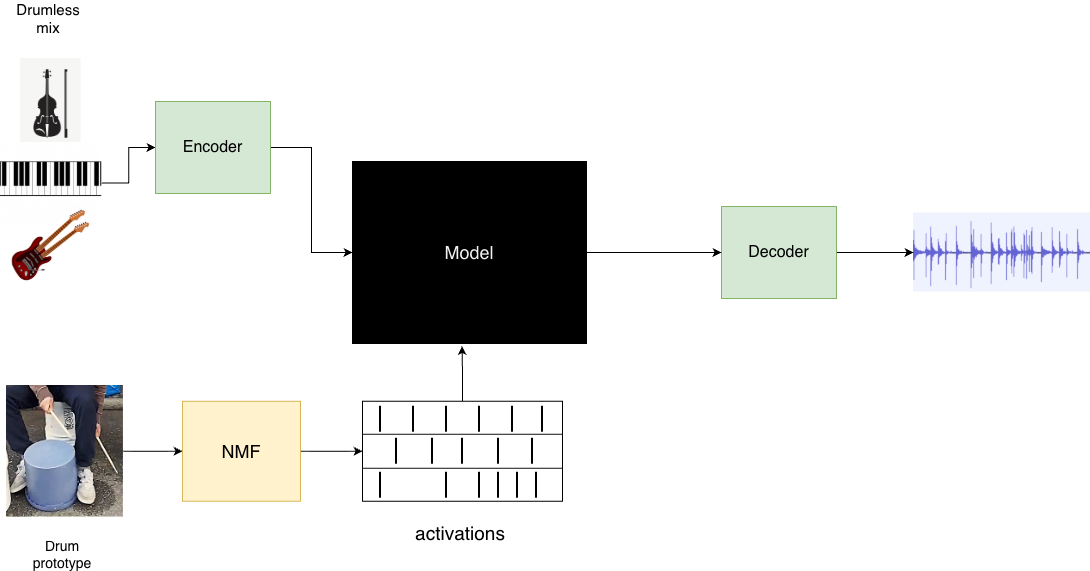
In music creation, rapid prototyping is essential for exploring and refining ideas, yet existing generative tools often fall short when users require both structural control and stylistic flexibility. Prior approaches in stem-to-stem generation can condition on other musical stems but offer limited control over rhythm, and timbre-transfer methods allow users to specify specific rhythms, but cannot condition on musical context. We introduce DARC, a generative drum accompaniment model that conditions both on musical context from other stems and explicit rhythm prompts such as beatboxing or tapping tracks. Using parameter-efficient fine-tuning, we augment STAGE, a state-of-the-art drum stem generator, with fine-grained rhythm control while maintaining musical context awareness.

paper research
MM-Sonate  Multimodal Controllable Audio-Video Generation with Zero-Shot Voice Cloning

MM-Sonate Multimodal Controllable Audio-Video Generation with Zero-Shot Voice Cloning

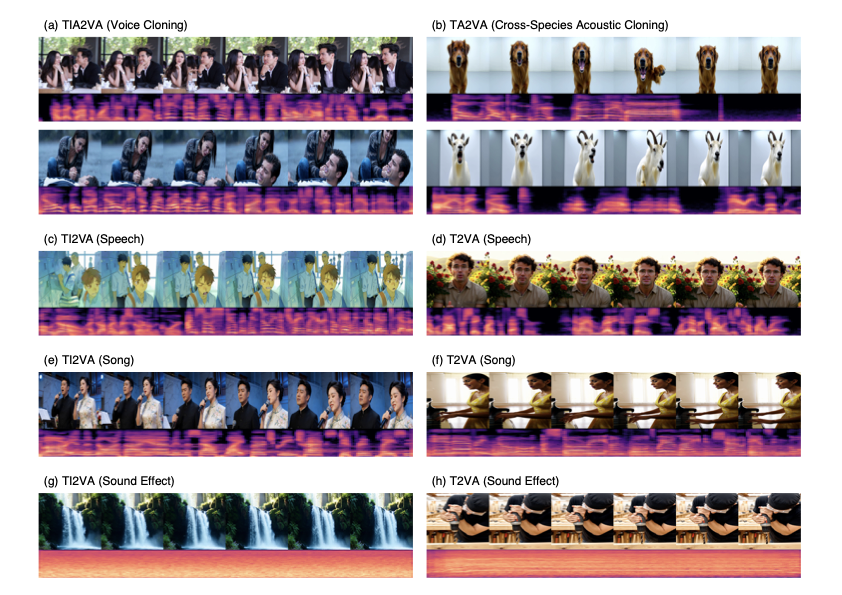
Joint audio-video generation aims to synthesize synchronized multisensory content, yet current unified models struggle with fine-grained acoustic control, particularly for identity-preserving speech. Existing approaches either suffer from temporal misalignment due to cascaded generation or lack the capability to perform zero-shot voice cloning within a joint synthesis framework. In this work, we present MM-Sonate, a multimodal flow-matching framework that unifies controllable audio-video joint generation with zero-shot voice cloning capabilities. Unlike prior works that rely on coarse semantic descriptions, MM-Sonate utilizes a unified instruction-phoneme input to enforce strict linguistic and temporal alignment. To enable zero-shot voice cloning, we introduce a timbre injection mechanism that effectively decouples speaker identity from linguistic content. Furthermore, addressing the limitations of standard classifier-free guidance in multimodal settings, we propose a noise-based negative conditioning strategy that utilizes natural noise priors to significantly enhance acoustic fidelity. Empirical evaluations demonstrate that MM-Sonate establishes new state-of-the-art performance in joint generation benchmarks, significantly outperforming baselines in lip synchronization and speech intelligibility, while achieving voice cloning fidelity comparable to specialized Text-to-Speech systems.

paper research
UltraEval-Audio  A Unified Framework for Comprehensive Evaluation of Audio Foundation Models

UltraEval-Audio A Unified Framework for Comprehensive Evaluation of Audio Foundation Models

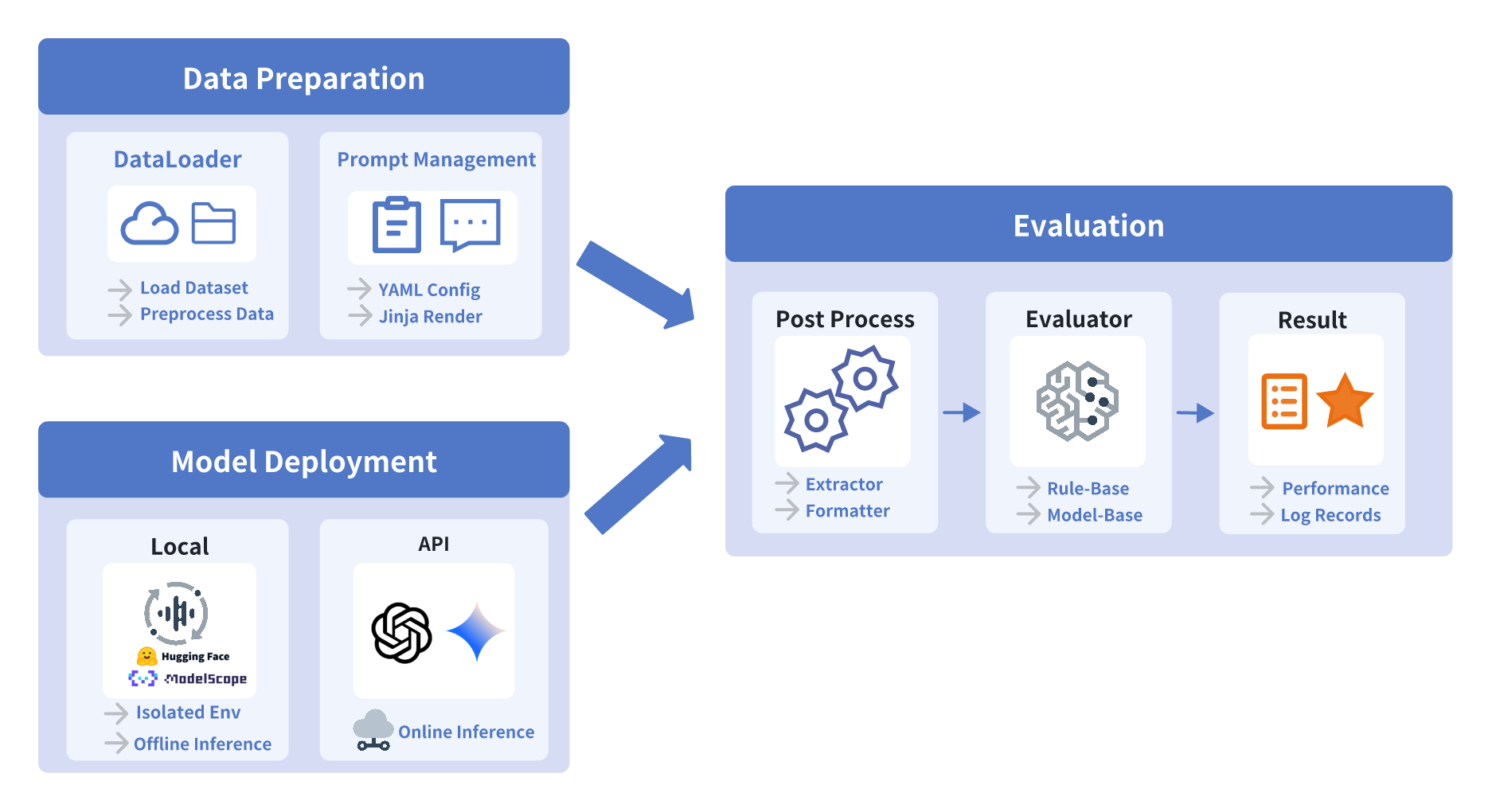
The development of audio foundation models has accelerated rapidly since the emergence of GPT-4o. However, the lack of comprehensive evaluation has become a critical bottleneck for further progress in the field, particularly in audio generation. Current audio evaluation faces three major challenges (1) audio evaluation lacks a unified framework, with datasets and code scattered across various sources, hindering fair and efficient cross-model comparison;(2) audio codecs, as a key component of audio foundation models, lack a widely accepted and holistic evaluation methodology; (3) existing speech benchmarks are heavily reliant on English, making it challenging to objectively assess models performance on Chinese. To address the first issue, we introduce UltraEval-Audio, a unified evaluation framework for audio foundation models, specifically designed for both audio understanding and generation tasks. UltraEval-Audio features a modular architecture, supporting 10 languages and 14 core task categories, while seamlessly integrating 24 mainstream models and 36 authoritative benchmarks. To enhance research efficiency, the framework provides a one-command evaluation feature, accompanied by real-time public leaderboards. For the second challenge, UltraEval-Audio adopts a novel comprehensive evaluation scheme for audio codecs, evaluating performance across three key dimensions semantic accuracy, timbre fidelity, and acoustic quality. To address the third issue, we propose two new Chinese benchmarks, SpeechCMMLU and SpeechHSK, designed to assess Chinese knowledge proficiency and language fluency. We wish that UltraEval-Audio will provide both academia and industry with a transparent, efficient, and fair platform for comparison of audio models. Our code, benchmarks, and leaderboards are available at https //github.com/OpenBMB/UltraEval-Audio.
paper research

Start searching

Enter keywords to search articles

↑↓
↵
ESC
⌘K Shortcut