Social and Information Networks

All posts under category "Social and Information Networks"

3 posts total
Sorted by date
Beyond Homophily  Community Search on Heterophilic Graphs

Beyond Homophily Community Search on Heterophilic Graphs

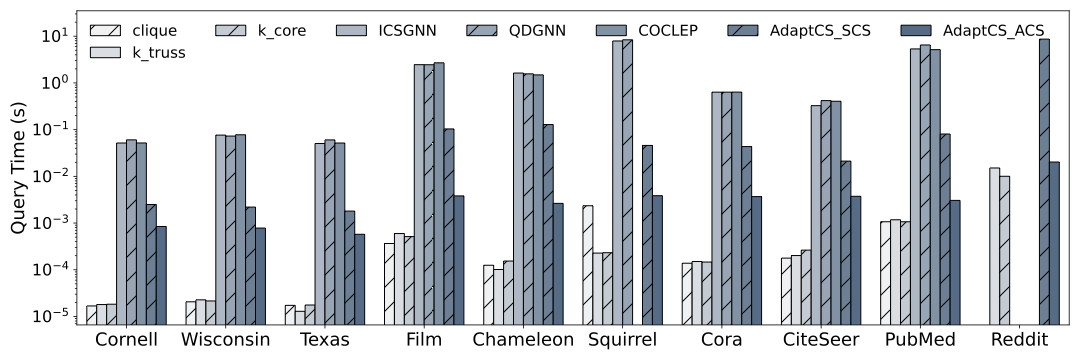
Community search aims to identify a refined set of nodes that are most relevant to a given query, supporting tasks ranging from fraud detection to recommendation. Unlike homophilic graphs, many real-world networks are heterophilic, where edges predominantly connect dissimilar nodes. Therefore, structural signals that once reflected smooth, low-frequency similarity now appear as sharp, high-frequency contrasts. However, both classical algorithms (e.g., k-core, k-truss) and recent ML-based models struggle to achieve effective community search on heterophilic graphs, where edge signs or semantics are generally unknown. Algorithm-based methods often return communities with mixed class labels, while GNNs, built on homophily, smooth away meaningful signals and blur community boundaries. Therefore, we propose Adaptive Community Search (AdaptCS), a unified framework featuring three key designs (i) an AdaptCS Encoder that disentangles multi-hop and multi-frequency signals, enabling the model to capture both smooth (homophilic) and contrastive (heterophilic) relations; (ii) a memory-efficient low-rank optimization that removes the main computational bottleneck and ensures model scalability; and (iii) an Adaptive Community Score (ACS) that guides online search by balancing embedding similarity and topological relations. Extensive experiments on both heterophilic and homophilic benchmarks demonstrate that AdaptCS outperforms the best-performing baseline by an average of 11% in F1-score, retains robustness across heterophily levels, and achieves up to 2 orders of magnitude speedup.
paper research
Inferring Network Evolutionary History via Structure-State Coupled Learning

Inferring Network Evolutionary History via Structure-State Coupled Learning

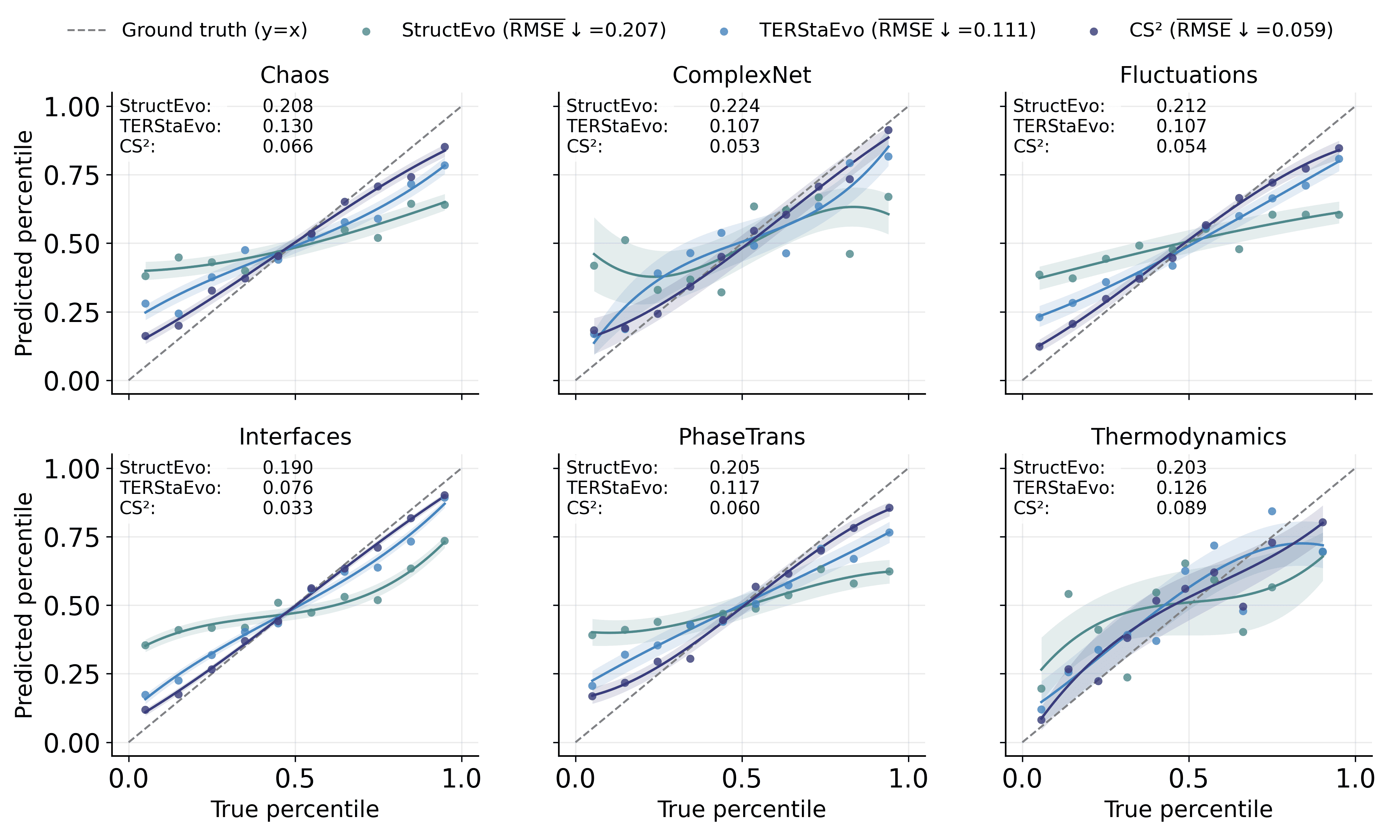
Inferring a network s evolutionary history from a single final snapshot with limited temporal annotations is fundamental yet challenging. Existing approaches predominantly rely on topology alone, which often provides insufficient and noisy cues. This paper leverages network steady-state dynamics -- converged node states under a given dynamical process -- as an additional and widely accessible observation for network evolution history inference. We propose CS$^2$, which explicitly models structure-state coupling to capture how topology modulates steady states and how the two signals jointly improve edge discrimination for formation-order recovery. Experiments on six real temporal networks, evaluated under multiple dynamical processes, show that CS$^2$ consistently outperforms strong baselines, improving pairwise edge precedence accuracy by 4.0% on average and global ordering consistency (Spearman-$ρ$) by 7.7% on average. CS$^2$ also more faithfully recovers macroscopic evolution trajectories such as clustering formation, degree heterogeneity, and hub growth. Moreover, a steady-state-only variant remains competitive when reliable topology is limited, highlighting steady states as an independent signal for evolution inference.

paper research
Measuring Social Media Polarization Using Large Language Models and Heuristic Rules

Measuring Social Media Polarization Using Large Language Models and Heuristic Rules

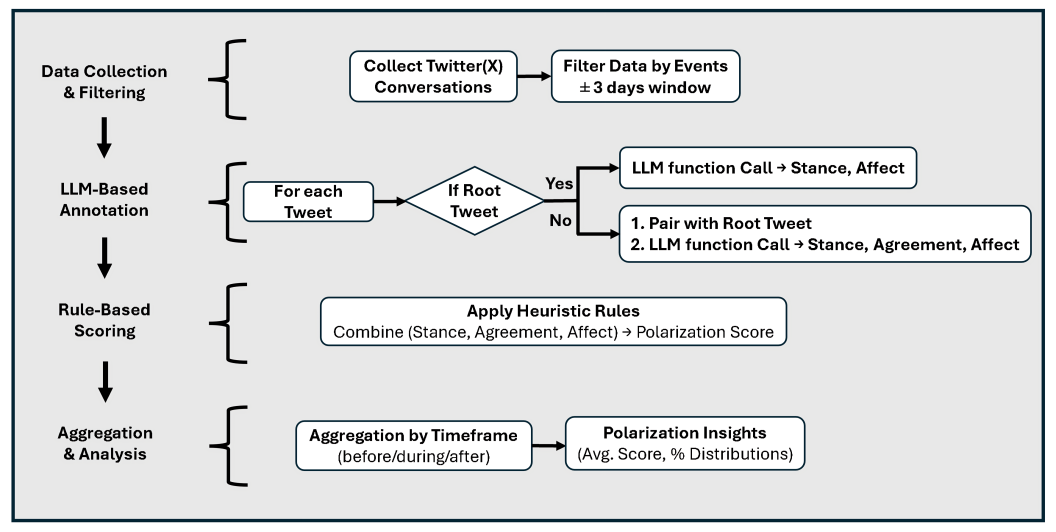
Understanding affective polarization in online discourse is crucial for evaluating the societal impact of social media interactions. This study presents a novel framework that leverages large language models (LLMs) and domain-informed heuristics to systematically analyze and quantify affective polarization in discussions on divisive topics such as climate change and gun control. Unlike most prior approaches that relied on sentiment analysis or predefined classifiers, our method integrates LLMs to extract stance, affective tone, and agreement patterns from large-scale social media discussions. We then apply a rule-based scoring system capable of quantifying affective polarization even in small conversations consisting of single interactions, based on stance alignment, emotional content, and interaction dynamics. Our analysis reveals distinct polarization patterns that are event dependent (i) anticipation-driven polarization, where extreme polarization escalates before well-publicized events, and (ii) reactive polarization, where intense affective polarization spikes immediately after sudden, high-impact events. By combining AI-driven content annotation with domain-informed scoring, our framework offers a scalable and interpretable approach to measuring affective polarization. The source code is publicly available at https //github.com/hasanjawad001/llm-social-media-polarization.

paper research

Start searching

Enter keywords to search articles

↑↓
ESC
⌘K Shortcut