Quantitative Finance / General Finance

All posts under category "Quantitative Finance / General Finance"

2 posts total
Sorted by date
Sabrina  Modeling and Visualization of Economic Data with Incremental Domain Knowledge

Sabrina Modeling and Visualization of Economic Data with Incremental Domain Knowledge

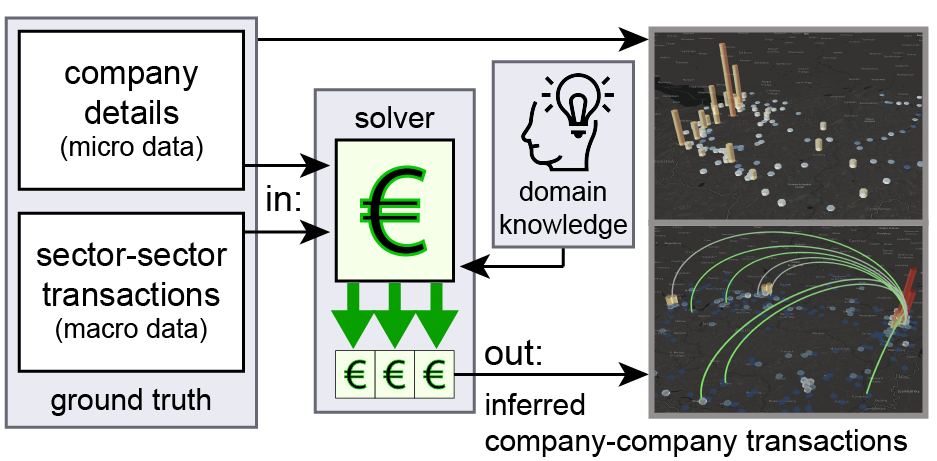
Investment planning requires knowledge of the financial landscape on a large scale, both in terms of geo-spatial and industry sector distribution. There is plenty of data available, but it is scattered across heterogeneous sources (newspapers, open data, etc.), which makes it difficult for financial analysts to understand the big picture. In this paper, we present Sabrina, a financial data analysis and visualization approach that incorporates a pipeline for the generation of firm-to-firm financial transaction networks. The pipeline is capable of fusing the ground truth on individual firms in a region with (incremental) domain knowledge on general macroscopic aspects of the economy. Sabrina unites these heterogeneous data sources within a uniform visual interface that enables the visual analysis process. In a user study with three domain experts, we illustrate the usefulness of Sabrina, which eases their analysis process.
paper research
Visualizing Value  Deep Learning in Art Market Prediction

Visualizing Value Deep Learning in Art Market Prediction

We study how deep learning can improve valuation in the art market by incorporating the visual content of artworks into predictive models. Using a large repeated-sales dataset from major auction houses, we benchmark classical hedonic regressions and tree-based methods against modern deep architectures, including multi-modal models that fuse tabular and image data. We find that while artist identity and prior transaction history dominate overall predictive power, visual embeddings provide a distinct and economically meaningful contribution for fresh-to-market works where historical anchors are absent. Interpretability analyses using Grad-CAM and embedding visualizations show that models attend to compositional and stylistic cues. Our findings demonstrate that multi-modal deep learning delivers significant value precisely when valuation is hardest, namely first-time sales, and thus offers new insights for both academic research and practice in art market valuation.

paper research

< Category Statistics (Total: 566) >

Quantum Physics
5

Start searching

Enter keywords to search articles

↑↓
ESC
⌘K Shortcut