Quantitative Biology / Neurons and Cognition

All posts under category "Quantitative Biology / Neurons and Cognition"

3 posts total
Sorted by date
Biologically Inspired LGN-CNN Architecture Mimics Lateral Geniculate Nucleus Functionality

Biologically Inspired LGN-CNN Architecture Mimics Lateral Geniculate Nucleus Functionality

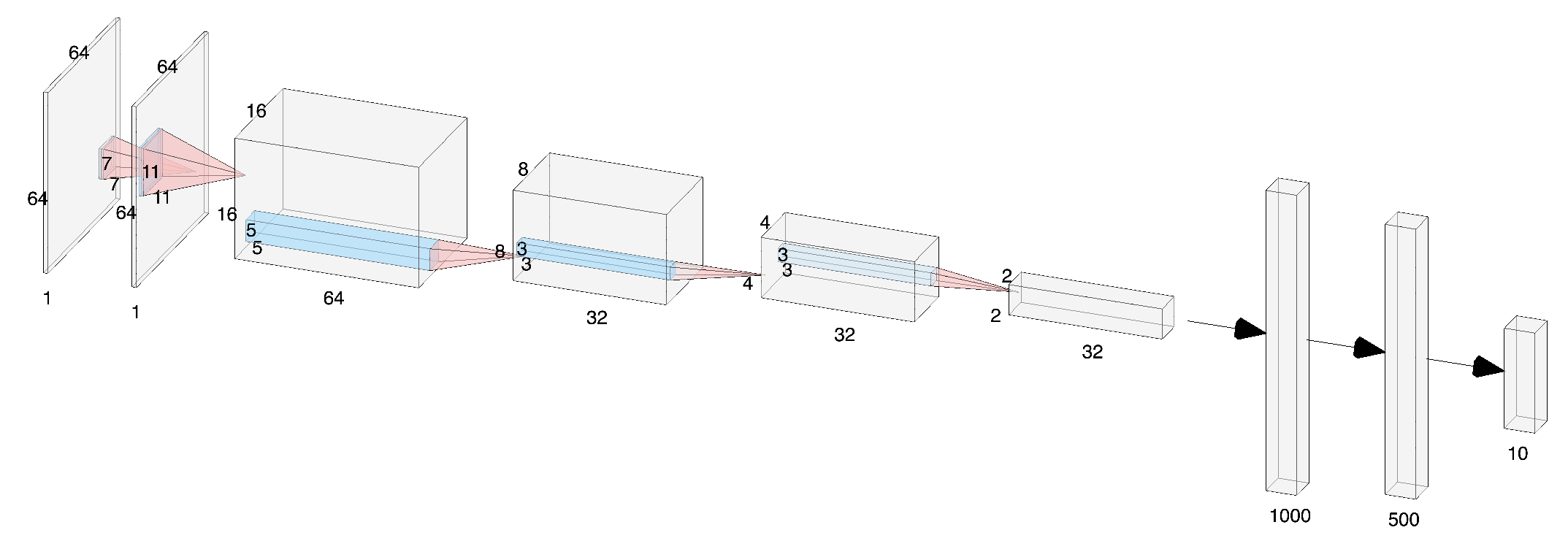
In this paper we introduce a biologically inspired Convolutional Neural Network (CNN) architecture called LGN-CNN that has a first convolutional layer composed by a single filter that mimics the role of the Lateral Geniculate Nucleus (LGN). The first layer of the neural network shows a rotational symmetric pattern justified by the structure of the net itself that turns up to be an approximation of a Laplacian of Gaussian (LoG). The latter function is in turn a good approximation of the receptive field profiles (RFPs) of the cells in the LGN. The analogy with the visual system is established, emerging directly from the architecture of the neural network. A proof of rotation invariance of the first layer is given on a fixed LGN-CNN architecture and the computational results are shown. Thus, contrast invariance capability of the LGN-CNN is investigated and a comparison between the Retinex effects of the first layer of LGN-CNN and the Retinex effects of a LoG is provided on different images. A statistical study is done on the filters of the second convolutional layer with respect to biological data. In conclusion, the model we have introduced approximates well the RFPs of both LGN and V1 attaining similar behavior as regards long range connections of LGN cells that show Retinex effects.
paper research
Using Engineered Neurons in Digital Logic Circuits  A Molecular Communications Analysis

Using Engineered Neurons in Digital Logic Circuits A Molecular Communications Analysis

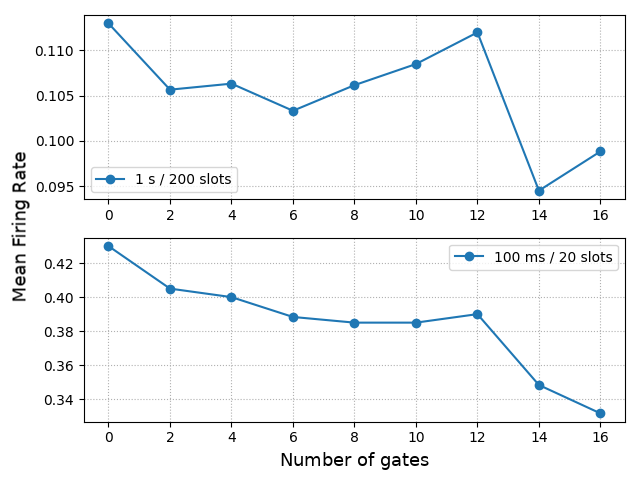
With the advancement of synthetic biology, several new tools have been conceptualized over the years as alternative treatments for current medical procedures. Most of those applications are applied to various chronic diseases. This work investigates how synthetically engineered neurons can operate as digital logic gates that can be used towards bio-computing for the brain. We quantify the accuracy of logic gates under high firing rates amid a network of neurons and by how much it can smooth out uncontrolled neuronal firings. To test the efficacy of our method, simulations composed of computational models of neurons connected in a structure that represents a logic gate are performed. The simulations demonstrated the accuracy of performing the correct logic operation, and how specific properties such as the firing rate can play an important role in the accuracy. As part of the analysis, the Mean squared error is used to quantify the quality of our proposed model and predicting the accurate operation of a gate based on different sampling frequencies. As an application, the logic gates were used to trap epileptic seizures in a neuronal network, where the results demonstrated the effectiveness of reducing the firing rate. Our proposed system has the potential for computing numerous neurological conditions of the brain.

paper research
SymSeqBench  a unified framework for the generation and analysis of rule-based symbolic sequences and datasets

SymSeqBench a unified framework for the generation and analysis of rule-based symbolic sequences and datasets

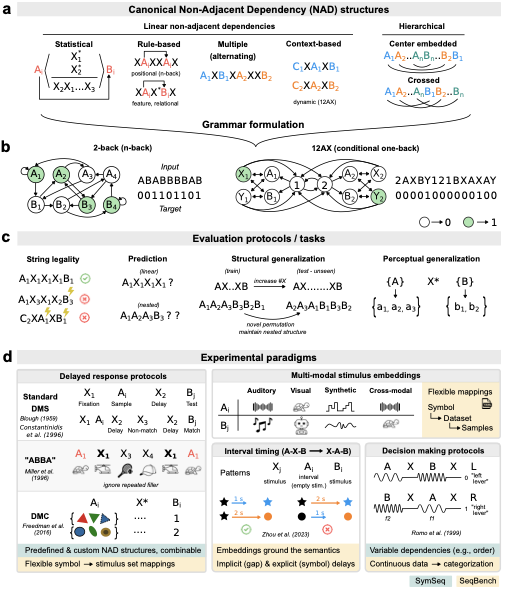
Sequential structure is a key feature of multiple domains of natural cognition and behavior, such as language, movement and decision-making. Likewise, it is also a central property of tasks to which we would like to apply artificial intelligence. It is therefore of great importance to develop frameworks that allow us to evaluate sequence learning and processing in a domain agnostic fashion, whilst simultaneously providing a link to formal theories of computation and computability. To address this need, we introduce two complementary software tools SymSeq, designed to rigorously generate and analyze structured symbolic sequences, and SeqBench, a comprehensive benchmark suite of rule-based sequence processing tasks to evaluate the performance of artificial learning systems in cognitively relevant domains. In combination, SymSeqBench offers versatility in investigating sequential structure across diverse knowledge domains, including experimental psycholinguistics, cognitive psychology, behavioral analysis, neuromorphic computing and artificial intelligence. Due to its basis in Formal Language Theory (FLT), SymSeqBench provides researchers in multiple domains with a convenient and practical way to apply the concepts of FLT to conceptualize and standardize their experiments, thus advancing our understanding of cognition and behavior through shared computational frameworks and formalisms. The tool is modular, openly available and accessible to the research community.

paper research

< Category Statistics (Total: 566) >

Quantum Physics
5

Start searching

Enter keywords to search articles

↑↓
ESC
⌘K Shortcut