Physics / Optics

All posts under category "Physics / Optics"

2 posts total
Sorted by date
Photonics Meets AI  An Open-Source Co-Design Toolflow

Photonics Meets AI An Open-Source Co-Design Toolflow

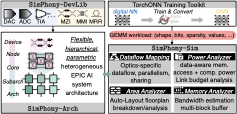
Photonics is becoming a cornerstone technology for high-performance AI systems and scientific computing, offering unparalleled speed, parallelism, and energy efficiency. Despite this promise, the design and deployment of electronic-photonic AI systems remain highly challenging due to a steep learning curve across multiple layers, spanning device physics, circuit design, system architecture, and AI algorithms. The absence of a mature electronic-photonic design automation (EPDA) toolchain leads to long, inefficient design cycles and limits cross-disciplinary innovation and co-evolution. In this work, we present a cross-layer co-design and automation framework aimed at democratizing photonic AI system development. We begin by introducing our architecture designs for scalable photonic edge AI and Transformer inference, followed by SimPhony, an open-source modeling tool for rapid EPIC AI system evaluation and design-space exploration. We then highlight advances in AI-enabled photonic design automation, including physical AI-based Maxwell solvers, a fabrication-aware inverse design framework, and a scalable inverse training algorithm for meta-optical neural networks, enabling a scalable EPDA stack for next-generation electronic-photonic AI systems.
paper research
Scaling Photonic AI  From Design to Co-Exploration

Scaling Photonic AI From Design to Co-Exploration

In this work, we identify three considerations that are essential for realizing practical photonic AI systems at scale (1) dynamic tensor operation support for modern models rather than only weight-static kernels, especially for attention/Transformer-style workloads; (2) systematic management of conversion, control, and data-movement overheads, where multiplexing and dataflow must amortize electronic costs instead of letting ADC/DAC and I/O dominate; and (3) robustness under hardware non-idealities that become more severe as integration density grows. To study these coupled tradeoffs quantitatively, and to ensure they remain meaningful under real implementation constraints, we build a cross-layer toolchain that supports photonic AI design from early exploration to physical realization. SimPhony provides implementation-aware modeling and rapid cross-layer evaluation, translating physical costs into system-level metrics so architectural decisions are grounded in realistic assumptions. ADEPT and ADEPT-Z enable end-to-end circuit and topology exploration, connecting system objectives to feasible photonic fabrics under practical device and circuit constraints. Finally, Apollo and LiDAR provide scalable photonic physical design automation, turning candidate circuits into manufacturable layouts while accounting for routing, thermal, and crosstalk constraints.

paper research

< Category Statistics (Total: 566) >

Quantum Physics
5

Start searching

Enter keywords to search articles

↑↓
ESC
⌘K Shortcut