Networking and Internet

All posts under category "Networking and Internet"

3 posts total
Sorted by date
Chat-Driven Optimal Management for Virtual Network Services

Chat-Driven Optimal Management for Virtual Network Services

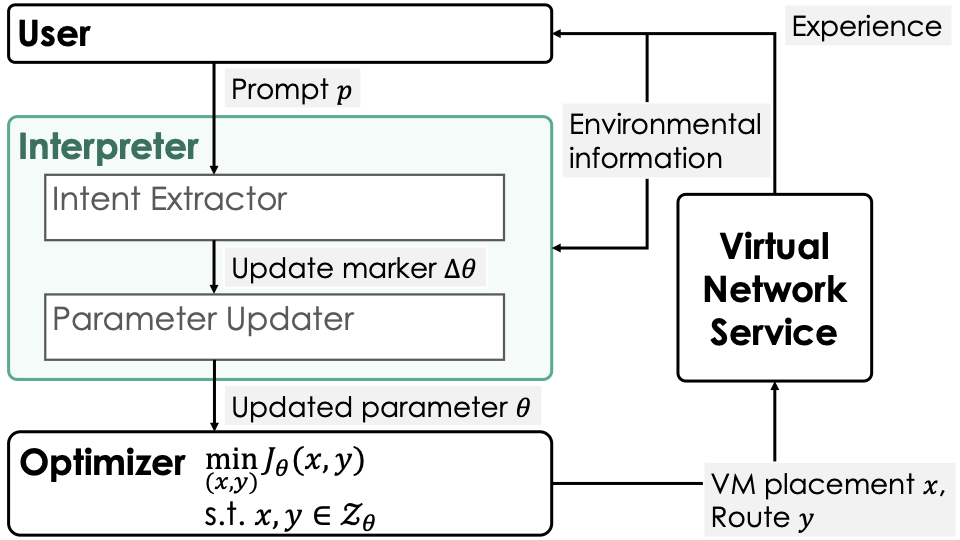
This paper proposes a chat-driven network management framework that integrates natural language processing (NLP) with optimization-based virtual network allocation, enabling intuitive and reliable reconfiguration of virtual network services. Conventional intent-based networking (IBN) methods depend on statistical language models to interpret user intent but cannot guarantee the feasibility of generated configurations. To overcome this, we develop a two-stage framework consisting of an Interpreter, which extracts intent from natural language prompts using NLP, and an Optimizer, which computes feasible virtual machine (VM) placement and routing via an integer linear programming. In particular, the Interpreter translates user chats into update directions, i.e., whether to increase, decrease, or maintain parameters such as CPU demand and latency bounds, thereby enabling iterative refinement of the network configuration. In this paper, two intent extractors, which are a Sentence-BERT model with support vector machine (SVM) classifiers and a large language model (LLM), are introduced. Experiments in single-user and multi-user settings show that the framework dynamically updates VM placement and routing while preserving feasibility. The LLM-based extractor achieves higher accuracy with fewer labeled samples, whereas the Sentence-BERT with SVM classifiers provides significantly lower latency suitable for real-time operation. These results underscore the effectiveness of combining NLP-driven intent extraction with optimization-based allocation for safe, interpretable, and user-friendly virtual network management.
paper research
MAESTRO  Multi-Agent Evaluation Suite for Testing, Reliability, and Observability

MAESTRO Multi-Agent Evaluation Suite for Testing, Reliability, and Observability

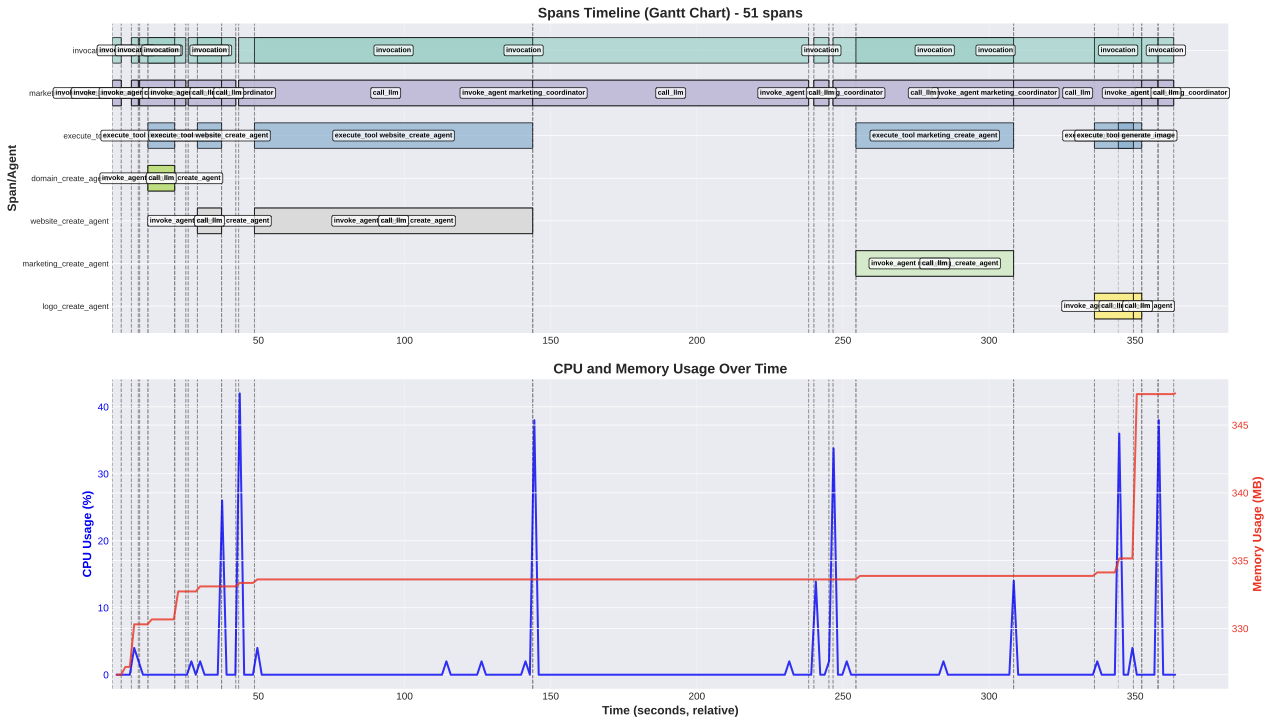
We present MAESTRO, an evaluation suite for the testing, reliability, and observability of LLM-based MAS. MAESTRO standardizes MAS configuration and execution through a unified interface, supports integrating both native and third-party MAS via a repository of examples and lightweight adapters, and exports framework-agnostic execution traces together with system-level signals (e.g., latency, cost, and failures). We instantiate MAESTRO with 12 representative MAS spanning popular agentic frameworks and interaction patterns, and conduct controlled experiments across repeated runs, backend models, and tool configurations. Our case studies show that MAS executions can be structurally stable yet temporally variable, leading to substantial run-to-run variance in performance and reliability. We further find that MAS architecture is the dominant driver of resource profiles, reproducibility, and cost-latency-accuracy trade-off, often outweighing changes in backend models or tool settings. Overall, MAESTRO enables systematic evaluation and provides empirical guidance for designing and optimizing agentic systems.

paper research
Privacy-Preserving Semantic Communications via Multi-Task Learning and Adversarial Perturbations

Privacy-Preserving Semantic Communications via Multi-Task Learning and Adversarial Perturbations

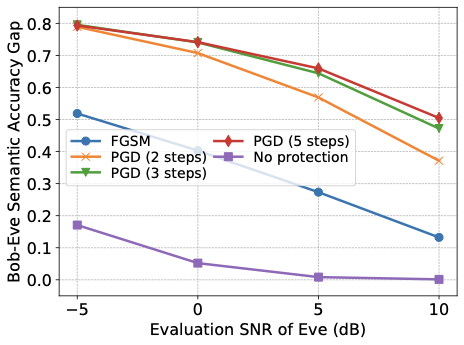
Semantic communications conveys task-relevant meaning rather than focusing solely on message reconstruction, improving bandwidth efficiency and robustness for next-generation wireless systems. However, learned semantic representations can still leak sensitive information to unintended receivers (eavesdroppers). This paper presents a deep learning-based semantic communication framework that jointly supports multiple receiver tasks while explicitly limiting semantic leakage to an eavesdropper. The legitimate link employs a learned encoder at the transmitter, while the receiver trains decoders for semantic inference and data reconstruction. The security problem is formulated via an iterative min-max optimization in which an eavesdropper is trained to improve its semantic inference, while the legitimate transmitter-receiver pair is trained to preserve task performance while reducing the eavesdropper s success. We also introduce an auxiliary layer that superimposes a cooperative, adversarially crafted perturbation on the transmitted waveform to degrade semantic leakage to an eavesdropper. Performance is evaluated over Rayleigh fading channels with additive white Gaussian noise using MNIST and CIFAR-10 datasets. Semantic accuracy and reconstruction quality improve with increasing latent dimension, while the min-max mechanism reduces the eavesdropper s inference performance significantly without degrading the legitimate receiver. The perturbation layer is successful in reducing semantic leakage even when the legitimate link is trained only for its own task. This comprehensive framework motivates semantic communication designs with tunable, end-to-end privacy against adaptive adversaries in realistic wireless settings.

paper research

Start searching

Enter keywords to search articles

↑↓
↵
ESC
⌘K Shortcut