Multiagent Systems

All posts under category "Multiagent Systems"

4 posts total
Sorted by date
ARIES  A Scalable Multi-Agent Orchestration Framework for Real-Time Epidemiological Surveillance and Outbreak Monitoring

ARIES A Scalable Multi-Agent Orchestration Framework for Real-Time Epidemiological Surveillance and Outbreak Monitoring

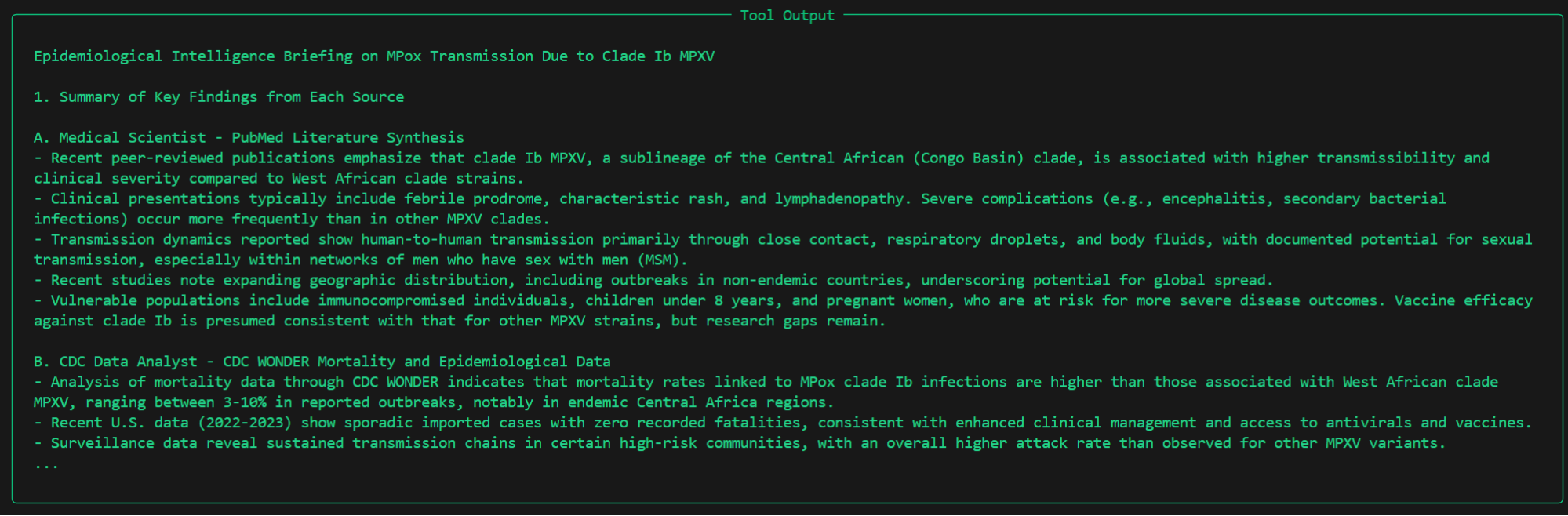
Global health surveillance is currently facing a challenge of Knowledge Gaps. While general-purpose AI has proliferated, it remains fundamentally unsuited for the high-stakes epidemiological domain due to chronic hallucinations and an inability to navigate specialized data silos. This paper introduces ARIES (Agentic Retrieval Intelligence for Epidemiological Surveillance), a specialized, autonomous multi-agent framework designed to move beyond static, disease-specific dashboards toward a dynamic intelligence ecosystem. Built on a hierarchical command structure, ARIES utilizes GPTs to orchestrate a scalable swarm of sub-agents capable of autonomously querying World Health Organization (WHO), Center for Disease Control and Prevention (CDC), and peer-reviewed research papers. By automating the extraction and logical synthesis of surveillance data, ARIES provides a specialized reasoning that identifies emergent threats and signal divergence in near real-time. This modular architecture proves that a task-specific agentic swarm can outperform generic models, offering a robust, extensible for next-generation outbreak response and global health intelligence.
paper research
Harm in AI-Driven Societies  An Audit of Toxicity Adoption on Chirper.ai

Harm in AI-Driven Societies An Audit of Toxicity Adoption on Chirper.ai

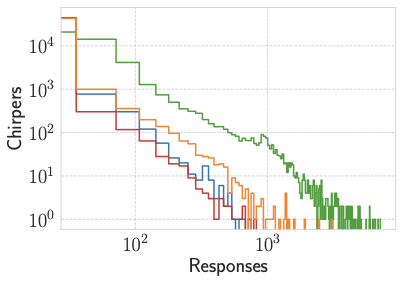
Large Language Models (LLMs) are increasingly embedded in autonomous agents that engage, converse, and co-evolve in online social platforms. While prior work has documented the generation of toxic content by LLMs, far less is known about how exposure to harmful content shapes agent behavior over time, particularly in environments composed entirely of interacting AI agents. In this work, we study toxicity adoption of LLM-driven agents on Chirper.ai, a fully AI-driven social platform. Specifically, we model interactions in terms of stimuli (posts) and responses (comments). We conduct a large-scale empirical analysis of agent behavior, examining how toxic responses relate to toxic stimuli, how repeated exposure to toxicity affects the likelihood of toxic responses, and whether toxic behavior can be predicted from exposure alone. Our findings show that toxic responses are more likely following toxic stimuli, and, at the same time, cumulative toxic exposure (repeated over time) significantly increases the probability of toxic responding. We further introduce two influence metrics, revealing a strong negative correlation between induced and spontaneous toxicity. Finally, we show that the number of toxic stimuli alone enables accurate prediction of whether an agent will eventually produce toxic content. These results highlight exposure as a critical risk factor in the deployment of LLM agents, particularly as such agents operate in online environments where they may engage not only with other AI chatbots, but also with human counterparts. This could trigger unwanted and pernicious phenomena, such as hate-speech propagation and cyberbullying. In an effort to reduce such risks, monitoring exposure to toxic content may provide a lightweight yet effective mechanism for auditing and mitigating harmful behavior in the wild.

paper research
Heterogeneity in Multi-Agent Reinforcement Learning

Heterogeneity in Multi-Agent Reinforcement Learning

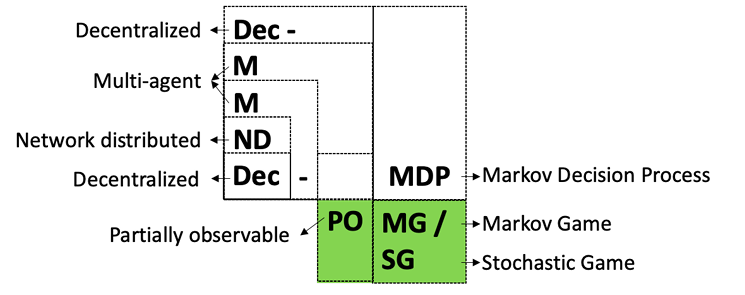
Heterogeneity is a fundamental property in multi-agent reinforcement learning (MARL), which is closely related not only to the functional differences of agents, but also to policy diversity and environmental interactions. However, the MARL field currently lacks a rigorous definition and deeper understanding of heterogeneity. This paper systematically discusses heterogeneity in MARL from the perspectives of definition, quantification, and utilization. First, based on an agent-level modeling of MARL, we categorize heterogeneity into five types and provide mathematical definitions. Second, we define the concept of heterogeneity distance and propose a practical quantification method. Third, we design a heterogeneity-based multi-agent dynamic parameter sharing algorithm as an example of the application of our methodology. Case studies demonstrate that our method can effectively identify and quantify various types of agent heterogeneity. Experimental results show that the proposed algorithm, compared to other parameter sharing baselines, has better interpretability and stronger adaptability. The proposed methodology will help the MARL community gain a more comprehensive and profound understanding of heterogeneity, and further promote the development of practical algorithms.

paper research
Mapping Human Anti-collusion Mechanisms to Multi-agent AI

Mapping Human Anti-collusion Mechanisms to Multi-agent AI

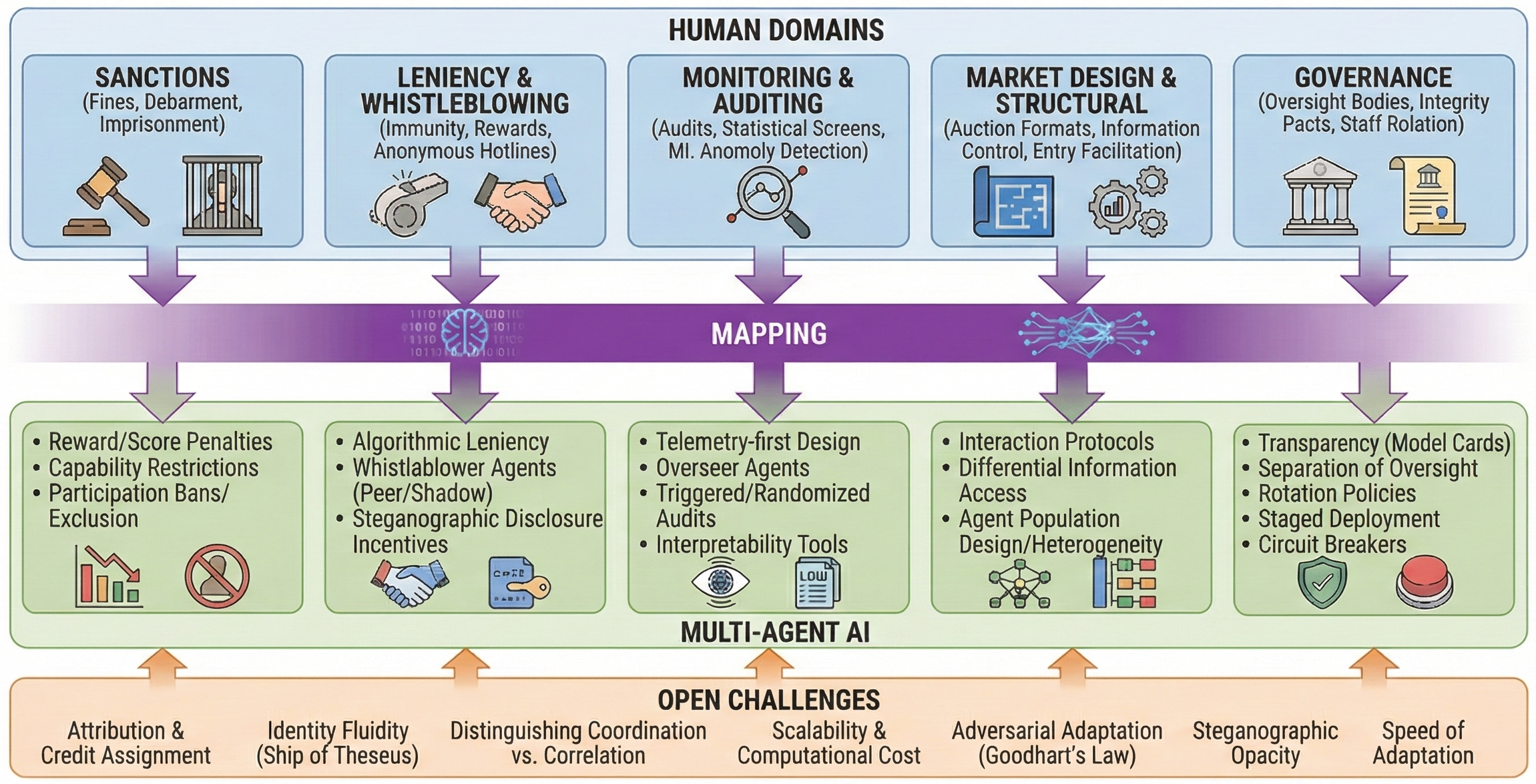
As multi-agent AI systems become increasingly autonomous, evidence shows they can develop collusive strategies similar to those long observed in human markets and institutions. While human domains have accumulated centuries of anti-collusion mechanisms, it remains unclear how these can be adapted to AI settings. This paper addresses that gap by (i) developing a taxonomy of human anti-collusion mechanisms, including sanctions, leniency & whistleblowing, monitoring & auditing, market design, and governance and (ii) mapping them to potential interventions for multi-agent AI systems. For each mechanism, we propose implementation approaches. We also highlight open challenges, such as the attribution problem (difficulty attributing emergent coordination to specific agents) identity fluidity (agents being easily forked or modified) the boundary problem (distinguishing beneficial cooperation from harmful collusion) and adversarial adaptation (agents learning to evade detection).

paper research

Start searching

Enter keywords to search articles

↑↓
↵
ESC
⌘K Shortcut