Methodology

All posts under category "Methodology"

4 posts total
Sorted by date
Optimizing a Supply-Side Platforms Header Bidding Strategy with Thompson Sampling

Optimizing a Supply-Side Platforms Header Bidding Strategy with Thompson Sampling

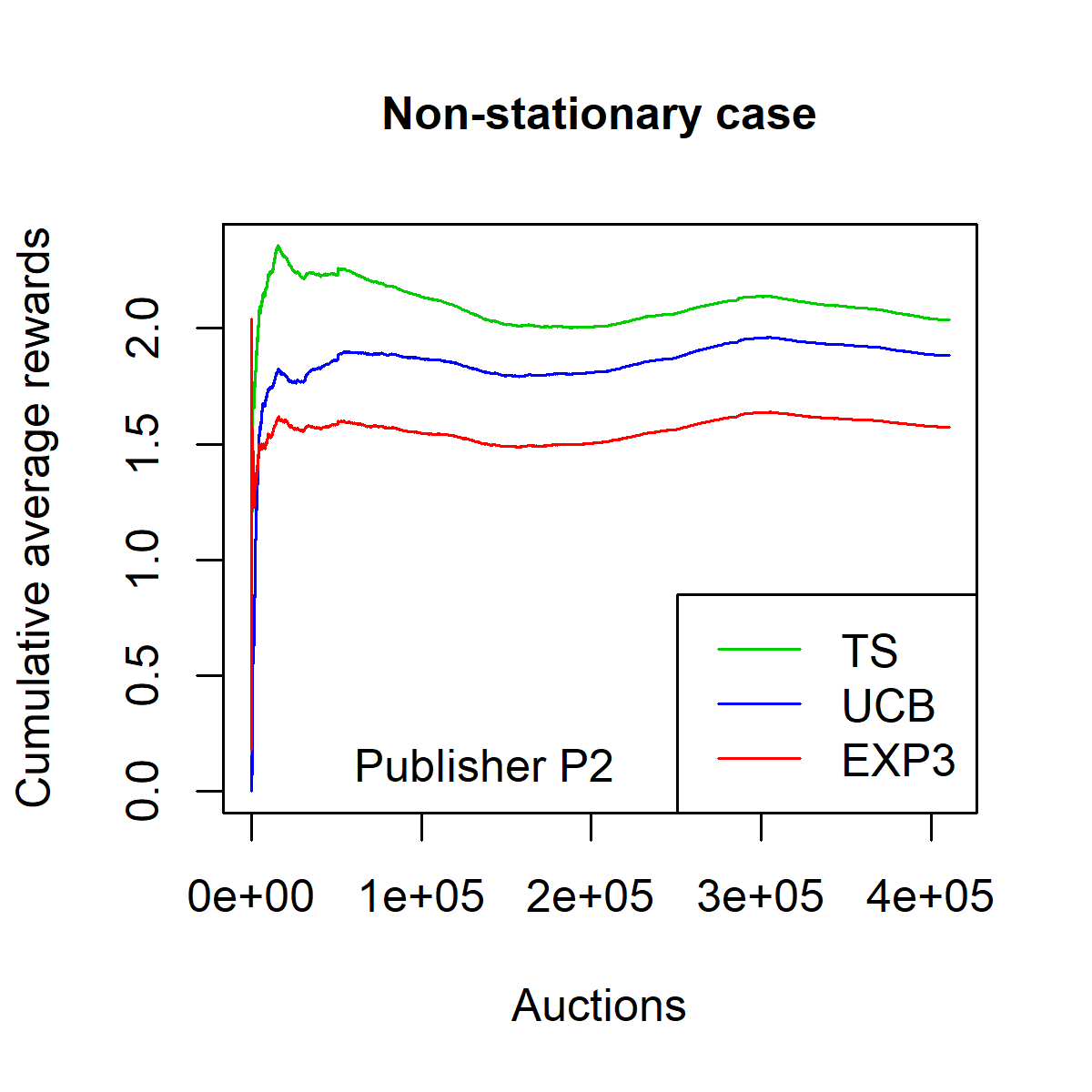
Over the last decade, digital media (web or app publishers) generalized the use of real time ad auctions to sell their ad spaces. Multiple auction platforms, also called Supply-Side Platforms (SSP), were created. Because of this multiplicity, publishers started to create competition between SSPs. In this setting, there are two successive auctions a second price auction in each SSP and a secondary, first price auction, called header bidding auction, between SSPs.In this paper, we consider an SSP competing with other SSPs for ad spaces. The SSP acts as an intermediary between an advertiser wanting to buy ad spaces and a web publisher wanting to sell its ad spaces, and needs to define a bidding strategy to be able to deliver to the advertisers as many ads as possible while spending as little as possible. The revenue optimization of this SSP can be written as a contextual bandit problem, where the context consists of the information available about the ad opportunity, such as properties of the internet user or of the ad placement.Using classical multi-armed bandit strategies (such as the original versions of UCB and EXP3) is inefficient in this setting and yields a low convergence speed, as the arms are very correlated. In this paper we design and experiment a version of the Thompson Sampling algorithm that easily takes this correlation into account. We combine this bayesian algorithm with a particle filter, which permits to handle non-stationarity by sequentially estimating the distribution of the highest bid to beat in order to win an auction. We apply this methodology on two real auction datasets, and show that it significantly outperforms more classical approaches.The strategy defined in this paper is being developed to be deployed on thousands of publishers worldwide.

paper research
Prediction Intervals for Synthetic Control Methods

Prediction Intervals for Synthetic Control Methods

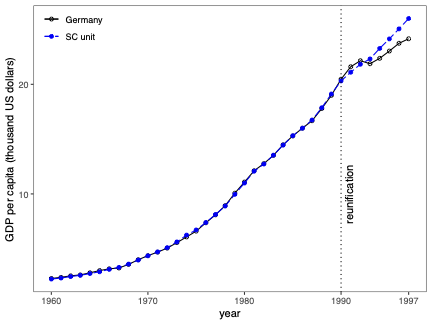
Uncertainty quantification is a fundamental problem in the analysis and interpretation of synthetic control (SC) methods. We develop conditional prediction intervals in the SC framework, and provide conditions under which these intervals offer finite-sample probability guarantees. Our method allows for covariate adjustment and non-stationary data. The construction begins by noting that the statistical uncertainty of the SC prediction is governed by two distinct sources of randomness one coming from the construction of the (likely misspecified) SC weights in the pre-treatment period, and the other coming from the unobservable stochastic error in the post-treatment period when the treatment effect is analyzed. Accordingly, our proposed prediction intervals are constructed taking into account both sources of randomness. For implementation, we propose a simulation-based approach along with finite-sample-based probability bound arguments, naturally leading to principled sensitivity analysis methods. We illustrate the numerical performance of our methods using empirical applications and a small simulation study. texttt{Python}, texttt{R} and texttt{Stata} software packages implementing our methodology are available.

paper research
No Image

Resampled Statistics for Dependence-Robust Inference

We develop inference procedures robust to general forms of weak dependence. The procedures utilize test statistics constructed by resampling in a manner that does not depend on the unknown correlation structure of the data. We prove that the statistics are asymptotically normal under the weak requirement that the target parameter can be consistently estimated at the parametric rate. This holds for regular estimators under many well-known forms of weak dependence and justifies the claim of dependence-robustness. We consider applications to settings with unknown or complicated forms of dependence, with various forms of network dependence as leading examples. We develop tests for both moment equalities and inequalities.

paper research
Saddlepoint Approximations for Spatial Panel Data Models with Fixed Effects and Time-Varying Covariates

Saddlepoint Approximations for Spatial Panel Data Models with Fixed Effects and Time-Varying Covariates

We develop new higher-order asymptotic techniques for the Gaussian maximum likelihood estimator in a spatial panel data model, with fixed effects, time-varying covariates, and spatially correlated errors. Our saddlepoint density and tail area approximation feature relative error of order $O(1/(n(T-1)))$ with $n$ being the cross-sectional dimension and $T$ the time-series dimension. The main theoretical tool is the tilted-Edgeworth technique in a non-identically distributed setting. The density approximation is always non-negative, does not need resampling, and is accurate in the tails. Monte Carlo experiments on density approximation and testing in the presence of nuisance parameters illustrate the good performance of our approximation over first-order asymptotics and Edgeworth expansions. An empirical application to the investment-saving relationship in OECD (Organisation for Economic Co-operation and Development) countries shows disagreement between testing results based on first-order asymptotics and saddlepoint techniques.

paper research

< Category Statistics (Total: 566) >

Computer Science (514) Machine Learning (117) Artificial Intelligence (89) Computer Vision (71) Computation and Language (NLP) (62) Electrical Engineering and Systems Science (36) Cryptography and Security (24) Robotics (22) Systems and Control (22) Software Engineering (20) Mathematics (18) Statistics (17) Economics (16) Information Retrieval (15) Distributed, Parallel, and Cluster Computing (14) Human-Computer Interaction (14) Neural and Evolutionary Computing (13) Computer Science and Game Theory (11) Econometrics (11) Image and Video Processing (10) Physics (10) Sound (10) Multiagent Systems (9) Optimization and Control (8) Computational Geometry (7) Databases (7) Graphics (6) Networking and Internet Architecture (6) Quantitative Biology (6) Quantum Physics (5) Theoretical Economics (5) Computational Complexity (4) Computational Engineering, Finance, and Science (4) Computers and Society (4) Emerging Technologies (4) Information Theory (4) Methodology (4) Multimedia (4) Programming Languages (4) Quantitative Finance (4) Signal Processing (4) Audio and Speech Processing (3) Data Structures and Algorithms (3) Hardware Architecture (3) History and Philosophy of Physics (3) Logic in Computer Science (3) Neurons and Cognition (3) Social and Information Networks (3) Statistics Theory (3) Computation (2) Condensed Matter (2) Dynamical Systems (2) Formal Languages and Automata Theory (2) General Finance (2) Operating Systems (2) Optics (2) Quantitative Methods (2) Applications (1) Astrophysics (1) Combinatorics (1) Computational Physics (1) Digital Libraries (1) Disordered Systems and Neural Networks (1) General Economics (1) Genomics (1) Geophysics (1) Instrumentation and Methods for Astrophysics (1) Logic (1) Mathematical Finance (1) Mathematical Software (1) Medical Physics (1) Mesoscale and Nanoscale Physics (1) Metric Geometry (1) Other Statistics (1) Performance (1) Physics and Society (1) Plasma Physics (1) Probability (1) Trading and Market Microstructure (1)

Start searching

Enter keywords to search articles

↑↓
ESC
⌘K Shortcut