Mathematics / Optimization and Control

All posts under category "Mathematics / Optimization and Control"

8 posts total
Sorted by date
A Mixed-Logical-Dynamical Model for Autonomous Highway Driving

A Mixed-Logical-Dynamical Model for Autonomous Highway Driving

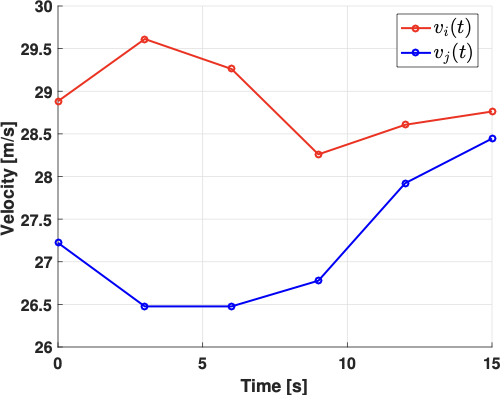
We propose a hybrid decision-making framework for safe and efficient autonomous driving of selfish vehicles on highways. Specifically, we model the dynamics of each vehicle as a Mixed-Logical-Dynamical system and propose simple driving rules to prevent potential sources of conflict among neighboring vehicles. We formalize the coordination problem as a generalized mixed-integer potential game, where an equilibrium solution generates a sequence of mixed-integer decisions for the vehicles that trade off individual optimality and overall safety.

paper research
An Introduction to Decentralized Stochastic Optimization with Gradient Tracking

An Introduction to Decentralized Stochastic Optimization with Gradient Tracking

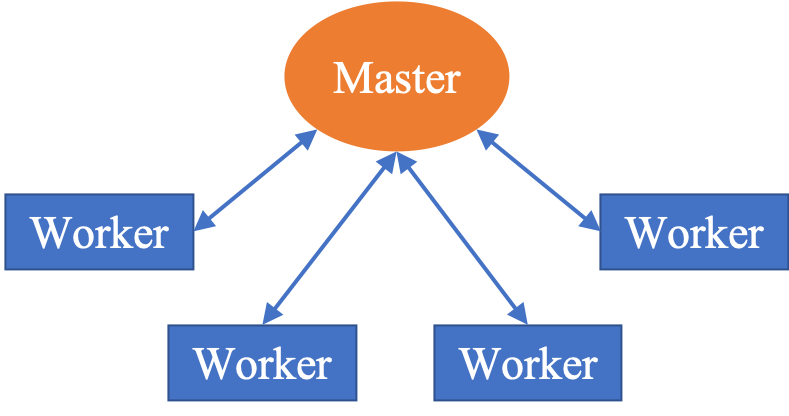
Decentralized solutions to finite-sum minimization are of significant importance in many signal processing, control, and machine learning applications. In such settings, the data is distributed over a network of arbitrarily-connected nodes and raw data sharing is prohibitive often due to communication or privacy constraints. In this article, we review decentralized stochastic first-order optimization methods and illustrate some recent improvements based on gradient tracking and variance reduction, focusing particularly on smooth and strongly-convex objective functions. We provide intuitive illustrations of the main technical ideas as well as applications of the algorithms in the context of decentralized training of machine learning models.

paper research
Real-Time Trajectory Planning and Feedback Control for Feedback-Linearizable Systems Using Time-Varying Optimization

Real-Time Trajectory Planning and Feedback Control for Feedback-Linearizable Systems Using Time-Varying Optimization

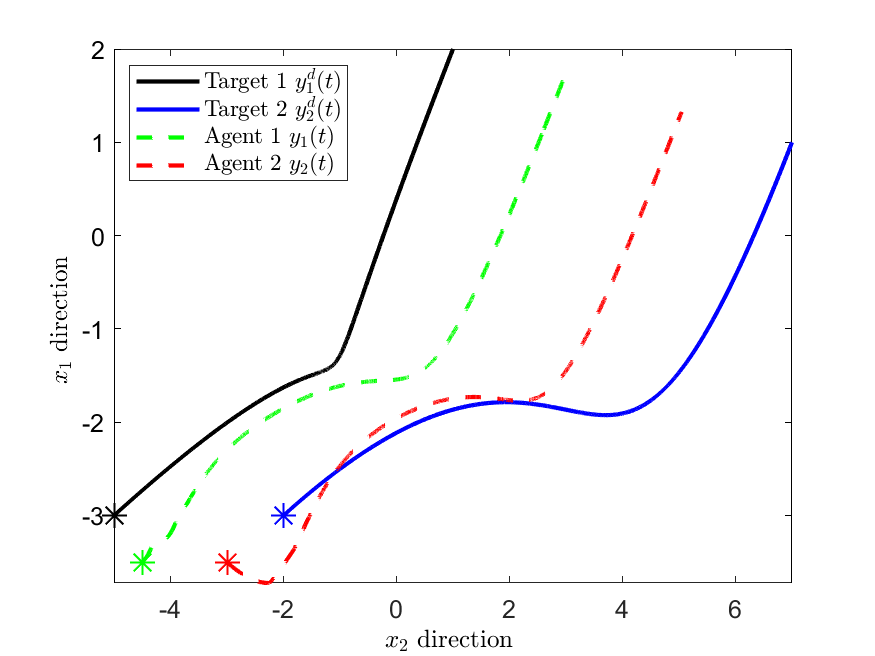
We develop an optimization-based framework for joint real-time trajectory planning and feedback control of feedback-linearizable systems. To achieve this goal, we define a target trajectory as the optimal solution of a time-varying optimization problem. In general, however, such trajectory may not be feasible due to , e.g., nonholonomic constraints. To solve this problem, we design a control law that generates feasible trajectories that asymptotically converge to the target trajectory. More precisely, for systems that are (dynamic) full-state linearizable, the proposed control law implicitly transforms the nonlinear system into an optimization algorithm of sufficiently high order. We prove global exponential convergence to the target trajectory for both the optimization algorithm and the original system. We illustrate the effectiveness of our proposed method on multi-target or multi-agent tracking problems with constraints.

paper research
Automated Decision-Making for Electric Power Network Recovery

Automated Decision-Making for Electric Power Network Recovery

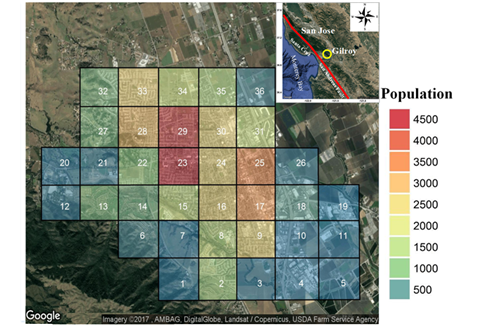
Critical infrastructure systems such as electric power networks, water networks, and transportation systems play a major role in the welfare of any community. In the aftermath of disasters, their recovery is of paramount importance; orderly and efficient recovery involves the assignment of limited resources (a combination of human repair workers and machines) to repair damaged infrastructure components. The decision maker must also deal with uncertainty in the outcome of the resource-allocation actions during recovery. The manual assignment of resources seldom is optimal despite the expertise of the decision maker because of the large number of choices and uncertainties in consequences of sequential decisions. This combinatorial assignment problem under uncertainty is known to be mbox{NP-hard}. We propose a novel decision technique that addresses the massive number of decision choices for large-scale real-world problems; in addition, our method also features an experiential learning component that adaptively determines the utilization of the computational resources based on the performance of a small number of choices. Our framework is closed-loop, and naturally incorporates all the attractive features of such a decision-making system. In contrast to myopic approaches, which do not account for the future effects of the current choices, our methodology has an anticipatory learning component that effectively incorporates emph{lookahead} into the solutions. To this end, we leverage the theory of regression analysis, Markov decision processes (MDPs), multi-armed bandits, and stochastic models of community damage from natural disasters to develop a method for near-optimal recovery of communities. Our method contributes to the general problem of MDPs with massive action spaces with application to recovery of communities affected by hazards.

paper research
No Image

Event-Triggered Stabilization Using Lyapunov Functions with Guaranteed Convergence Rate

A constructive tool of nonlinear control systems design, the method of Control Lyapunov Functions (CLF) has found numerous applications in stabilization problems for continuous time, discrete-time and hybrid systems. In this paper, we address the fundamental question given a CLF, corresponding to the continuous-time controller with some predefined (e.g. exponential) convergence rate, can the same convergence rate be provided by an event-triggered controller? Under certain assumptions, we give an affirmative answer to this question and show that the corresponding event-based controllers provide positive dwelltimes between the consecutive events. Furthermore, we prove the existence of self-triggered and periodic event-triggered controllers, providing stabilization with a known convergence rate.

paper research
Unlimited Budget Analysis of Randomized Search Heuristics

Unlimited Budget Analysis of Randomized Search Heuristics

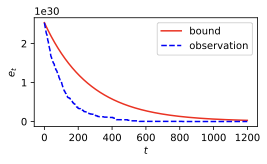
Performance analysis of all kinds of randomised search heuristics is a rapidly growing and developing field. Run time and solution quality are two popular measures of the performance of these algorithms. The focus of this paper is on the solution quality an optimisation heuristic achieves, not on the time it takes to reach this goal, setting it far apart from runtime analysis. We contribute to its further development by introducing a novel analytical framework, called unlimited budget analysis, to derive the expected fitness value after arbitrary computational steps. It has its roots in the very recently introduced approximation error analysis and bears some similarity to fixed budget analysis. We present the framework, apply it to simple mutation-based algorithms, covering both, local and global search. We provide analytical results for a number of pseudo-Boolean functions for unlimited budget analysis and compare them to results derived within the fixed budget framework for the same algorithms and functions. There are also results of experiments to compare bounds obtained in the two different frameworks with the actual observed performance. The study show that unlimited budget analysis may lead to the same or more general estimation beyond fixed budget.

paper research
Frequency Stability with MPC-based Inverter Power Control in Low-Inertia Power Systems

Frequency Stability with MPC-based Inverter Power Control in Low-Inertia Power Systems

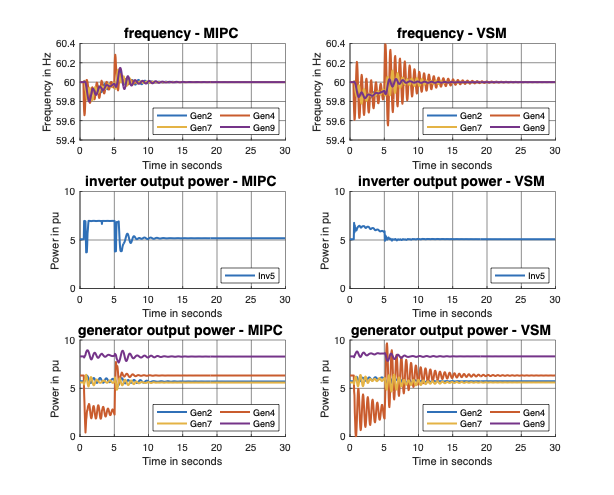
The electrical grid is evolving from a network consisting of mostly synchronous machines to a mixture of synchronous machines and inverter-based resources such as wind, solar, and energy storage. This transformation has led to a decrease in mechanical inertia, which necessitate a need for the new resources to provide frequency responses through their inverter interfaces. In this paper we proposed a new strategy based on model predictive control to determine the optimal active-power set-point for inverters in the event of a disturbance in the system. Our framework explicitly takes the hard constraints in power and energy into account, and we show that it is robust to measurement noise, limited communications and delay by using an observer to estimate the model mismatches in real-time. We demonstrate the proposed controller significantly outperforms an optimally tuned virtual synchronous machine on a standard 39-bus system under a number of scenarios. In turn, this implies optimized inverter-based resources can provide better frequency responses compared to conventional synchronous machines.

paper research
Minimizing Makespan with CP and BRKGA for Coupled Task Scheduling

Minimizing Makespan with CP and BRKGA for Coupled Task Scheduling

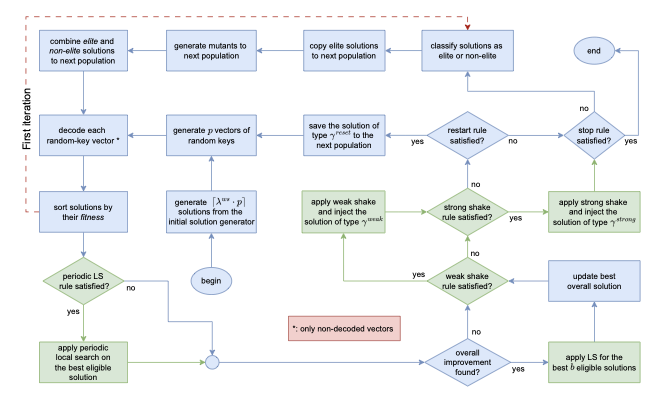
We consider the strongly NP-hard single-machine coupled task scheduling problem with exact delays to minimize the makespan. In this problem, a set of jobs has to be scheduled, each composed of two tasks interspersed by an exact delay. Given that no preemption is allowed, the goal consists of minimizing the completion time of the last scheduled task. We model the problem using constraint programming (CP) and propose a biased random-key genetic algorithm (BRKGA). Our CP model applies well-established global constraints. Our BRKGA combines some successful components in the literature an initial solution generator, periodical restarts and shakes, and a local search algorithm. Furthermore, the BRKGA s decoder is focused on efficiency rather than optimality, which accelerates the solution space exploration. Computational experiments on a benchmark set containing instances with up to 100 jobs (200 tasks) indicate that the proposed BRKGA can efficiently explore the problem solution space, providing high-quality approximate solutions within low computational times. It can also provide better solutions than the CP model under the same computational settings, i.e., three minutes of time limit and a single thread. The CP model, when offered a longer running time of 3600 seconds and multiple threads, significantly improved the results, reaching the current best-known solution for 90.56% of these instances. Finally, our experiments highlight the importance of the shake and local search components in the BRKGA, whose combination significantly improves the results of a standard BRKGA.

paper research

< Category Statistics (Total: 566) >

Quantum Physics
5

Start searching

Enter keywords to search articles

↑↓
ESC
⌘K Shortcut