Logic in Computer Science

All posts under category "Logic in Computer Science"

2 posts total
Sorted by date
No Image

A Modal Logic for Possibilistic Reasoning with Fuzzy Formal Contexts

We introduce a two-sort weighted modal logic for possibilistic reasoning with fuzzy formal contexts. The syntax of the logic includes two types of weighted modal operators corresponding to classical necessity ($ Box$) and sufficiency ($ boxminus$) modalities and its formulas are interpreted in fuzzy formal contexts based on possibility theory. We present its axiomatization that is emph{sound} with respect to the class of all fuzzy context models. In addition, both the necessity and sufficiency fragments of the logic are also individually complete with respect to the class of all fuzzy context models. We highlight the expressive power of the logic with some illustrative examples. As a formal context is the basic construct of formal concept analysis (FCA), we generalize three main notions in FCA, i.e., formal concepts, object oriented concepts, and property oriented concepts, to their corresponding $c$-cut concepts in fuzzy formal contexts. Then, we show that our logical language can represent all three of these generalized notions. Finally, we demonstrate the possibility of extending our logic to reasoning with multi-relational fuzzy contexts, in which the Boolean combinations of different fuzzy relations are allowed.
paper research
LeanCat  A Benchmark Suite for Formal Category Theory in Lean (Part I  1-Categories)

LeanCat A Benchmark Suite for Formal Category Theory in Lean (Part I 1-Categories)

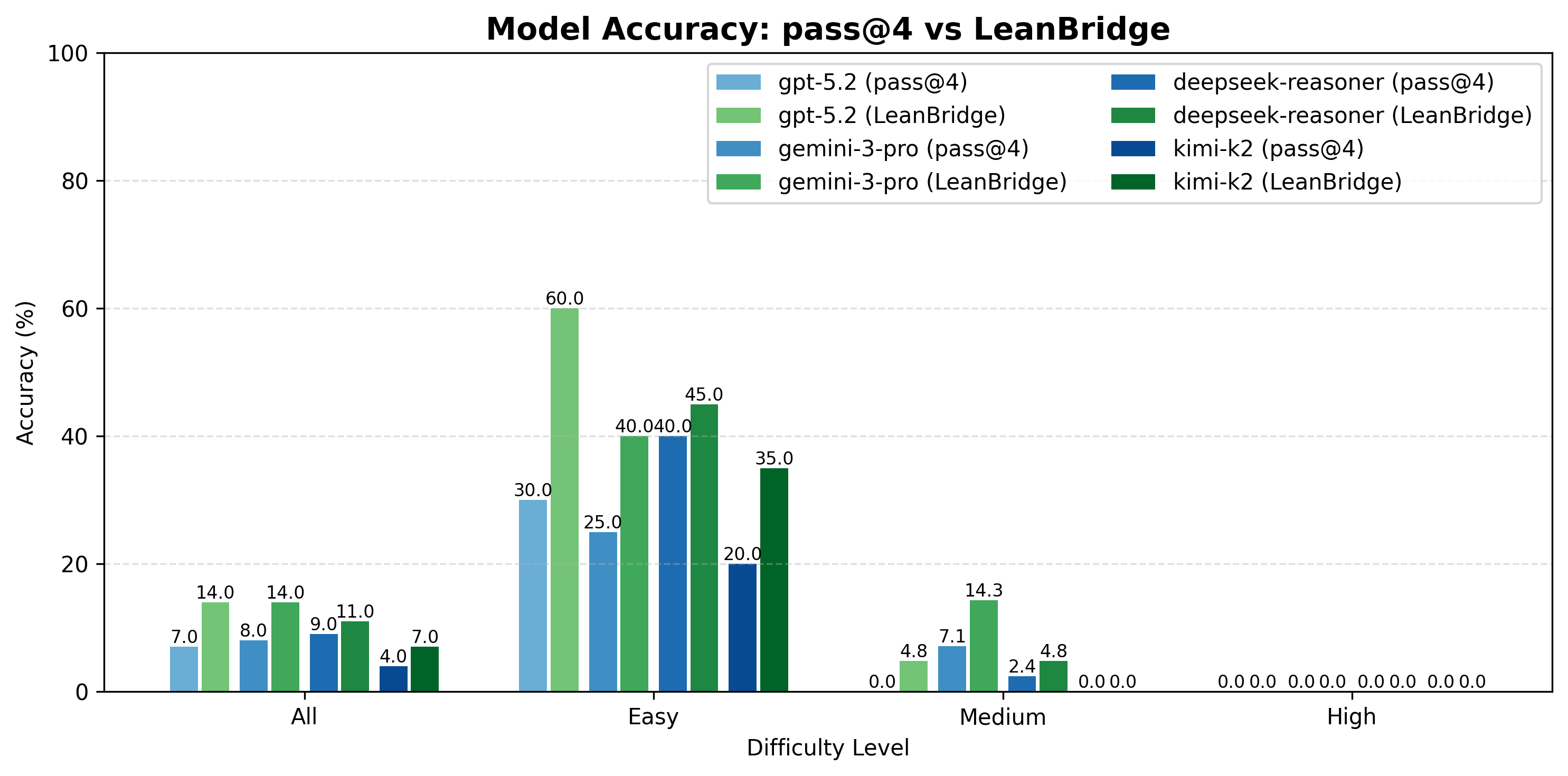
Large language models (LLMs) have made rapid progress in formal theorem proving, yet current benchmarks under-measure the kind of abstraction and library-mediated reasoning that organizes modern mathematics. In parallel with FATE s emphasis on frontier algebra, we introduce LeanCat, a Lean benchmark for category-theoretic formalization -- a unifying language for mathematical structure and a core layer of modern proof engineering -- serving as a stress test of structural, interface-level reasoning. Part I 1-Categories contains 100 fully formalized statement-level tasks, curated into topic families and three difficulty tiers via an LLM-assisted + human grading process. The best model solves 8.25% of tasks at pass@1 (32.50%/4.17%/0.00% by Easy/Medium/High) and 12.00% at pass@4 (50.00%/4.76%/0.00%). We also evaluate LeanBridge which use LeanExplore to search Mathlib, and observe consistent gains over single-model baselines. LeanCat is intended as a compact, reusable checkpoint for tracking both AI and human progress toward reliable, research-level formalization in Lean.

paper research

Start searching

Enter keywords to search articles

↑↓
↵
ESC
⌘K Shortcut