Electrical Engineering and Systems Science / Audio and Speech Processing

All posts under category "Electrical Engineering and Systems Science / Audio and Speech Processing"

3 posts total
Sorted by date
No Image

Indian EmoSpeech Command Dataset A Real-World Dataset for Emotion-Based Speech Recognition

Speech emotion analysis is an important task which further enables several application use cases. The non-verbal sounds within speech utterances also play a pivotal role in emotion analysis in speech. Due to the widespread use of smartphones, it becomes viable to analyze speech commands captured using microphones for emotion understanding by utilizing on-device machine learning models. The non-verbal information includes the environment background sounds describing the type of surroundings, current situation and activities being performed. In this work, we consider both verbal (speech commands) and non-verbal sounds (background noises) within an utterance for emotion analysis in real-life scenarios. We create an indigenous dataset for this task namely Indian EmoSpeech Command Dataset . It contains keywords with diverse emotions and background sounds, presented to explore new challenges in audio analysis. We exhaustively compare with various baseline models for emotion analysis on speech commands on several performance metrics. We demonstrate that we achieve a significant average gain of 3.3% in top-one score over a subset of speech command dataset for keyword spotting.
paper research
Improving Code-Switching Speech Recognition with TTS Data Augmentation

Improving Code-Switching Speech Recognition with TTS Data Augmentation

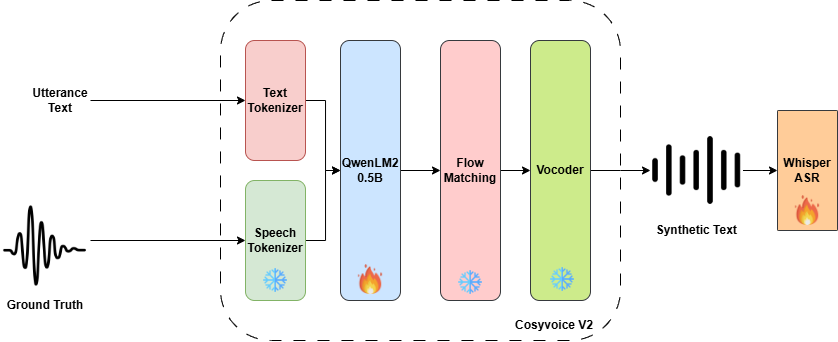
Automatic speech recognition (ASR) for conversational code-switching speech remains challenging due to the scarcity of realistic, high-quality labeled speech data. This paper explores multilingual text-to-speech (TTS) models as an effective data augmentation technique to address this shortage. Specifically, we fine-tune the multilingual CosyVoice2 TTS model on the SEAME dataset to generate synthetic conversational Chinese-English code-switching speech, significantly increasing the quantity and speaker diversity of available training data. Our experiments demonstrate that augmenting real speech with synthetic speech reduces the mixed error rate (MER) from 12.1 percent to 10.1 percent on DevMan and from 17.8 percent to 16.0 percent on DevSGE, indicating consistent performance gains. These results confirm that multilingual TTS is an effective and practical tool for enhancing ASR robustness in low-resource conversational code-switching scenarios.

paper research
MORE  Multi-Objective Adversarial Attacks on Speech Recognition

MORE Multi-Objective Adversarial Attacks on Speech Recognition

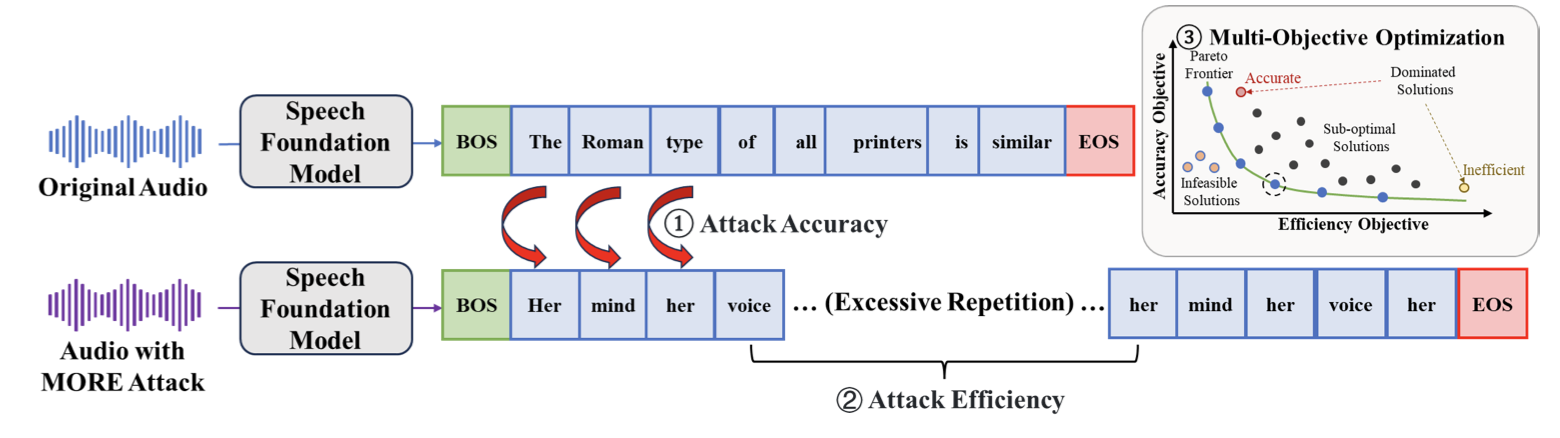
The emergence of large-scale automatic speech recognition (ASR) models such as Whisper has greatly expanded their adoption across diverse real-world applications. Ensuring robustness against even minor input perturbations is therefore critical for maintaining reliable performance in real-time environments. While prior work has mainly examined accuracy degradation under adversarial attacks, robustness with respect to efficiency remains largely unexplored. This narrow focus provides only a partial understanding of ASR model vulnerabilities. To address this gap, we conduct a comprehensive study of ASR robustness under multiple attack scenarios. We introduce MORE, a multi-objective repetitive doubling encouragement attack, which jointly degrades recognition accuracy and inference efficiency through a hierarchical staged repulsion-anchoring mechanism. Specifically, we reformulate multi-objective adversarial optimization into a hierarchical framework that sequentially achieves the dual objectives. To further amplify effectiveness, we propose a novel repetitive encouragement doubling objective (REDO) that induces duplicative text generation by maintaining accuracy degradation and periodically doubling the predicted sequence length. Overall, MORE compels ASR models to produce incorrect transcriptions at a substantially higher computational cost, triggered by a single adversarial input. Experiments show that MORE consistently yields significantly longer transcriptions while maintaining high word error rates compared to existing baselines, underscoring its effectiveness in multi-objective adversarial attack.

paper research

< Category Statistics (Total: 566) >

Quantum Physics
5

Start searching

Enter keywords to search articles

↑↓
ESC
⌘K Shortcut