Economics / Theoretical Economics

All posts under category "Economics / Theoretical Economics"

5 posts total
Sorted by date
No Image

Building Social Networks with Consent A Survey

This survey explores the literature on game-theoretic models of network formation under the hypothesis of mutual consent in link formation. The introduction of consent in link formation imposes a coordination problem in the network formation process. This survey explores the conclusions from this theory and the various methodologies to avoid the main pitfalls. The main insight originates from Myerson s work on mutual consent in link formation and his main conclusion that the empty network (the network without any links) always emerges as a strong Nash equilibrium in any game-theoretic model of network formation under mutual consent and positive link formation costs. Jackson and Wolinsky introduced a cooperative framework to avoid this main pitfall. They devised the notion of a pairwise stable network to arrive at equilibrium networks that are mainly non-trivial. Unfortunately, this notion of pairwise stability requires coordinated action by pairs of decision makers in link formation. I survey the possible solutions in a purely non-cooperative framework of network formation under mutual consent by exploring potential refinements of the standard Nash equilibrium concept to explain the emergence of non-trivial networks. This includes the notions of unilateral and monadic stability. The first one is founded on advanced rational reasoning of individuals about how others would respond to one s efforts to modify the network. The latter incorporates trusting, boundedly rational behaviour into the network formation process. The survey is concluded with an initial exploration of external correlation devices as an alternative framework to address mutual consent in network formation.
paper research
No Image

Super-Nash Performance A New Benchmark and Solution Concept in Game Theory

In this paper, I introduce a novel benchmark in games, super-Nash performance, and a solution concept, optimin, whereby players maximize their minimal payoff under unilateral profitable deviations by other players. Optimin achieves super-Nash performance in that, for every Nash equilibrium, there exists an optimin where each player not only receives but also guarantees super-Nash payoffs under unilateral profitable deviations by others. Further, optimin generalizes Nash equilibrium in n-person constant-sum games and coincides with it when n=2. Finally, optimin is consistent with the direction of non-Nash deviations in games in which cooperation has been extensively studied.

paper research
No Image

Game-Theoretic Approach to Open Shop Scheduling Problems with Unit Execution Times

This paper takes a game theoretical approach to open shop scheduling problems with unit execution times to minimize the sum of completion times. By supposing an initial schedule and associating each job (consisting in a number of operations) to a different player, we can construct a cooperative TU-game associated with any open shop scheduling problem. We assign to each coalition the maximal cost savings it can obtain through admissible rearrangements of jobs operations. By providing a core allocation, we show that the associated games are balanced. Finally, we relax the definition of admissible rearrangements for a coalition to study to what extend balancedness still holds.

paper research
No Image

Testing the Drift-Diffusion Model

The drift diffusion model (DDM) is a model of sequential sampling with diffusion (Brownian) signals, where the decision maker accumulates evidence until the process hits a stopping boundary, and then stops and chooses the alternative that corresponds to that boundary. This model has been widely used in psychology, neuroeconomics, and neuroscience to explain the observed patterns of choice and response times in a range of binary choice decision problems. This paper provides a statistical test for DDM s with general boundaries. We first prove a characterization theorem we find a condition on choice probabilities that is satisfied if and only if the choice probabilities are generated by some DDM. Moreover, we show that the drift and the boundary are uniquely identified. We then use our condition to nonparametrically estimate the drift and the boundary and construct a test statistic.

paper research
LLM Collusion

LLM Collusion

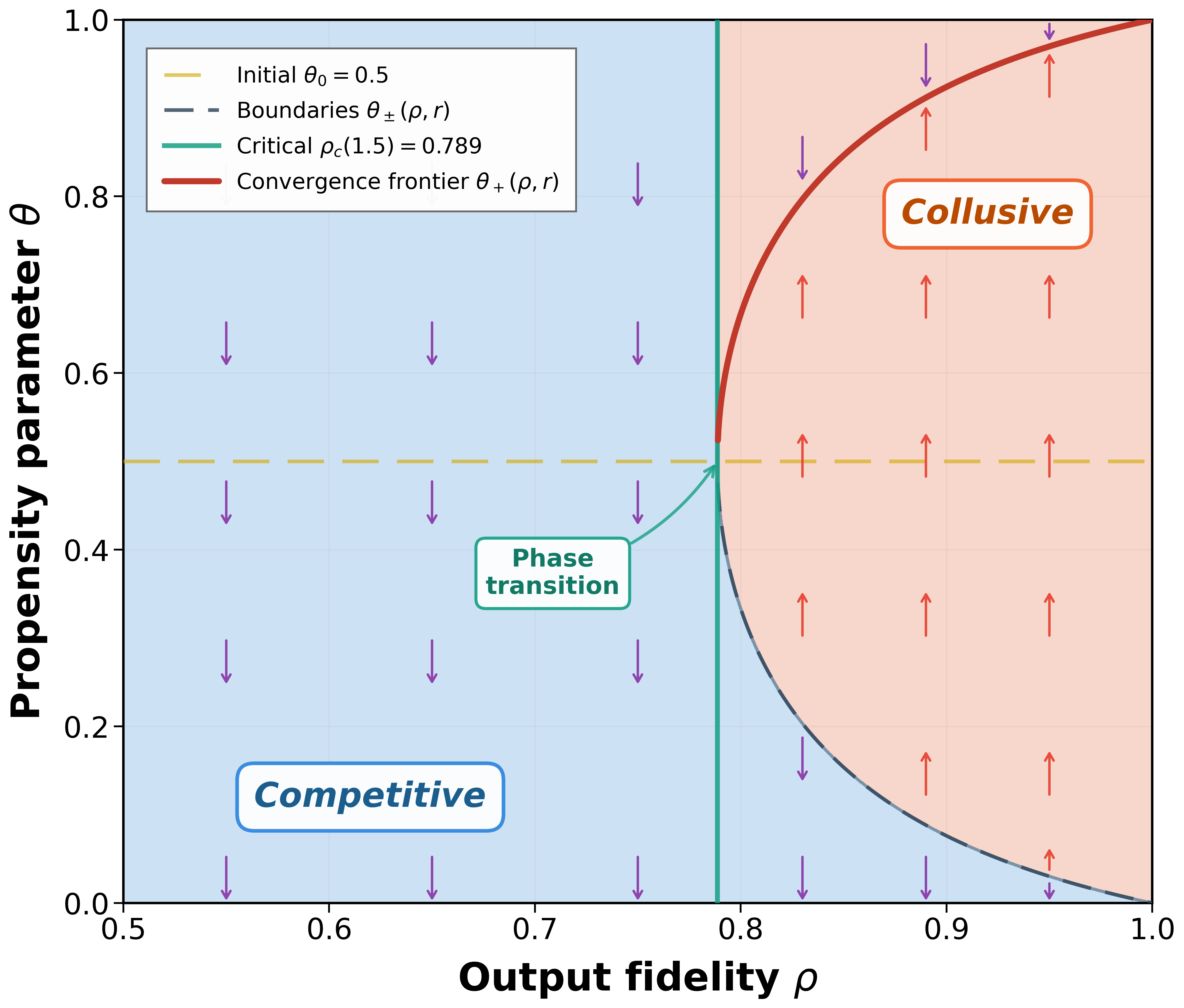
We study how delegating pricing to large language models (LLMs) can facilitate collusion in a duopoly when both sellers rely on the same pre-trained model. The LLM is characterized by (i) a propensity parameter capturing its internal bias toward high-price recommendations and (ii) an output-fidelity parameter measuring how tightly outputs track that bias; the propensity evolves through retraining. We show that configuring LLMs for robustness and reproducibility can induce collusion via a phase transition there exists a critical output-fidelity threshold that pins down long-run behavior. Below it, competitive pricing is the unique long-run outcome. Above it, the system is bistable, with competitive and collusive pricing both locally stable and the realized outcome determined by the model s initial preference. The collusive regime resembles tacit collusion prices are elevated on average, yet occasional low-price recommendations provide plausible deniability. With perfect fidelity, full collusion emerges from any interior initial condition. For finite training batches of size $b$, infrequent retraining (driven by computational costs) further amplifies collusion conditional on starting in the collusive basin, the probability of collusion approaches one as $b$ grows, since larger batches dampen stochastic fluctuations that might otherwise tip the system toward competition. The indeterminacy region shrinks at rate $O(1/ sqrt{b})$.

paper research

< Category Statistics (Total: 566) >

Quantum Physics
5

Start searching

Enter keywords to search articles

↑↓
ESC
⌘K Shortcut