Distributed Computing

All posts under category "Distributed Computing"

5 posts total
Sorted by date
AI-Driven Cloud Resource Optimization for Multi-Cluster Environments

AI-Driven Cloud Resource Optimization for Multi-Cluster Environments

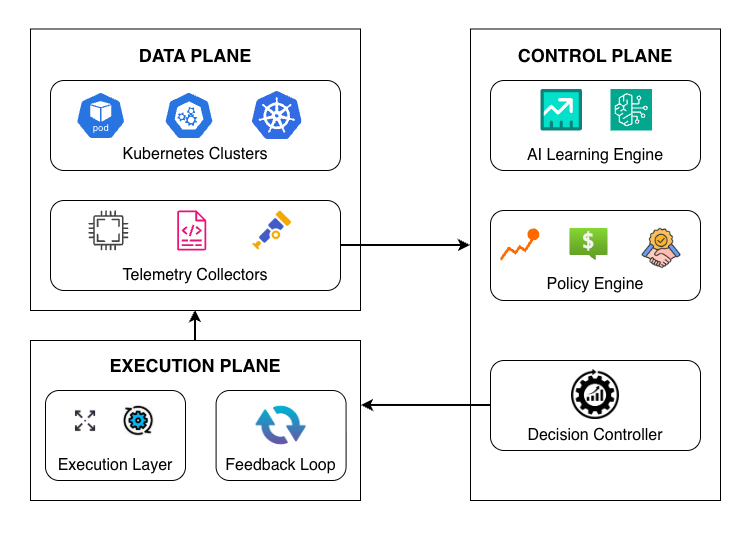
Modern cloud-native systems increasingly rely on multi-cluster deployments to support scalability, resilience, and geographic distribution. However, existing resource management approaches remain largely reactive and cluster-centric, limiting their ability to optimize system-wide behavior under dynamic workloads. These limitations result in inefficient resource utilization, delayed adaptation, and increased operational overhead across distributed environments. This paper presents an AI-driven framework for adaptive resource optimization in multi-cluster cloud systems. The proposed approach integrates predictive learning, policy-aware decision-making, and continuous feedback to enable proactive and coordinated resource management across clusters. By analyzing cross-cluster telemetry and historical execution patterns, the framework dynamically adjusts resource allocation to balance performance, cost, and reliability objectives. A prototype implementation demonstrates improved resource efficiency, faster stabilization during workload fluctuations, and reduced performance variability compared to conventional reactive approaches. The results highlight the effectiveness of intelligent, self-adaptive infrastructure management as a key enabler for scalable and resilient cloud platforms.

paper research
PackKV  Reducing KV Cache Memory Footprint through LLM-Aware Lossy Compression

PackKV Reducing KV Cache Memory Footprint through LLM-Aware Lossy Compression

Transformer-based large language models (LLMs) have demonstrated remarkable potential across a wide range of practical applications. However, long-context inference remains a significant challenge due to the substantial memory requirements of the key-value (KV) cache, which can scale to several gigabytes as sequence length and batch size increase. In this paper, we present textbf{PackKV}, a generic and efficient KV cache management framework optimized for long-context generation. %, which synergistically supports both latency-critical and throughput-critical inference scenarios. PackKV introduces novel lossy compression techniques specifically tailored to the characteristics of KV cache data, featuring a careful co-design of compression algorithms and system architecture. Our approach is compatible with the dynamically growing nature of the KV cache while preserving high computational efficiency. Experimental results show that, under the same and minimum accuracy drop as state-of-the-art quantization methods, PackKV achieves, on average, textbf{153.2} % higher memory reduction rate for the K cache and textbf{179.6} % for the V cache. Furthermore, PackKV delivers extremely high execution throughput, effectively eliminating decompression overhead and accelerating the matrix-vector multiplication operation. Specifically, PackKV achieves an average throughput improvement of textbf{75.7} % for K and textbf{171.7} % for V across A100 and RTX Pro 6000 GPUs, compared to cuBLAS matrix-vector multiplication kernels, while demanding less GPU memory bandwidth. Code available on https //github.com/BoJiang03/PackKV

paper research
No Image

Placement Semantics for Distributed Deep Learning A Systematic Framework for Analyzing Parallelism Strategies

Training large language models requires distributing computation across many accelerators, yet practitioners select parallelism strategies (data, tensor, pipeline, ZeRO) through trial and error because no unified systematic framework predicts their behavior. We introduce placement semantics each strategy is specified by how it places four training states (parameters, optimizer, gradients, activations) across devices using five modes (replicated, sharded, sharded-with-gather, materialized, offloaded). From placement alone, without implementation details, we derive memory consumption and communication volume. Our predictions match published results exactly ZeRO-3 uses 8x less memory than data parallelism at 1.5x communication cost, as reported in the original paper. We prove two conditions (gradient integrity, state consistency) are necessary and sufficient for distributed training to match single-device results, and provide composition rules for combining strategies safely. The framework unifies ZeRO Stages 1-3, Fully Sharded Data Parallel (FSDP), tensor parallelism, and pipeline parallelism as instances with different placement choices.

paper research
RelayGR  Scaling Long-Sequence Generative Recommendation via Cross-Stage Relay-Race Inference

RelayGR Scaling Long-Sequence Generative Recommendation via Cross-Stage Relay-Race Inference

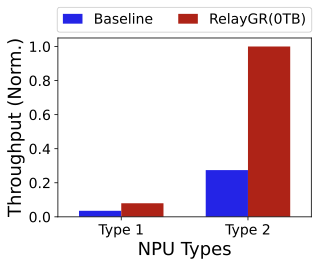
Real-time recommender systems execute multi-stage cascades (retrieval, pre-processing, fine-grained ranking) under strict tail-latency SLOs, leaving only tens of milliseconds for ranking. Generative recommendation (GR) models can improve quality by consuming long user-behavior sequences, but in production their online sequence length is tightly capped by the ranking-stage P99 budget. We observe that the majority of GR tokens encode user behaviors that are independent of the item candidates, suggesting an opportunity to pre-infer a user-behavior prefix once and reuse it during ranking rather than recomputing it on the critical path. Realizing this idea at industrial scale is non-trivial the prefix cache must survive across multiple pipeline stages before the final ranking instance is determined, the user population implies cache footprints far beyond a single device, and indiscriminate pre-inference would overload shared resources under high QPS. We present RelayGR, a production system that enables in-HBM relay-race inference for GR. RelayGR selectively pre-infers long-term user prefixes, keeps their KV caches resident in HBM over the request lifecycle, and ensures the subsequent ranking can consume them without remote fetches. RelayGR combines three techniques 1) a sequence-aware trigger that admits only at-risk requests under a bounded cache footprint and pre-inference load, 2) an affinity-aware router that co-locates cache production and consumption by routing both the auxiliary pre-infer signal and the ranking request to the same instance, and 3) a memory-aware expander that uses server-local DRAM to capture short-term cross-request reuse while avoiding redundant reloads. We implement RelayGR on Huawei Ascend NPUs and evaluate it with real queries. Under a fixed P99 SLO, RelayGR supports up to 1.5$ times$ longer sequences and improves SLO-compliant throughput by up to 3.6$ times$.

paper research
Viability and Performance of a Private LLM Server for SMBs  A Benchmark Analysis of Qwen3-30B

Viability and Performance of a Private LLM Server for SMBs A Benchmark Analysis of Qwen3-30B

The proliferation of Large Language Models (LLMs) has been accompanied by a reliance on cloud-based, proprietary systems, raising significant concerns regarding data privacy, operational sovereignty, and escalating costs. This paper investigates the feasibility of deploying a high-performance, private LLM inference server at a cost accessible to Small and Medium Businesses (SMBs). We present a comprehensive benchmarking analysis of a locally hosted, quantized 30-billion parameter Mixture-of-Experts (MoE) model based on Qwen3, running on a consumer-grade server equipped with a next-generation NVIDIA GPU. Unlike cloud-based offerings, which are expensive and complex to integrate, our approach provides an affordable and private solution for SMBs. We evaluate two dimensions the model s intrinsic capabilities and the server s performance under load. Model performance is benchmarked against academic and industry standards to quantify reasoning and knowledge relative to cloud services. Concurrently, we measure server efficiency through latency, tokens per second, and time to first token, analyzing scalability under increasing concurrent users. Our findings demonstrate that a carefully configured on-premises setup with emerging consumer hardware and a quantized open-source model can achieve performance comparable to cloud-based services, offering SMBs a viable pathway to deploy powerful LLMs without prohibitive costs or privacy compromises.

paper research

Start searching

Enter keywords to search articles

↑↓
↵
ESC
⌘K Shortcut