Data Structures and Algorithms

All posts under category "Data Structures and Algorithms"

3 posts total
Sorted by date
No Image

Lower Bounds for Function Inversion with Quantum Advice

Function inversion is the problem that given a random function $f [M] to [N]$, we want to find pre-image of any image $f^{-1}(y)$ in time $T$. In this work, we revisit this problem under the preprocessing model where we can compute some auxiliary information or advice of size $S$ that only depends on $f$ but not on $y$. It is a well-studied problem in the classical settings, however, it is not clear how quantum algorithms can solve this task any better besides invoking Grover s algorithm, which does not leverage the power of preprocessing. Nayebi et al. proved a lower bound $ST^2 ge tilde Omega(N)$ for quantum algorithms inverting permutations, however, they only consider algorithms with classical advice. Hhan et al. subsequently extended this lower bound to fully quantum algorithms for inverting permutations. In this work, we give the same asymptotic lower bound to fully quantum algorithms for inverting functions for fully quantum algorithms under the regime where $M = O(N)$. In order to prove these bounds, we generalize the notion of quantum random access code, originally introduced by Ambainis et al., to the setting where we are given a list of (not necessarily independent) random variables, and we wish to compress them into a variable-length encoding such that we can retrieve a random element just using the encoding with high probability. As our main technical contribution, we give a nearly tight lower bound (for a wide parameter range) for this generalized notion of quantum random access codes, which may be of independent interest.
paper research
A Parallel Projection Technique for Optimization Under Metric Constraints

A Parallel Projection Technique for Optimization Under Metric Constraints

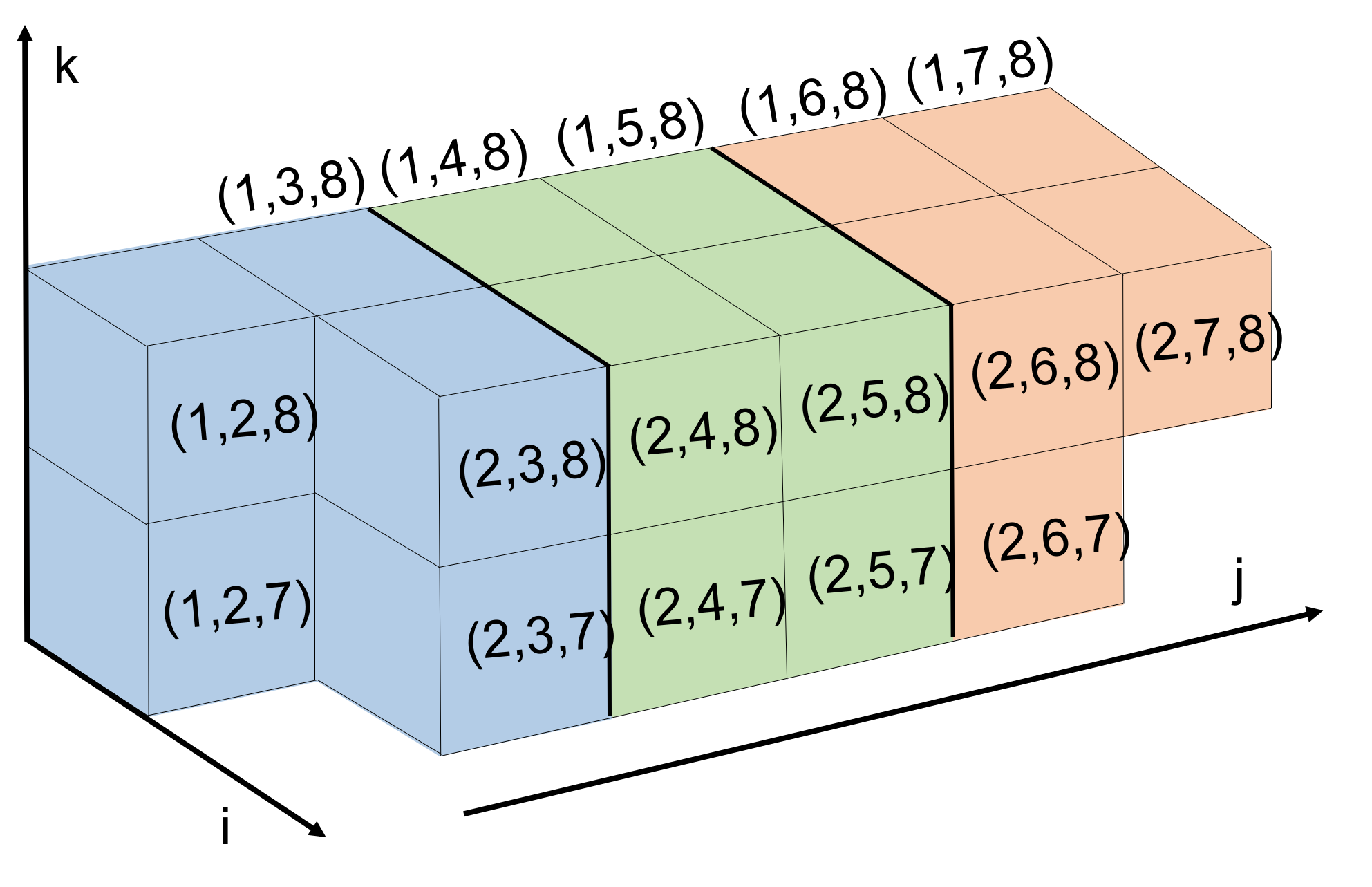
Many clustering applications in machine learning and data mining rely on solving metric-constrained optimization problems. These problems are characterized by $O(n^3)$ constraints that enforce triangle inequalities on distance variables associated with $n$ objects in a large dataset. Despite its usefulness, metric-constrained optimization is challenging in practice due to the cubic number of constraints and the high-memory requirements of standard optimization software. Recent work has shown that iterative projection methods are able to solve metric-constrained optimization problems on a much larger scale than was previously possible, thanks to their comparatively low memory requirement. However, the major limitation of projection methods is their slow convergence rate. In this paper we present a parallel projection method for metric-constrained optimization which allows us to speed up the convergence rate in practice. The key to our approach is a new parallel execution schedule that allows us to perform projections at multiple metric constraints simultaneously without any conflicts or locking of variables. We illustrate the effectiveness of this execution schedule by implementing and testing a parallel projection method for solving the metric-constrained linear programming relaxation of correlation clustering. We show numerous experimental results on problems involving up to 2.9 trillion constraints.

paper research
Minimum Cuts in Graphs Embedded on Surfaces

Minimum Cuts in Graphs Embedded on Surfaces

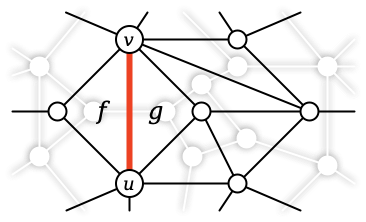
We describe algorithms to efficiently compute minimum $(s,t)$-cuts and global minimum cuts of undirected surface-embedded graphs. Given an edge-weighted undirected graph $G$ with $n$ vertices embedded on an orientable surface of genus $g$, our algorithms can solve either problem in $g^{O(g)} n log log n$ or $2^{O(g)} n log n$ time, whichever is better. When $g$ is a constant, our $g^{O(g)} n log log n$ time algorithms match the best running times known for computing minimum cuts in planar graphs. Our algorithms for minimum cuts rely on reductions to the problem of finding a minimum-weight subgraph in a given $ mathbb{Z}_2$-homology class, and we give efficient algorithms for this latter problem as well. If $G$ is embedded on a surface with $b$ boundary components, these algorithms run in $(g + b)^{O(g + b)} n log log n$ and $2^{O(g + b)} n log n$ time. We also prove that finding a minimum-weight subgraph homologous to a single input cycle is NP-hard, showing it is likely impossible to improve upon the exponential dependencies on $g$ for this latter problem.

paper research

< Category Statistics (Total: 566) >

Computer Science (514) Machine Learning (117) Artificial Intelligence (89) Computer Vision (71) Computation and Language (NLP) (62) Electrical Engineering and Systems Science (36) Cryptography and Security (24) Robotics (22) Systems and Control (22) Software Engineering (20) Mathematics (18) Statistics (17) Economics (16) Information Retrieval (15) Distributed, Parallel, and Cluster Computing (14) Human-Computer Interaction (14) Neural and Evolutionary Computing (13) Computer Science and Game Theory (11) Econometrics (11) Image and Video Processing (10) Physics (10) Sound (10) Multiagent Systems (9) Optimization and Control (8) Computational Geometry (7) Databases (7) Graphics (6) Networking and Internet Architecture (6) Quantitative Biology (6) Quantum Physics (5) Theoretical Economics (5) Computational Complexity (4) Computational Engineering, Finance, and Science (4) Computers and Society (4) Emerging Technologies (4) Information Theory (4) Methodology (4) Multimedia (4) Programming Languages (4) Quantitative Finance (4) Signal Processing (4) Audio and Speech Processing (3) Data Structures and Algorithms (3) Hardware Architecture (3) History and Philosophy of Physics (3) Logic in Computer Science (3) Neurons and Cognition (3) Social and Information Networks (3) Statistics Theory (3) Computation (2) Condensed Matter (2) Dynamical Systems (2) Formal Languages and Automata Theory (2) General Finance (2) Operating Systems (2) Optics (2) Quantitative Methods (2) Applications (1) Astrophysics (1) Combinatorics (1) Computational Physics (1) Digital Libraries (1) Disordered Systems and Neural Networks (1) General Economics (1) Genomics (1) Geophysics (1) Instrumentation and Methods for Astrophysics (1) Logic (1) Mathematical Finance (1) Mathematical Software (1) Medical Physics (1) Mesoscale and Nanoscale Physics (1) Metric Geometry (1) Other Statistics (1) Performance (1) Physics and Society (1) Plasma Physics (1) Probability (1) Trading and Market Microstructure (1)

Start searching

Enter keywords to search articles

↑↓
ESC
⌘K Shortcut