Computer Science and Game Theory

All posts under category "Computer Science and Game Theory"

11 posts total
Sorted by date
Optimizing a Supply-Side Platforms Header Bidding Strategy with Thompson Sampling

Optimizing a Supply-Side Platforms Header Bidding Strategy with Thompson Sampling

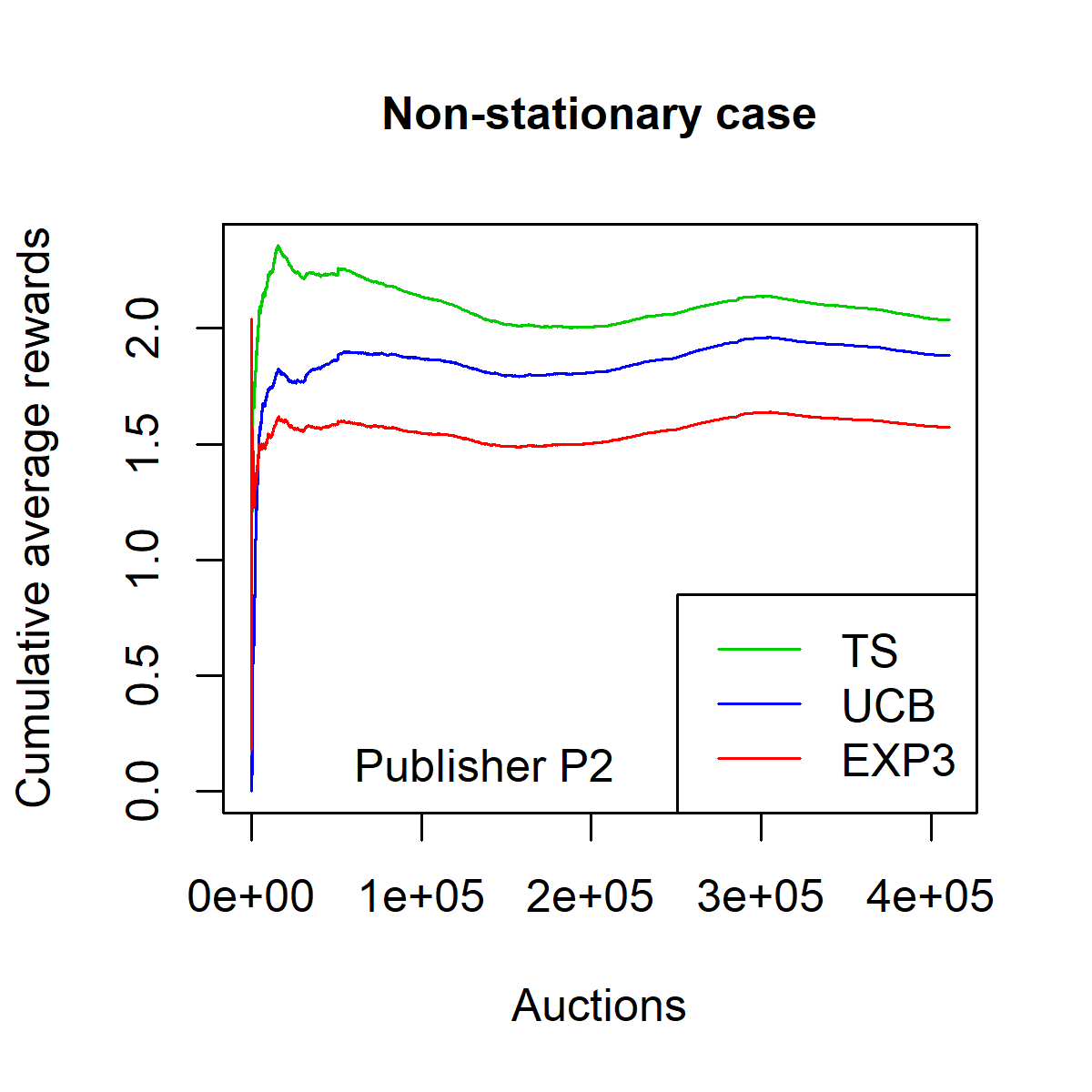
Over the last decade, digital media (web or app publishers) generalized the use of real time ad auctions to sell their ad spaces. Multiple auction platforms, also called Supply-Side Platforms (SSP), were created. Because of this multiplicity, publishers started to create competition between SSPs. In this setting, there are two successive auctions a second price auction in each SSP and a secondary, first price auction, called header bidding auction, between SSPs.In this paper, we consider an SSP competing with other SSPs for ad spaces. The SSP acts as an intermediary between an advertiser wanting to buy ad spaces and a web publisher wanting to sell its ad spaces, and needs to define a bidding strategy to be able to deliver to the advertisers as many ads as possible while spending as little as possible. The revenue optimization of this SSP can be written as a contextual bandit problem, where the context consists of the information available about the ad opportunity, such as properties of the internet user or of the ad placement.Using classical multi-armed bandit strategies (such as the original versions of UCB and EXP3) is inefficient in this setting and yields a low convergence speed, as the arms are very correlated. In this paper we design and experiment a version of the Thompson Sampling algorithm that easily takes this correlation into account. We combine this bayesian algorithm with a particle filter, which permits to handle non-stationarity by sequentially estimating the distribution of the highest bid to beat in order to win an auction. We apply this methodology on two real auction datasets, and show that it significantly outperforms more classical approaches.The strategy defined in this paper is being developed to be deployed on thousands of publishers worldwide.
paper research
A Mixed-Logical-Dynamical Model for Autonomous Highway Driving

A Mixed-Logical-Dynamical Model for Autonomous Highway Driving

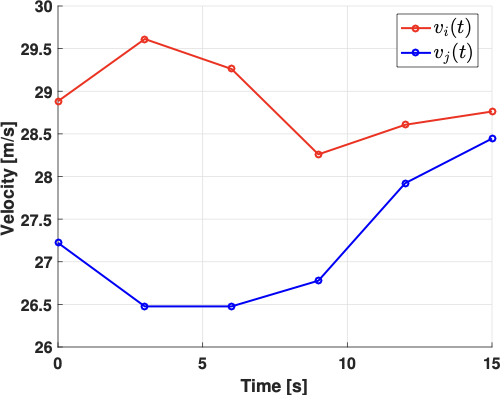
We propose a hybrid decision-making framework for safe and efficient autonomous driving of selfish vehicles on highways. Specifically, we model the dynamics of each vehicle as a Mixed-Logical-Dynamical system and propose simple driving rules to prevent potential sources of conflict among neighboring vehicles. We formalize the coordination problem as a generalized mixed-integer potential game, where an equilibrium solution generates a sequence of mixed-integer decisions for the vehicles that trade off individual optimality and overall safety.

paper research
No Image

Maximizing Revenue Robustly with Minimal Statistical Information

We study the problem of multi-dimensional revenue maximization when selling $m$ items to a buyer that has additive valuations for them, drawn from a (possibly correlated) prior distribution. Unlike traditional Bayesian auction design, we assume that the seller has a very restricted knowledge of this prior they only know the mean $ mu_j$ and an upper bound $ sigma_j$ on the standard deviation of each item s marginal distribution. Our goal is to design mechanisms that achieve good revenue against an ideal optimal auction that has full knowledge of the distribution in advance. Informally, our main contribution is a tight quantification of the interplay between the dispersity of the priors and the aforementioned robust approximation ratio. Furthermore, this can be achieved by very simple selling mechanisms. More precisely, we show that selling the items via separate price lotteries achieves an $O( log r)$ approximation ratio where $r= max_j( sigma_j/ mu_j)$ is the maximum coefficient of variation across the items. To prove the result, we leverage a price lottery for the single-item case. If forced to restrict ourselves to deterministic mechanisms, this guarantee degrades to $O(r^2)$. Assuming independence of the item valuations, these ratios can be further improved by pricing the full bundle. For the case of identical means and variances, in particular, we get a guarantee of $O( log(r/m))$ which converges to optimality as the number of items grows large. We demonstrate the optimality of the above mechanisms by providing matching lower bounds. Our tight analysis for the single-item deterministic case resolves an open gap from the work of Azar and Micali [ITCS 13]. As a by-product, we also show how one can directly use our upper bounds to improve and extend previous results related to the parametric auctions of Azar et al. [SODA 13].

paper research
No Image

Open Shop Scheduling Games

This paper takes a game theoretical approach to open shop scheduling problems with unit execution times to minimize the sum of completion times. By supposing an initial schedule and associating each job (consisting in a number of operations) to a different player, we can construct a cooperative TU-game associated with any open shop scheduling problem. We assign to each coalition the maximal cost savings it can obtain through admissible rearrangements of jobs operations. By providing a core allocation, we show that the associated games are balanced. Finally, we relax the definition of admissible rearrangements for a coalition to study to what extend balancedness still holds.

paper research
Stability of User Equilibria in Heterogeneous Routing Games

Stability of User Equilibria in Heterogeneous Routing Games

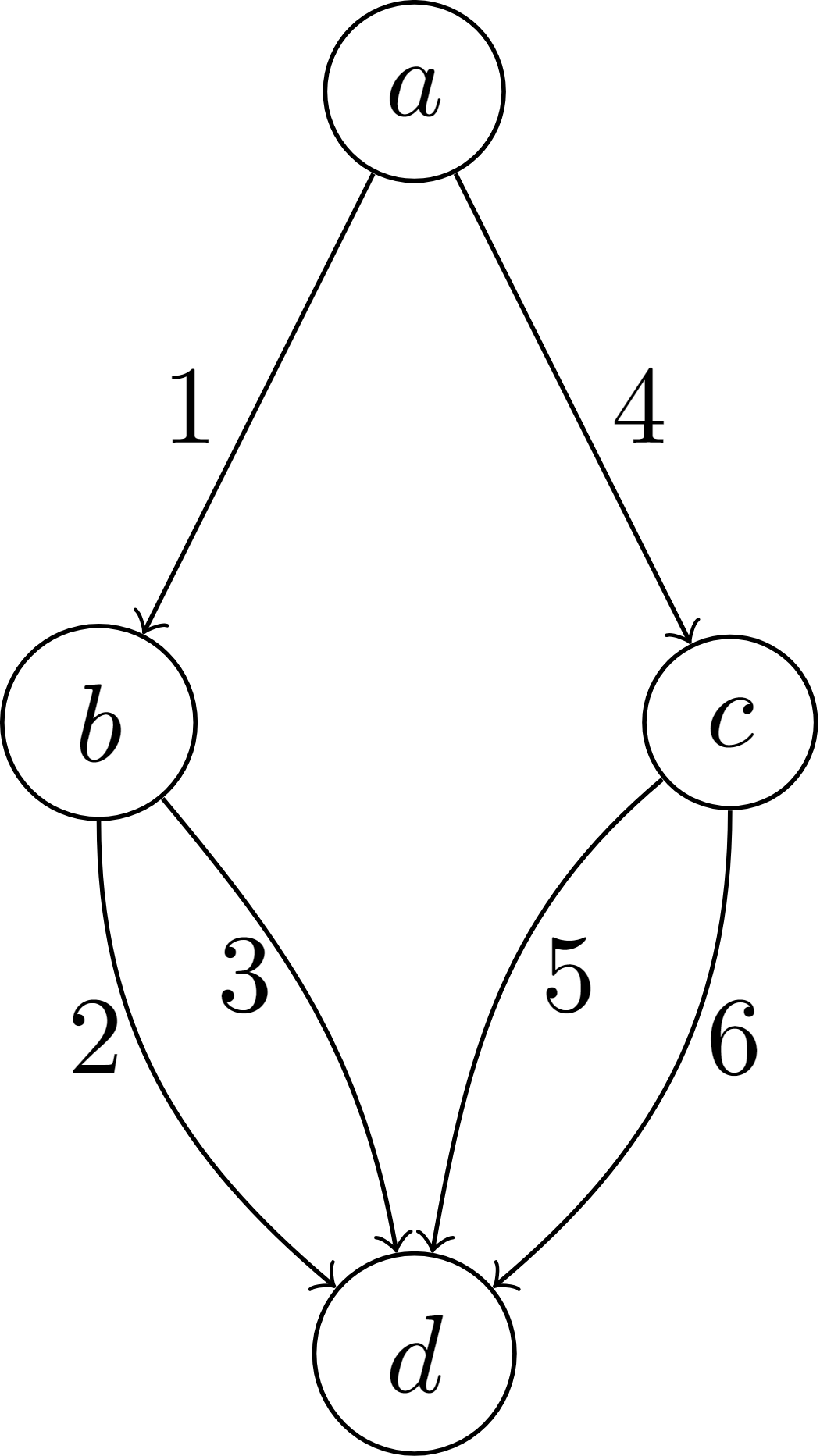
The asymptotic behaviour of deterministic logit dynamics in heterogeneous routing games is analyzed. It is proved that in directed multigraphs with parallel routes, and in series composition of such multigraphs, the dynamics admits a globally asymptotically stable fixed point. Moreover, the unique fixed point of the dynamics approaches the set of Wardrop equilibria, as the noise vanishes. The result relies on the fact that the dynamics of aggregate flows is monotone, and its Jacobian is strictly diagonally dominant by columns.

paper research
Storage or No Storage  Duopoly Competition Among Renewable Energy Suppliers in a Local Market

Storage or No Storage Duopoly Competition Among Renewable Energy Suppliers in a Local Market

This paper studies the duopoly competition between renewable energy suppliers with or without energy storage in a local energy market. The storage investment brings the benefits of stabilizing renewable energy suppliers outputs, but it also leads to substantial investment costs as well as some surprising changes in the market outcome. To study the equilibrium decisions of storage investment in the renewable energy suppliers competition, we model the interactions between suppliers and consumers using a three-stage game-theoretic model. In Stage I, at the beginning of the investment horizon, suppliers decide whether to invest in storage. Once such decisions have been made, in the day-ahead market of each day, suppliers decide on their bidding prices and quantities in Stage II, based on which consumers decide the electricity quantity purchased from each supplier in Stage III. In the real-time market, a supplier is penalized if his actual generation falls short of his commitment. We characterize a price-quantity competition equilibrium of Stage II, and we further characterize a storage-investment equilibrium in Stage I incorporating electricity-selling revenue and storage cost. Counter-intuitively, we show that the uncertainty of renewable energy without storage investment can lead to higher supplier profits compared with the stable generations with storage investment due to the reduced market competition under random energy generation. Simulations further illustrate results due to the market competition. For example, a higher penalty for not meeting the commitment, a higher storage cost, or a lower consumer demand can sometimes increase a supplier s profit. We also show that although storage investment can increase a supplier s profit, the first-mover supplier who invests in storage may benefit less than the free-rider competitor who chooses not to invest.

paper research
When to Restrict Provider Entry in Regulated Markets with Mandatory Purchase Requirements

When to Restrict Provider Entry in Regulated Markets with Mandatory Purchase Requirements

We study a problem inspired by regulated health insurance markets, such as those created by the government in the Affordable Care Act Exchanges or by employers when they contract with private insurers to provide plans for their employees. The market regulator can choose to do nothing, running a Free Market, or can exercise her regulatory power by limiting the entry of providers (decreasing consumer welfare by limiting options, but also decreasing revenue via enhanced competition). We investigate whether limiting entry increases or decreases the utility (welfare minus revenue) of the consumers who purchase from the providers, specifically in settings where the outside option of purchasing nothing is prohibitively undesirable. We focus primarily on the case where providers are symmetric. We propose a sufficient condition on the distribution of consumer values for (a) a unique symmetric equilibrium to exist in both markets and (b) utility to be higher with limited entry. (We also establish that these conclusions do not necessarily hold for all distributions, and therefore some condition is necessary.) Our techniques are primarily based on tools from revenue maximization, and in particular Myerson s virtual value theory. We also consider extensions to settings where providers have identical costs for providing plans, and to two providers with an asymmetric distribution.

paper research
No Image

Building Social Networks with Consent A Survey

This survey explores the literature on game-theoretic models of network formation under the hypothesis of mutual consent in link formation. The introduction of consent in link formation imposes a coordination problem in the network formation process. This survey explores the conclusions from this theory and the various methodologies to avoid the main pitfalls. The main insight originates from Myerson s work on mutual consent in link formation and his main conclusion that the empty network (the network without any links) always emerges as a strong Nash equilibrium in any game-theoretic model of network formation under mutual consent and positive link formation costs. Jackson and Wolinsky introduced a cooperative framework to avoid this main pitfall. They devised the notion of a pairwise stable network to arrive at equilibrium networks that are mainly non-trivial. Unfortunately, this notion of pairwise stability requires coordinated action by pairs of decision makers in link formation. I survey the possible solutions in a purely non-cooperative framework of network formation under mutual consent by exploring potential refinements of the standard Nash equilibrium concept to explain the emergence of non-trivial networks. This includes the notions of unilateral and monadic stability. The first one is founded on advanced rational reasoning of individuals about how others would respond to one s efforts to modify the network. The latter incorporates trusting, boundedly rational behaviour into the network formation process. The survey is concluded with an initial exploration of external correlation devices as an alternative framework to address mutual consent in network formation.

paper research
Hierarchical Fair Shareouts

Hierarchical Fair Shareouts

We introduce the concept of multilevel fair allocation of resources with tree-structured hierarchical relations among agents. While at each level it is possible to consider the problem locally as an allocation of an agent to its children, the multilevel allocation can be seen as a trace capturing the fact that the process is iterated until the leaves of the tree. In principle, each intermediary node may have its own local allocation mechanism. The main challenge is then to design algorithms which can retain good fairness and efficiency properties. In this paper we propose two original algorithms under the assumption that leaves of the tree have matroid-rank utility functions and the utility of any internal node is the sum of the utilities of its children. The first one is a generic polynomial-time sequential algorithm that comes with theoretical guarantees in terms of efficiency and fairness. It operates in a top-down fashion -- as commonly observed in real-world applications -- and is compatible with various local algorithms. The second one extends the recently proposed General Yankee Swap to the multilevel setting. This extension comes with efficiency guarantees only, but we show that it preserves excellent fairness properties in practice.

paper research
Learning Sparse Coalitions via Bayesian Pursuit and $ ell_1$ Relaxation

Learning Sparse Coalitions via Bayesian Pursuit and $ ell_1$ Relaxation

We study coalition structure generation (CSG) when coalition values are not given but must be learned from episodic observations. We model each episode as a sparse linear regression problem, where the realised payoff (Y_t ) is a noisy linear combination of a small number of coalition contributions. This yields a probabilistic CSG framework in which the planner first estimates a sparse value function from (T ) episodes, then runs a CSG solver on the inferred coalition set. We analyse two estimation schemes. The first, Bayesian Greedy Coalition Pursuit (BGCP), is a greedy procedure that mimics orthogonal matching pursuit. Under a coherence condition and a minimum signal assumption, BGCP recovers the true set of profitable coalitions with high probability once (T gtrsim K log m ), and hence yields welfare-optimal structures. The second scheme uses an ( ell_1 )-penalised estimator; under a restricted eigenvalue condition, we derive ( ell_1 ) and prediction error bounds and translate them into welfare gap guarantees. We compare both methods to probabilistic baselines and identify regimes where sparse probabilistic CSG is superior, as well as dense regimes where classical least-squares approaches are competitive.

paper research
No Image

The Optimal Sample Complexity of Linear Contracts

In this paper, we settle the problem of learning optimal linear contracts from data in the offline setting, where agent types are drawn from an unknown distribution and the principal s goal is to design a contract that maximizes her expected utility. Specifically, our analysis shows that the simple Empirical Utility Maximization (EUM) algorithm yields an $ varepsilon$-approximation of the optimal linear contract with probability at least $1-δ$, using just $O( ln(1/δ) / varepsilon^2)$ samples. This result improves upon previously known bounds and matches a lower bound from Duetting et al. [2025] up to constant factors, thereby proving its optimality. Our analysis uses a chaining argument, where the key insight is to leverage a simple structural property of linear contracts their expected reward is non-decreasing. This property, which holds even though the utility function itself is non-monotone and discontinuous, enables the construction of fine-grained nets required for the chaining argument, which in turn yields the optimal sample complexity. Furthermore, our proof establishes the stronger guarantee of uniform convergence the empirical utility of every linear contract is a $ varepsilon$-approximation of its true expectation with probability at least $1-δ$, using the same optimal $O( ln(1/δ) / varepsilon^2)$ sample complexity.

paper research

< Category Statistics (Total: 566) >

Computer Science (514) Machine Learning (117) Artificial Intelligence (89) Computer Vision (71) Computation and Language (NLP) (62) Electrical Engineering and Systems Science (36) Cryptography and Security (24) Robotics (22) Systems and Control (22) Software Engineering (20) Mathematics (18) Statistics (17) Economics (16) Information Retrieval (15) Distributed, Parallel, and Cluster Computing (14) Human-Computer Interaction (14) Neural and Evolutionary Computing (13) Computer Science and Game Theory (11) Econometrics (11) Image and Video Processing (10) Physics (10) Sound (10) Multiagent Systems (9) Optimization and Control (8) Computational Geometry (7) Databases (7) Graphics (6) Networking and Internet Architecture (6) Quantitative Biology (6) Quantum Physics (5) Theoretical Economics (5) Computational Complexity (4) Computational Engineering, Finance, and Science (4) Computers and Society (4) Emerging Technologies (4) Information Theory (4) Methodology (4) Multimedia (4) Programming Languages (4) Quantitative Finance (4) Signal Processing (4) Audio and Speech Processing (3) Data Structures and Algorithms (3) Hardware Architecture (3) History and Philosophy of Physics (3) Logic in Computer Science (3) Neurons and Cognition (3) Social and Information Networks (3) Statistics Theory (3) Computation (2) Condensed Matter (2) Dynamical Systems (2) Formal Languages and Automata Theory (2) General Finance (2) Operating Systems (2) Optics (2) Quantitative Methods (2) Applications (1) Astrophysics (1) Combinatorics (1) Computational Physics (1) Digital Libraries (1) Disordered Systems and Neural Networks (1) General Economics (1) Genomics (1) Geophysics (1) Instrumentation and Methods for Astrophysics (1) Logic (1) Mathematical Finance (1) Mathematical Software (1) Medical Physics (1) Mesoscale and Nanoscale Physics (1) Metric Geometry (1) Other Statistics (1) Performance (1) Physics and Society (1) Plasma Physics (1) Probability (1) Trading and Market Microstructure (1)

Start searching

Enter keywords to search articles

↑↓
ESC
⌘K Shortcut