Computer Science / Sound

All posts under category "Computer Science / Sound"

10 posts total
Sorted by date
No Image

Indian EmoSpeech Command Dataset A Real-World Dataset for Emotion-Based Speech Recognition

Speech emotion analysis is an important task which further enables several application use cases. The non-verbal sounds within speech utterances also play a pivotal role in emotion analysis in speech. Due to the widespread use of smartphones, it becomes viable to analyze speech commands captured using microphones for emotion understanding by utilizing on-device machine learning models. The non-verbal information includes the environment background sounds describing the type of surroundings, current situation and activities being performed. In this work, we consider both verbal (speech commands) and non-verbal sounds (background noises) within an utterance for emotion analysis in real-life scenarios. We create an indigenous dataset for this task namely Indian EmoSpeech Command Dataset . It contains keywords with diverse emotions and background sounds, presented to explore new challenges in audio analysis. We exhaustively compare with various baseline models for emotion analysis on speech commands on several performance metrics. We demonstrate that we achieve a significant average gain of 3.3% in top-one score over a subset of speech command dataset for keyword spotting.
paper research
AHA  Counterfactual Negatives for Grounding Audio-Language Models

AHA Counterfactual Negatives for Grounding Audio-Language Models

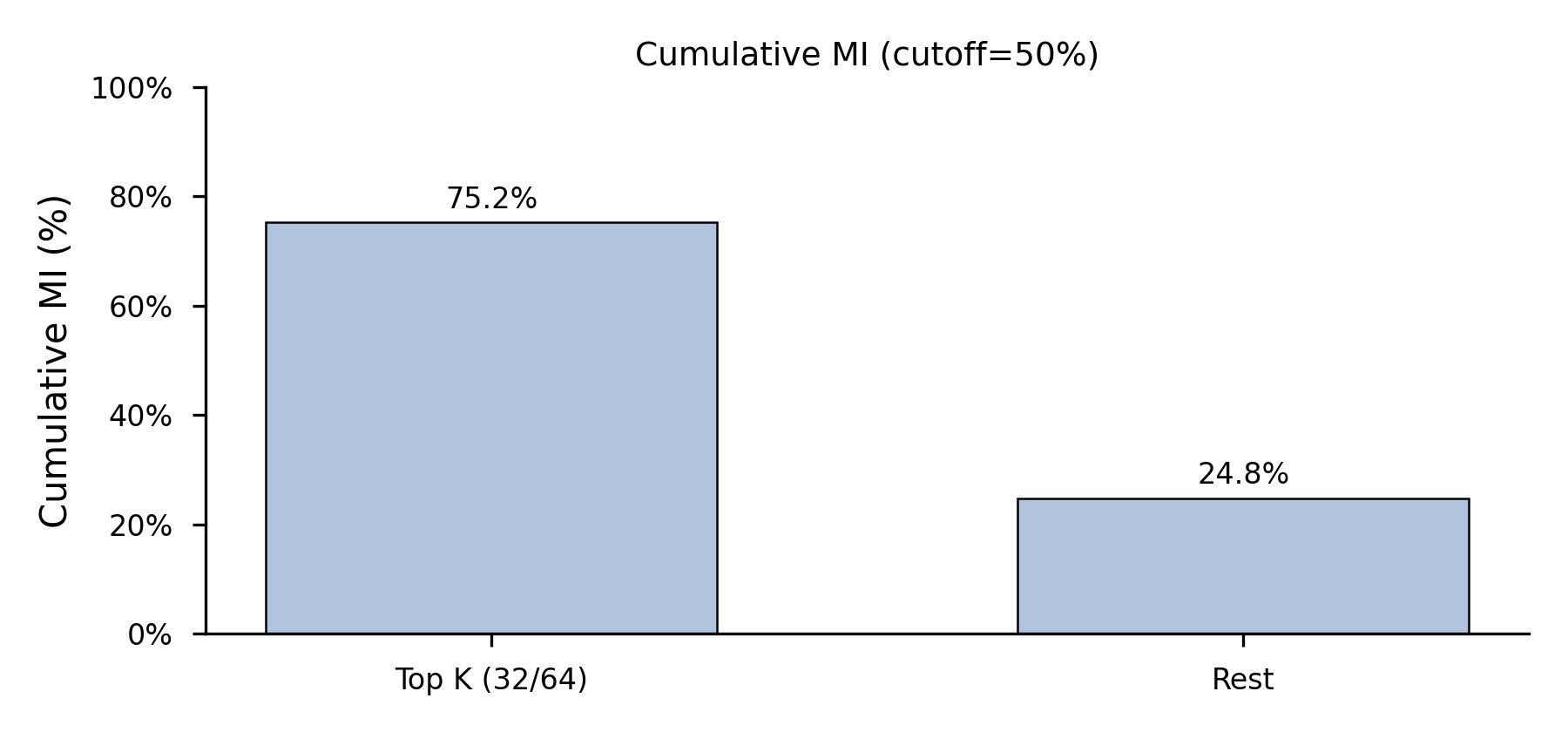
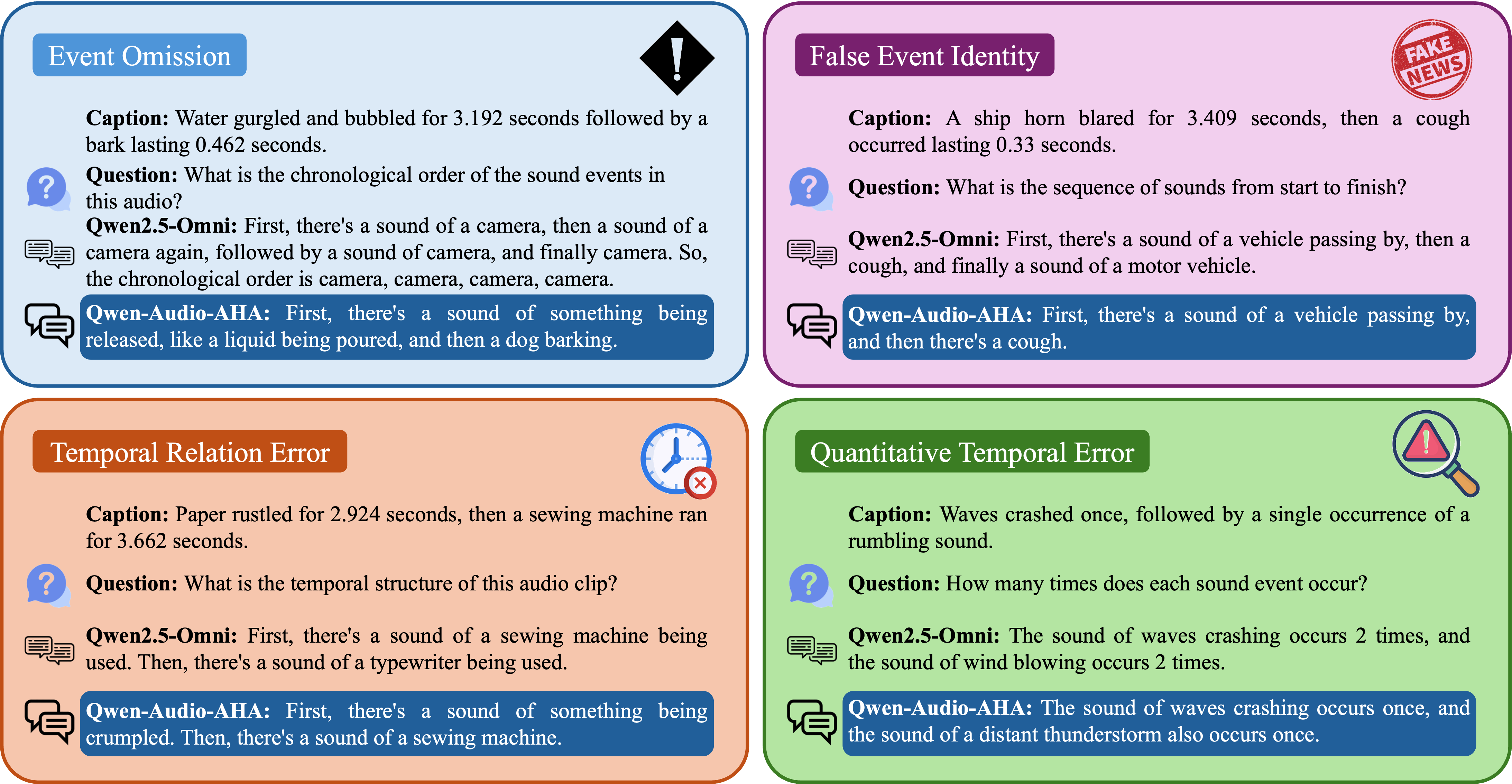
Although Large Audio-Language Models (LALMs) deliver state-of-the-art (SOTA) performance, they frequently suffer from hallucinations, e.g. generating text not grounded in the audio input. We analyze these grounding failures and identify a distinct taxonomy Event Omission, False Event Identity, Temporal Relation Error, and Quantitative Temporal Error. To address this, we introduce the AHA (Audio Hallucination Alignment) framework. By leveraging counterfactual hard negative mining, our pipeline constructs a high-quality preference dataset that forces models to distinguish strict acoustic evidence from linguistically plausible fabrications. Additionally, we establish AHA-Eval, a diagnostic benchmark designed to rigorously test these fine-grained temporal reasoning capabilities. We apply this data to align Qwen2.5-Omni. The resulting model, Qwen-Audio-AHA, achieves a 13.7% improvement on AHA-Eval. Crucially, this benefit generalizes beyond our diagnostic set. Our model shows substantial gains on public benchmarks, including 1.3% on MMAU-Test and 1.6% on MMAR, outperforming latest SOTA methods. The model and dataset are open-sourced at https //github.com/LLM-VLM-GSL/AHA.

paper research
DARC  Fine-Grained Rhythm Control for Drum Accompaniment Generation

DARC Fine-Grained Rhythm Control for Drum Accompaniment Generation

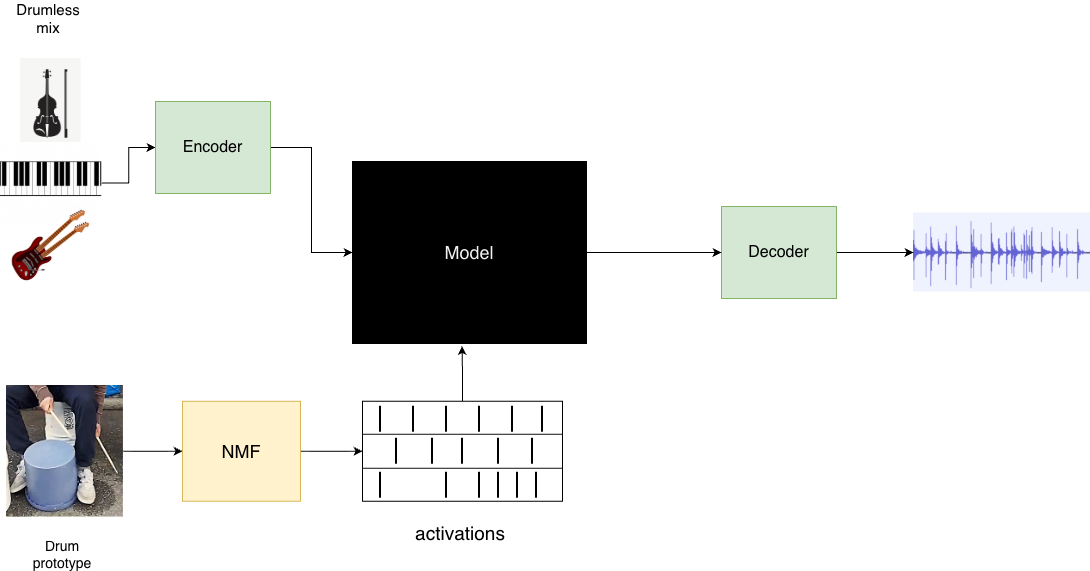
In music creation, rapid prototyping is essential for exploring and refining ideas, yet existing generative tools often fall short when users require both structural control and stylistic flexibility. Prior approaches in stem-to-stem generation can condition on other musical stems but offer limited control over rhythm, and timbre-transfer methods allow users to specify specific rhythms, but cannot condition on musical context. We introduce DARC, a generative drum accompaniment model that conditions both on musical context from other stems and explicit rhythm prompts such as beatboxing or tapping tracks. Using parameter-efficient fine-tuning, we augment STAGE, a state-of-the-art drum stem generator, with fine-grained rhythm control while maintaining musical context awareness.

paper research
Melodypreserve  Timbre Transfer with Latent Diffusion Guidance

Melodypreserve Timbre Transfer with Latent Diffusion Guidance

We study timbre transfer as an inference-time editing problem for music audio. Starting from a strong pre-trained latent diffusion model, we introduce a lightweight procedure that requires no additional training (i) a dimension-wise noise injection that targets latent channels most informative of instrument identity, and (ii) an early-step clamping mechanism that re-imposes the input s melodic and rhythmic structure during reverse diffusion. The method operates directly on audio latents and is compatible with text/audio conditioning (e.g., CLAP). We discuss design choices,analyze trade-offs between timbral change and structural preservation, and show that simple inference-time controls can meaningfully steer pre-trained models for style-transfer use cases.

paper research
MM-Sonate  Multimodal Controllable Audio-Video Generation with Zero-Shot Voice Cloning

MM-Sonate Multimodal Controllable Audio-Video Generation with Zero-Shot Voice Cloning

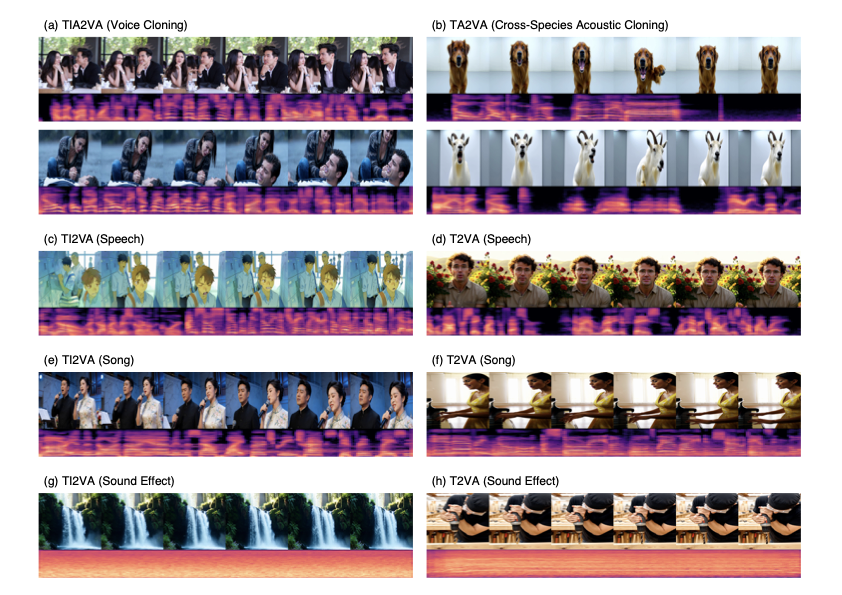
Joint audio-video generation aims to synthesize synchronized multisensory content, yet current unified models struggle with fine-grained acoustic control, particularly for identity-preserving speech. Existing approaches either suffer from temporal misalignment due to cascaded generation or lack the capability to perform zero-shot voice cloning within a joint synthesis framework. In this work, we present MM-Sonate, a multimodal flow-matching framework that unifies controllable audio-video joint generation with zero-shot voice cloning capabilities. Unlike prior works that rely on coarse semantic descriptions, MM-Sonate utilizes a unified instruction-phoneme input to enforce strict linguistic and temporal alignment. To enable zero-shot voice cloning, we introduce a timbre injection mechanism that effectively decouples speaker identity from linguistic content. Furthermore, addressing the limitations of standard classifier-free guidance in multimodal settings, we propose a noise-based negative conditioning strategy that utilizes natural noise priors to significantly enhance acoustic fidelity. Empirical evaluations demonstrate that MM-Sonate establishes new state-of-the-art performance in joint generation benchmarks, significantly outperforming baselines in lip synchronization and speech intelligibility, while achieving voice cloning fidelity comparable to specialized Text-to-Speech systems.

paper research
Mobile SER with DistilHuBERT  Efficient, Accurate, Cross-Corpus Validated

Mobile SER with DistilHuBERT Efficient, Accurate, Cross-Corpus Validated

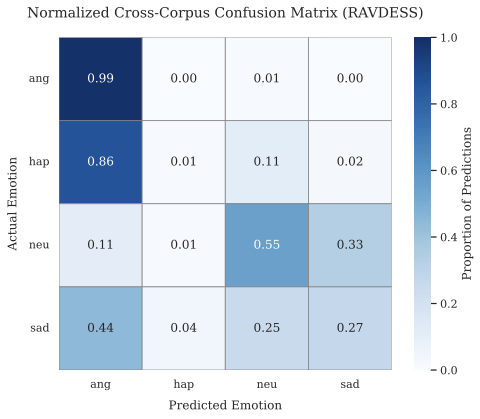
Speech Emotion Recognition (SER) has significant potential for mobile applications, yet deployment remains constrained by the computational demands of state-of-the-art transformer architectures. This paper presents a mobile-efficient SER system based on DistilHuBERT, a distilled and 8-bit quantized transformer that achieves approximately 92% parameter reduction compared to full-scale Wav2Vec 2.0 models while maintaining competitive accuracy. We conduct a rigorous 5-fold Leave-One-Session-Out (LOSO) cross-validation on the IEMOCAP dataset to ensure speaker independence, augmented with cross-corpus training on CREMA-D to enhance generalization. Cross-corpus training with CREMA-D yields a 1.2% improvement in Weighted Accuracy, a 1.4% gain in Macro F1-score, and a 32% reduction in cross-fold variance, with the Neutral class showing the most substantial benefit at 5.4% F1-score improvement. Our approach achieves an Unweighted Accuracy of 61.4% with a quantized model footprint of only 23 MB, representing approximately 91% of the Unweighted Accuracy of a full-scale baseline. Cross-corpus evaluation on RAVDESS reveals that the theatrical nature of acted emotions causes predictions to cluster by arousal level rather than by specific emotion categories - happiness predictions systematically bleed into anger predictions, and sadness predictions bleed into neutral predictions, due to acoustic saturation when actors prioritize clarity over subtlety. Despite this theatricality effect reducing overall RAVDESS accuracy to 46.64%, the model maintains robust arousal detection with 99% recall for anger, 55% recall for neutral, and 27% recall for sadness. These findings demonstrate a Pareto-optimal tradeoff between model size and accuracy, enabling practical affect recognition on resource-constrained mobile devices.

paper research
MOSS Unifies Speech  Transcribe, Diarize, Enhance

MOSS Unifies Speech Transcribe, Diarize, Enhance

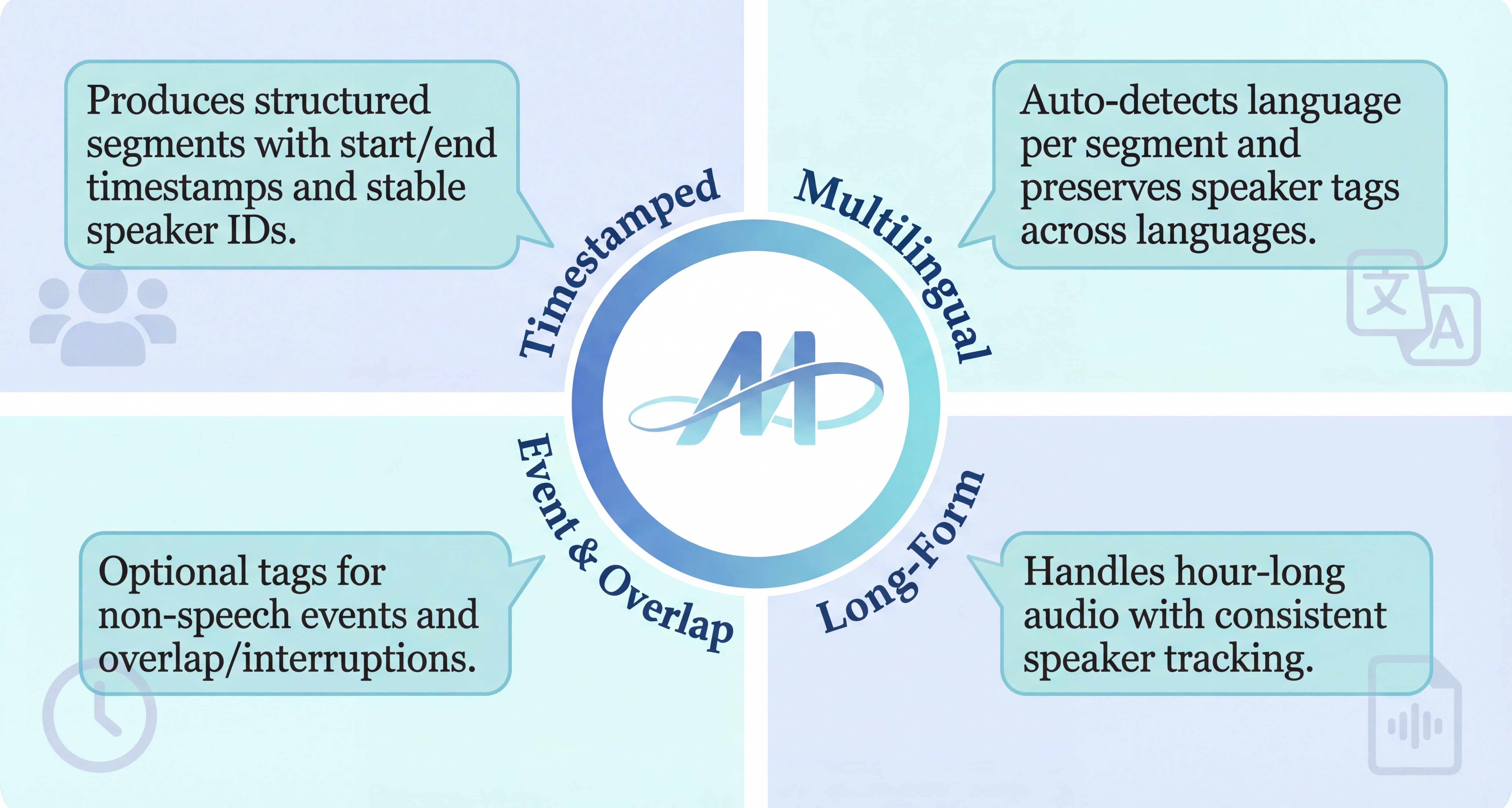
Speaker-Attributed, Time-Stamped Transcription (SATS) aims to transcribe what is said and to precisely determine the timing of each speaker, which is particularly valuable for meeting transcription. Existing SATS systems rarely adopt an end-to-end formulation and are further constrained by limited context windows, weak long-range speaker memory, and the inability to output timestamps. To address these limitations, we present MOSS Transcribe Diarize, a unified multimodal large language model that jointly performs Speaker-Attributed, Time-Stamped Transcription in an end-to-end paradigm. Trained on extensive real wild data and equipped with a 128k context window for up to 90-minute inputs, MOSS Transcribe Diarize scales well and generalizes robustly. Across comprehensive evaluations, it outperforms state-of-the-art commercial systems on multiple public and in-house benchmarks.

paper research
PhyAVBench  Testing T2AV Models  Physical Sound Accuracy

PhyAVBench Testing T2AV Models Physical Sound Accuracy

Text-to-audio-video (T2AV) generation underpins a wide range of applications demanding realistic audio-visual content, including virtual reality, world modeling, gaming, and filmmaking. However, existing T2AV models remain incapable of generating physically plausible sounds, primarily due to their limited understanding of physical principles. To situate current research progress, we present PhyAVBench, a challenging audio physics-sensitivity benchmark designed to systematically evaluate the audio physics grounding capabilities of existing T2AV models. PhyAVBench comprises 1,000 groups of paired text prompts with controlled physical variables that implicitly induce sound variations, enabling a fine-grained assessment of models sensitivity to changes in underlying acoustic conditions. We term this evaluation paradigm the Audio-Physics Sensitivity Test (APST). Unlike prior benchmarks that primarily focus on audio-video synchronization, PhyAVBench explicitly evaluates models understanding of the physical mechanisms underlying sound generation, covering 6 major audio physics dimensions, 4 daily scenarios (music, sound effects, speech, and their mix), and 50 fine-grained test points, ranging from fundamental aspects such as sound diffraction to more complex phenomena, e.g., Helmholtz resonance. Each test point consists of multiple groups of paired prompts, where each prompt is grounded by at least 20 newly recorded or collected real-world videos, thereby minimizing the risk of data leakage during model pre-training. Both prompts and videos are iteratively refined through rigorous human-involved error correction and quality control to ensure high quality. We argue that only models with a genuine grasp of audio-related physical principles can generate physically consistent audio-visual content. We hope PhyAVBench will stimulate future progress in this critical yet largely unexplored domain.

paper research
UltraEval-Audio  A Unified Framework for Comprehensive Evaluation of Audio Foundation Models

UltraEval-Audio A Unified Framework for Comprehensive Evaluation of Audio Foundation Models

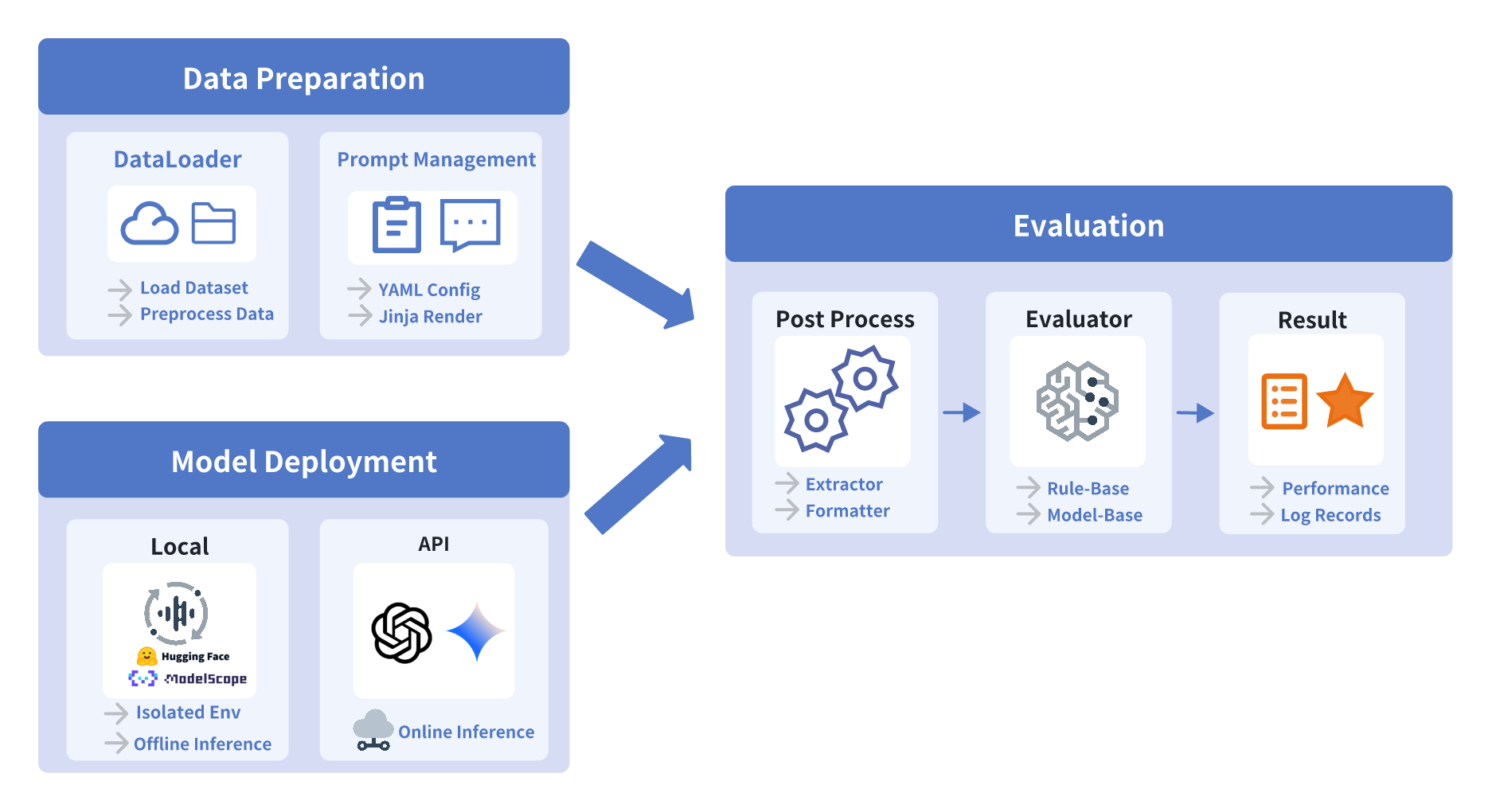
The development of audio foundation models has accelerated rapidly since the emergence of GPT-4o. However, the lack of comprehensive evaluation has become a critical bottleneck for further progress in the field, particularly in audio generation. Current audio evaluation faces three major challenges (1) audio evaluation lacks a unified framework, with datasets and code scattered across various sources, hindering fair and efficient cross-model comparison;(2) audio codecs, as a key component of audio foundation models, lack a widely accepted and holistic evaluation methodology; (3) existing speech benchmarks are heavily reliant on English, making it challenging to objectively assess models performance on Chinese. To address the first issue, we introduce UltraEval-Audio, a unified evaluation framework for audio foundation models, specifically designed for both audio understanding and generation tasks. UltraEval-Audio features a modular architecture, supporting 10 languages and 14 core task categories, while seamlessly integrating 24 mainstream models and 36 authoritative benchmarks. To enhance research efficiency, the framework provides a one-command evaluation feature, accompanied by real-time public leaderboards. For the second challenge, UltraEval-Audio adopts a novel comprehensive evaluation scheme for audio codecs, evaluating performance across three key dimensions semantic accuracy, timbre fidelity, and acoustic quality. To address the third issue, we propose two new Chinese benchmarks, SpeechCMMLU and SpeechHSK, designed to assess Chinese knowledge proficiency and language fluency. We wish that UltraEval-Audio will provide both academia and industry with a transparent, efficient, and fair platform for comparison of audio models. Our code, benchmarks, and leaderboards are available at https //github.com/OpenBMB/UltraEval-Audio.

paper research
Universal Encoder Attack on Audio-Language Models

Universal Encoder Attack on Audio-Language Models

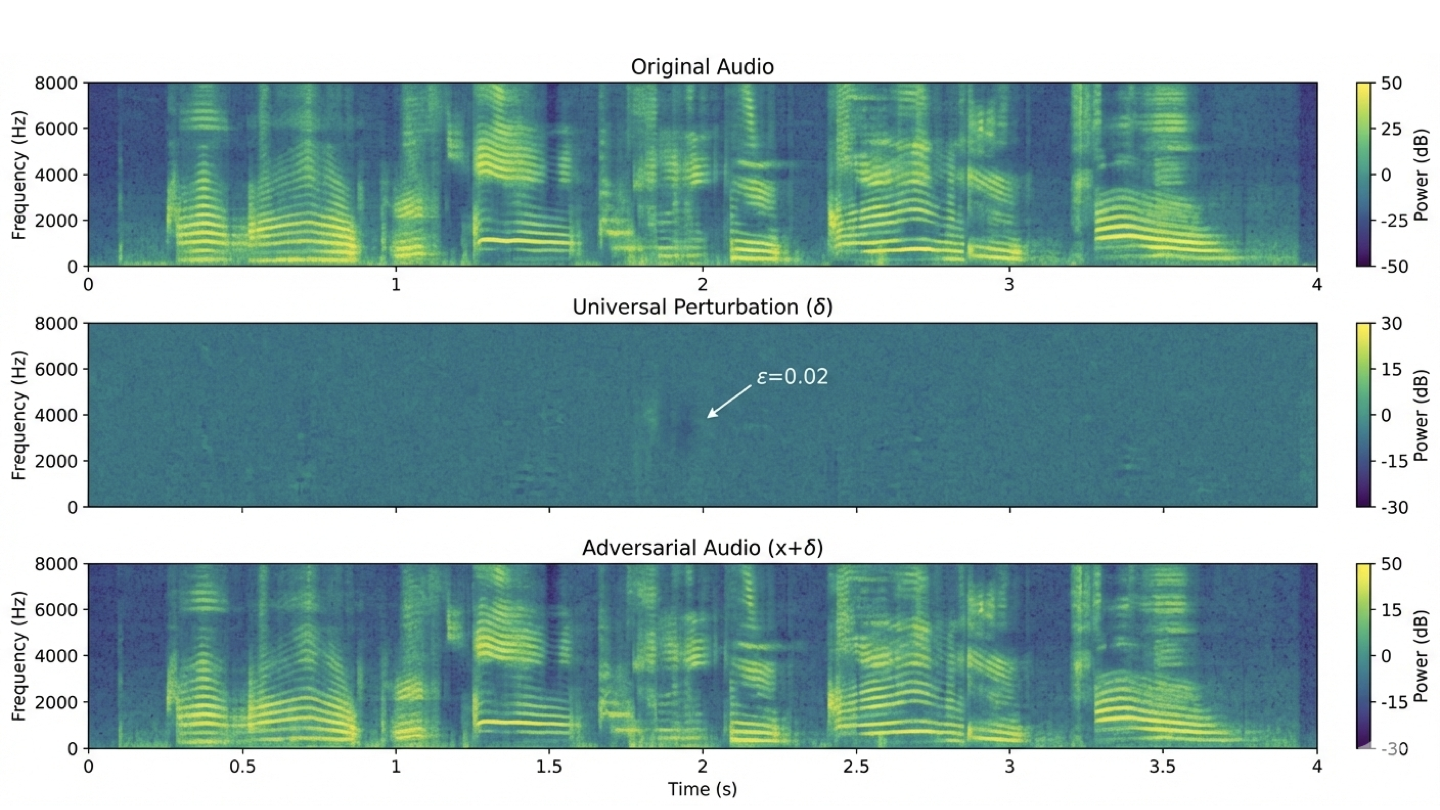
Audio-language models combine audio encoders with large language models to enable multimodal reasoning, but they also introduce new security vulnerabilities. We propose a universal targeted latent space attack, an encoder-level adversarial attack that manipulates audio latent representations to induce attacker-specified outputs in downstream language generation. Unlike prior waveform-level or input-specific attacks, our approach learns a universal perturbation that generalizes across inputs and speakers and does not require access to the language model. Experiments on Qwen2-Audio-7B-Instruct demonstrate consistently high attack success rates with minimal perceptual distortion, revealing a critical and previously underexplored attack surface at the encoder level of multimodal systems.

paper research

< Category Statistics (Total: 566) >

Quantum Physics
5

Start searching

Enter keywords to search articles

↑↓
ESC
⌘K Shortcut