Computer Science / Networking and Internet Architecture

All posts under category "Computer Science / Networking and Internet Architecture"

6 posts total
Sorted by date
A Study of Network Congestion in Two Supercomputing High-Speed Interconnects

A Study of Network Congestion in Two Supercomputing High-Speed Interconnects

Network congestion in high-speed interconnects is a major source of application run time performance variation. Recent years have witnessed a surge of interest from both academia and industry in the development of novel approaches for congestion control at the network level and in application placement, mapping, and scheduling at the system-level. However, these studies are based on proxy applications and benchmarks that are not representative of field-congestion characteristics of high-speed interconnects. To address this gap, we present (a) an end-to-end framework for monitoring and analysis to support long-term field-congestion characterization studies, and (b) an empirical study of network congestion in petascale systems across two different interconnect technologies (i) Cray Gemini, which uses a 3-D torus topology, and (ii) Cray Aries, which uses the DragonFly topology.
paper research
No Delay  Latency-Driven and Application Performance-Aware Cluster Scheduling

No Delay Latency-Driven and Application Performance-Aware Cluster Scheduling

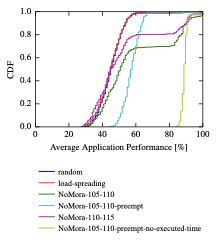
Given the network latency variability observed in data centers, applications performance is also determined by their placement within the data centre. We present NoMora, a cluster scheduling architecture whose core is represented by a latency-driven, application performance-aware, cluster scheduling policy. The policy places the tasks of an application taking into account the expected performance based on the measured network latency between pairs of hosts in the data center. Furthermore, if a tenant s application experiences increased network latency, and thus lower application performance, their application may be migrated to a better placement. Preliminary results show that our policy improves the overall average application performance by up to 13.4% and by up to 42% if preemption is enabled, and improves the task placement latency by a factor of 1.79x and the median algorithm runtime by 1.16x compared to a random policy on the Google cluster workload. This demonstrates that application performance can be improved by exploiting the relationship between network latency and application performance, and the current network conditions in a data center, while preserving the demands of low-latency cluster scheduling.

paper research
Let s Share  A Game-Theoretic Approach to Resource Allocation in Mobile Edge Clouds

Let s Share A Game-Theoretic Approach to Resource Allocation in Mobile Edge Clouds

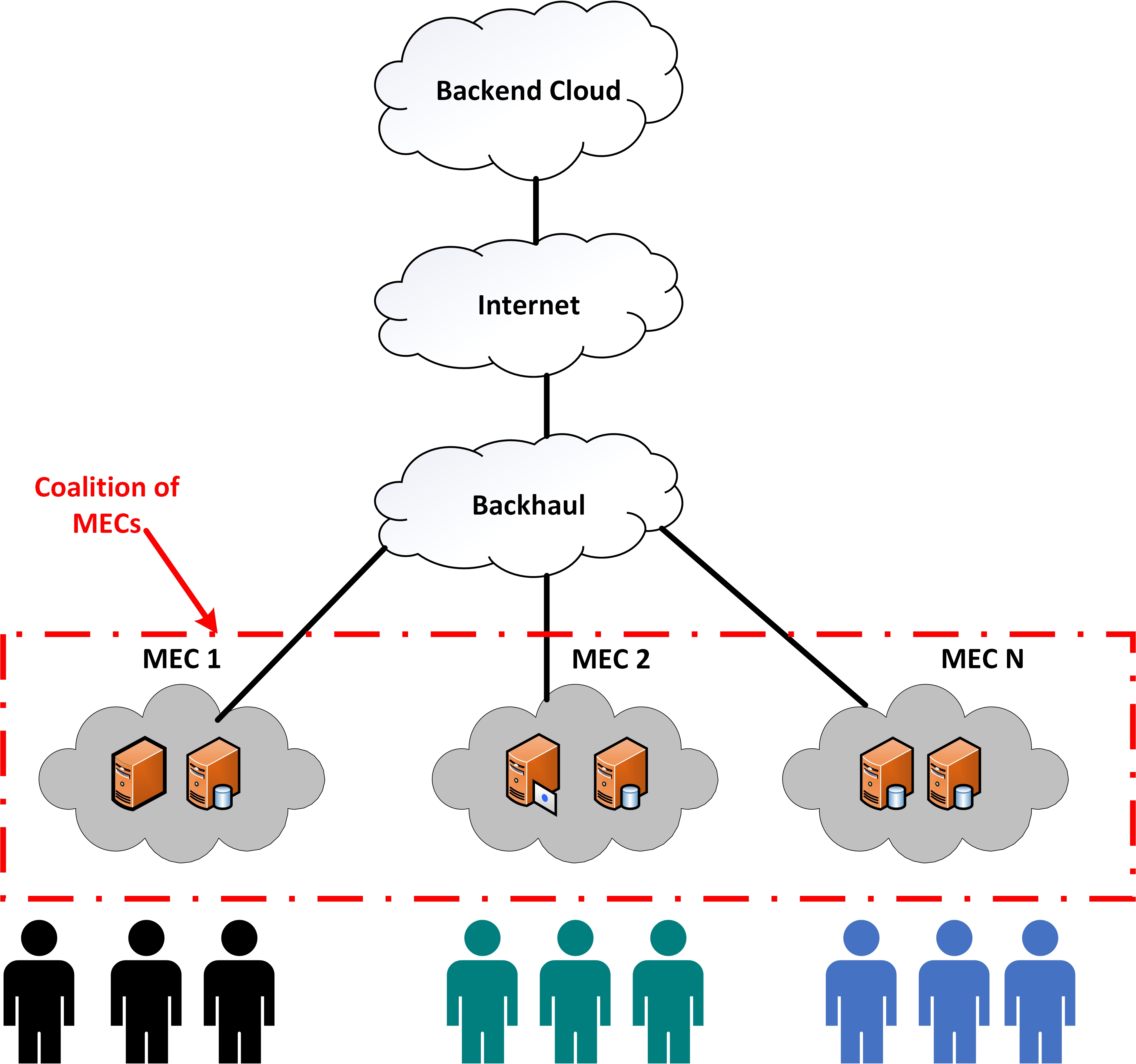
Mobile edge computing seeks to provide resources to different delay-sensitive applications. This is a challenging problem as an edge cloud-service provider may not have sufficient resources to satisfy all resource requests. Furthermore, allocating available resources optimally to different applications is also challenging. Resource sharing among different edge cloud-service providers can address the aforementioned limitation as certain service providers may have resources available that can be ``rented by other service providers. However, edge cloud service providers can have different objectives or emph{utilities}. Therefore, there is a need for an efficient and effective mechanism to share resources among service providers, while considering the different objectives of various providers. We model resource sharing as a multi-objective optimization problem and present a solution framework based on emph{Cooperative Game Theory} (CGT). We consider the strategy where each service provider allocates resources to its native applications first and shares the remaining resources with applications from other service providers. We prove that for a monotonic, non-decreasing utility function, the game is canonical and convex. Hence, the emph{core} is not empty and the grand coalition is stable. We propose two algorithms emph{Game-theoretic Pareto optimal allocation} (GPOA) and emph{Polyandrous-Polygamous Matching based Pareto Optimal Allocation} (PPMPOA) that provide allocations from the core. Hence the obtained allocations are emph{Pareto} optimal and the grand coalition of all the service providers is stable. Experimental results confirm that our proposed resource sharing framework improves utilities of edge cloud-service providers and application request satisfaction.

paper research
Chat-Driven Optimal Management for Virtual Network Services

Chat-Driven Optimal Management for Virtual Network Services

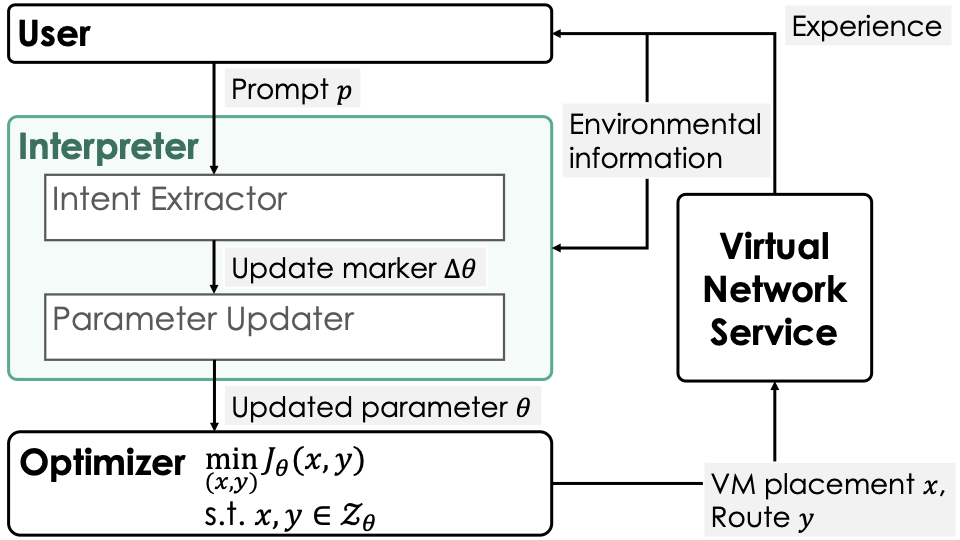
This paper proposes a chat-driven network management framework that integrates natural language processing (NLP) with optimization-based virtual network allocation, enabling intuitive and reliable reconfiguration of virtual network services. Conventional intent-based networking (IBN) methods depend on statistical language models to interpret user intent but cannot guarantee the feasibility of generated configurations. To overcome this, we develop a two-stage framework consisting of an Interpreter, which extracts intent from natural language prompts using NLP, and an Optimizer, which computes feasible virtual machine (VM) placement and routing via an integer linear programming. In particular, the Interpreter translates user chats into update directions, i.e., whether to increase, decrease, or maintain parameters such as CPU demand and latency bounds, thereby enabling iterative refinement of the network configuration. In this paper, two intent extractors, which are a Sentence-BERT model with support vector machine (SVM) classifiers and a large language model (LLM), are introduced. Experiments in single-user and multi-user settings show that the framework dynamically updates VM placement and routing while preserving feasibility. The LLM-based extractor achieves higher accuracy with fewer labeled samples, whereas the Sentence-BERT with SVM classifiers provides significantly lower latency suitable for real-time operation. These results underscore the effectiveness of combining NLP-driven intent extraction with optimization-based allocation for safe, interpretable, and user-friendly virtual network management.

paper research
MAESTRO  Multi-Agent Evaluation Suite for Testing, Reliability, and Observability

MAESTRO Multi-Agent Evaluation Suite for Testing, Reliability, and Observability

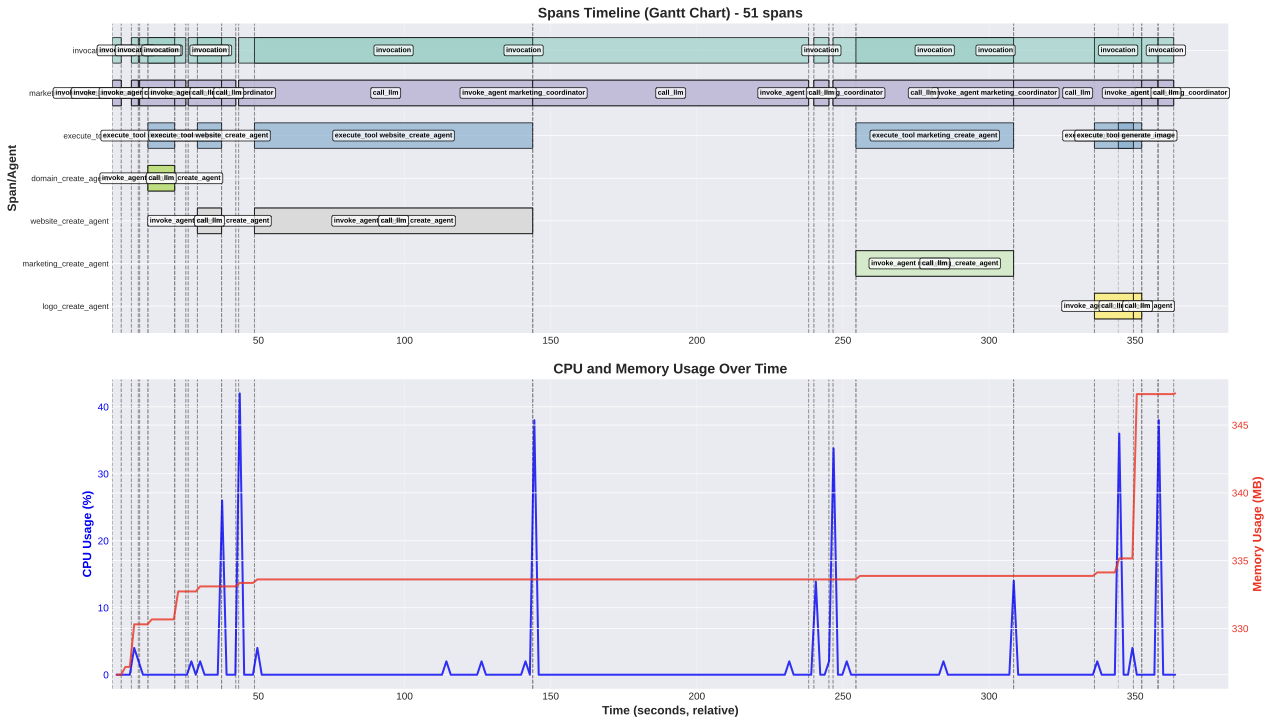
We present MAESTRO, an evaluation suite for the testing, reliability, and observability of LLM-based MAS. MAESTRO standardizes MAS configuration and execution through a unified interface, supports integrating both native and third-party MAS via a repository of examples and lightweight adapters, and exports framework-agnostic execution traces together with system-level signals (e.g., latency, cost, and failures). We instantiate MAESTRO with 12 representative MAS spanning popular agentic frameworks and interaction patterns, and conduct controlled experiments across repeated runs, backend models, and tool configurations. Our case studies show that MAS executions can be structurally stable yet temporally variable, leading to substantial run-to-run variance in performance and reliability. We further find that MAS architecture is the dominant driver of resource profiles, reproducibility, and cost-latency-accuracy trade-off, often outweighing changes in backend models or tool settings. Overall, MAESTRO enables systematic evaluation and provides empirical guidance for designing and optimizing agentic systems.

paper research
Privacy-Preserving Semantic Communications via Multi-Task Learning and Adversarial Perturbations

Privacy-Preserving Semantic Communications via Multi-Task Learning and Adversarial Perturbations

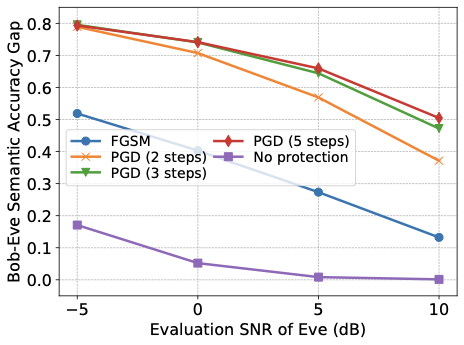
Semantic communications conveys task-relevant meaning rather than focusing solely on message reconstruction, improving bandwidth efficiency and robustness for next-generation wireless systems. However, learned semantic representations can still leak sensitive information to unintended receivers (eavesdroppers). This paper presents a deep learning-based semantic communication framework that jointly supports multiple receiver tasks while explicitly limiting semantic leakage to an eavesdropper. The legitimate link employs a learned encoder at the transmitter, while the receiver trains decoders for semantic inference and data reconstruction. The security problem is formulated via an iterative min-max optimization in which an eavesdropper is trained to improve its semantic inference, while the legitimate transmitter-receiver pair is trained to preserve task performance while reducing the eavesdropper s success. We also introduce an auxiliary layer that superimposes a cooperative, adversarially crafted perturbation on the transmitted waveform to degrade semantic leakage to an eavesdropper. Performance is evaluated over Rayleigh fading channels with additive white Gaussian noise using MNIST and CIFAR-10 datasets. Semantic accuracy and reconstruction quality improve with increasing latent dimension, while the min-max mechanism reduces the eavesdropper s inference performance significantly without degrading the legitimate receiver. The perturbation layer is successful in reducing semantic leakage even when the legitimate link is trained only for its own task. This comprehensive framework motivates semantic communication designs with tunable, end-to-end privacy against adaptive adversaries in realistic wireless settings.

paper research

< Category Statistics (Total: 566) >

Quantum Physics
5

Start searching

Enter keywords to search articles

↑↓
ESC
⌘K Shortcut