Computer Science / Machine Learning

All posts under category "Computer Science / Machine Learning"

116 posts total
Sorted by date
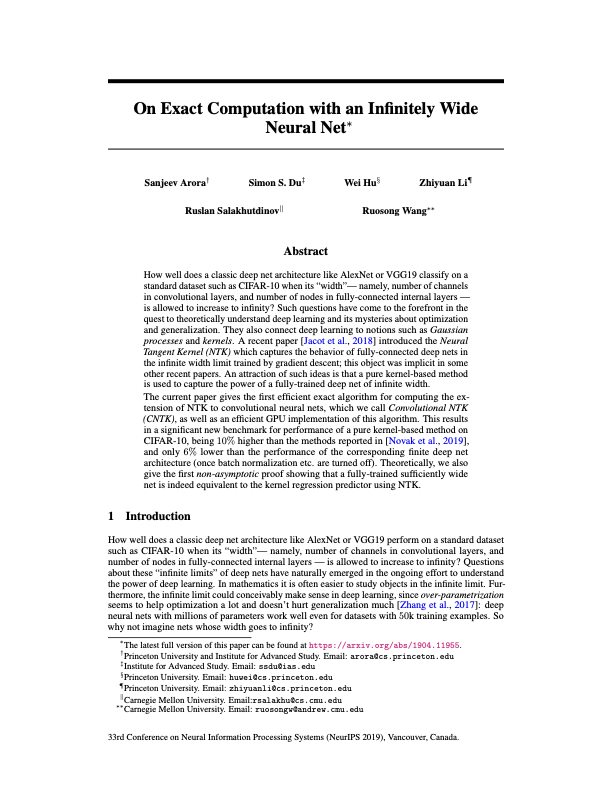
Exact Computation with Infinitely Wide Neural Networks

Exact Computation with Infinitely Wide Neural Networks

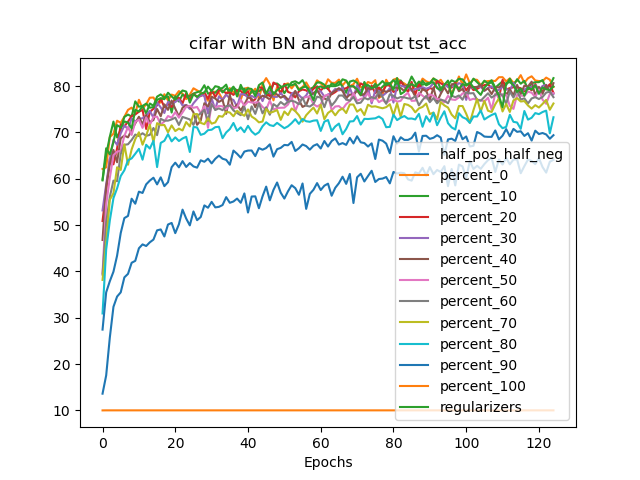
How well does a classic deep net architecture like AlexNet or VGG19 classify on a standard dataset such as CIFAR-10 when its width --- namely, number of channels in convolutional layers, and number of nodes in fully-connected internal layers --- is allowed to increase to infinity? Such questions have come to the forefront in the quest to theoretically understand deep learning and its mysteries about optimization and generalization. They also connect deep learning to notions such as Gaussian processes and kernels. A recent paper [Jacot et al., 2018] introduced the Neural Tangent Kernel (NTK) which captures the behavior of fully-connected deep nets in the infinite width limit trained by gradient descent; this object was implicit in some other recent papers. An attraction of such ideas is that a pure kernel-based method is used to capture the power of a fully-trained deep net of infinite width. The current paper gives the first efficient exact algorithm for computing the extension of NTK to convolutional neural nets, which we call Convolutional NTK (CNTK), as well as an efficient GPU implementation of this algorithm. This results in a significant new benchmark for the performance of a pure kernel-based method on CIFAR-10, being $10 %$ higher than the methods reported in [Novak et al., 2019], and only $6 %$ lower than the performance of the corresponding finite deep net architecture (once batch normalization, etc. are turned off). Theoretically, we also give the first non-asymptotic proof showing that a fully-trained sufficiently wide net is indeed equivalent to the kernel regression predictor using NTK.

paper research
From Interpretability to Inference  An Estimation Framework for Universal Approximators

From Interpretability to Inference An Estimation Framework for Universal Approximators

We present a novel framework for estimation and inference with the broad class of universal approximators. Estimation is based on the decomposition of model predictions into Shapley values. Inference relies on analyzing the bias and variance properties of individual Shapley components. We show that Shapley value estimation is asymptotically unbiased, and we introduce Shapley regressions as a tool to uncover the true data generating process from noisy data alone. The well-known case of the linear regression is the special case in our framework if the model is linear in parameters. We present theoretical, numerical, and empirical results for the estimation of heterogeneous treatment effects as our guiding example.

paper research
Approximate Query Processing Using Deep Generative Models

Approximate Query Processing Using Deep Generative Models

Data is generated at an unprecedented rate surpassing our ability to analyze them. The database community has pioneered many novel techniques for Approximate Query Processing (AQP) that could give approximate results in a fraction of time needed for computing exact results. In this work, we explore the usage of deep learning (DL) for answering aggregate queries specifically for interactive applications such as data exploration and visualization. We use deep generative models, an unsupervised learning based approach, to learn the data distribution faithfully such that aggregate queries could be answered approximately by generating samples from the learned model. The model is often compact - few hundred KBs - so that arbitrary AQP queries could be answered on the client side without contacting the database server. Our other contributions include identifying model bias and minimizing it through a rejection sampling based approach and an algorithm to build model ensembles for AQP for improved accuracy. Our extensive experiments show that our proposed approach can provide answers with high accuracy and low latency.

paper research
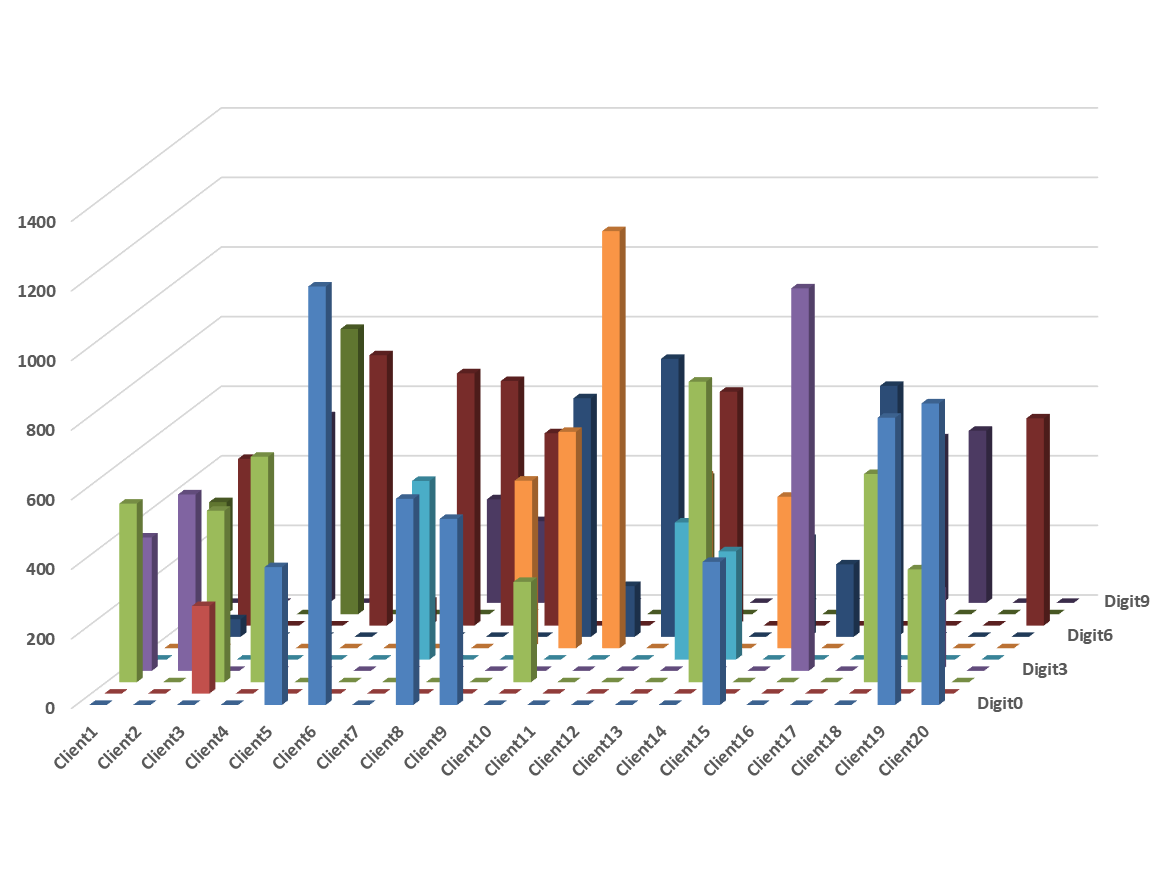
Communication-Efficient Federated Deep Learning with Asynchronous Model Updates and Temporally Weighted Aggregation

Communication-Efficient Federated Deep Learning with Asynchronous Model Updates and Temporally Weighted Aggregation

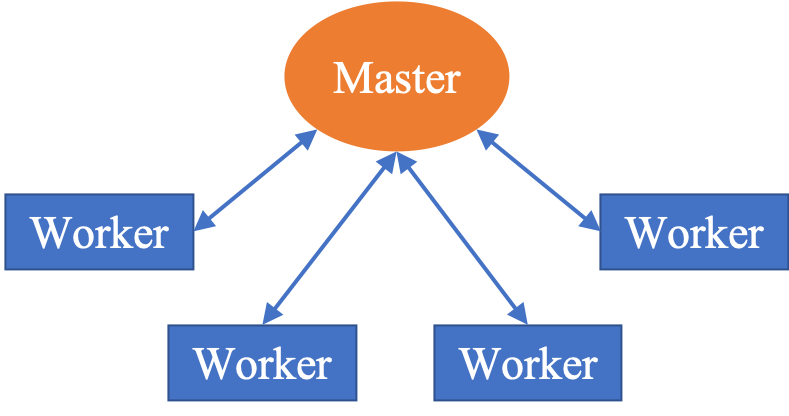
Federated learning obtains a central model on the server by aggregating models trained locally on clients. As a result, federated learning does not require clients to upload their data to the server, thereby preserving the data privacy of the clients. One challenge in federated learning is to reduce the client-server communication since the end devices typically have very limited communication bandwidth. This paper presents an enhanced federated learning technique by proposing a synchronous learning strategy on the clients and a temporally weighted aggregation of the local models on the server. In the asynchronous learning strategy, different layers of the deep neural networks are categorized into shallow and deeps layers and the parameters of the deep layers are updated less frequently than those of the shallow layers. Furthermore, a temporally weighted aggregation strategy is introduced on the server to make use of the previously trained local models, thereby enhancing the accuracy and convergence of the central model. The proposed algorithm is empirically on two datasets with different deep neural networks. Our results demonstrate that the proposed asynchronous federated deep learning outperforms the baseline algorithm both in terms of communication cost and model accuracy.

paper research
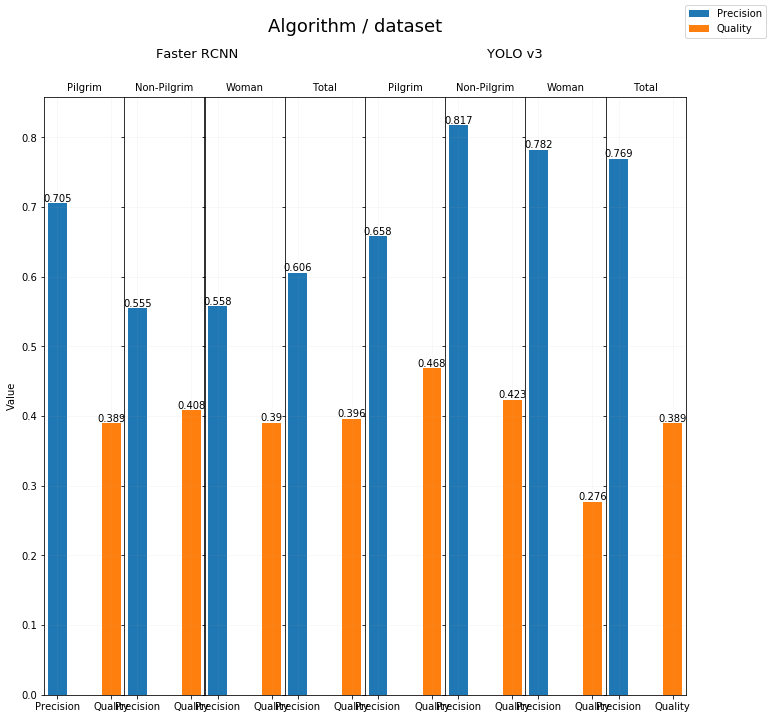
AI-Based Detection of Pilgrims Using Convolutional Neural Networks

AI-Based Detection of Pilgrims Using Convolutional Neural Networks

Pilgrimage represents the most important Islamic religious gathering in the world where millions of pilgrims visit the holy places of Makkah and Madinah to perform their rituals. The safety and security of pilgrims is the highest priority for the authorities. In Makkah, 5000 cameras are spread around the holy for monitoring pilgrims, but it is almost impossible to track all events by humans considering the huge number of images collected every second. To address this issue, we propose to use artificial intelligence technique based on deep learning and convolution neural networks to detect and identify Pilgrims and their features. For this purpose, we built a comprehensive dataset for the detection of pilgrims and their genders. Then, we develop two convolutional neural networks based on YOLOv3 and Faster-RCNN for the detection of Pilgrims. Experiments results show that Faster RCNN with Inception v2 feature extractor provides the best mean average precision over all classes of 51%.

paper research
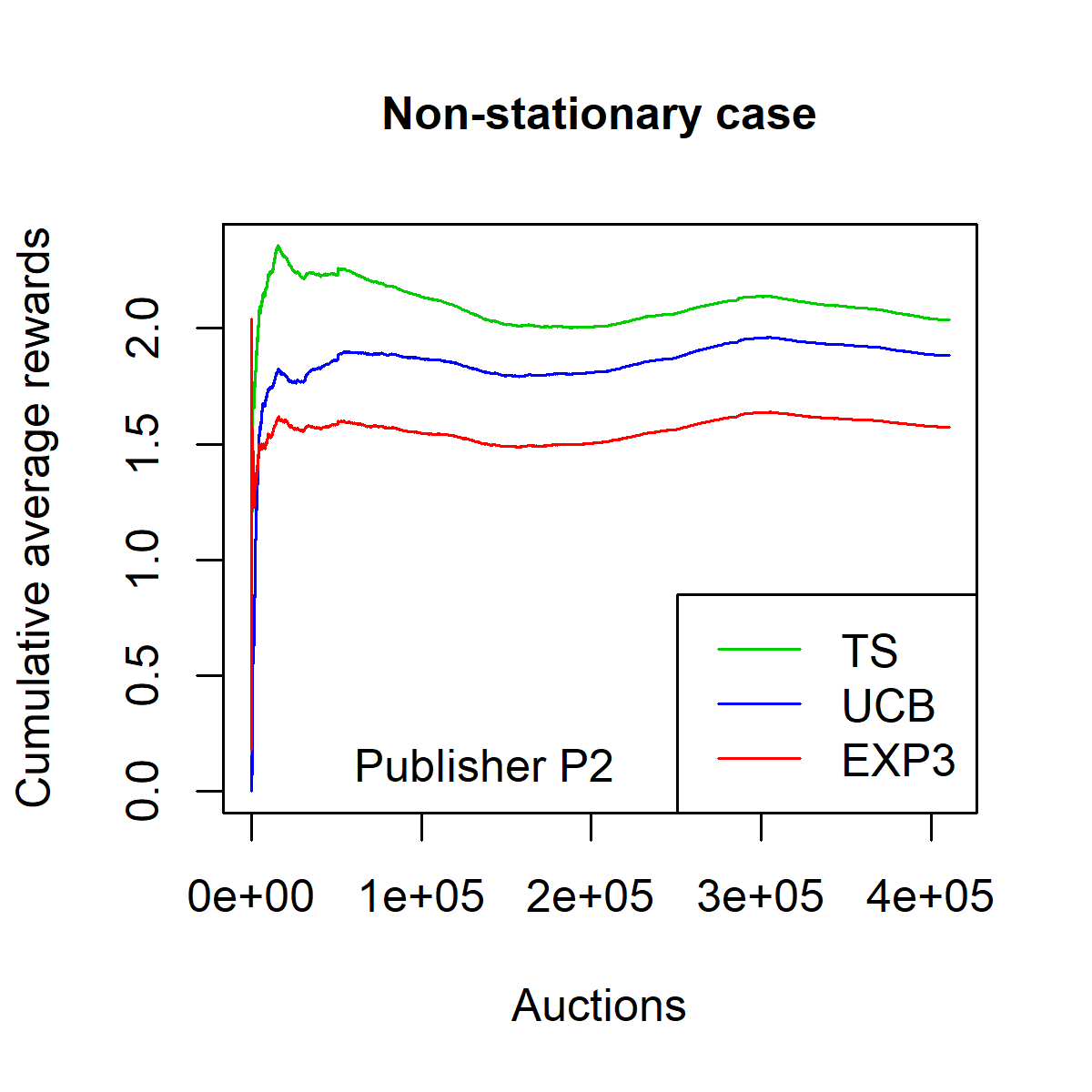
Optimizing a Supply-Side Platforms Header Bidding Strategy with Thompson Sampling

Optimizing a Supply-Side Platforms Header Bidding Strategy with Thompson Sampling

Over the last decade, digital media (web or app publishers) generalized the use of real time ad auctions to sell their ad spaces. Multiple auction platforms, also called Supply-Side Platforms (SSP), were created. Because of this multiplicity, publishers started to create competition between SSPs. In this setting, there are two successive auctions a second price auction in each SSP and a secondary, first price auction, called header bidding auction, between SSPs.In this paper, we consider an SSP competing with other SSPs for ad spaces. The SSP acts as an intermediary between an advertiser wanting to buy ad spaces and a web publisher wanting to sell its ad spaces, and needs to define a bidding strategy to be able to deliver to the advertisers as many ads as possible while spending as little as possible. The revenue optimization of this SSP can be written as a contextual bandit problem, where the context consists of the information available about the ad opportunity, such as properties of the internet user or of the ad placement.Using classical multi-armed bandit strategies (such as the original versions of UCB and EXP3) is inefficient in this setting and yields a low convergence speed, as the arms are very correlated. In this paper we design and experiment a version of the Thompson Sampling algorithm that easily takes this correlation into account. We combine this bayesian algorithm with a particle filter, which permits to handle non-stationarity by sequentially estimating the distribution of the highest bid to beat in order to win an auction. We apply this methodology on two real auction datasets, and show that it significantly outperforms more classical approaches.The strategy defined in this paper is being developed to be deployed on thousands of publishers worldwide.

paper research
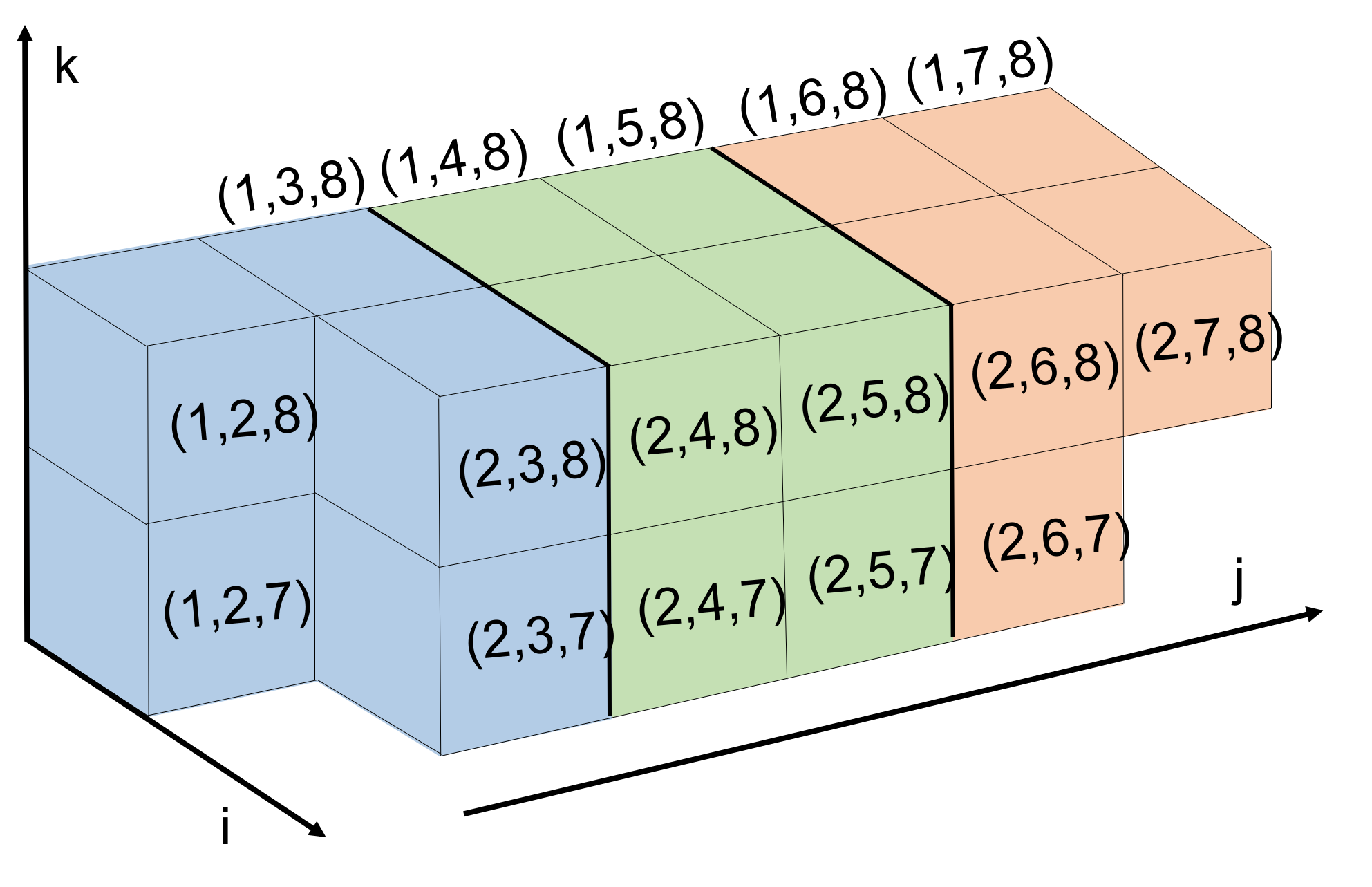
A Parallel Projection Technique for Optimization Under Metric Constraints

A Parallel Projection Technique for Optimization Under Metric Constraints

Many clustering applications in machine learning and data mining rely on solving metric-constrained optimization problems. These problems are characterized by $O(n^3)$ constraints that enforce triangle inequalities on distance variables associated with $n$ objects in a large dataset. Despite its usefulness, metric-constrained optimization is challenging in practice due to the cubic number of constraints and the high-memory requirements of standard optimization software. Recent work has shown that iterative projection methods are able to solve metric-constrained optimization problems on a much larger scale than was previously possible, thanks to their comparatively low memory requirement. However, the major limitation of projection methods is their slow convergence rate. In this paper we present a parallel projection method for metric-constrained optimization which allows us to speed up the convergence rate in practice. The key to our approach is a new parallel execution schedule that allows us to perform projections at multiple metric constraints simultaneously without any conflicts or locking of variables. We illustrate the effectiveness of this execution schedule by implementing and testing a parallel projection method for solving the metric-constrained linear programming relaxation of correlation clustering. We show numerous experimental results on problems involving up to 2.9 trillion constraints.

paper research
Large-Scale Traffic Signal Control with a New Multi-Agent Reinforcement Learning Approach

Large-Scale Traffic Signal Control with a New Multi-Agent Reinforcement Learning Approach

Finding the optimal signal timing strategy is a difficult task for the problem of large-scale traffic signal control (TSC). Multi-Agent Reinforcement Learning (MARL) is a promising method to solve this problem. However, there is still room for improvement in extending to large-scale problems and modeling the behaviors of other agents for each individual agent. In this paper, a new MARL, called Cooperative double Q-learning (Co-DQL), is proposed, which has several prominent features. It uses a highly scalable independent double Q-learning method based on double estimators and the UCB policy, which can eliminate the over-estimation problem existing in traditional independent Q-learning while ensuring exploration. It uses mean field approximation to model the interaction among agents, thereby making agents learn a better cooperative strategy. In order to improve the stability and robustness of the learning process, we introduce a new reward allocation mechanism and a local state sharing method. In addition, we analyze the convergence properties of the proposed algorithm. Co-DQL is applied on TSC and tested on a multi-traffic signal simulator. According to the results obtained on several traffic scenarios, Co- DQL outperforms several state-of-the-art decentralized MARL algorithms. It can effectively shorten the average waiting time of the vehicles in the whole road system.

paper research
No Image

Distributed Deep Convolutional Neural Networks for the Internet-of-Things

Severe constraints on memory and computation characterizing the Internet-of-Things (IoT) units may prevent the execution of Deep Learning (DL)-based solutions, which typically demand large memory and high processing load. In order to support a real-time execution of the considered DL model at the IoT unit level, DL solutions must be designed having in mind constraints on memory and processing capability exposed by the chosen IoT technology. In this paper, we introduce a design methodology aiming at allocating the execution of Convolutional Neural Networks (CNNs) on a distributed IoT application. Such a methodology is formalized as an optimization problem where the latency between the data-gathering phase and the subsequent decision-making one is minimized, within the given constraints on memory and processing load at the units level. The methodology supports multiple sources of data as well as multiple CNNs in execution on the same IoT system allowing the design of CNN-based applications demanding autonomy, low decision-latency, and high Quality-of-Service.

paper research
A Novel Approach to Distributed Hypothesis Testing and Non-Bayesian Learning  Enhancing Learning Speed and Byzantine Resilience

A Novel Approach to Distributed Hypothesis Testing and Non-Bayesian Learning Enhancing Learning Speed and Byzantine Resilience

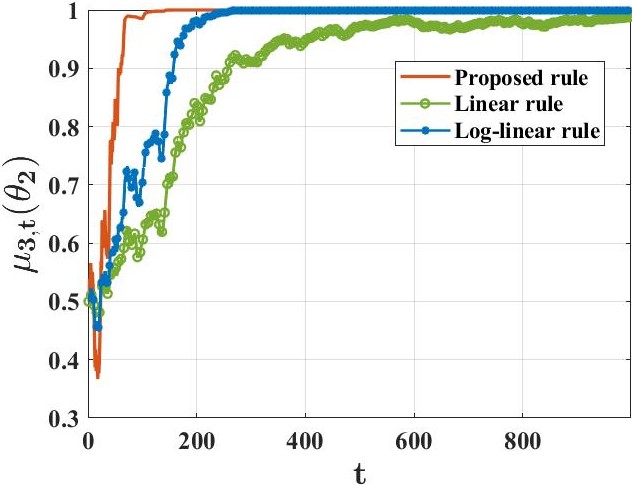
We study a setting where a group of agents, each receiving partially informative private signals, seek to collaboratively learn the true underlying state of the world (from a finite set of hypotheses) that generates their joint observation profiles. To solve this problem, we propose a distributed learning rule that differs fundamentally from existing approaches, in that it does not employ any form of belief-averaging . Instead, agents update their beliefs based on a min-rule. Under standard assumptions on the observation model and the network structure, we establish that each agent learns the truth asymptotically almost surely. As our main contribution, we prove that with probability 1, each false hypothesis is ruled out by every agent exponentially fast at a network-independent rate that is strictly larger than existing rates. We then develop a computationally-efficient variant of our learning rule that is provably resilient to agents who do not behave as expected (as represented by a Byzantine adversary model) and deliberately try to spread misinformation.

paper research
Multi-Task Regression-Based Learning for Autonomous Drone Flight Control in Unstructured Outdoor Environments

Multi-Task Regression-Based Learning for Autonomous Drone Flight Control in Unstructured Outdoor Environments

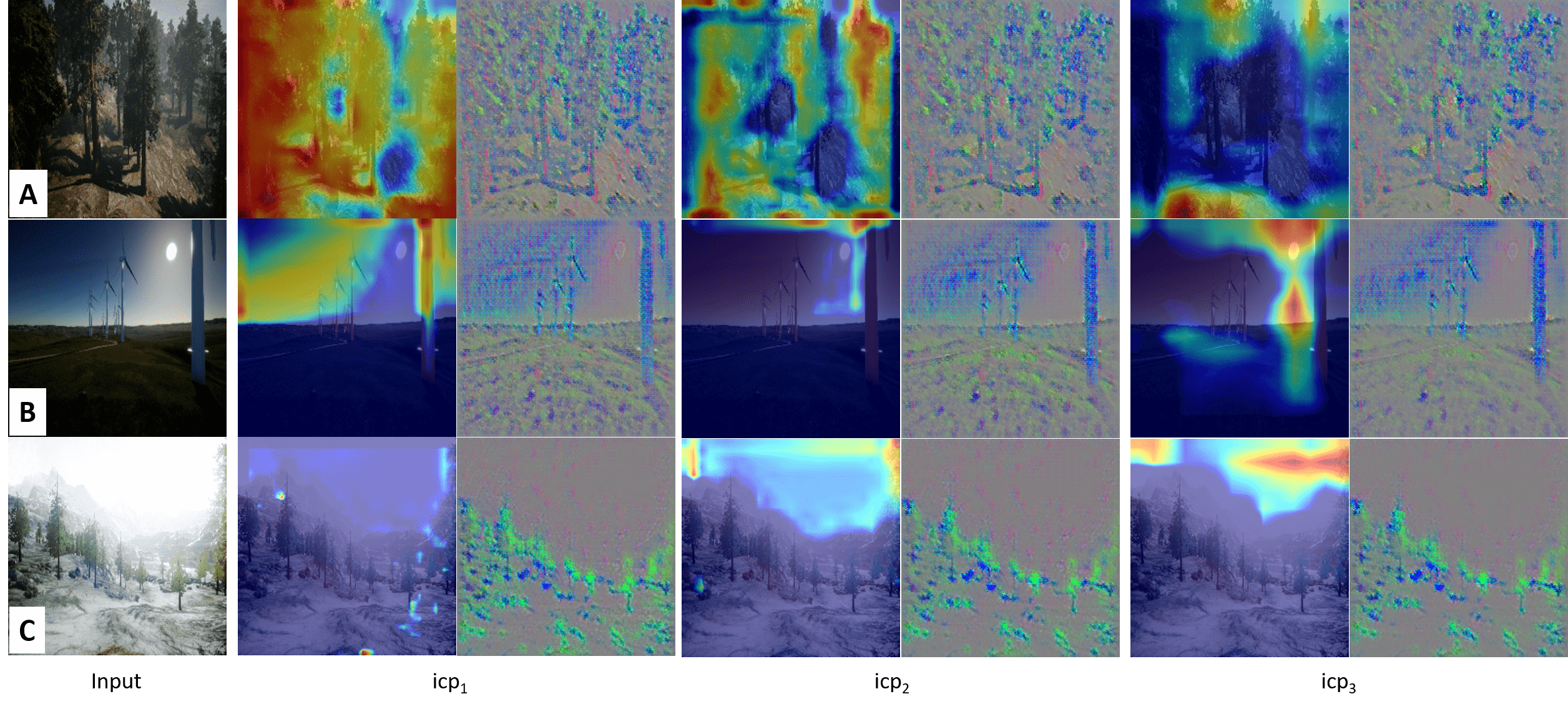
Increased growth in the global Unmanned Aerial Vehicles (UAV) (drone) industry has expanded possibilities for fully autonomous UAV applications. A particular application which has in part motivated this research is the use of UAV in wide area search and surveillance operations in unstructured outdoor environments. The critical issue with such environments is the lack of structured features that could aid in autonomous flight, such as road lines or paths. In this paper, we propose an End-to-End Multi-Task Regression-based Learning approach capable of defining flight commands for navigation and exploration under the forest canopy, regardless of the presence of trails or additional sensors (i.e. GPS). Training and testing are performed using a software in the loop pipeline which allows for a detailed evaluation against state-of-the-art pose estimation techniques. Our extensive experiments demonstrate that our approach excels in performing dense exploration within the required search perimeter, is capable of covering wider search regions, generalises to previously unseen and unexplored environments and outperforms contemporary state-of-the-art techniques.

paper research
An Introduction to Decentralized Stochastic Optimization with Gradient Tracking

An Introduction to Decentralized Stochastic Optimization with Gradient Tracking

Decentralized solutions to finite-sum minimization are of significant importance in many signal processing, control, and machine learning applications. In such settings, the data is distributed over a network of arbitrarily-connected nodes and raw data sharing is prohibitive often due to communication or privacy constraints. In this article, we review decentralized stochastic first-order optimization methods and illustrate some recent improvements based on gradient tracking and variance reduction, focusing particularly on smooth and strongly-convex objective functions. We provide intuitive illustrations of the main technical ideas as well as applications of the algorithms in the context of decentralized training of machine learning models.

paper research
Training DNN IoT Applications for Deployment on Analog NVM Crossbars

Training DNN IoT Applications for Deployment on Analog NVM Crossbars

A trend towards energy-efficiency, security and privacy has led to a recent focus on deploying DNNs on microcontrollers. However, limits on compute and memory resources restrict the size and the complexity of the ML models deployable in these systems. Computation-In-Memory architectures based on resistive nonvolatile memory (NVM) technologies hold great promise of satisfying the compute and memory demands of high-performance and low-power, inherent in modern DNNs. Nevertheless, these technologies are still immature and suffer from both the intrinsic analog-domain noise problems and the inability of representing negative weights in the NVM structures, incurring in larger crossbar sizes with concomitant impact on ADCs and DACs. In this paper, we provide a training framework for addressing these challenges and quantitatively evaluate the circuit-level efficiency gains thus accrued. We make two contributions Firstly, we propose a training algorithm that eliminates the need for tuning individual layers of a DNN ensuring uniformity across layer weights and activations. This ensures analog-blocks that can be reused and peripheral hardware substantially reduced. Secondly, using NAS methods, we propose the use of unipolar-weighted (either all-positive or all-negative weights) matrices/sub-matrices. Weight unipolarity obviates the need for doubling crossbar area leading to simplified analog periphery. We validate our methodology with CIFAR10 and HAR applications by mapping to crossbars using 4-bit and 2-bit devices. We achieve up to 92 91% accuracy (95% floating-point) using 2-bit only-positive weights for HAR. A combination of the proposed techniques leads to 80% area improvement and up to 45% energy reduction.

paper research
I Feel You  A Theory of Mind Experiment in Games

I Feel You A Theory of Mind Experiment in Games

In this study into the player s emotional theory of mind of gameplaying agents, we investigate how an agent s behaviour and the player s own performance and emotions shape the recognition of a frustrated behaviour. We focus on the perception of frustration as it is a prevalent affective experience in human-computer interaction. We present a testbed game tailored towards this end, in which a player competes against an agent with a frustration model based on theory. We collect gameplay data, an annotated ground truth about the player s appraisal of the agent s frustration, and apply face recognition to estimate the player s emotional state. We examine the collected data through correlation analysis and predictive machine learning models, and find that the player s observable emotions are not correlated highly with the perceived frustration of the agent. This suggests that our subject s theory of mind is a cognitive process based on the gameplay context. Our predictive models---using ranking support vector machines---corroborate these results, yielding moderately accurate predictors of players theory of mind.

paper research
Multimodal Functional Maximum Correlation for Emotion Recognition

Multimodal Functional Maximum Correlation for Emotion Recognition

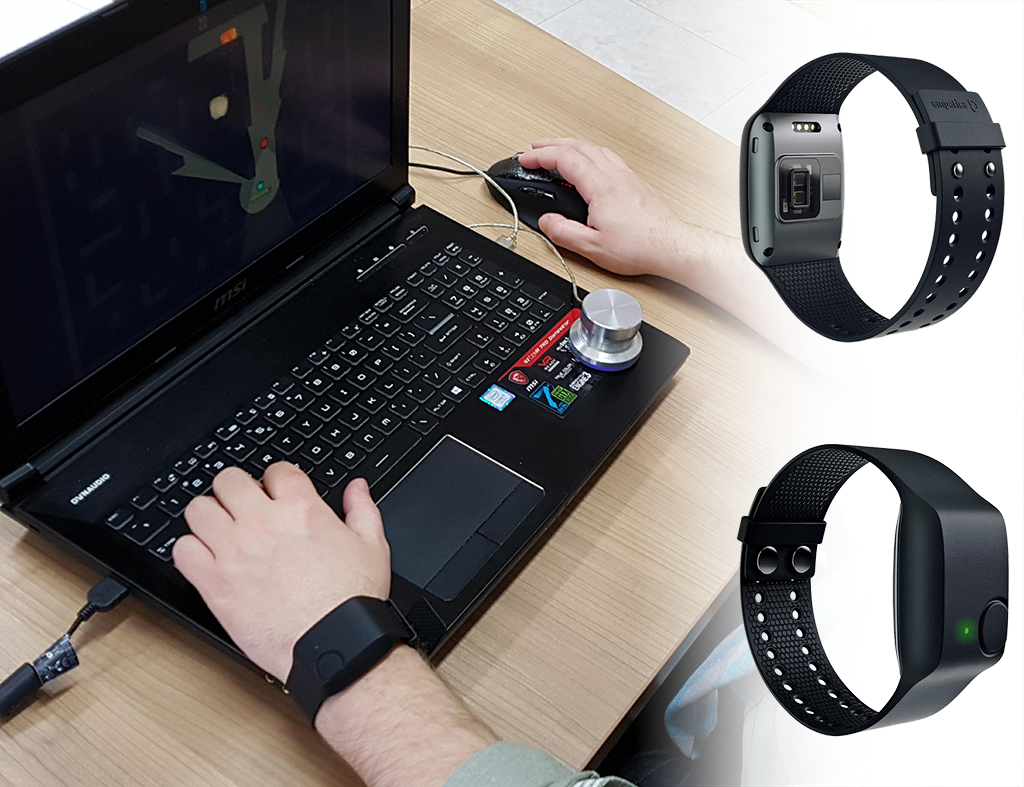
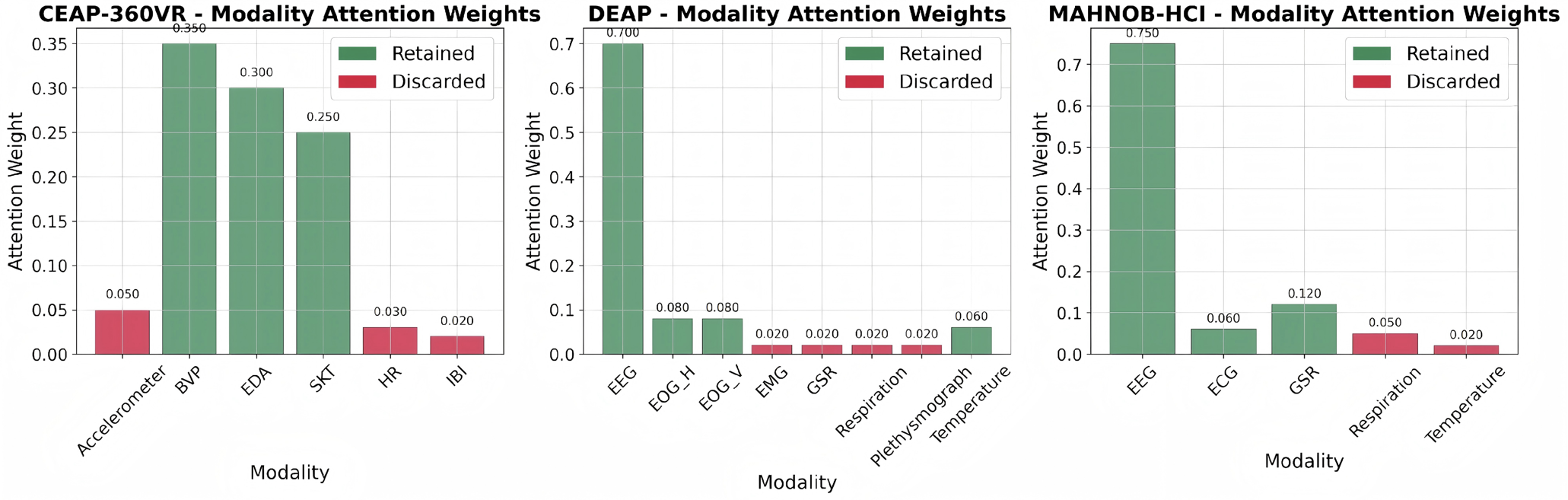
Emotional states manifest as coordinated yet heterogeneous physiological responses across central and autonomic systems, posing a fundamental challenge for multimodal representation learning in affective computing. Learning such joint dynamics is further complicated by the scarcity and subjectivity of affective annotations, which motivates the use of self-supervised learning (SSL). However, most existing SSL approaches rely on pairwise alignment objectives, which are insufficient to characterize dependencies among more than two modalities and fail to capture higher-order interactions arising from coordinated brain and autonomic responses. To address this limitation, we propose Multimodal Functional Maximum Correlation (MFMC), a principled SSL framework that maximizes higher-order multimodal dependence through a Dual Total Correlation (DTC) objective. By deriving a tight sandwich bound and optimizing it using a functional maximum correlation analysis (FMCA) based trace surrogate, MFMC captures joint multimodal interactions directly, without relying on pairwise contrastive losses. Experiments on three public affective computing benchmarks demonstrate that MFMC consistently achieves state-of-the-art or competitive performance under both subject-dependent and subject-independent evaluation protocols, highlighting its robustness to inter-subject variability. In particular, MFMC improves subject-dependent accuracy on CEAP-360VR from 78.9% to 86.8%, and subject-independent accuracy from 27.5% to 33.1% using the EDA signal alone. Moreover, MFMC remains within 0.8 percentage points of the best-performing method on the most challenging EEG subject-independent split of MAHNOB-HCI. Our code is available at https //github.com/DY9910/MFMC.

paper research
A DRL-Based Method with Bayesian Optimization for Joint Link Adaptation and Device Scheduling in URLLC Industrial IoT Networks

A DRL-Based Method with Bayesian Optimization for Joint Link Adaptation and Device Scheduling in URLLC Industrial IoT Networks

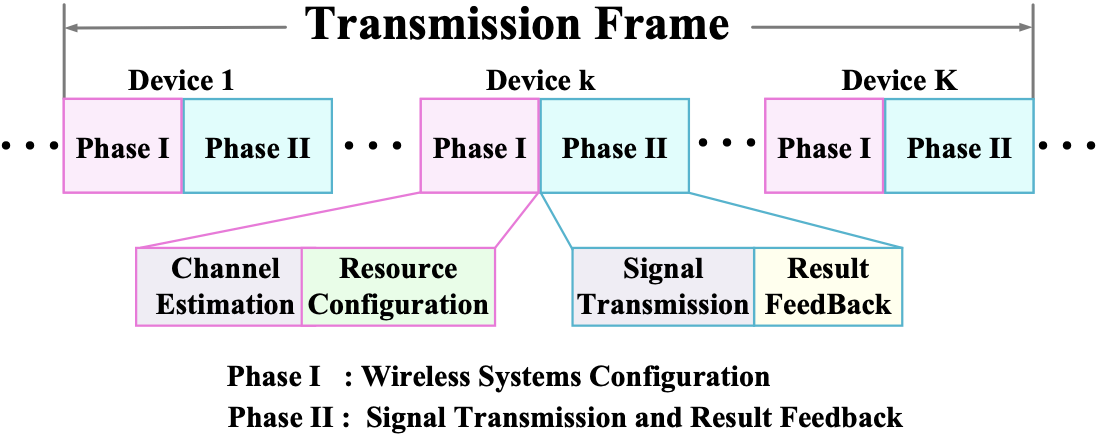
In this article, we consider an industrial internet of things (IIoT) network supporting multi-device dynamic ultra-reliable low-latency communication (URLLC) while the channel state information (CSI) is imperfect. A joint link adaptation (LA) and device scheduling (including the order) design is provided, aiming at maximizing the total transmission rate under strict block error rate (BLER) constraints. In particular, a Bayesian optimization (BO) driven Twin Delayed Deep Deterministic Policy Gradient (TD3) method is proposed, which determines the device served order sequence and the corresponding modulation and coding scheme (MCS) adaptively based on the imperfect CSI. Note that the imperfection of CSI, error sample imbalance in URLLC networks, as well as the parameter sensitivity nature of the TD3 algorithm likely diminish the algorithm s convergence speed and reliability. To address such an issue, we proposed a BO based training mechanism for the convergence speed improvement, which provides a more reliable learning direction and sample selection method to track the imbalance sample problem. Via extensive simulations, we show that the proposed algorithm achieves faster convergence and higher sum-rate performance compared to existing solutions.

paper research
Causify DataFlow  A Framework for High-Performance Machine Learning Stream Processing

Causify DataFlow A Framework for High-Performance Machine Learning Stream Processing

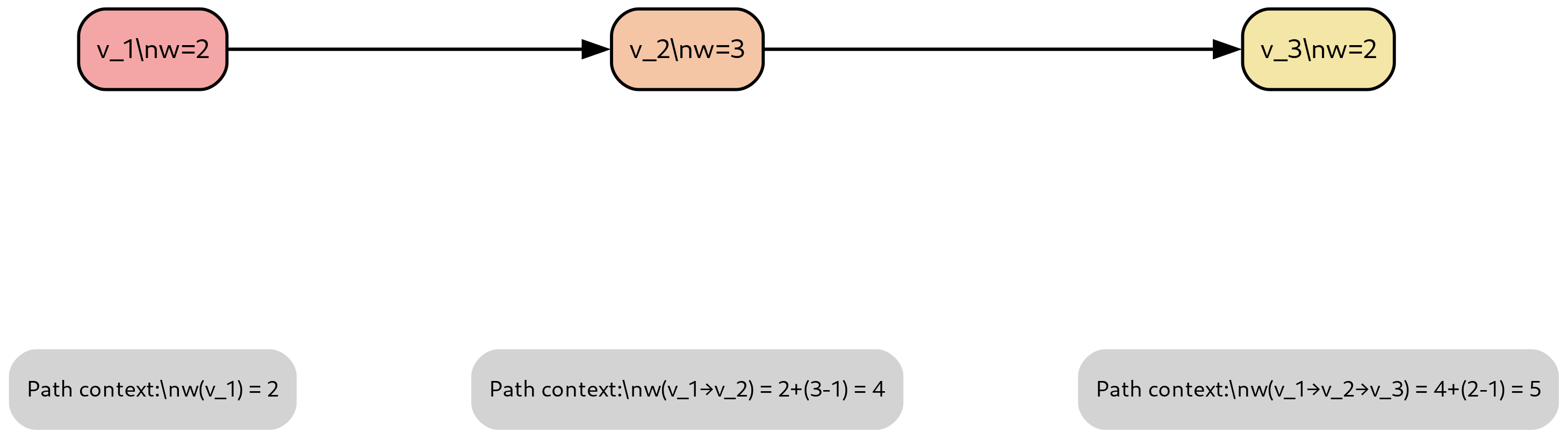
We present DataFlow, a computational framework for building, testing, and deploying high-performance machine learning systems on unbounded time-series data. Traditional data science workflows assume finite datasets and require substantial reimplementation when moving from batch prototypes to streaming production systems. This gap introduces causality violations, batch boundary artifacts, and poor reproducibility of real-time failures. DataFlow resolves these issues through a unified execution model based on directed acyclic graphs (DAGs) with point-in-time idempotency outputs at any time t depend only on a fixed-length context window preceding t. This guarantee ensures that models developed in batch mode execute identically in streaming production without code changes. The framework enforces strict causality by automatically tracking knowledge time across all transformations, eliminating future-peeking bugs. DataFlow supports flexible tiling across temporal and feature dimensions, allowing the same model to operate at different frequencies and memory profiles via configuration alone. It integrates natively with the Python data science stack and provides fit/predict semantics for online learning, caching and incremental computation, and automatic parallelization through DAG-based scheduling. We demonstrate its effectiveness across domains including financial trading, IoT, fraud detection, and real-time analytics.

paper research
Boosting the Low-Altitude Economy  A Reliability-Aware Dynamic Weight Allocation for Multi-modal UAV Beam Prediction

Boosting the Low-Altitude Economy A Reliability-Aware Dynamic Weight Allocation for Multi-modal UAV Beam Prediction

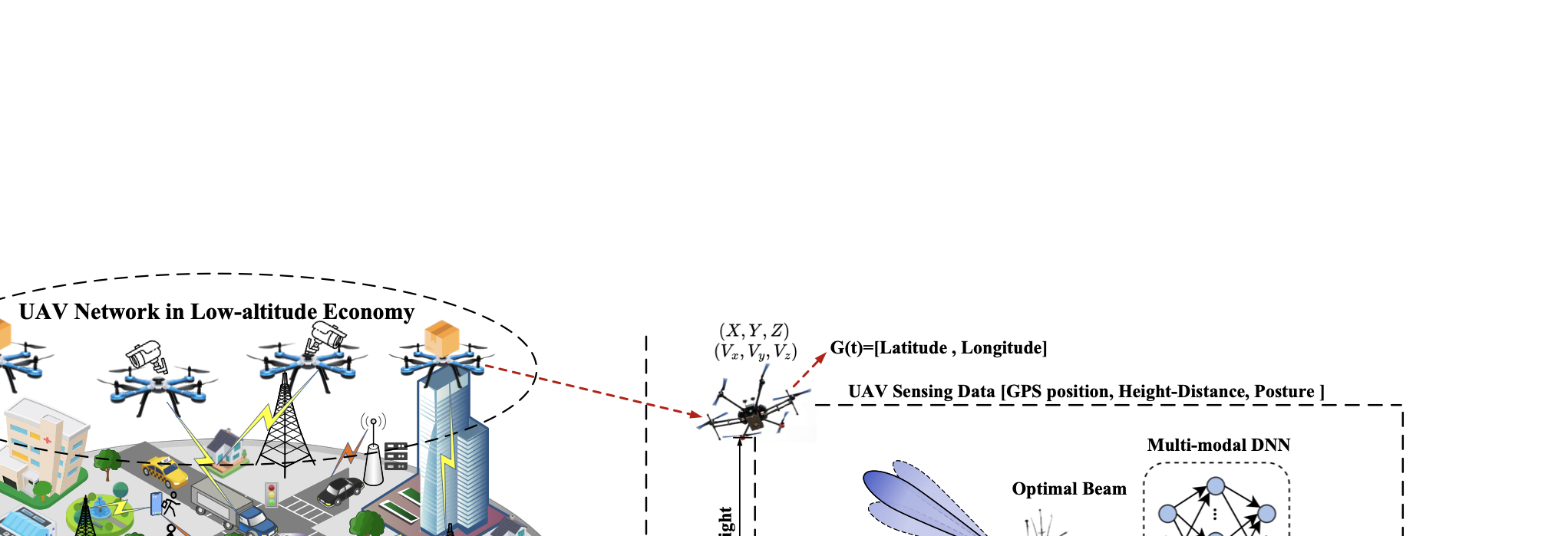
The low-altitude economy (LAE) is rapidly expanding driven by urban air mobility, logistics drones, and aerial sensing, while fast and accurate beam prediction in uncrewed aerial vehicles (UAVs) communications is crucial for achieving reliable connectivity. Current research is shifting from single-signal to multi-modal collaborative approaches. However, existing multi-modal methods mostly employ fixed or empirical weights, assuming equal reliability across modalities at any given moment. Indeed, the importance of different modalities fluctuates dramatically with UAV motion scenarios, and static weighting amplifies the negative impact of degraded modalities. Furthermore, modal mismatch and weak alignment further undermine cross-scenario generalization. To this end, we propose a reliability-aware dynamic weighting scheme applied to a semantic-aware multi-modal beam prediction framework, named SaM2B. Specifically, SaM2B leverages lightweight cues such as environmental visual, flight posture, and geospatial data to adaptively allocate contributions across modalities at different time points through reliability-aware dynamic weight updates. Moreover, by utilizing cross-modal contrastive learning, we align the multi-source representation beam semantics associated with specific beam information to a shared semantic space, thereby enhancing discriminative power and robustness under modal noise and distribution shifts. Experiments on real-world low-altitude UAV datasets show that SaM2B achieves more satisfactory results than baseline methods.

paper research
Can Small Training Runs Reliably Guide Data Curation? Rethinking the Use of Proxy Models

Can Small Training Runs Reliably Guide Data Curation? Rethinking the Use of Proxy Models

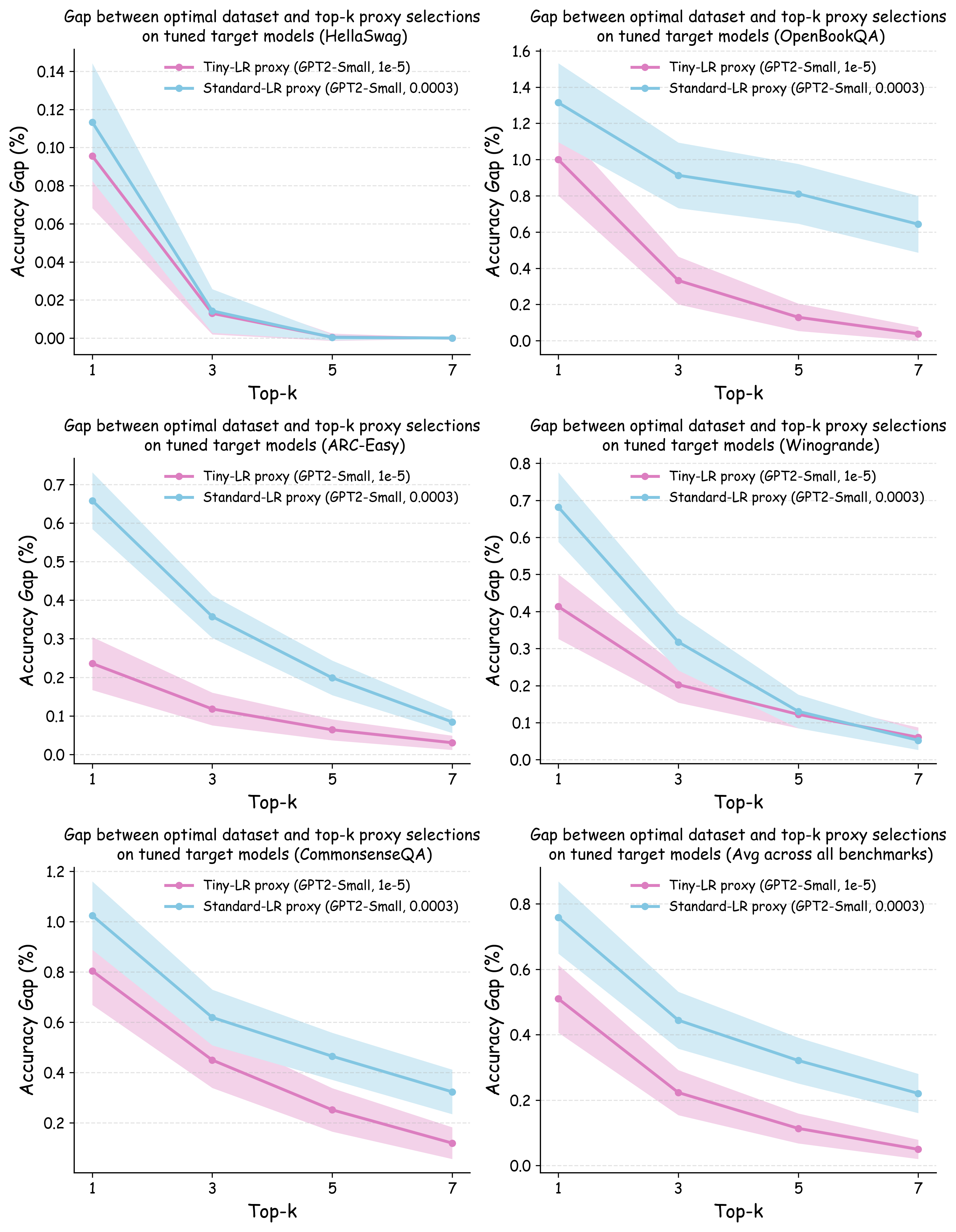
Data teams at frontier AI companies routinely train small proxy models to make critical decisions about pretraining data recipes for full-scale training runs. However, the community has a limited understanding of whether and when conclusions drawn from small-scale experiments reliably transfer to full-scale model training. In this work, we uncover a subtle yet critical issue in the standard experimental protocol for data recipe assessment the use of identical small-scale model training configurations across all data recipes in the name of fair comparison. We show that the experiment conclusions about data quality can flip with even minor adjustments to training hyperparameters, as the optimal training configuration is inherently data-dependent. Moreover, this fixed-configuration protocol diverges from full-scale model development pipelines, where hyperparameter optimization is a standard step. Consequently, we posit that the objective of data recipe assessment should be to identify the recipe that yields the best performance under data-specific tuning. To mitigate the high cost of hyperparameter tuning, we introduce a simple patch to the evaluation protocol using reduced learning rates for proxy model training. We show that this approach yields relative performance that strongly correlates with that of fully tuned large-scale LLM pretraining runs. Theoretically, we prove that for random-feature models, this approach preserves the ordering of datasets according to their optimal achievable loss. Empirically, we validate this approach across 23 data recipes covering four critical dimensions of data curation, demonstrating dramatic improvements in the reliability of small-scale experiments.

paper research
MSACL  Multi-Step Actor-Critic Learning with Lyapunov Certificates for Exponential Stabilization

MSACL Multi-Step Actor-Critic Learning with Lyapunov Certificates for Exponential Stabilization

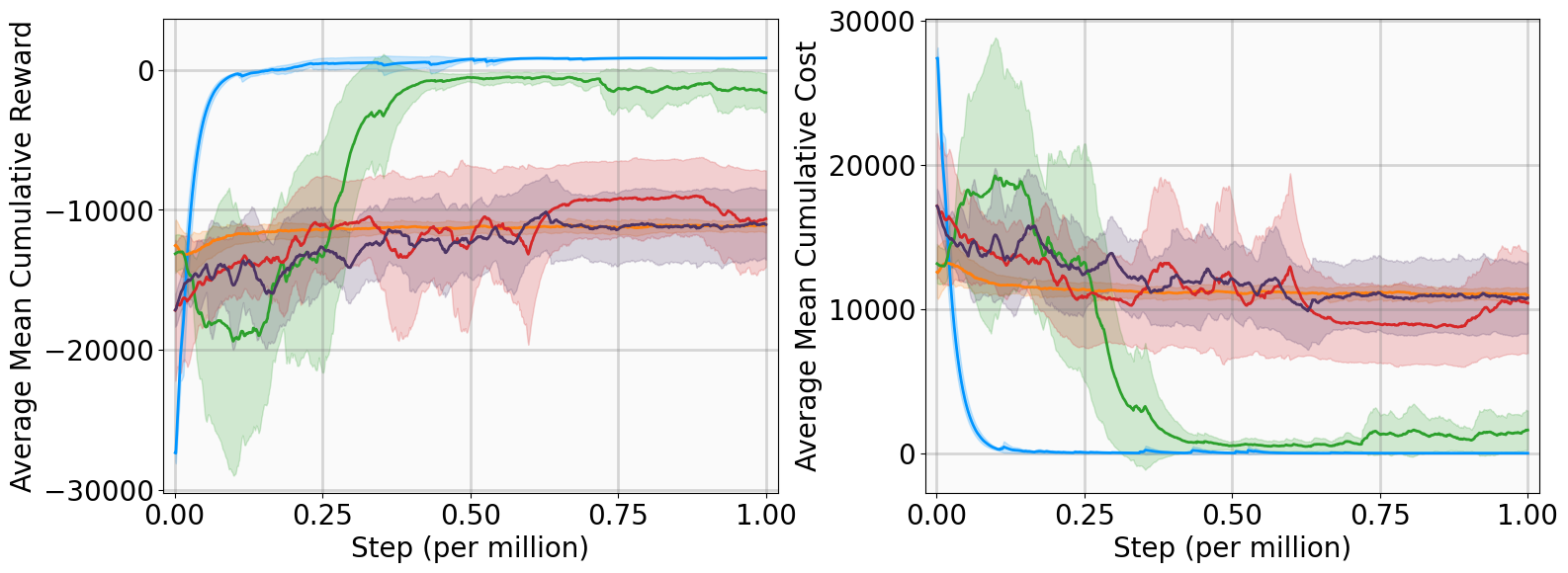
Achieving provable stability in model-free reinforcement learning (RL) remains a challenge, particularly in balancing exploration with rigorous safety. This article introduces MSACL, a framework that integrates exponential stability theory with maximum entropy RL through multi-step Lyapunov certificate learning. Unlike methods relying on complex reward engineering, MSACL utilizes off-policy multi-step data to learn Lyapunov certificates satisfying theoretical stability conditions. By introducing Exponential Stability Labels (ESL) and a $λ$-weighted aggregation mechanism, the framework effectively balances the bias-variance trade-off in multi-step learning. Policy optimization is guided by a stability-aware advantage function, ensuring the learned policy promotes rapid Lyapunov descent. We evaluate MSACL across six benchmarks, including stabilization and nonlinear tracking tasks, demonstrating its superiority over state-of-the-art Lyapunov-based RL algorithms. MSACL achieves exponential stability and rapid convergence under simple rewards, while exhibiting significant robustness to uncertainties and generalization to unseen trajectories. Sensitivity analysis establishes the multi-step horizon $n=20$ as a robust default across diverse systems. By linking Lyapunov theory with off-policy actor-critic frameworks, MSACL provides a foundation for verifiably safe learning-based control. Source code and benchmark environments will be made publicly available.

paper research
HFedMoE  Resource-Aware Heterogeneous Federated Learning with Mixture-of-Experts

HFedMoE Resource-Aware Heterogeneous Federated Learning with Mixture-of-Experts

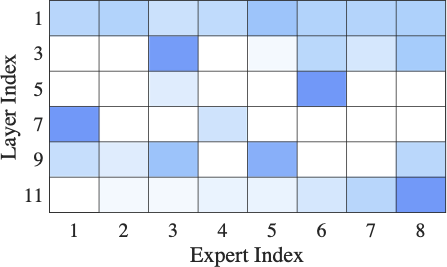
While federated learning (FL) enables fine-tuning of large language models (LLMs) without compromising data privacy, the substantial size of an LLM renders on-device training impractical for resource-constrained clients, such as mobile devices. Thus, Mixture-of-Experts (MoE) models have emerged as a computation-efficient solution, which activates only a sparse subset of experts during model training to reduce computing burden without sacrificing performance. Though integrating MoE into FL fine-tuning holds significant potential, it still encounters three key challenges i) selecting appropriate experts for clients remains challenging due to the lack of a reliable metric to measure each expert s impact on local fine-tuning performance, ii) the heterogeneous computing resources across clients severely hinder MoE-based LLM fine-tuning, as dynamic expert activations across diverse input samples can overwhelm resource-constrained devices, and iii) client-specific expert subsets and routing preference undermine global aggregation, where misaligned expert updates and inconsistent gating networks in troduce destructive interference. To address these challenges, we propose HFedMoE, a heterogeneous MoE-based FL fine-tuning framework that customizes a subset of experts to each client for computation-efficient LLM fine-tuning. Specifically, HFedMoE identifies the expert importance based on its contributions to fine-tuning performance, and then adaptively selects a subset of experts from an information bottleneck perspective to align with each client s computing budget. A sparsity-aware model aggregation strategy is also designed to aggregate the actively fine-tuned experts and gating parameters with importance weighted contributions. Extensive experiments demonstrate that HFedMoE outperforms state-of-the-art benchmarks in training accuracy and convergence speed.

paper research
Scale-Adaptive Power Flow Analysis with Local Topology Slicing and Multi-Task Graph Learning

Scale-Adaptive Power Flow Analysis with Local Topology Slicing and Multi-Task Graph Learning

Developing deep learning models with strong adaptability to topological variations is of great practical significance for power flow analysis. To enhance model performance under variable system scales and improve robustness in branch power prediction, this paper proposes a Scale-adaptive Multi-task Power Flow Analysis (SaMPFA) framework. SaMPFA introduces a Local Topology Slicing (LTS) sampling technique that extracts subgraphs of different scales from the complete power network to strengthen the model s cross-scale learning capability. Furthermore, a Reference-free Multi-task Graph Learning (RMGL) model is designed for robust power flow prediction. Unlike existing approaches, RMGL predicts bus voltages and branch powers instead of phase angles. This design not only avoids the risk of error amplification in branch power calculation but also guides the model to learn the physical relationships of phase angle differences. In addition, the loss function incorporates extra terms that encourage the model to capture the physical patterns of angle differences and power transmission, further improving consistency between predictions and physical laws. Simulations on the IEEE 39-bus system and a real provincial grid in China demonstrate that the proposed model achieves superior adaptability and generalization under variable system scales, with accuracy improvements of 4.47% and 36.82%, respectively.

paper research
REE-TTT  Adaptive Radar Echo Extrapolation Through Test-Time Training

REE-TTT Adaptive Radar Echo Extrapolation Through Test-Time Training

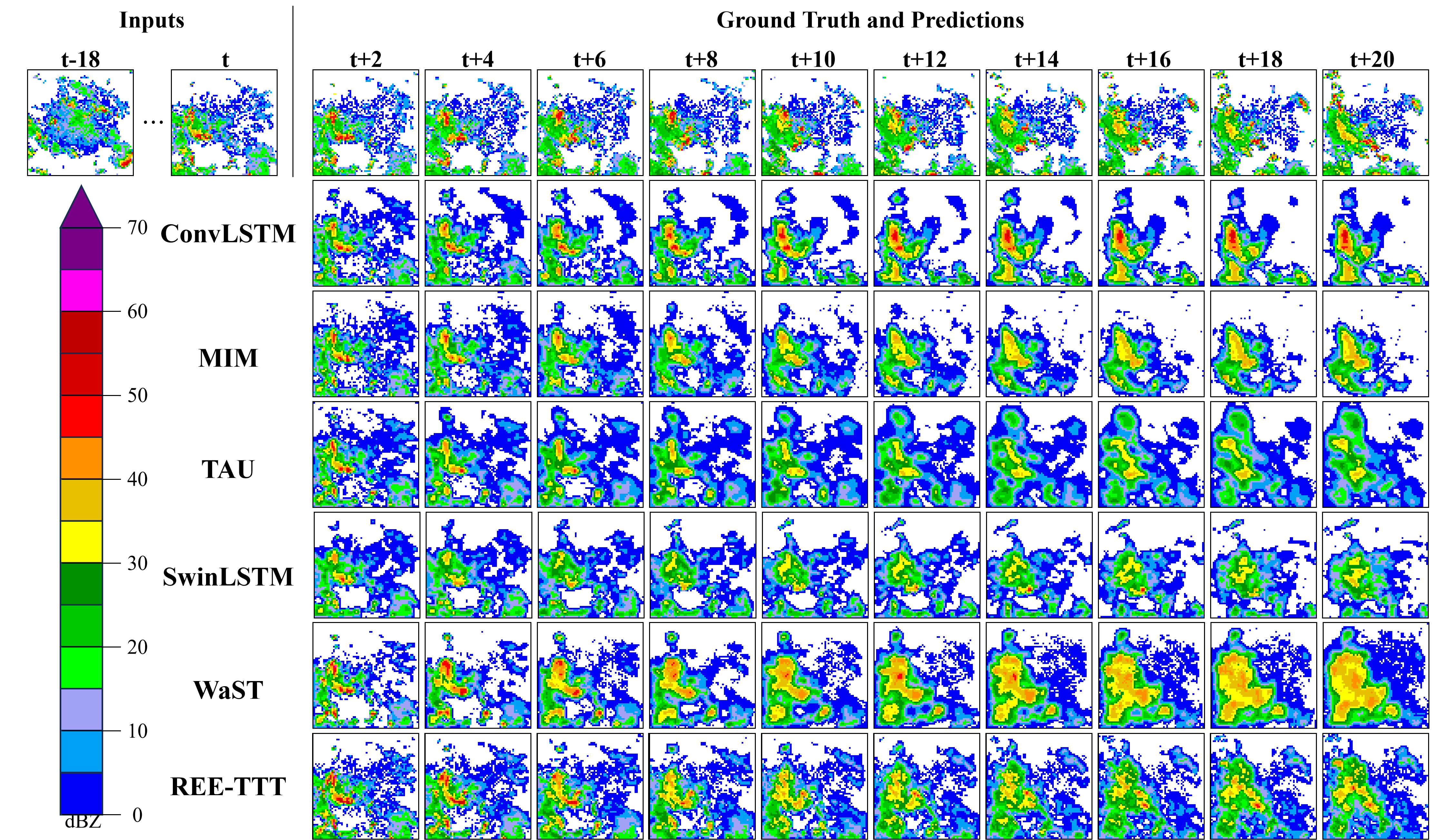
Precipitation nowcasting is critically important for meteorological forecasting. Deep learning-based Radar Echo Extrapolation (REE) has become a predominant nowcasting approach, yet it suffers from poor generalization due to its reliance on high-quality local training data and static model parameters, limiting its applicability across diverse regions and extreme events. To overcome this, we propose REE-TTT, a novel model that incorporates an adaptive Test-Time Training (TTT) mechanism. The core of our model lies in the newly designed Spatio-temporal Test-Time Training (ST-TTT) block, which replaces the standard linear projections in TTT layers with task-specific attention mechanisms, enabling robust adaptation to non-stationary meteorological distributions and thereby significantly enhancing the feature representation of precipitation. Experiments under cross-regional extreme precipitation scenarios demonstrate that REE-TTT substantially outperforms state-of-the-art baseline models in prediction accuracy and generalization, exhibiting remarkable adaptability to data distribution shifts.

paper research
Digital Twin-Driven Communication-Efficient Federated Anomaly Detection for Industrial IoT

Digital Twin-Driven Communication-Efficient Federated Anomaly Detection for Industrial IoT

Anomaly detection is increasingly becoming crucial for maintaining the safety, reliability, and efficiency of industrial systems. Recently, with the advent of digital twins and data-driven decision-making, several statistical and machine-learning methods have been proposed. However, these methods face several challenges, such as dependence on only real sensor datasets, limited labeled data, high false alarm rates, and privacy concerns. To address these problems, we propose a suite of digital twin-integrated federated learning (DTFL) methods that enhance global model performance while preserving data privacy and communication efficiency. Specifically, we present five novel approaches Digital Twin-Based Meta-Learning (DTML), Federated Parameter Fusion (FPF), Layer-wise Parameter Exchange (LPE), Cyclic Weight Adaptation (CWA), and Digital Twin Knowledge Distillation (DTKD). Each method introduces a unique mechanism to combine synthetic and real-world knowledge, balancing generalization with communication overhead. We conduct an extensive experiment using a publicly available cyber-physical anomaly detection dataset. For a target accuracy of 80%, CWA reaches the target in 33 rounds, FPF in 41 rounds, LPE in 48 rounds, and DTML in 87 rounds, whereas the standard FedAvg baseline and DTKD do not reach the target within 100 rounds. These results highlight substantial communication-efficiency gains (up to 62% fewer rounds than DTML and 31% fewer than LPE) and demonstrate that integrating DT knowledge into FL accelerates convergence to operationally meaningful accuracy thresholds for IIoT anomaly detection.

paper research
Sparse Threats, Focused Defense  Robust Reinforcement Learning Aware of Criticality for Safe Autonomous Driving

Sparse Threats, Focused Defense Robust Reinforcement Learning Aware of Criticality for Safe Autonomous Driving

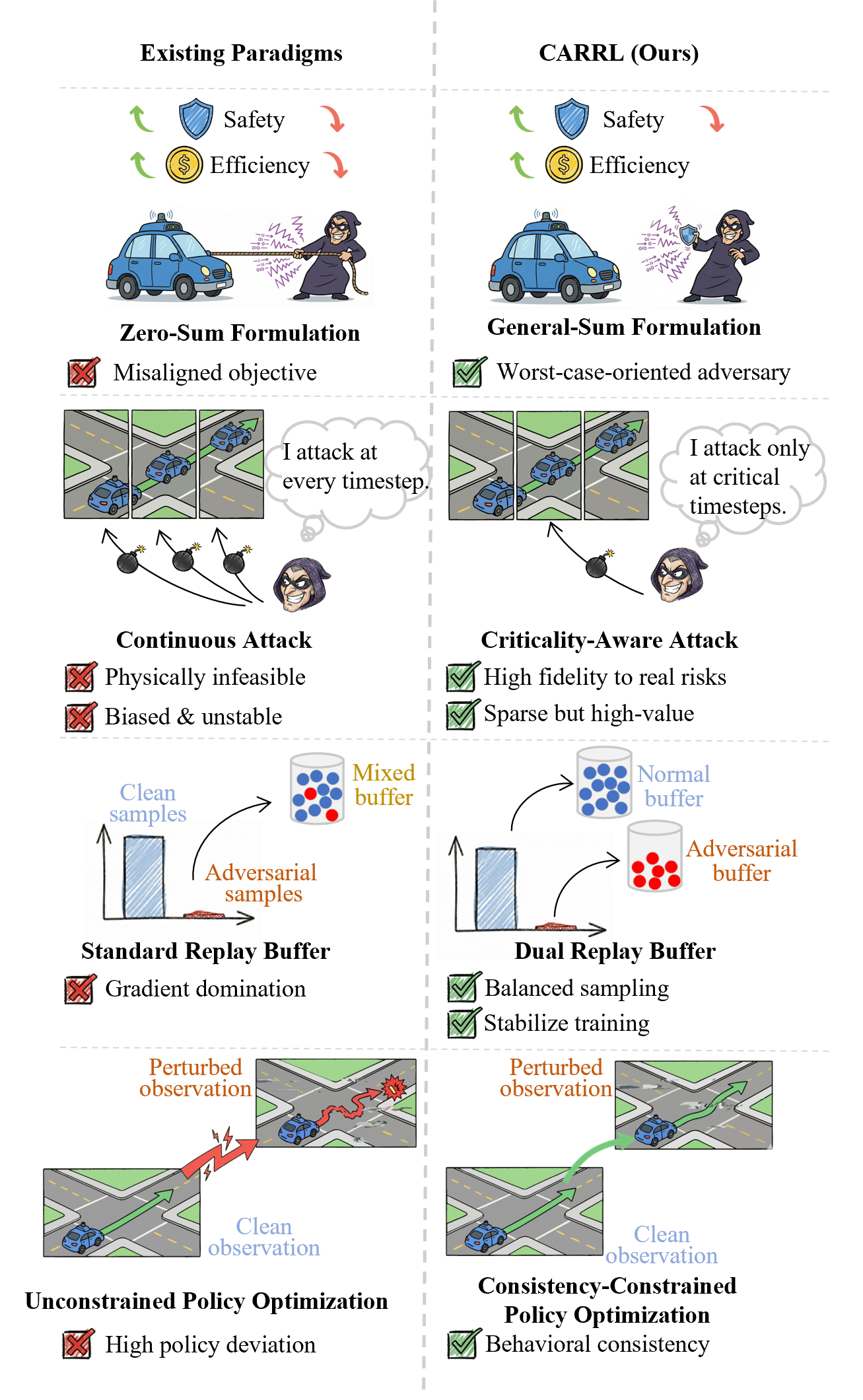
Reinforcement learning (RL) has shown considerable potential in autonomous driving (AD), yet its vulnerability to perturbations remains a critical barrier to real-world deployment. As a primary countermeasure, adversarial training improves policy robustness by training the AD agent in the presence of an adversary that deliberately introduces perturbations. Existing approaches typically model the interaction as a zero-sum game with continuous attacks. However, such designs overlook the inherent asymmetry between the agent and the adversary and then fail to reflect the sparsity of safety-critical risks, rendering the achieved robustness inadequate for practical AD scenarios. To address these limitations, we introduce criticality-aware robust RL (CARRL), a novel adversarial training approach for handling sparse, safety-critical risks in autonomous driving. CARRL consists of two interacting components a risk exposure adversary (REA) and a risk-targeted robust agent (RTRA). We model the interaction between the REA and RTRA as a general-sum game, allowing the REA to focus on exposing safety-critical failures (e.g., collisions) while the RTRA learns to balance safety with driving efficiency. The REA employs a decoupled optimization mechanism to better identify and exploit sparse safety-critical moments under a constrained budget. However, such focused attacks inevitably result in a scarcity of adversarial data. The RTRA copes with this scarcity by jointly leveraging benign and adversarial experiences via a dual replay buffer and enforces policy consistency under perturbations to stabilize behavior. Experimental results demonstrate that our approach reduces the collision rate by at least 22.66 % across all cases compared to state-of-the-art baseline methods.

paper research
Dynamic Radar Network of UAVs  A Joint Navigation and Tracking Approach

Dynamic Radar Network of UAVs A Joint Navigation and Tracking Approach

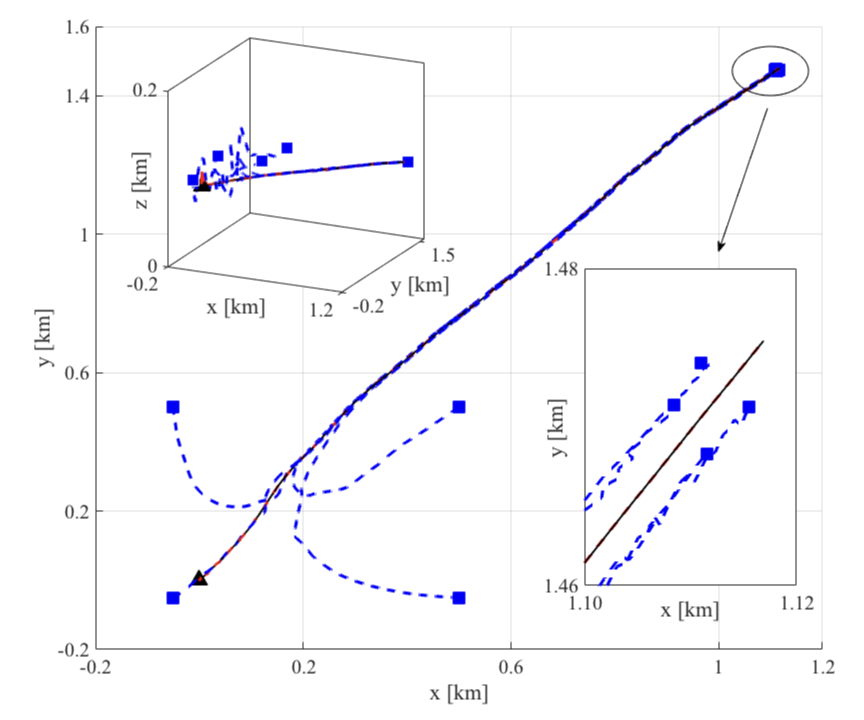
Nowadays there is a growing research interest on the possibility of enriching small flying robots with autonomous sensing and online navigation capabilities. This will enable a large number of applications spanning from remote surveillance to logistics, smarter cities and emergency aid in hazardous environments. In this context, an emerging problem is to track unauthorized small unmanned aerial vehicles (UAVs) hiding behind buildings or concealing in large UAV networks. In contrast with current solutions mainly based on static and on-ground radars, this paper proposes the idea of a dynamic radar network of UAVs for real-time and high-accuracy tracking of malicious targets. To this end, we describe a solution for real-time navigation of UAVs to track a dynamic target using heterogeneously sensed information. Such information is shared by the UAVs with their neighbors via multi-hops, allowing tracking the target by a local Bayesian estimator running at each agent. Since not all the paths are equal in terms of information gathering point-of-view, the UAVs plan their own trajectory by minimizing the posterior covariance matrix of the target state under UAV kinematic and anti-collision constraints. Our results show how a dynamic network of radars attains better localization results compared to a fixed configuration and how the on-board sensor technology impacts the accuracy in tracking a target with different radar cross sections, especially in non line-of-sight (NLOS) situations.

paper research
Neural Turtle Graphics for Modeling City Road Layouts

Neural Turtle Graphics for Modeling City Road Layouts

We propose Neural Turtle Graphics (NTG), a novel generative model for spatial graphs, and demonstrate its applications in modeling city road layouts. Specifically, we represent the road layout using a graph where nodes in the graph represent control points and edges in the graph represent road segments. NTG is a sequential generative model parameterized by a neural network. It iteratively generates a new node and an edge connecting to an existing node conditioned on the current graph. We train NTG on Open Street Map data and show that it outperforms existing approaches using a set of diverse performance metrics. Moreover, our method allows users to control styles of generated road layouts mimicking existing cities as well as to sketch parts of the city road layout to be synthesized. In addition to synthesis, the proposed NTG finds uses in an analytical task of aerial road parsing. Experimental results show that it achieves state-of-the-art performance on the SpaceNet dataset.

paper research
A Comprehensive Study on Temporal Modeling for Online Action Detection

A Comprehensive Study on Temporal Modeling for Online Action Detection

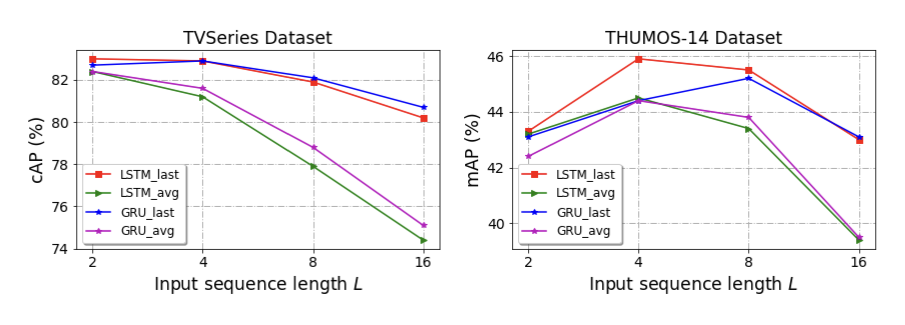
Online action detection (OAD) is a practical yet challenging task, which has attracted increasing attention in recent years. A typical OAD system mainly consists of three modules a frame-level feature extractor which is usually based on pre-trained deep Convolutional Neural Networks (CNNs), a temporal modeling module, and an action classifier. Among them, the temporal modeling module is crucial which aggregates discriminative information from historical and current features. Though many temporal modeling methods have been developed for OAD and other topics, their effects are lack of investigation on OAD fairly. This paper aims to provide a comprehensive study on temporal modeling for OAD including four meta types of temporal modeling methods, ie temporal pooling, temporal convolution, recurrent neural networks, and temporal attention, and uncover some good practices to produce a state-of-the-art OAD system. Many of them are explored in OAD for the first time, and extensively evaluated with various hyper parameters. Furthermore, based on our comprehensive study, we present several hybrid temporal modeling methods, which outperform the recent state-of-the-art methods with sizable margins on THUMOS-14 and TVSeries.

paper research
sql4ml  A Declarative End-to-End Workflow for Machine Learning

sql4ml A Declarative End-to-End Workflow for Machine Learning

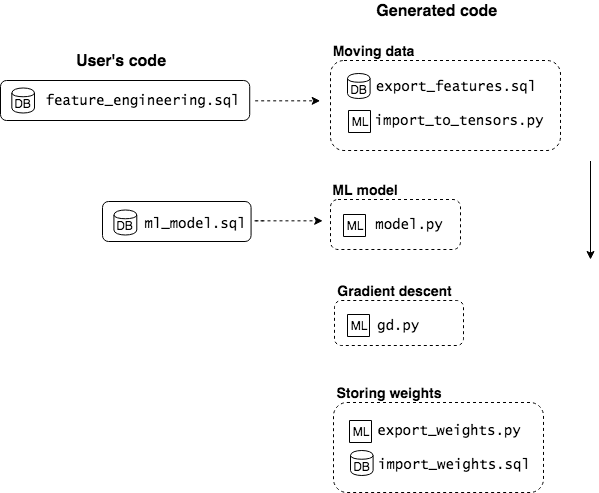
We present sql4ml, a system for expressing supervised machine learning (ML) models in SQL and automatically training them in TensorFlow. The primary motivation for this work stems from the observation that in many data science tasks there is a back-and-forth between a relational database that stores the data and a machine learning framework. Data preprocessing and feature engineering typically happen in a database, whereas learning is usually executed in separate ML libraries. This fragmented workflow requires from the users to juggle between different programming paradigms and software systems. With sql4ml the user can express both feature engineering and ML algorithms in SQL, while the system translates this code to an appropriate representation for training inside a machine learning framework. We describe our translation method, present experimental results from applying it on three well-known ML algorithms and discuss the usability benefits from concentrating the entire workflow on the database side.

paper research
VC Dimensions of Nondeterministic Finite Automata for Words of Equal Length

VC Dimensions of Nondeterministic Finite Automata for Words of Equal Length

Let $NFA_b(q)$ denote the set of languages accepted by nondeterministic finite automata with $q$ states over an alphabet with $b$ letters. Let $B_n$ denote the set of words of length $n$. We give a quadratic lower bound on the VC dimension of [ NFA_2(q) cap B_n = {L cap B_n mid L in NFA_2(q) } ] as a function of $q$. Next, the work of Gruber and Holzer (2007) gives an upper bound for the nondeterministic state complexity of finite languages contained in $B_n$, which we strengthen using our methods. Finally, we give some theoretical and experimental results on the dependence on $n$ of the VC dimension and testing dimension of $NFA_2(q) cap B_n$.

paper research
No Image

Coordinate Matrix Machine A Human-Level Approach to Classifying Very Similar Documents

Human-level concept learning argues that humans typically learn new concepts from a single example, whereas machine learning algorithms typically require hundreds of samples to learn a single concept. Our brain subconsciously identifies important features and learns more effectively. Contribution In this paper, we present the Coordinate Matrix Machine (CM$^2$). This purpose-built small model augments human intelligence by learning document structures and using this information to classify documents. While modern Red AI trends rely on massive pre-training and energy-intensive GPU infrastructure, CM$^2$ is designed as a Green AI solution. It achieves human-level concept learning by identifying only the structural important features a human would consider, allowing it to classify very similar documents using only one sample per class. Advantage Our algorithm outperforms traditional vectorizers and complex deep learning models that require larger datasets and significant compute. By focusing on structural coordinates rather than exhaustive semantic vectors, CM$^2$ offers 1. High accuracy with minimal data (one-shot learning) 2. Geometric and structural intelligence 3. Green AI and environmental sustainability 4. Optimized for CPU-only environments 5. Inherent explainability (glass-box model) 6. Faster computation and low latency 7. Robustness against unbalanced classes 8. Economic viability 9. Generic, expandable, and extendable

paper research
Attention Demands Focus  A Unified View on Attention Allocation

Attention Demands Focus A Unified View on Attention Allocation

The Transformer architecture, a cornerstone of modern Large Language Models (LLMs), has achieved extraordinary success in sequence modeling, primarily due to its attention mechanism. However, despite its power, the standard attention mechanism is plagued by well-documented issues representational collapse and attention sink. Although prior work has proposed approaches for these issues, they are often studied in isolation, obscuring their deeper connection. In this paper, we present a unified perspective, arguing that both can be traced to a common root -- improper attention allocation. We identify two failure modes 1) Attention Overload, where tokens receive comparable high weights, blurring semantic features that lead to representational collapse; 2) Attention Underload, where no token is semantically relevant, yet attention is still forced to distribute, resulting in spurious focus such as attention sink. Building on this insight, we introduce Lazy Attention, a novel mechanism designed for a more focused attention distribution. To mitigate overload, it employs positional discrimination across both heads and dimensions to sharpen token distinctions. To counteract underload, it incorporates Elastic-Softmax, a modified normalization function that relaxes the standard softmax constraint to suppress attention on irrelevant tokens. Experiments on the FineWeb-Edu corpus, evaluated across nine diverse benchmarks, demonstrate that Lazy Attention successfully mitigates attention sink and achieves competitive performance compared to both standard attention and modern architectures, while reaching up to 59.58% attention sparsity.

paper research
A Generalized UCB Bandit Algorithm for ML-Based Estimators

A Generalized UCB Bandit Algorithm for ML-Based Estimators

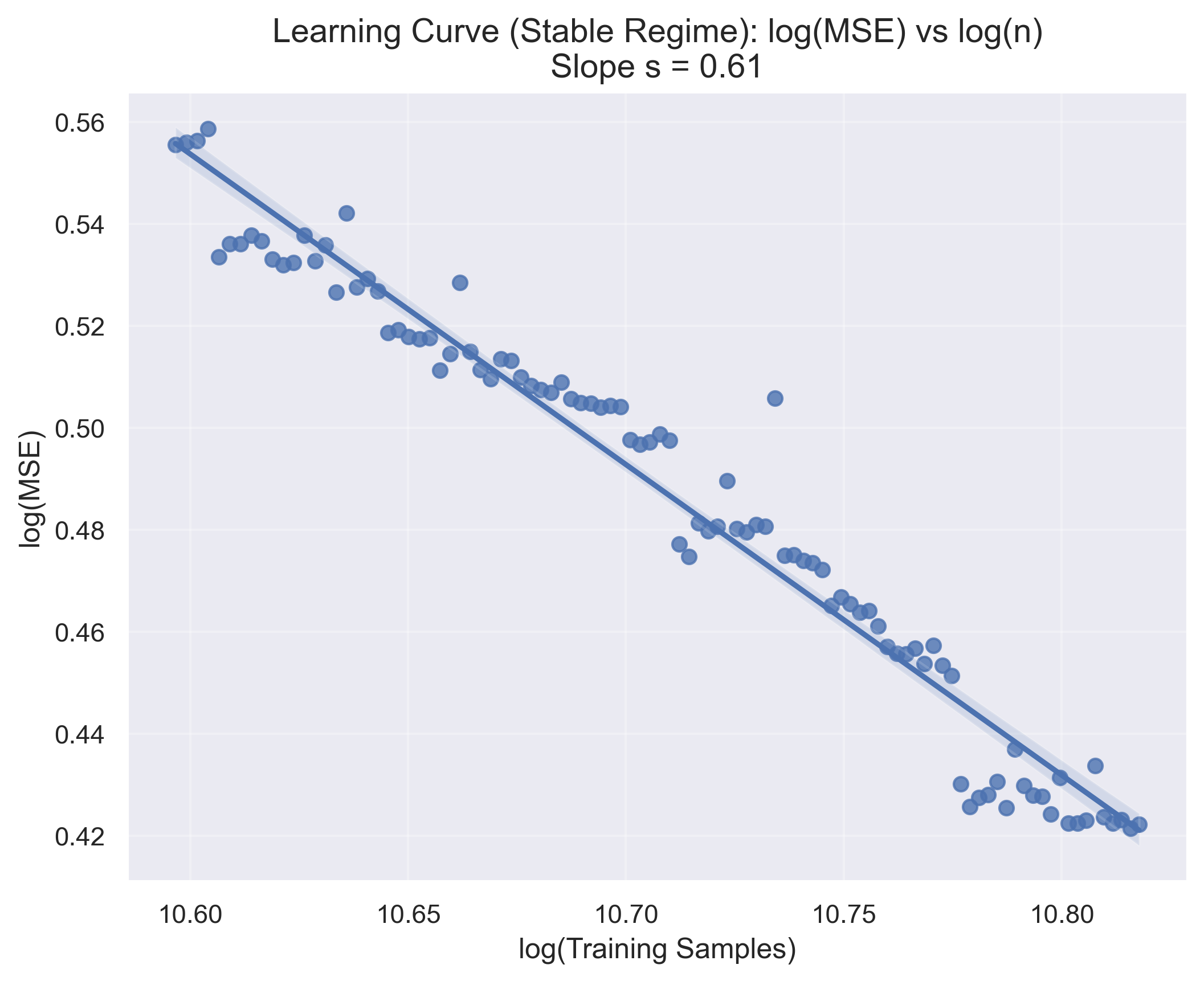
We present ML-UCB, a generalized upper confidence bound algorithm that integrates arbitrary machine learning models into multi-armed bandit frameworks. A fundamental challenge in deploying sophisticated ML models for sequential decision-making is the lack of tractable concentration inequalities required for principled exploration. We overcome this limitation by directly modeling the learning curve behavior of the underlying estimator. Specifically, assuming the Mean Squared Error decreases as a power law in the number of training samples, we derive a generalized concentration inequality and prove that ML-UCB achieves sublinear regret. This framework enables the principled integration of any ML model whose learning curve can be empirically characterized, eliminating the need for model-specific theoretical analysis. We validate our approach through experiments on a collaborative filtering recommendation system using online matrix factorization with synthetic data designed to simulate a simplified two-tower model, demonstrating substantial improvements over LinUCB

paper research
A Graph-based Framework for Online Time Series Anomaly Detection Using Model Ensemble

A Graph-based Framework for Online Time Series Anomaly Detection Using Model Ensemble

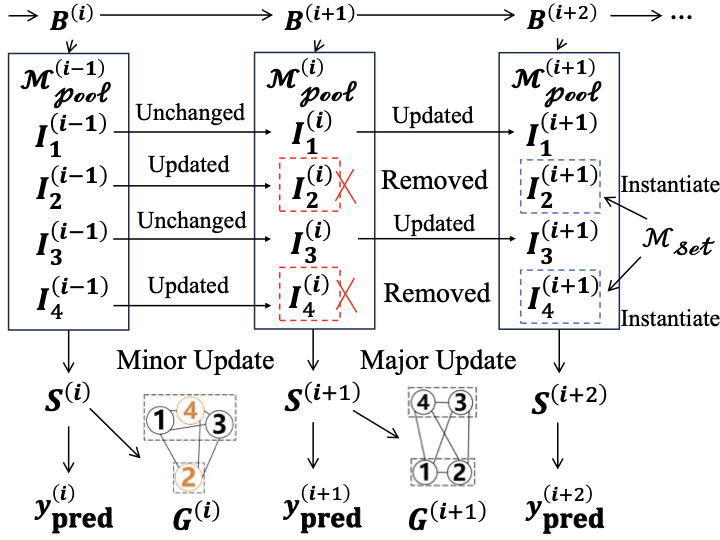
With the increasing volume of streaming data in industrial systems, online anomaly detection has become a critical task. The diverse and rapidly evolving data patterns pose significant challenges for online anomaly detection. Many existing anomaly detection methods are designed for offline settings or have difficulty in handling heterogeneous streaming data effectively. This paper proposes GDME, an unsupervised graph-based framework for online time series anomaly detection using model ensemble. GDME maintains a dynamic model pool that is continuously updated by pruning underperforming models and introducing new ones. It utilizes a dynamic graph structure to represent relationships among models and employs community detection on the graph to select an appropriate subset for ensemble. The graph structure is also used to detect concept drift by monitoring structural changes, allowing the framework to adapt to evolving streaming data. Experiments on seven heterogeneous time series demonstrate that GDME outperforms existing online anomaly detection methods, achieving improvements of up to 24%. In addition, its ensemble strategy provides superior detection performance compared with both individual models and average ensembles, with competitive computational efficiency.

paper research
Accelerating Storage-Based Training for Graph Neural Networks

Accelerating Storage-Based Training for Graph Neural Networks

Graph neural networks (GNNs) have achieved breakthroughs in various real-world downstream tasks due to their powerful expressiveness. As the scale of real-world graphs has been continuously growing, a storage-based approach to GNN training has been studied, which leverages external storage (e.g., NVMe SSDs) to handle such web-scale graphs on a single machine. Although such storage-based GNN training methods have shown promising potential in large-scale GNN training, we observed that they suffer from a severe bottleneck in data preparation since they overlook a critical challenge how to handle a large number of small storage I/Os. To address the challenge, in this paper, we propose a novel storage-based GNN training framework, named AGNES, that employs a method of block-wise storage I/O processing to fully utilize the I/O bandwidth of high-performance storage devices. Moreover, to further enhance the efficiency of each storage I/O, AGNES employs a simple yet effective strategy, hyperbatch-based processing based on the characteristics of real-world graphs. Comprehensive experiments on five real-world graphs reveal that AGNES consistently outperforms four state-of-the-art methods, by up to 4.1X faster than the best competitor. Our code is available at https //github.com/Bigdasgit/agnes-kdd26.

paper research
Adversarial Instance Generation and Robust Training for Neural Combinatorial Optimization with Multiple Objectives

Adversarial Instance Generation and Robust Training for Neural Combinatorial Optimization with Multiple Objectives

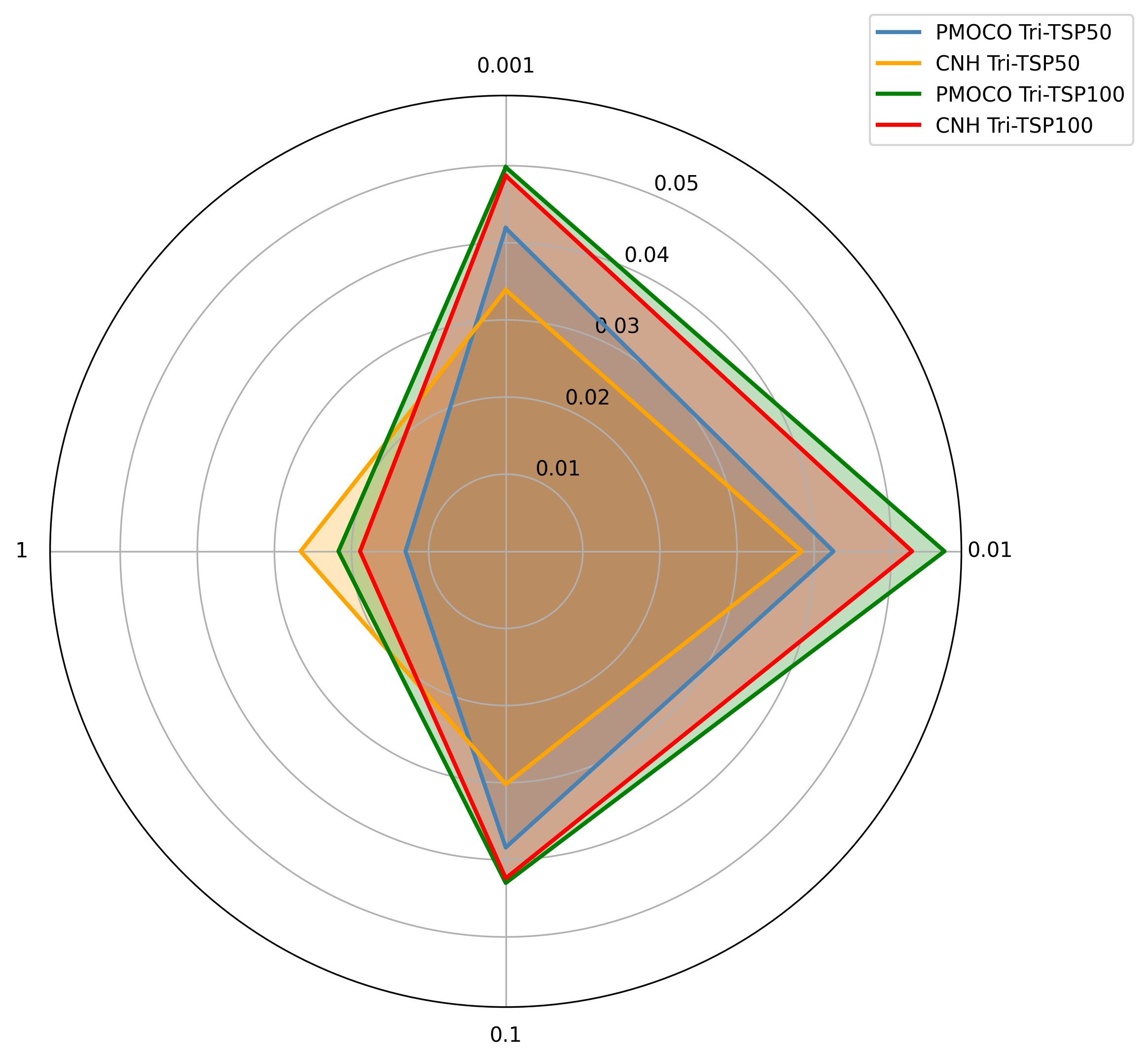
Deep reinforcement learning (DRL) has shown great promise in addressing multi-objective combinatorial optimization problems (MOCOPs). Nevertheless, the robustness of these learning-based solvers has remained insufficiently explored, especially across diverse and complex problem distributions. In this paper, we propose a unified robustness-oriented framework for preference-conditioned DRL solvers for MOCOPs. Within this framework, we develop a preference-based adversarial attack to generate hard instances that expose solver weaknesses, and quantify the attack impact by the resulting degradation on Pareto-front quality. We further introduce a defense strategy that integrates hardness-aware preference selection into adversarial training to reduce overfitting to restricted preference regions and improve out-of-distribution performance. The experimental results on multi-objective traveling salesman problem (MOTSP), multi-objective capacitated vehicle routing problem (MOCVRP), and multi-objective knapsack problem (MOKP) verify that our attack method successfully learns hard instances for different solvers. Furthermore, our defense method significantly strengthens the robustness and generalizability of neural solvers, delivering superior performance on hard or out-of-distribution instances.

paper research
AutoFed  Manual-Free Federated Traffic Prediction via Personalized Prompt

AutoFed Manual-Free Federated Traffic Prediction via Personalized Prompt

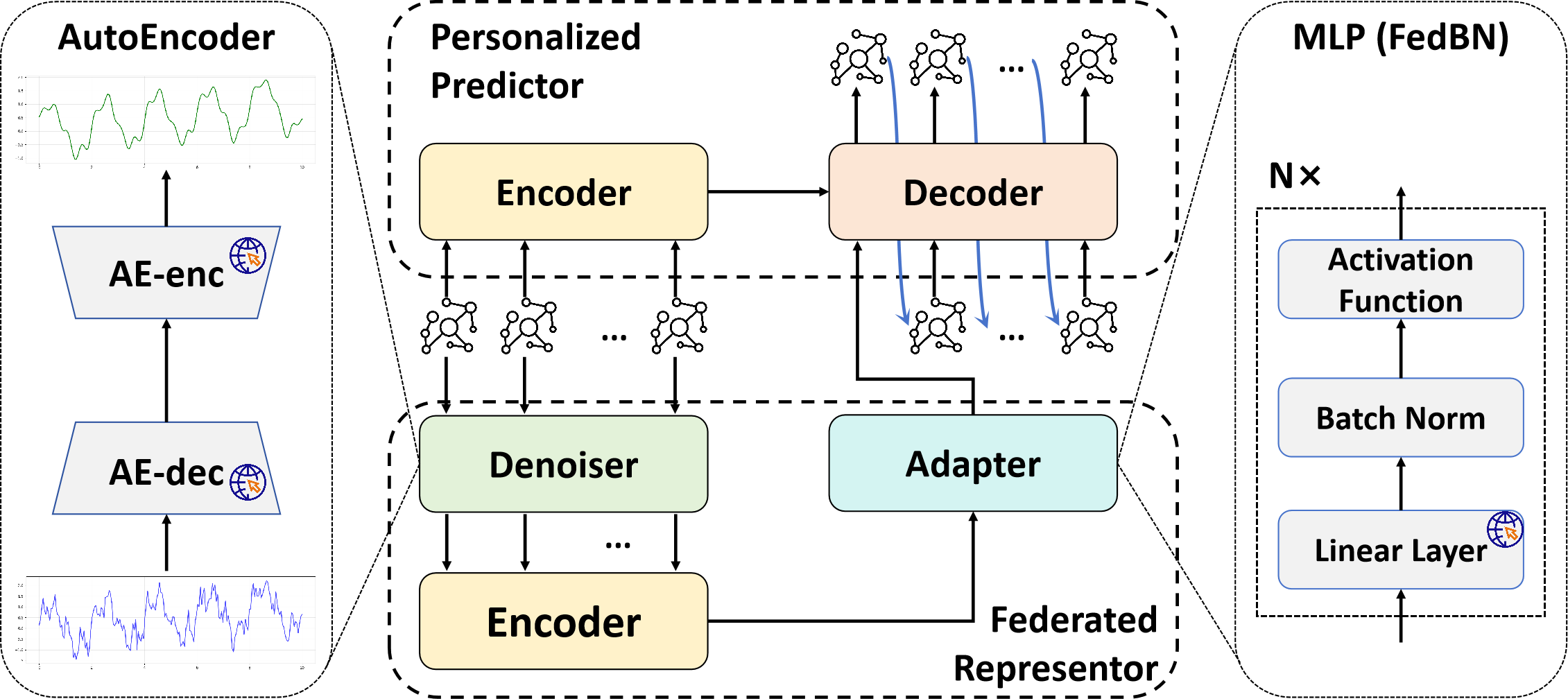
Accurate traffic prediction is essential for Intelligent Transportation Systems, including ride-hailing, urban road planning, and vehicle fleet management. However, due to significant privacy concerns surrounding traffic data, most existing methods rely on local training, resulting in data silos and limited knowledge sharing. Federated Learning (FL) offers an efficient solution through privacy-preserving collaborative training; however, standard FL struggles with the non-independent and identically distributed (non-IID) problem among clients. This challenge has led to the emergence of Personalized Federated Learning (PFL) as a promising paradigm. Nevertheless, current PFL frameworks require further adaptation for traffic prediction tasks, such as specialized graph feature engineering, data processing, and network architecture design. A notable limitation of many prior studies is their reliance on hyper-parameter optimization across datasets-information that is often unavailable in real-world scenarios-thus impeding practical deployment. To address this challenge, we propose AutoFed, a novel PFL framework for traffic prediction that eliminates the need for manual hyper-parameter tuning. Inspired by prompt learning, AutoFed introduces a federated representor that employs a client-aligned adapter to distill local data into a compact, globally shared prompt matrix. This prompt then conditions a personalized predictor, allowing each client to benefit from cross-client knowledge while maintaining local specificity. Extensive experiments on real-world datasets demonstrate that AutoFed consistently achieves superior performance across diverse scenarios. The code of this paper is provided at https //github.com/RS2002/AutoFed .

paper research
Avatar Forcing  Real-Time Interactive Head Avatar Generation for Natural Conversation

Avatar Forcing Real-Time Interactive Head Avatar Generation for Natural Conversation

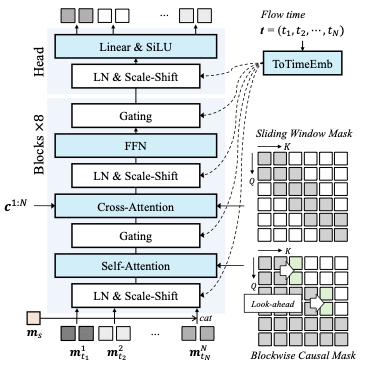
Talking head generation creates lifelike avatars from static portraits for virtual communication and content creation. However, current models do not yet convey the feeling of truly interactive communication, often generating one-way responses that lack emotional engagement. We identify two key challenges toward truly interactive avatars generating motion in real-time under causal constraints and learning expressive, vibrant reactions without additional labeled data. To address these challenges, we propose Avatar Forcing, a new framework for interactive head avatar generation that models real-time user-avatar interactions through diffusion forcing. This design allows the avatar to process real-time multimodal inputs, including the user s audio and motion, with low latency for instant reactions to both verbal and non-verbal cues such as speech, nods, and laughter. Furthermore, we introduce a direct preference optimization method that leverages synthetic losing samples constructed by dropping user conditions, enabling label-free learning of expressive interaction. Experimental results demonstrate that our framework enables real-time interaction with low latency (approximately 500ms), achieving 6.8X speedup compared to the baseline, and produces reactive and expressive avatar motion, which is preferred over 80% against the baseline.

paper research
BandiK  Efficient Multi-Task Decomposition Using a Multi-Bandit Framework

BandiK Efficient Multi-Task Decomposition Using a Multi-Bandit Framework

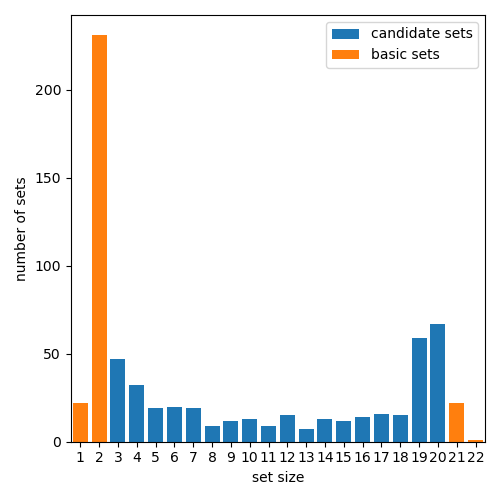
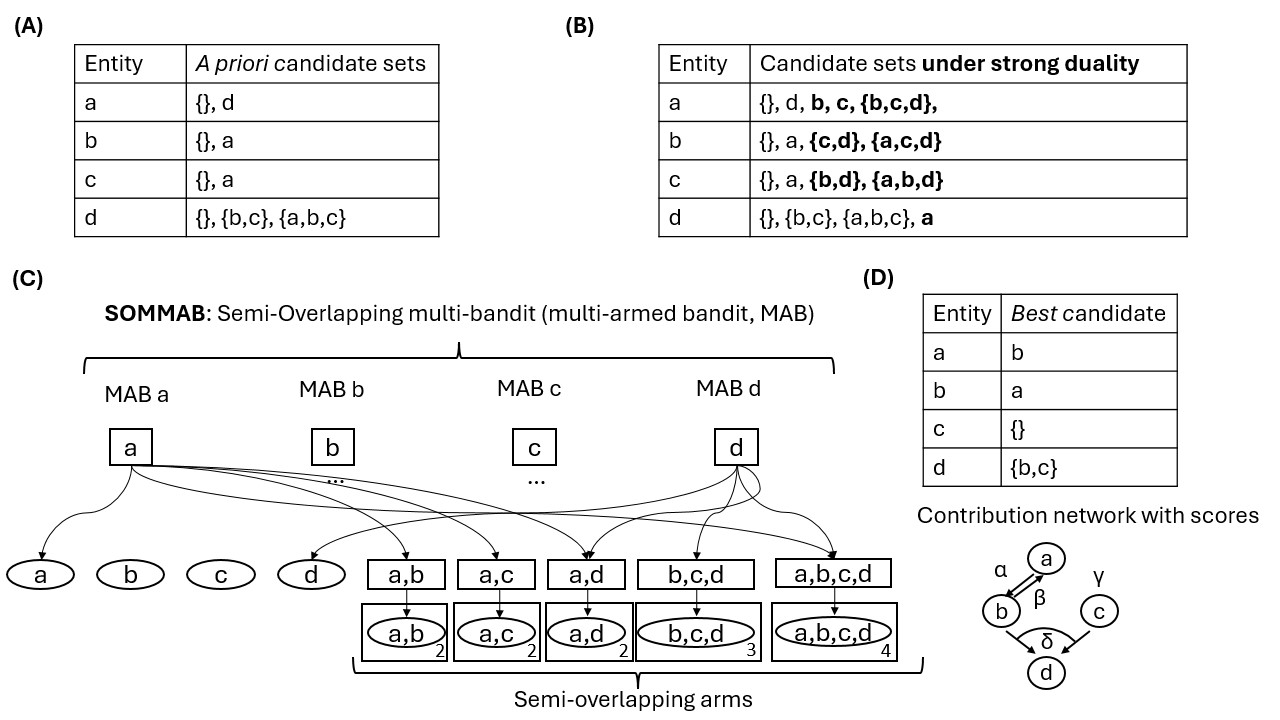
The challenge of effectively transferring knowledge across multiple tasks is of critical importance and is also present in downstream tasks with foundation models. However, the nature of transfer, its transitive-intransitive nature, is still an open problem, and negative transfer remains a significant obstacle. Selection of beneficial auxiliary task sets in multi-task learning is frequently hindered by the high computational cost of their evaluation, the high number of plausible candidate auxiliary sets, and the varying complexity of selection across target tasks. To address these constraints, we introduce BandiK, a novel three-stage multi-task auxiliary task subset selection method using multi-bandits, where each arm pull evaluates candidate auxiliary sets by training and testing a multiple output neural network on a single random train-test dataset split. Firstly, BandiK estimates the pairwise transfers between tasks, which helps in identifying which tasks are likely to benefit from joint learning. In the second stage, it constructs a linear number of candidate sets of auxiliary tasks (in the number of all tasks) for each target task based on the initial estimations, significantly reducing the exponential number of potential auxiliary task sets. Thirdly, it employs a Multi-Armed Bandit (MAB) framework for each task, where the arms correspond to the performance of candidate auxiliary sets realized as multiple output neural networks over train-test data set splits. To enhance efficiency, BandiK integrates these individual task-specific MABs into a multi-bandit structure. The proposed multi-bandit solution exploits that the same neural network realizes multiple arms of different individual bandits corresponding to a given candidate set. This semi-overlapping arm property defines a novel multi-bandit cost/reward structure utilized in BandiK.
paper research
Bayesian Geometry in Large Language Models

Bayesian Geometry in Large Language Models

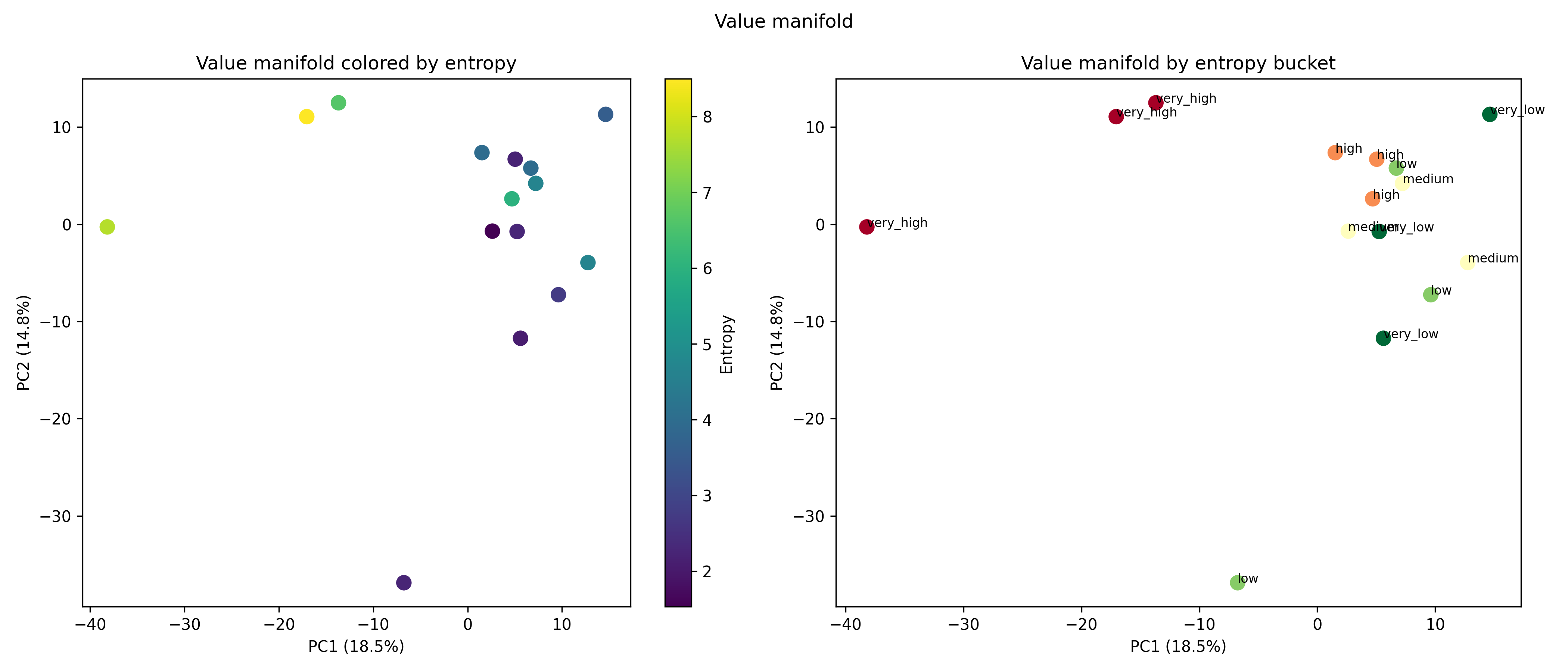
Recent work has shown that small transformers trained in controlled wind-tunnel settings can implement exact Bayesian inference, and that their training dynamics produce a geometric substrate -- low-dimensional value manifolds and progressively orthogonal keys -- that encodes posterior structure. We investigate whether this geometric signature persists in production-grade language models. Across Pythia, Phi-2, Llama-3, and Mistral families, we find that last-layer value representations organize along a single dominant axis whose position strongly correlates with predictive entropy, and that domain-restricted prompts collapse this structure into the same low-dimensional manifolds observed in synthetic settings. To probe the role of this geometry, we perform targeted interventions on the entropy-aligned axis of Pythia-410M during in-context learning. Removing or perturbing this axis selectively disrupts the local uncertainty geometry, whereas matched random-axis interventions leave it intact. However, these single-layer manipulations do not produce proportionally specific degradation in Bayesian-like behavior, indicating that the geometry is a privileged readout of uncertainty rather than a singular computational bottleneck. Taken together, our results show that modern language models preserve the geometric substrate that enables Bayesian inference in wind tunnels, and organize their approximate Bayesian updates along this substrate.
paper research
No Image

Benchmarking the Computational and Representational Efficiency of State Space Models against Transformers on Long-Context Dyadic Sessions

State Space Models (SSMs) have emerged as a promising alternative to Transformers for long-context sequence modeling, offering linear $O(N)$ computational complexity compared to the Transformer s quadratic $O(N^2)$ scaling. This paper presents a comprehensive benchmarking study comparing the Mamba SSM against the LLaMA Transformer on long-context sequences, using dyadic therapy sessions as a representative test case. We evaluate both architectures across two dimensions (1) computational efficiency, where we measure memory usage and inference speed from 512 to 8,192 tokens, and (2) representational efficiency, where we analyze hidden state dynamics and attention patterns. Our findings provide actionable insights for practitioners working with long-context applications, establishing precise conditions under which SSMs offer advantages over Transformers.

paper research
Beyond Invariance  Le Cam s Path to Robust Transfer Learning

Beyond Invariance Le Cam s Path to Robust Transfer Learning

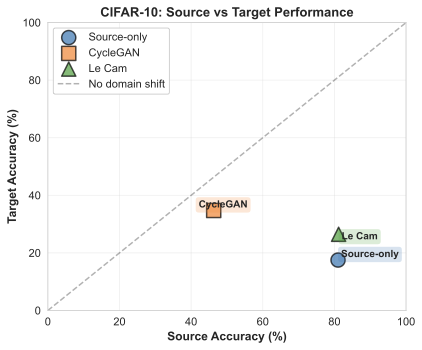
Distribution shift is the defining challenge of real-world machine learning. The dominant paradigm--Unsupervised Domain Adaptation (UDA)--enforces feature invariance, aligning source and target representations via symmetric divergence minimization [Ganin et al., 2016]. We demonstrate that this approach is fundamentally flawed when domains are unequally informative (e.g., high-quality vs degraded sensors), strict invariance necessitates information destruction, causing negative transfer that can be catastrophic in safety-critical applications [Wang et al., 2019]. We propose a decision-theoretic framework grounded in Le Cam s theory of statistical experiments [Le Cam, 1986], using constructive approximations to replace symmetric invariance with directional simulability. We introduce Le Cam Distortion, quantified by the Deficiency Distance $δ(E_1, E_2)$, as a rigorous upper bound for transfer risk conditional on simulability. Our framework enables transfer without source degradation by learning a kernel that simulates the target from the source. Across five experiments (genomics, vision, reinforcement learning), Le Cam Distortion achieves (1) near-perfect frequency estimation in HLA genomics (correlation $r=0.999$, matching classical methods), (2) zero source utility loss in CIFAR-10 image classification (81.2% accuracy preserved vs 34.7% drop for CycleGAN), and (3) safe policy transfer in RL control where invariance-based methods suffer catastrophic collapse. Le Cam Distortion provides the first principled framework for risk-controlled transfer learning in domains where negative transfer is unacceptable medical imaging, autonomous systems, and precision medicine.

paper research
Beyond Solo Giants  The Power of Multi-Model Teams

Beyond Solo Giants The Power of Multi-Model Teams

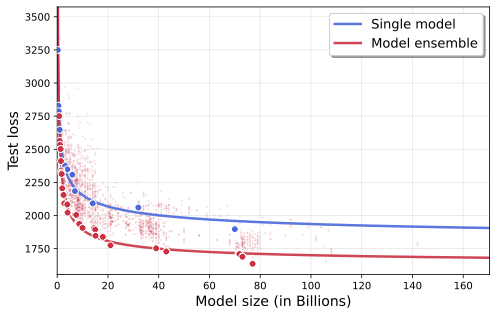
Recent advances in large language models (LLMs) have been largely driven by scaling laws for individual models, which predict performance improvements as model parameters and data volume increase. However, the capabilities of any single LLM are inherently bounded. One solution originates from intricate interactions among multiple LLMs, rendering their collective performance surpasses that of any constituent model. Despite the rapid proliferation of multi-model integration techniques such as model routing and post-hoc ensembling, a unifying theoretical framework of performance scaling for multi-model collaboration remains absent. In this work, we propose the Law of Multi-model Collaboration, a scaling law that predicts the performance limits of LLM ensembles based on their aggregated parameter budget. To quantify the intrinsic upper bound of multi-model collaboration, we adopt a method-agnostic formulation and assume an idealized integration oracle where the total cross-entropy loss of each sample is determined by the minimum loss of any model in the model pool. Experimental results reveal that multi-model systems follow a power-law scaling with respect to the total parameter count, exhibiting a more significant improvement trend and a lower theoretical loss floor compared to single model scaling. Moreover, ensembles of heterogeneous model families achieve better performance scaling than those formed within a single model family, indicating that model diversity is a primary driver of collaboration gains. These findings suggest that model collaboration represents a critical axis for extending the intelligence frontier of LLMs.

paper research
Bridging the Semantic Gap for Categorical Data Clustering via Large Language Models

Bridging the Semantic Gap for Categorical Data Clustering via Large Language Models

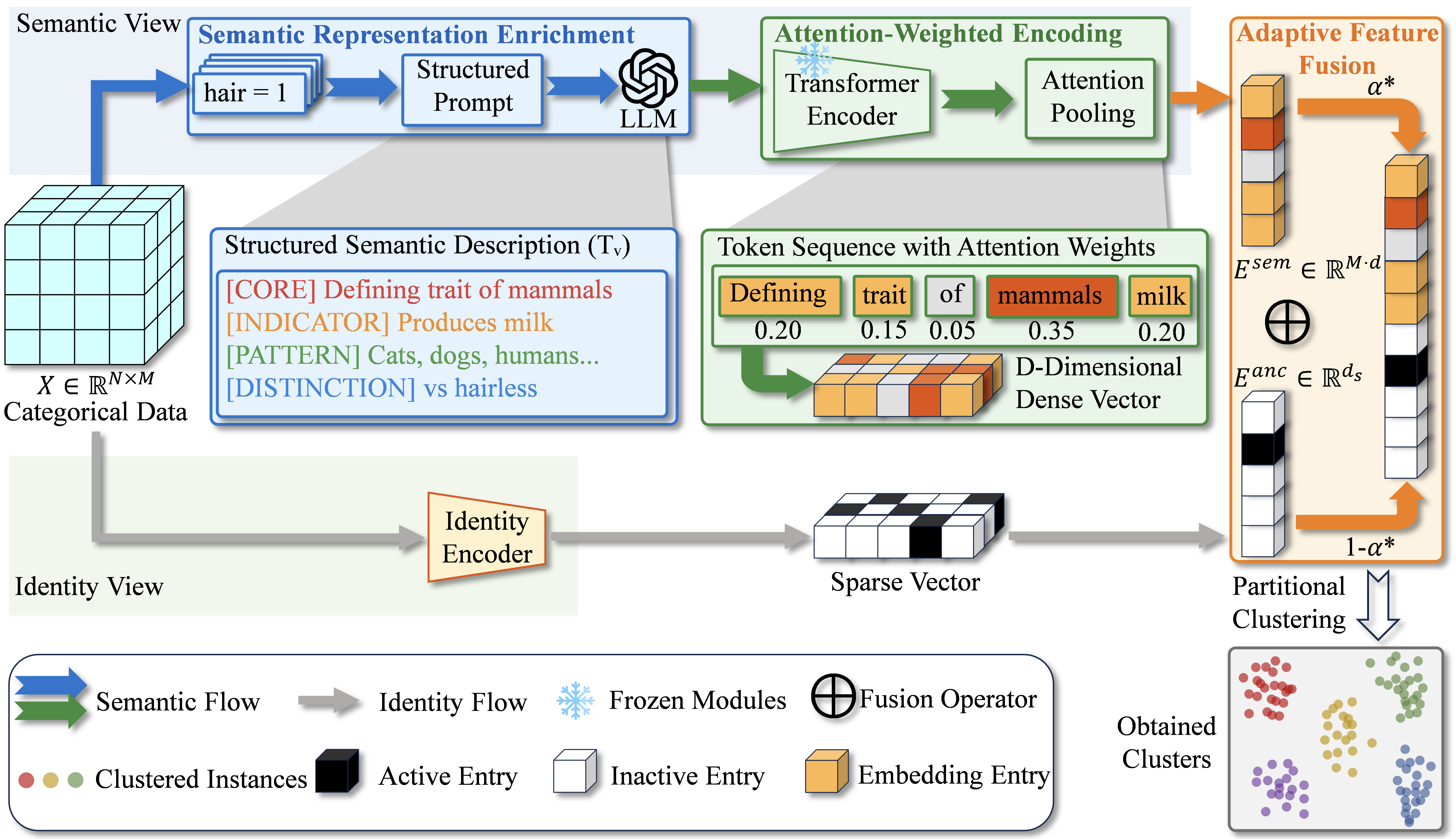
Categorical data are prevalent in domains such as healthcare, marketing, and bioinformatics, where clustering serves as a fundamental tool for pattern discovery. A core challenge in categorical data clustering lies in measuring similarity among attribute values that lack inherent ordering or distance. Without appropriate similarity measures, values are often treated as equidistant, creating a semantic gap that obscures latent structures and degrades clustering quality. Although existing methods infer value relationships from within-dataset co-occurrence patterns, such inference becomes unreliable when samples are limited, leaving the semantic context of the data underexplored. To bridge this gap, we present ARISE (Attention-weighted Representation with Integrated Semantic Embeddings), which draws on external semantic knowledge from Large Language Models (LLMs) to construct semantic-aware representations that complement the metric space of categorical data for accurate clustering. That is, LLM is adopted to describe attribute values for representation enhancement, and the LLM-enhanced embeddings are combined with the original data to explore semantically prominent clusters. Experiments on eight benchmark datasets demonstrate consistent improvements over seven representative counterparts, with gains of 19-27%. Code is available at https //github.com/develop-yang/ARISE

paper research
CoLog  Multimodal Anomaly Detection in OS Logs

CoLog Multimodal Anomaly Detection in OS Logs

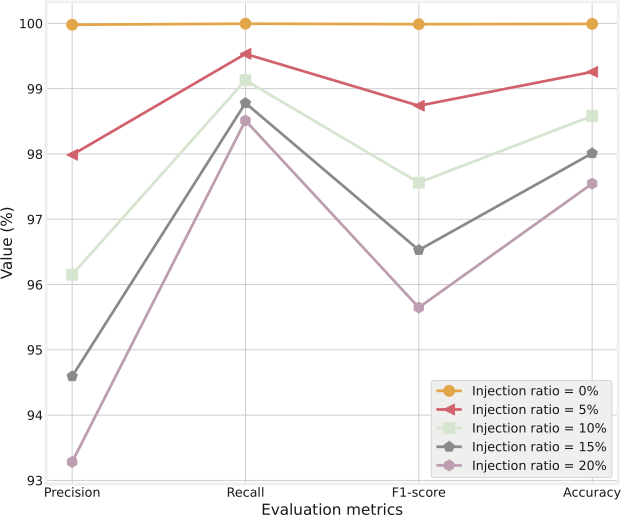
Log anomaly detection is crucial for preserving the security of operating systems. Depending on the source of log data collection, various information is recorded in logs that can be considered log modalities. In light of this intuition, unimodal methods often struggle by ignoring the different modalities of log data. Meanwhile, multimodal methods fail to handle the interactions between these modalities. Applying multimodal sentiment analysis to log anomaly detection, we propose CoLog, a framework that collaboratively encodes logs utilizing various modalities. CoLog utilizes collaborative transformers and multi-head impressed attention to learn interactions among several modalities, ensuring comprehensive anomaly detection. To handle the heterogeneity caused by these interactions, CoLog incorporates a modality adaptation layer, which adapts the representations from different log modalities. This methodology enables CoLog to learn nuanced patterns and dependencies within the data, enhancing its anomaly detection capabilities. Extensive experiments demonstrate CoLog s superiority over existing state-of-the-art methods. Furthermore, in detecting both point and collective anomalies, CoLog achieves a mean precision of 99.63%, a mean recall of 99.59%, and a mean F1 score of 99.61% across seven benchmark datasets for log-based anomaly detection. The comprehensive detection capabilities of CoLog make it highly suitable for cybersecurity, system monitoring, and operational efficiency. CoLog represents a significant advancement in log anomaly detection, providing a sophisticated and effective solution to point and collective anomaly detection through a unified framework and a solution to the complex challenges automatic log data analysis poses. We also provide the implementation of CoLog at https //github.com/NasirzadehMoh/CoLog.

paper research
Combatting Reward Hacking through Information-Theoretic Bias Reduction

Combatting Reward Hacking through Information-Theoretic Bias Reduction

Reward models (RMs) are essential in reinforcement learning from human feedback (RLHF) to align large language models (LLMs) with human values. However, RM training data is commonly recognized as low-quality, containing inductive biases that can easily lead to overfitting and reward hacking. For example, more detailed and comprehensive responses are usually human-preferred but with more words, leading response length to become one of the inevitable inductive biases. A limited number of prior RM debiasing approaches either target a single specific type of bias or model the problem with only simple linear correlations, textit{e.g.}, Pearson coefficients. To mitigate more complex and diverse inductive biases in reward modeling, we introduce a novel information-theoretic debiasing method called textbf{D}ebiasing via textbf{I}nformation optimization for textbf{R}M (DIR). Inspired by the information bottleneck (IB), we maximize the mutual information (MI) between RM scores and human preference pairs, while minimizing the MI between RM outputs and biased attributes of preference inputs. With theoretical justification from information theory, DIR can handle more sophisticated types of biases with non-linear correlations, broadly extending the real-world application scenarios for RM debiasing methods. In experiments, we verify the effectiveness of DIR with three types of inductive biases textit{response length}, textit{sycophancy}, and textit{format}. We discover that DIR not only effectively mitigates target inductive biases but also enhances RLHF performance across diverse benchmarks, yielding better generalization abilities. The code and training recipes are available at https //github.com/Qwen-Applications/DIR.

paper research
Complexity-based code embeddings

Complexity-based code embeddings

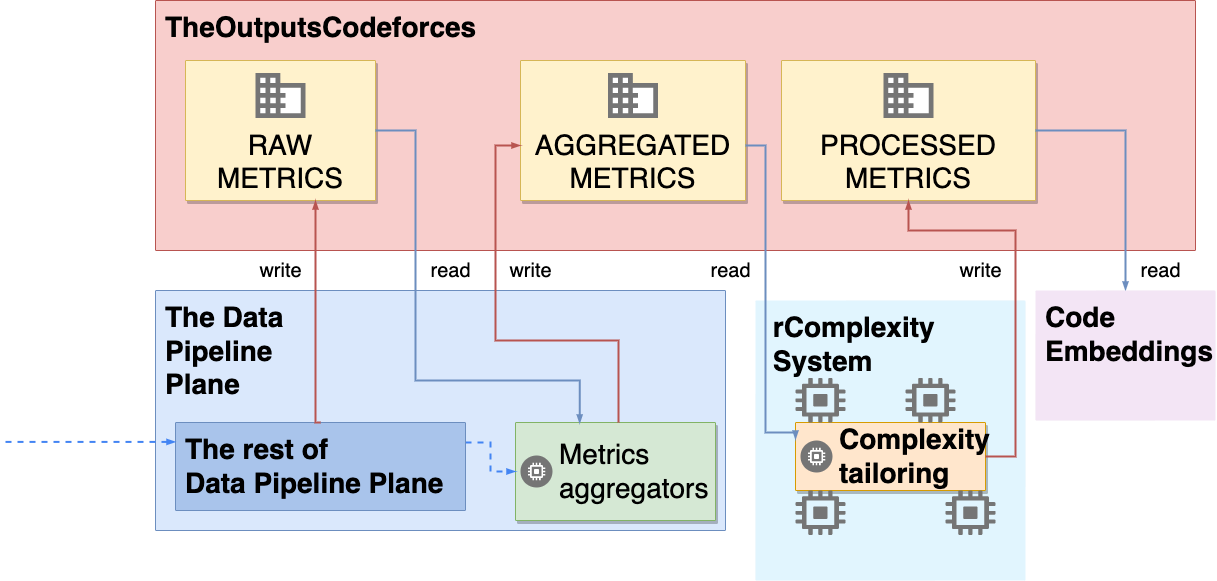
This paper presents a generic method for transforming the source code of various algorithms to numerical embeddings, by dynamically analysing the behaviour of computer programs against different inputs and by tailoring multiple generic complexity functions for the analysed metrics. The used algorithms embeddings are based on r-Complexity . Using the proposed code embeddings, we present an implementation of the XGBoost algorithm that achieves an average F1-score on a multi-label dataset with 11 classes, built using real-world code snippets submitted for programming competitions on the Codeforces platform.

paper research
Data Complexity-aware Deep Model Performance Forecasting

Data Complexity-aware Deep Model Performance Forecasting

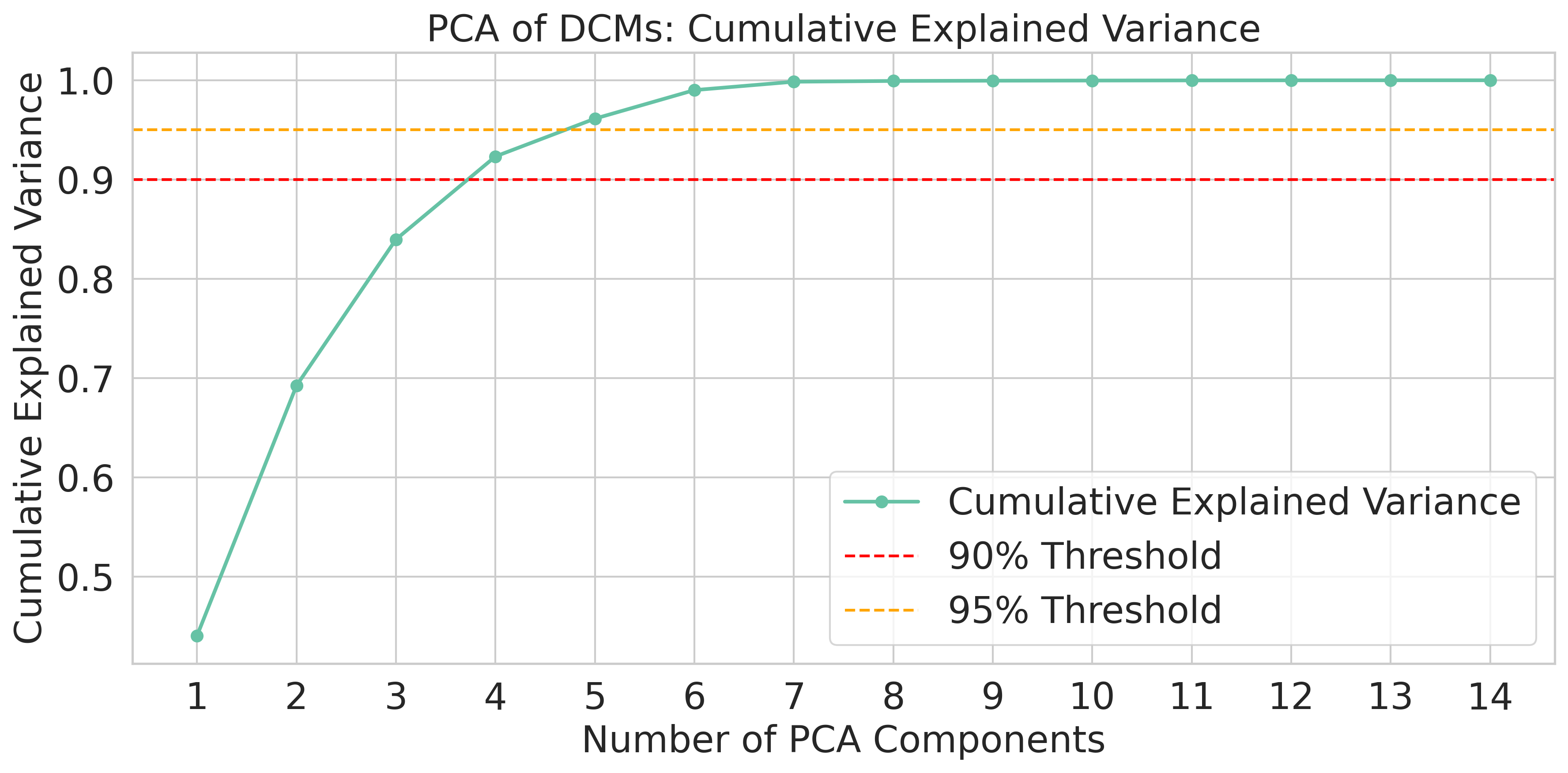
Deep learning models are widely used across computer vision and other domains. When working on the model induction, selecting the right architecture for a given dataset often relies on repetitive trial-and-error procedures. This procedure is time-consuming, resource-intensive, and difficult to automate. While previous work has explored performance prediction using partial training or complex simulations, these methods often require significant computational overhead or lack generalizability. In this work, we propose an alternative approach a lightweight, two-stage framework that can estimate model performance before training given the understanding of the dataset and the focused deep model structures. The first stage predicts a baseline based on the analysis of some measurable properties of the dataset, while the second stage adjusts the estimation with additional information on the model s architectural and hyperparameter details. The setup allows the framework to generalize across datasets and model types. Moreover, we find that some of the underlying features used for prediction - such as dataset variance - can offer practical guidance for model selection, and can serve as early indicators of data quality. As a result, the framework can be used not only to forecast model performance, but also to guide architecture choices, inform necessary preprocessing procedures, and detect potentially problematic datasets before training begins.

paper research
Data-Driven Assessment of Concrete Mixture Compositions on Chloride Transport via Standalone Machine Learning Algorithms

Data-Driven Assessment of Concrete Mixture Compositions on Chloride Transport via Standalone Machine Learning Algorithms

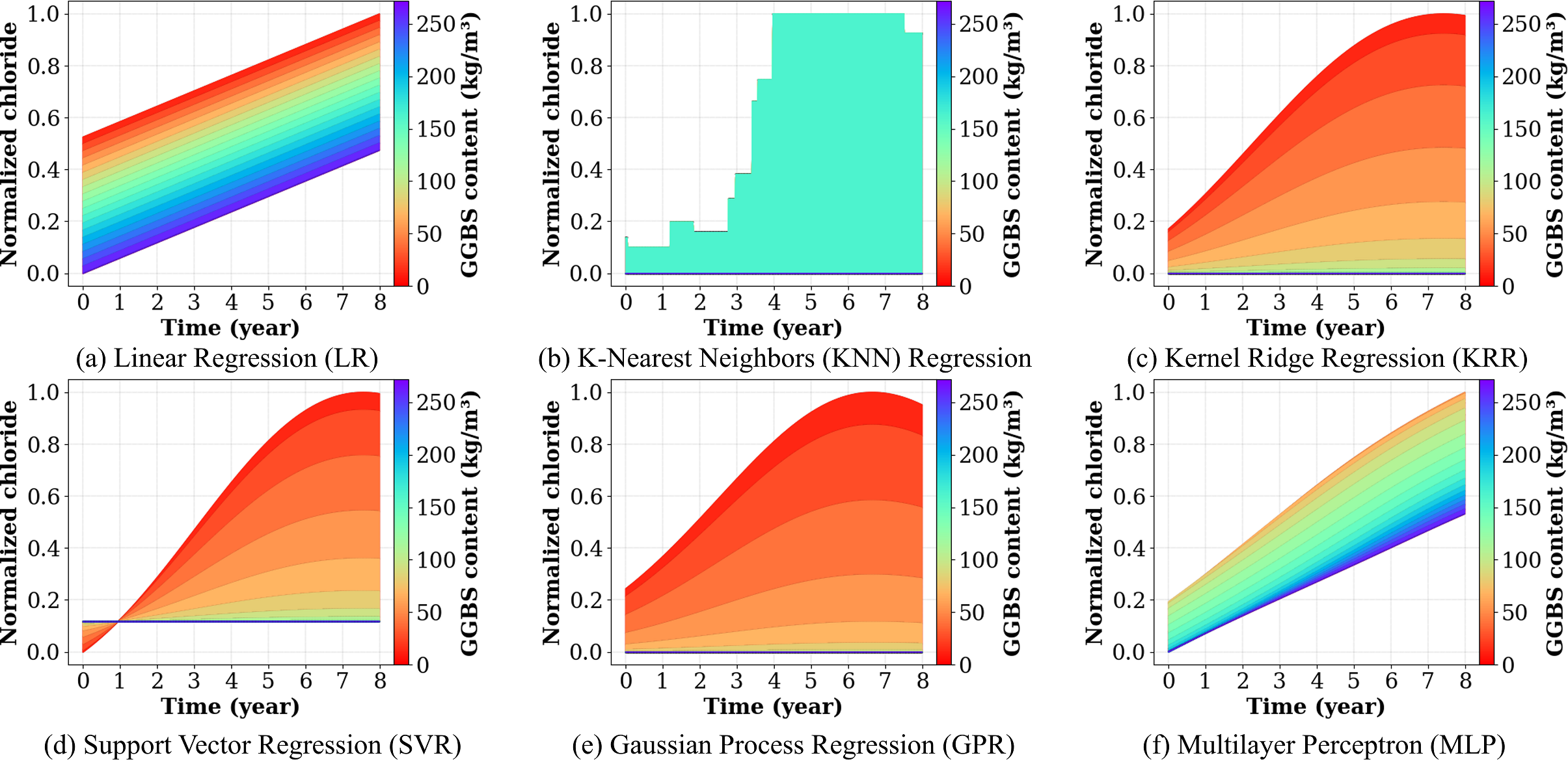
This paper employs a data-driven approach to determine the impact of concrete mixture compositions on the temporal evolution of chloride in concrete structures. This is critical for assessing the service life of civil infrastructure subjected to aggressive environments. The adopted methodology relies on several simple and complex standalone machine learning (ML) algorithms, with the primary objective of establishing confidence in the unbiased prediction of the underlying hidden correlations. The simple algorithms include linear regression (LR), k-nearest neighbors (KNN) regression, and kernel ridge regression (KRR). The complex algorithms entail support vector regression (SVR), Gaussian process regression (GPR), and two families of artificial neural networks, including a feedforward network (multilayer perceptron, MLP) and a gated recurrent unit (GRU). The MLP architecture cannot explicitly handle sequential data, a limitation addressed by the GRU. A comprehensive dataset is considered. The performance of ML algorithms is evaluated, with KRR, GPR, and MLP exhibiting high accuracy. Given the diversity of the adopted concrete mixture proportions, the GRU was unable to accurately reproduce the response in the test set. Further analyses elucidate the contributions of mixture compositions to the temporal evolution of chloride. The results obtained from the GPR model unravel latent correlations through clear and explainable trends. The MLP, SVR, and KRR also provide acceptable estimates of the overall trends. The majority of mixture components exhibit an inverse relation with chloride content, while a few components demonstrate a direct correlation. These findings highlight the potential of surrogate approaches for describing the physical processes involved in chloride ingress and the associated correlations, toward the ultimate goal of enhancing the service life of civil infrastructure.

paper research
DatBench  Discriminative, Faithful, and Efficient VLM Evaluations

DatBench Discriminative, Faithful, and Efficient VLM Evaluations

Empirical evaluation serves as the primary compass guiding research progress in foundation models. Despite a large body of work focused on training frontier vision-language models (VLMs), approaches to their evaluation remain nascent. To guide their maturation, we propose three desiderata that evaluations should satisfy (1) faithfulness to the modality and application, (2) discriminability between models of varying quality, and (3) efficiency in compute. Through this lens, we identify critical failure modes that violate faithfulness and discriminability, misrepresenting model capabilities (i) multiple-choice formats reward guessing, poorly reflect downstream use cases, and saturate early as models improve; (ii) blindly solvable questions, which can be answered without images, constitute up to 70% of some evaluations; and (iii) mislabeled or ambiguous samples compromise up to 42% of examples in certain datasets. Regarding efficiency, the computational burden of evaluating frontier models has become prohibitive by some accounts, nearly 20% of development compute is devoted to evaluation alone. Rather than discarding existing benchmarks, we curate them via transformation and filtering to maximize fidelity and discriminability. We find that converting multiple-choice questions to generative tasks reveals sharp capability drops of up to 35%. In addition, filtering blindly solvable and mislabeled samples improves discriminative power while simultaneously reducing computational cost. We release DatBench-Full, a cleaned evaluation suite of 33 datasets spanning nine VLM capabilities, and DatBench, a discriminative subset that achieves 13x average speedup (up to 50x) while closely matching the discriminative power of the original datasets. Our work outlines a path toward evaluation practices that are both rigorous and sustainable as VLMs continue to scale.

paper research
No Image

Deep Delta Learning

The efficacy of deep residual networks is fundamentally predicated on the identity shortcut connection. While this mechanism effectively mitigates the vanishing gradient problem, it imposes a strictly additive inductive bias on feature transformations, thereby limiting the network s capacity to model complex state transitions. In this paper, we introduce Deep Delta Learning (DDL), a novel architecture that generalizes the standard residual connection by modulating the identity shortcut with a learnable, data-dependent geometric transformation. This transformation, termed the Delta Operator, constitutes a rank-1 perturbation of the identity matrix, parameterized by a reflection direction vector $ mathbf{k}( mathbf{X})$ and a gating scalar $β( mathbf{X})$. We provide a spectral analysis of this operator, demonstrating that the gate $β( mathbf{X})$ enables dynamic interpolation between identity mapping, orthogonal projection, and geometric reflection. Furthermore, we restructure the residual update as a synchronous rank-1 injection, where the gate acts as a dynamic step size governing both the erasure of old information and the writing of new features. This unification empowers the network to explicitly control the spectrum of its layer-wise transition operator, enabling the modeling of complex, non-monotonic dynamics while preserving the stable training characteristics of gated residual architectures.

paper research
No Image

Deep Networks Learn Deep Hierarchical Models

We consider supervised learning with $n$ labels and show that layerwise SGD on residual networks can efficiently learn a class of hierarchical models. This model class assumes the existence of an (unknown) label hierarchy $L_1 subseteq L_2 subseteq dots subseteq L_r = [n]$, where labels in $L_1$ are simple functions of the input, while for $i > 1$, labels in $L_i$ are simple functions of simpler labels. Our class surpasses models that were previously shown to be learnable by deep learning algorithms, in the sense that it reaches the depth limit of efficient learnability. That is, there are models in this class that require polynomial depth to express, whereas previous models can be computed by log-depth circuits. Furthermore, we suggest that learnability of such hierarchical models might eventually form a basis for understanding deep learning. Beyond their natural fit for domains where deep learning excels, we argue that the mere existence of human ``teachers supports the hypothesis that hierarchical structures are inherently available. By providing granular labels, teachers effectively reveal ``hints or ``snippets of the internal algorithms used by the brain. We formalize this intuition, showing that in a simplified model where a teacher is partially aware of their internal logic, a hierarchical structure emerges that facilitates efficient learnability.

paper research
DéjàQ  Open-Ended Evolution of Diverse, Learnable and Verifiable Problems

DéjàQ Open-Ended Evolution of Diverse, Learnable and Verifiable Problems

Recent advances in reasoning models have yielded impressive results in mathematics and coding. However, most approaches rely on static datasets, which have been suggested to encourage memorisation and limit generalisation. We introduce DéjàQ, a framework that departs from this paradigm by jointly evolving a diverse set of synthetic mathematical problems alongside model training. This evolutionary process adapts to the model s ability throughout training, optimising problems for learnability. We propose two LLM-driven mutation strategies in which the model itself mutates the training data, either by altering contextual details or by directly modifying problem structure. We find that the model can generate novel and meaningful problems, and that these LLM-driven mutations improve RL training. We analyse key aspects of DéjàQ, including the validity of generated problems and computational overhead. Our results underscore the potential of dynamically evolving training data to enhance mathematical reasoning and indicate broader applicability, which we will support by open-sourcing our code.

paper research
Dynamic Large Concept Models  Latent Reasoning in an Adaptive Semantic Space

Dynamic Large Concept Models Latent Reasoning in an Adaptive Semantic Space

Large Language Models (LLMs) apply uniform computation to all tokens, despite language exhibiting highly non-uniform information density. This token-uniform regime wastes capacity on locally predictable spans while under-allocating computation to semantically critical transitions. We propose $ textbf{Dynamic Large Concept Models (DLCM)}$, a hierarchical language modeling framework that learns semantic boundaries from latent representations and shifts computation from tokens to a compressed concept space where reasoning is more efficient. DLCM discovers variable-length concepts end-to-end without relying on predefined linguistic units. Hierarchical compression fundamentally changes scaling behavior. We introduce the first $ textbf{compression-aware scaling law}$, which disentangles token-level capacity, concept-level reasoning capacity, and compression ratio, enabling principled compute allocation under fixed FLOPs. To stably train this heterogeneous architecture, we further develop a $ textbf{decoupled $μ$P parametrization}$ that supports zero-shot hyperparameter transfer across widths and compression regimes. At a practical setting ($R=4$, corresponding to an average of four tokens per concept), DLCM reallocates roughly one-third of inference compute into a higher-capacity reasoning backbone, achieving a $ textbf{+2.69$ %$ average improvement}$ across 12 zero-shot benchmarks under matched inference FLOPs.

paper research
E-GRPO  High Entropy Steps Drive Effective Reinforcement Learning for Flow Models

E-GRPO High Entropy Steps Drive Effective Reinforcement Learning for Flow Models

Recent reinforcement learning has enhanced the flow matching models on human preference alignment. While stochastic sampling enables the exploration of denoising directions, existing methods which optimize over multiple denoising steps suffer from sparse and ambiguous reward signals. We observe that the high entropy steps enable more efficient and effective exploration while the low entropy steps result in undistinguished roll-outs. To this end, we propose E-GRPO, an entropy aware Group Relative Policy Optimization to increase the entropy of SDE sampling steps. Since the integration of stochastic differential equations suffer from ambiguous reward signals due to stochasticity from multiple steps, we specifically merge consecutive low entropy steps to formulate one high entropy step for SDE sampling, while applying ODE sampling on other steps. Building upon this, we introduce multi-step group normalized advantage, which computes group-relative advantages within samples sharing the same consolidated SDE denoising step. Experimental results on different reward settings have demonstrated the effectiveness of our methods.

paper research
Edge AI Surge  Hardware-Powered Real-Time Dynamics Prediction

Edge AI Surge Hardware-Powered Real-Time Dynamics Prediction

Physical AI at the edge -- enabling autonomous systems to understand and predict real-world dynamics in real time -- requires hardware-efficient learning and inference. Model recovery (MR), which identifies governing equations from sensor data, is a key primitive for safe and explainable monitoring in mission-critical autonomous systems operating under strict latency, compute, and power constraints. However, state-of-the-art MR methods (e.g., EMILY and PINN+SR) rely on Neural ODE formulations that require iterative solvers and are difficult to accelerate efficiently on edge hardware. We present textbf{MERINDA} (Model Recovery in Reconfigurable Dynamic Architecture), an FPGA-accelerated MR framework designed to make physical AI practical on resource-constrained devices. MERINDA replaces expensive Neural ODE components with a hardware-friendly formulation that combines (i) GRU-based discretized dynamics, (ii) dense inverse-ODE layers, (iii) sparsity-driven dropout, and (iv) lightweight ODE solvers. The resulting computation is structured for streaming parallelism, enabling critical kernels to be fully parallelized on the FPGA. Across four benchmark nonlinear dynamical systems, MERINDA delivers substantial gains over GPU implementations textbf{114$ times$ lower energy} (434~J vs. 49{,}375~J), textbf{28$ times$ smaller memory footprint} (214~MB vs. 6{,}118~MB), and textbf{1.68$ times$ faster training}, while matching state-of-the-art model-recovery accuracy. These results demonstrate that MERINDA can bring accurate, explainable MR to the edge for real-time monitoring of autonomous systems.

paper research
Efficient Deployment of OpenPangu Models with Post-Training Quantization

Efficient Deployment of OpenPangu Models with Post-Training Quantization

Huawei s openPangu-Embedded-1B and openPangu-Embedded-7B are variants of the openPangu large language model, designed for efficient deployment on Ascend NPUs. The 7B variant supports three distinct Chain-of-Thought (CoT) reasoning paradigms, namely slow_think, auto_think, and no_think, while the 1B variant operates exclusively in the no_think mode, which employs condensed reasoning for higher efficiency. Although CoT reasoning enhances capability, the generation of extended reasoning traces introduces substantial memory and latency overheads, posing challenges for practical deployment on Ascend NPUs. This paper addresses these computational constraints by leveraging low-bit quantization, which transforms FP16 computations into more efficient integer arithmetic. We introduce a unified low-bit inference framework, supporting INT8 (W8A8) and W4A8 quantization, specifically optimized for openPangu-Embedded models on the Atlas A2. Our comprehensive evaluation on code generation benchmarks (HumanEval and MBPP) demonstrates the efficacy of this approach. INT8 quantization consistently preserves over 90 % of the FP16 baseline accuracy and achieves a 1.5x prefill speedup on the Atlas A2. Furthermore, W4A8 quantization significantly reduces memory consumption, albeit with a moderate trade-off in accuracy. These findings collectively indicate that low-bit quantization effectively facilitates efficient CoT reasoning on Ascend NPUs, maintaining high model fidelity.

paper research
Entropy-Adaptive Fine-Tuning  Resolving Confident Conflicts to Mitigate Forgetting

Entropy-Adaptive Fine-Tuning Resolving Confident Conflicts to Mitigate Forgetting

Supervised Fine-Tuning (SFT) is the standard paradigm for domain adaptation, yet it frequently incurs the cost of catastrophic forgetting. In sharp contrast, on-policy Reinforcement Learning (RL) effectively preserves general capabilities. We investigate this discrepancy and identify a fundamental distributional gap while RL aligns with the model s internal belief, SFT forces the model to fit external supervision. This mismatch often manifests as Confident Conflicts tokens characterized by low probability but low entropy. In these instances, the model is highly confident in its own prediction but is forced to learn a divergent ground truth, triggering destructive gradient updates. To address this, we propose Entropy-Adaptive Fine-Tuning (EAFT). Unlike methods relying solely on prediction probability, EAFT utilizes token-level entropy as a gating mechanism to distinguish between epistemic uncertainty and knowledge conflict. This allows the model to learn from uncertain samples while suppressing gradients on conflicting data. Extensive experiments on Qwen and GLM series (ranging from 4B to 32B parameters) across mathematical, medical, and agentic domains confirm our hypothesis. EAFT consistently matches the downstream performance of standard SFT while significantly mitigating the degradation of general capabilities.

paper research
Escaping the Homogeneity Trap in DSM Deep Networks

Escaping the Homogeneity Trap in DSM Deep Networks

Doubly-stochastic matrices (DSM) are increasingly utilized in structure-preserving deep architectures -- such as Optimal Transport layers and Sinkhorn-based attention -- to enforce numerical stability and probabilistic interpretability. In this work, we identify a critical spectral degradation phenomenon inherent to these constraints, termed the Homogeneity Trap. We demonstrate that the maximum-entropy bias, typical of Sinkhorn-based projections, drives the mixing operator towards the uniform barycenter, thereby suppressing the subdominant singular value σ_2 and filtering out high-frequency feature components. We derive a spectral bound linking σ_2 to the network s effective depth, showing that high-entropy constraints restrict feature transformation to a shallow effective receptive field. Furthermore, we formally demonstrate that Layer Normalization fails to mitigate this collapse in noise-dominated regimes; specifically, when spectral filtering degrades the Signal-to-Noise Ratio (SNR) below a critical threshold, geometric structure is irreversibly lost to noise-induced orthogonal collapse. Our findings highlight a fundamental trade-off between entropic stability and spectral expressivity in DSM-constrained networks.

paper research
Evaluating Feature Dependent Noise in Preference-based Reinforcement Learning

Evaluating Feature Dependent Noise in Preference-based Reinforcement Learning

Learning from Preferences in Reinforcement Learning (PbRL) has gained attention recently, as it serves as a natural fit for complicated tasks where the reward function is not easily available. However, preferences often come with uncertainty and noise if they are not from perfect teachers. Much prior literature aimed to detect noise, but with limited types of noise and most being uniformly distributed with no connection to observations. In this work, we formalize the notion of targeted feature-dependent noise and propose several variants like trajectory feature noise, trajectory similarity noise, uncertainty-aware noise, and Language Model noise. We evaluate feature-dependent noise, where noise is correlated with certain features in complex continuous control tasks from DMControl and Meta-world. Our experiments show that in some feature-dependent noise settings, the state-of-the-art noise-robust PbRL method s learning performance is significantly deteriorated, while PbRL method with no explicit denoising can surprisingly outperform noise-robust PbRL in majority settings. We also find language model s noise exhibits similar characteristics to feature-dependent noise, thereby simulating realistic humans and call for further study in learning with feature-dependent noise robustly.

paper research
Evolving Networks, Shifting Datasets  A Stability Test

Evolving Networks, Shifting Datasets A Stability Test

Machine learning (ML) represents an efficient and popular approach for network traffic classification. However, network traffic classification is a challenging domain, and trained models may degrade soon after deployment due to the obsolete datasets and quick evolution of computer networks as new or updated protocols appear. Moreover, significant change in the behavior of a traffic type (and, therefore, the underlying features representing the traffic) can produce a large and sudden performance drop of the deployed model, known as a data or concept drift. In most cases, complete retraining is performed, often without further investigation of root causes, as good dataset quality is assumed. However, this is not always the case and further investigation must be performed. This paper proposes a novel methodology to evaluate the stability of datasets and a benchmark workflow that can be used to compare datasets. The proposed framework is based on a concept drift detection method that also uses ML feature weights to boost the detection performance. The benefits of this work are demonstrated on CESNET-TLS-Year22 dataset. We provide the initial dataset stability benchmark that is used to describe dataset stability and weak points to identify the next steps for optimization. Lastly, using the proposed benchmarking methodology, we show the optimization impact on the created dataset variants.

paper research
FedSCAM  Scam-resistant SAM for Robust Federated Optimization in Heterogeneous Environments

FedSCAM Scam-resistant SAM for Robust Federated Optimization in Heterogeneous Environments

Federated Learning (FL) enables collaborative model training across decentralized edge devices while preserving data privacy. However, statistical heterogeneity among clients, often manifested as non-IID label distributions, poses significant challenges to convergence and generalization. While Sharpness-Aware Minimization (SAM) has been introduced to FL to seek flatter, more robust minima, existing approaches typically apply a uniform perturbation radius across all clients, ignoring client-specific heterogeneity. In this work, we propose textbf{FedSCAM} (Federated Sharpness-Aware Minimization with Clustered Aggregation and Modulation), a novel algorithm that dynamically adjusts the SAM perturbation radius and aggregation weights based on client-specific heterogeneity scores. By calculating a heterogeneity metric for each client and modulating the perturbation radius inversely to this score, FedSCAM prevents clients with high variance from destabilizing the global model. Furthermore, we introduce a heterogeneity-aware weighted aggregation mechanism that prioritizes updates from clients that align with the global optimization direction. Extensive experiments on CIFAR-10 and Fashion-MNIST under various degrees of Dirichlet-based label skew demonstrate that FedSCAM achieves competitive performance among state-of-the-art baselines, including FedSAM, FedLESAM, etc. in terms of convergence speed and final test accuracy.

paper research
Flow Equivariant World Models  Memory for Partially Observed Dynamic Environments

Flow Equivariant World Models Memory for Partially Observed Dynamic Environments

Embodied systems experience the world as a symphony of flows a combination of many continuous streams of sensory input coupled to self-motion, interwoven with the dynamics of external objects. These streams obey smooth, time-parameterized symmetries, which combine through a precisely structured algebra; yet most neural network world models ignore this structure and instead repeatedly re-learn the same transformations from data. In this work, we introduce Flow Equivariant World Models , a framework in which both self-motion and external object motion are unified as one-parameter Lie group flows . We leverage this unification to implement group equivariance with respect to these transformations, thereby providing a stable latent world representation over hundreds of timesteps. On both 2D and 3D partially observed video world modeling benchmarks, we demonstrate that Flow Equivariant World Models significantly outperform comparable state-of-the-art diffusion-based and memory-augmented world modeling architectures -- particularly when there are predictable world dynamics outside the agent s current field of view. We show that flow equivariance is particularly beneficial for long rollouts, generalizing far beyond the training horizon. By structuring world model representations with respect to internal and external motion, flow equivariance charts a scalable route to data efficient, symmetry-guided, embodied intelligence. Project link https //flowequivariantworldmodels.github.io.

paper research
Generative Classifiers Avoid Shortcut Solutions

Generative Classifiers Avoid Shortcut Solutions

Discriminative approaches to classification often learn shortcuts that hold in-distribution but fail even under minor distribution shift. This failure mode stems from an overreliance on features that are spuriously correlated with the label. We show that generative classifiers, which use class-conditional generative models, can avoid this issue by modeling all features, both core and spurious, instead of mainly spurious ones. These generative classifiers are simple to train, avoiding the need for specialized augmentations, strong regularization, extra hyperparameters, or knowledge of the specific spurious correlations to avoid. We find that diffusion-based and autoregressive generative classifiers achieve state-of-the-art performance on five standard image and text distribution shift benchmarks and reduce the impact of spurious correlations in realistic applications, such as medical or satellite datasets. Finally, we carefully analyze a Gaussian toy setting to understand the inductive biases of generative classifiers, as well as the data properties that determine when generative classifiers outperform discriminative ones.

paper research
Geometric and Dynamic Scaling in Deep Transformers

Geometric and Dynamic Scaling in Deep Transformers

Despite their empirical success, pushing Transformer architectures to extreme depth often leads to a paradoxical failure representations become increasingly redundant, lose rank, and ultimately collapse. Existing explanations largely attribute this phenomenon to optimization instability or vanishing gradients, yet such accounts fail to explain why collapse persists even under modern normalization and initialization schemes. In this paper, we argue that the collapse of deep Transformers is fundamentally a geometric problem. Standard residual updates implicitly assume that feature accumulation is always beneficial, but offer no mechanism to constrain update directions or to erase outdated information. As depth increases, this leads to systematic drift off the semantic manifold and monotonic feature accumulation, causing representational degeneracy. We propose a unified geometric framework that addresses these failures through two orthogonal principles. First, manifold-constrained hyper-connections restrict residual updates to valid local tangent directions, preventing uncontrolled manifold drift. Second, deep delta learning introduces data-dependent, non-monotonic updates that enable reflection and erasure of redundant features rather than their unconditional accumulation. Together, these mechanisms decouple the direction and sign of feature updates, yielding a stable geometric evolution across depth. We term the resulting architecture the Manifold-Geometric Transformer (MGT). Our analysis predicts that enforcing geometric validity while allowing dynamic erasure is essential for avoiding rank collapse in ultra-deep networks. We outline an evaluation protocol for Transformers exceeding 100 layers to test the hypothesis that geometry, rather than depth itself, is the key limiting factor in deep representation learning.

paper research
Geometric Regularization in Mixture-of-Experts  The Disconnect Between Weights and Activations

Geometric Regularization in Mixture-of-Experts The Disconnect Between Weights and Activations

Mixture-of-Experts (MoE) models achieve efficiency through sparse activation, but the role of geometric regularization in expert specialization remains unclear. We apply orthogonality loss to enforce expert diversity and find it fails on multiple fronts it does not reduce weight-space overlap (MSO actually increases by up to 114%), activation-space overlap remains high (~0.6) regardless of regularization, and effects on performance are inconsistent -- marginal improvement on WikiText-103 (-0.9%), slight degradation on TinyStories (+0.9%), and highly variable results on PTB (std > 1.0). Our analysis across 7 regularization strengths reveals no significant correlation (r = -0.293, p = 0.523) between weight and activation orthogonality. These findings demonstrate that weight-space regularization neither achieves its geometric goal nor reliably improves performance, making it unsuitable for MoE diversity.

paper research
Geometry of Reason  Spectral Signatures of Valid Mathematical Reasoning

Geometry of Reason Spectral Signatures of Valid Mathematical Reasoning

We present a training-free method for detecting valid mathematical reasoning in large language models through spectral analysis of attention patterns. By treating attention matrices as adjacency matrices of dynamic graphs over tokens, we extract four interpretable spectral diagnostics, the Fiedler value (algebraic connectivity), high-frequency energy ratio (HFER), graph signal smoothness, and spectral entropy, that exhibit statistically significant differences between valid and invalid mathematical proofs. Experiments across seven transformer models from four independent architectural families (Meta Llama, Alibaba Qwen, Microsoft Phi, and Mistral AI) demonstrate that this spectral signature produces effect sizes up to Cohen s $d = 3.30$ ($p < 10^{-116}$), enabling 85.0--95.6 % classification accuracy under rigorous evaluation, with calibrated thresholds reaching 93--95 % on the full dataset. The method requires no training data, fine-tuning, or learned classifiers a single threshold on a spectral metric suffices for high accuracy. Through systematic label correction, we discover that the spectral method detects logical coherence rather than compiler acceptance, identifying mathematically valid proofs that formal verifiers reject due to technical failures. We further identify an architectural dependency Mistral-7B s Sliding Window Attention shifts the discriminative signal from HFER to late-layer Smoothness ($d = 2.09$, $p_{ text{MW}} = 1.16 times 10^{-48}$), revealing that attention mechanism design affects which spectral features capture reasoning validity. These findings establish spectral graph analysis as a principled framework for reasoning verification with immediate applications to hallucination detection and AI safety monitoring.

paper research
No Image

Hierarchical Agents Tackle Real-World SWE with Bandit Optimization

Large language models (LLMs) have shown strong reasoning and coding capabilities, yet they struggle to generalize to real-world software engineering (SWE) problems that are long-horizon and out of distribution. Existing systems often rely on a single agent to handle the entire workflow-interpreting issues, navigating large codebases, and implementing fixes-within one reasoning chain. Such monolithic designs force the model to retain irrelevant context, leading to spurious correlations and poor generalization. Motivated by how human engineers decompose complex problems, we propose structuring SWE agents as orchestrators coordinating specialized sub-agents for sub-tasks such as localization, editing, and validation. The challenge lies in discovering effective hierarchies automatically as the number of sub-agents grows, the search space becomes combinatorial, and it is difficult to attribute credit to individual sub-agents within a team. We address these challenges by formulating hierarchy discovery as a multi-armed bandit (MAB) problem, where each arm represents a candidate sub-agent and the reward measures its helpfulness when collaborating with others. This framework, termed Bandit Optimization for Agent Design (BOAD), enables efficient exploration of sub-agent designs under limited evaluation budgets. On SWE-bench-Verified, BOAD outperforms single-agent and manually designed multi-agent systems. On SWE-bench-Live, featuring more recent and out-of-distribution issues, our 36B system ranks second on the leaderboard at the time of evaluation, surpassing larger models such as GPT-4 and Claude. These results demonstrate that automatically discovered hierarchical multi-agent systems significantly improve generalization on challenging long-horizon SWE tasks. Code is available at https //github.com/iamxjy/BOAD-SWE-Agent.

paper research
No Image

HOLOGRAPH Active Causal Discovery via Sheaf-Theoretic Alignment of Large Language Model Priors

Causal discovery from observational data remains fundamentally limited by identifiability constraints. Recent work has explored leveraging Large Language Models (LLMs) as sources of prior causal knowledge, but existing approaches rely on heuristic integration that lacks theoretical grounding. We introduce HOLOGRAPH, a framework that formalizes LLM-guided causal discovery through sheaf theory--representing local causal beliefs as sections of a presheaf over variable subsets. Our key insight is that coherent global causal structure corresponds to the existence of a global section, while topological obstructions manifest as non-vanishing sheaf cohomology. We propose the Algebraic Latent Projection to handle hidden confounders and Natural Gradient Descent on the belief manifold for principled optimization. Experiments on synthetic and real-world benchmarks demonstrate that HOLOGRAPH provides rigorous mathematical foundations while achieving competitive performance on causal discovery tasks with 50-100 variables. Our sheaf-theoretic analysis reveals that while Identity, Transitivity, and Gluing axioms are satisfied to numerical precision (<10^{-6}), the Locality axiom fails for larger graphs, suggesting fundamental non-local coupling in latent variable projections. Code is available at [https //github.com/hyunjun1121/holograph](https //github.com/hyunjun1121/holograph).

paper research
HyperCLOVA X 8B Omni

HyperCLOVA X 8B Omni

In this report, we present HyperCLOVA X 8B Omni, the first any-to-any omnimodal model in the HyperCLOVA X family that supports text, audio, and vision as both inputs and outputs. By consolidating multimodal understanding and generation into a single model rather than separate modality-specific pipelines, HyperCLOVA X 8B Omni serves as an 8B-scale omni-pathfinding point toward practical any-to-any omni assistants. At a high level, the model unifies modalities through a shared next-token prediction interface over an interleaved multimodal sequence, while vision and audio encoders inject continuous embeddings for fine-grained understanding and grounding. Empirical evaluations demonstrate competitive performance against comparably sized models across diverse input-output combinations spanning text, audio, and vision, in both Korean and English. We anticipate that the open-weight release of HyperCLOVA X 8B Omni will support a wide range of research and deployment scenarios.

paper research
Infini-Attention  Boosting Small-Scale Pretraining Limits

Infini-Attention Boosting Small-Scale Pretraining Limits

This study investigates small-scale pretraining for Small Language Models (SLMs) to enable efficient use of limited data and compute, improve accessibility in low-resource settings and reduce costs. To enhance long-context extrapolation in compact models, we focus on Infini-attention, which builds a compressed memory from past segments while preserving local attention. In our work, we conduct an empirical study using 300M-parameter LLaMA models pretrained with Infini-attention. The model demonstrates training stability and outperforms the baseline in long-context retrieval. We identify the balance factor as a key part of the model performance, and we found that retrieval accuracy drops with repeated memory compressions over long sequences. Even so, Infini-attention still effectively compensates for the SLM s limited parameters. Particularly, despite performance degradation at a 16,384-token context, the Infini-attention model achieves up to 31% higher accuracy than the baseline. Our findings suggest that achieving robust long-context capability in SLMs benefits from architectural memory like Infini-attention.

paper research
No Image

Interpretability-Guided Bi-objective Optimization Aligning Accuracy and Explainability

This paper introduces Interpretability-Guided Bi-objective Optimization (IGBO), a framework that trains interpretable models by incorporating structured domain knowledge via a bi-objective formulation. IGBO encodes feature importance hierarchies as a Directed Acyclic Graph (DAG) via Central Limit Theorem-based construction and uses Temporal Integrated Gradients (TIG) to measure feature importance. To address the Out-of-Distribution (OOD) problem in TIG computation, we propose an Optimal Path Oracle that learns data-manifold-aware integration paths. Theoretical analysis establishes convergence properties via a geometric projection mapping $ mathcal{P}$ and proves robustness to mini-batch noise. Central Limit Theorem-based construction of the interpretability DAG ensures statistical validity of edge orientation decisions. Empirical results on time-series data demonstrate IGBO s effectiveness in enforcing DAG constraints with minimal accuracy loss, outperforming standard regularization baselines.

paper research
IRPO  Scaling the Bradley-Terry Model via Reinforcement Learning

IRPO Scaling the Bradley-Terry Model via Reinforcement Learning

Generative Reward Models (GRMs) have attracted considerable research interest in reward modeling due to their interpretability, inference-time scalability, and potential for refinement through reinforcement learning (RL). However, widely used pairwise GRMs create a computational bottleneck when integrated with RL algorithms such as Group Relative Policy Optimization (GRPO). This bottleneck arises from two factors (i) the O(n^2) time complexity of pairwise comparisons required to obtain relative scores, and (ii) the computational overhead of repeated sampling or additional chain-of-thought (CoT) reasoning to improve performance. To address the first factor, we propose Intergroup Relative Preference Optimization (IRPO), a novel RL framework that incorporates the well-established Bradley-Terry model into GRPO. By generating a pointwise score for each response, IRPO enables efficient evaluation of arbitrarily many candidates during RL training while preserving interpretability and fine-grained reward signals. Experimental results demonstrate that IRPO achieves state-of-the-art (SOTA) performance among pointwise GRMs across multiple benchmarks, with performance comparable to that of current leading pairwise GRMs. Furthermore, we show that IRPO significantly outperforms pairwise GRMs in post-training evaluations.

paper research
KernelEvolve  Automating DLRM Kernels for AI Heterogeneity

KernelEvolve Automating DLRM Kernels for AI Heterogeneity

Making deep learning recommendation model (DLRM) training and inference fast and efficient is important. However, this presents three key system challenges - model architecture diversity, kernel primitive diversity, and hardware generation and architecture heterogeneity. This paper presents KernelEvolve-an agentic kernel coding framework-to tackle heterogeneity at-scale for DLRM. KernelEvolve is designed to take kernel specifications as input and automate the process of kernel generation and optimization for recommendation model across heterogeneous hardware architectures. KernelEvolve does so by operating at multiple programming abstractions, from Triton and CuTe DSL to low-level hardware agnostic languages, spanning the full hardware-software optimization stack. The kernel optimization process is described as graph-based search with selection policy, universal operator, fitness function, and termination rule, dynamically adapts to runtime execution context through retrieval-augmented prompt synthesis. We designed, implemented, and deployed KernelEvolve to optimize a wide variety of production recommendation models across generations of NVIDIA and AMD GPUs, as well as Meta s AI accelerators. We validate KernelEvolve on the publicly-available KernelBench suite, achieving 100% pass rate on all 250 problems across three difficulty levels, and 160 PyTorch ATen operators across three heterogeneous hardware platforms, demonstrating 100% correctness. KernelEvolve reduces development time from weeks to hours and achieves substantial performance improvements over PyTorch baselines across diverse production use cases and for heterogeneous AI systems at-scale. Beyond performance efficiency improvements, KernelEvolve significantly mitigates the programmability barrier for new AI hardware by enabling automated kernel generation for in-house developed AI hardware.

paper research
KL Divergence in Alignment  Covering Modes vs. Seeking Rewards

KL Divergence in Alignment Covering Modes vs. Seeking Rewards

Two divergence regimes dominate modern alignment practice. Supervised fine-tuning and many distillation-style objectives implicitly minimize the forward KL divergence KL(q || pi_theta), yielding stable mode-covering updates but often under-exploiting high-reward modes. In contrast, PPO-style online reinforcement learning from human feedback behaves closer to reverse KL divergence KL(pi_theta || q), enabling mode-seeking improvements but risking mode collapse. Recent anchored methods, such as ADPO, show that performing the projection in anchored coordinates can substantially improve stability, yet they typically commit to a single divergence. We introduce Alpha-Divergence Preference Optimization (APO), an anchored framework that uses Csiszar alpha-divergence to continuously interpolate between forward and reverse KL behavior within the same anchored geometry. We derive unified gradient dynamics parameterized by alpha, analyze gradient variance properties, and propose a practical reward-and-confidence-guarded alpha schedule that transitions from coverage to exploitation only when the policy is both improving and confidently calibrated. Experiments on Qwen3-1.7B with math-level3 demonstrate that APO achieves competitive performance with GRPO and GSPO baselines while maintaining training stability.

paper research
LearnAD  Learning Interpretable Rules for Brain Networks in Alzheimer s Disease Classification

LearnAD Learning Interpretable Rules for Brain Networks in Alzheimer s Disease Classification

We introduce LearnAD, a neuro-symbolic method for predicting Alzheimer s disease from brain magnetic resonance imaging data, learning fully interpretable rules. LearnAD applies statistical models, Decision Trees, Random Forests, or GNNs to identify relevant brain connections, and then employs FastLAS to learn global rules. Our best instance outperforms Decision Trees, matches Support Vector Machine accuracy, and performs only slightly below Random Forests and GNNs trained on all features, all while remaining fully interpretable. Ablation studies show that our neuro-symbolic approach improves interpretability with comparable performance to pure statistical models. LearnAD demonstrates how symbolic learning can deepen our understanding of GNN behaviour in clinical neuroscience.

paper research
Learning from Historical Activations in Graph Neural Networks

Learning from Historical Activations in Graph Neural Networks

Graph Neural Networks (GNNs) have demonstrated remarkable success in various domains such as social networks, molecular chemistry, and more. A crucial component of GNNs is the pooling procedure, in which the node features calculated by the model are combined to form an informative final descriptor to be used for the downstream task. However, previous graph pooling schemes rely on the last GNN layer features as an input to the pooling or classifier layers, potentially under-utilizing important activations of previous layers produced during the forward pass of the model, which we regard as historical graph activations. This gap is particularly pronounced in cases where a node s representation can shift significantly over the course of many graph neural layers, and worsened by graph-specific challenges such as over-smoothing in deep architectures. To bridge this gap, we introduce HISTOGRAPH, a novel two-stage attention-based final aggregation layer that first applies a unified layer-wise attention over intermediate activations, followed by node-wise attention. By modeling the evolution of node representations across layers, our HISTOGRAPH leverages both the activation history of nodes and the graph structure to refine features used for final prediction. Empirical results on multiple graph classification benchmarks demonstrate that HISTOGRAPH offers strong performance that consistently improves traditional techniques, with particularly strong robustness in deep GNNs.

paper research
Length-Aware Adversarial Training for Variable-Length Trajectories  Digital Twins for Mall Shopper Paths

Length-Aware Adversarial Training for Variable-Length Trajectories Digital Twins for Mall Shopper Paths

We study generative modeling of emph{variable-length trajectories} -- sequences of visited locations/items with associated timestamps -- for downstream simulation and counterfactual analysis. A recurring practical issue is that standard mini-batch training can be unstable when trajectory lengths are highly heterogeneous, which in turn degrades emph{distribution matching} for trajectory-derived statistics. We propose textbf{length-aware sampling (LAS)}, a simple batching strategy that groups trajectories by length and samples batches from a single length bucket, reducing within-batch length heterogeneity (and making updates more consistent) without changing the model class. We integrate LAS into a conditional trajectory GAN with auxiliary time-alignment losses and provide (i) a distribution-level guarantee for derived variables under mild boundedness assumptions, and (ii) an IPM/Wasserstein mechanism explaining why LAS improves distribution matching by removing length-only shortcut critics and targeting within-bucket discrepancies. Empirically, LAS consistently improves matching of derived-variable distributions on a multi-mall dataset of shopper trajectories and on diverse public sequence datasets (GPS, education, e-commerce, and movies), outperforming random sampling across dataset-specific metrics.

paper research
LION-DG  Layer-Informed Initialization with Deep Gradient Protocols for Accelerated Neural Network Training

LION-DG Layer-Informed Initialization with Deep Gradient Protocols for Accelerated Neural Network Training

Weight initialization remains decisive for neural network optimization, yet existing methods are largely layer-agnostic. We study initialization for deeply-supervised architectures with auxiliary classifiers, where untrained auxiliary heads can destabilize early training through gradient interference. We propose LION-DG, a layer-informed initialization that zero-initializes auxiliary classifier heads while applying standard He-initialization to the backbone. We prove that this implements Gradient Awakening auxiliary gradients are exactly zero at initialization, then phase in naturally as weights grow -- providing an implicit warmup without hyperparameters. Experiments on CIFAR-10 and CIFAR-100 with DenseNet-DS and ResNet-DS architectures demonstrate (1) DenseNet-DS +8.3% faster convergence on CIFAR-10 with comparable accuracy, (2) Hybrid approach Combining LSUV with LION-DG achieves best accuracy (81.92% on CIFAR-10), (3) ResNet-DS Positive speedup on CIFAR-100 (+11.3%) with side-tap auxiliary design. We identify architecture-specific trade-offs and provide clear guidelines for practitioners. LION-DG is simple, requires zero hyperparameters, and adds no computational overhead.

paper research
LOFA  Online Influence Maximization under Full-Bandit Feedback using Lazy Forward Selection

LOFA Online Influence Maximization under Full-Bandit Feedback using Lazy Forward Selection

We study the problem of influence maximization (IM) in an online setting, where the goal is to select a subset of nodes$ unicode{x2014}$called the seed set$ unicode{x2014}$at each time step over a fixed time horizon, subject to a cardinality budget constraint, to maximize the expected cumulative influence. We operate under a full-bandit feedback model, where only the influence of the chosen seed set at each time step is observed, with no additional structural information about the network or diffusion process. It is well-established that the influence function is submodular, and existing algorithms exploit this property to achieve low regret. In this work, we leverage this property further and propose the Lazy Online Forward Algorithm (LOFA), which achieves a lower empirical regret. We conduct experiments on a real-world social network to demonstrate that LOFA achieves superior performance compared to existing bandit algorithms in terms of cumulative regret and instantaneous reward.

paper research
Mental Game  Predicting Personality-Job Fit for Software Developers Using Multi-Genre Games and Machine Learning

Mental Game Predicting Personality-Job Fit for Software Developers Using Multi-Genre Games and Machine Learning

Personality assessment in career guidance and personnel selection traditionally relies on self-report questionnaires, which are susceptible to response bias, fatigue, and intentional distortion. Game-based assessment offers a promising alternative by capturing implicit behavioral signals during gameplay. This study proposes a multi-genre serious-game framework combined with machine-learning techniques to predict suitability for software development roles. Developer-relevant personality and behavioral traits were identified through a systematic literature review and an empirical study of professional software engineers. A custom mobile game was designed to elicit behaviors related to problem solving, planning, adaptability, persistence, time management, and information seeking. Fine-grained gameplay event data were collected and analyzed using a two-phase modeling strategy where suitability was predicted exclusively from gameplay-derived behavioral features. Results show that our model achieved up to 97% precision and 94% accuracy. Behavioral analysis revealed that proper candidates exhibited distinct gameplay patterns, such as more wins in puzzle-based games, more side challenges, navigating menus more frequently, and exhibiting fewer pauses, retries, and surrender actions. These findings demonstrate that implicit behavioral traces captured during gameplay is promising in predicting software-development suitability without explicit personality testing, supporting serious games as a scalable, engaging, and less biased alternative for career assessment.

paper research
ML Compass  Bridging Capability to Deployment

ML Compass Bridging Capability to Deployment

We study how organizations should select among competing AI models when user utility, deployment costs, and compliance requirements jointly matter. Widely used capability leaderboards do not translate directly into deployment decisions, creating a capability -- deployment gap; to bridge it, we take a systems-level view in which model choice is tied to application outcomes, operating constraints, and a capability-cost frontier. We develop ML Compass, a framework that treats model selection as constrained optimization over this frontier. On the theory side, we characterize optimal model configurations under a parametric frontier and show a three-regime structure in optimal internal measures some dimensions are pinned at compliance minima, some saturate at maximum levels, and the remainder take interior values governed by frontier curvature. We derive comparative statics that quantify how budget changes, regulatory tightening, and technological progress propagate across capability dimensions and costs. On the implementation side, we propose a pipeline that (i) extracts low-dimensional internal measures from heterogeneous model descriptors, (ii) estimates an empirical frontier from capability and cost data, (iii) learns a user- or task-specific utility function from interaction outcome data, and (iv) uses these components to target capability-cost profiles and recommend models. We validate ML Compass with two case studies a general-purpose conversational setting using the PRISM Alignment dataset and a healthcare setting using a custom dataset we build using HealthBench. In both environments, our framework produces recommendations -- and deployment-aware leaderboards based on predicted deployment value under constraints -- that can differ materially from capability-only rankings, and clarifies how trade-offs between capability, cost, and safety shape optimal model choice.

paper research
MODE  Efficient Time Series Prediction with Mamba Enhanced by Low-Rank Neural ODEs

MODE Efficient Time Series Prediction with Mamba Enhanced by Low-Rank Neural ODEs

Time series prediction plays a pivotal role across diverse domains such as finance, healthcare, energy systems, and environmental modeling. However, existing approaches often struggle to balance efficiency, scalability, and accuracy, particularly when handling long-range dependencies and irregularly sampled data. To address these challenges, we propose MODE, a unified framework that integrates Low-Rank Neural Ordinary Differential Equations (Neural ODEs) with an Enhanced Mamba architecture. As illustrated in our framework, the input sequence is first transformed by a Linear Tokenization Layer and then processed through multiple Mamba Encoder blocks, each equipped with an Enhanced Mamba Layer that employs Causal Convolution, SiLU activation, and a Low-Rank Neural ODE enhancement to efficiently capture temporal dynamics. This low-rank formulation reduces computational overhead while maintaining expressive power. Furthermore, a segmented selective scanning mechanism, inspired by pseudo-ODE dynamics, adaptively focuses on salient subsequences to improve scalability and long-range sequence modeling. Extensive experiments on benchmark datasets demonstrate that MODE surpasses existing baselines in both predictive accuracy and computational efficiency. Overall, our contributions include (1) a unified and efficient architecture for long-term time series modeling, (2) integration of Mamba s selective scanning with low-rank Neural ODEs for enhanced temporal representation, and (3) substantial improvements in efficiency and scalability enabled by low-rank approximation and dynamic selective scanning.

paper research
More Than Bits  Multi-Envelope Double Binary Factorization for Extreme Quantization

More Than Bits Multi-Envelope Double Binary Factorization for Extreme Quantization

For extreme low-bit quantization of large language models (LLMs), Double Binary Factorization (DBF) is attractive as it enables efficient inference without sacrificing accuracy. However, the scaling parameters of DBF are too restrictive; after factoring out signs, all rank components share the same magnitude profile, resulting in performance saturation. We propose Multi-envelope DBF (MDBF), which retains a shared pair of 1-bit sign bases but replaces the single envelope with a rank-$l$ envelope. By sharing sign matrices among envelope components, MDBF effectively maintains a binary carrier and utilizes the limited memory budget for magnitude expressiveness. We also introduce a closed-form initialization and an alternating refinement method to optimize MDBF. Across the LLaMA and Qwen families, MDBF enhances perplexity and zero-shot accuracy over previous binary formats at matched bits per weight while preserving the same deployment-friendly inference primitive.

paper research
Neural Chains and Discrete Dynamical Systems

Neural Chains and Discrete Dynamical Systems

We inspect the analogy between machine-learning (ML) applications based on the transformer architecture without self-attention, { it neural chains} hereafter, and discrete dynamical systems associated with discretised versions of neural integral and partial differential equations (NIE, PDE). A comparative analysis of the numerical solution of the (viscid and inviscid) Burgers and Eikonal equations via standard numerical discretization (also cast in terms of neural chains) and via PINN s learning is presented and commented on. It is found that standard numerical discretization and PINN learning provide two different paths to acquire essentially the same knowledge about the dynamics of the system. PINN learning proceeds through random matrices which bear no direct relation to the highly structured matrices associated with finite-difference (FD) procedures. Random matrices leading to acceptable solutions are far more numerous than the unique tridiagonal form in matrix space, which explains why the PINN search typically lands on the random ensemble. The price is a much larger number of parameters, causing lack of physical transparency (explainability) as well as large training costs with no counterpart in the FD procedure. However, our results refer to one-dimensional dynamic problems, hence they don t rule out the possibility that PINNs and ML in general, may offer better strategies for high-dimensional problems.

paper research
Optimizing LSTM Neural Networks for Resource-Constrained Retail Sales Forecasting  A Model Compression Study

Optimizing LSTM Neural Networks for Resource-Constrained Retail Sales Forecasting A Model Compression Study

Standard LSTM(Long Short-Term Memory) neural networks provide accurate predictions for sales data in the retail industry, but require a lot of computing power. It can be challenging especially for mid to small retail industries. This paper examines LSTM model compression by gradually reducing the number of hidden units from 128 to 16. We used the Kaggle Store Item Demand Forecasting dataset, which has 913,000 daily sales records from 10 stores and 50 items, to look at the trade-off between model size and how accurate the predictions are. Experiments show that lowering the number of hidden LSTM units to 64 maintains the same level of accuracy while also improving it. The mean absolute percentage error (MAPE) ranges from 23.6% for the full 128-unit model to 12.4% for the 64-unit model. The optimized model is 73% smaller (from 280KB to 76KB) and 47% more accurate. These results show that larger models do not always achieve better results.

paper research
OptRot  Taming Weight Outliers with Data-Free Rotations

OptRot Taming Weight Outliers with Data-Free Rotations

The presence of outliers in Large Language Models (LLMs) weights and activations makes them difficult to quantize. Recent work has leveraged rotations to mitigate these outliers. In this work, we propose methods that learn fusible rotations by minimizing principled and cheap proxy objectives to the weight quantization error. We primarily focus on GPTQ as the quantization method. Our main method is OptRot, which reduces weight outliers simply by minimizing the element-wise fourth power of the rotated weights. We show that OptRot outperforms both Hadamard rotations and more expensive, data-dependent methods like SpinQuant and OSTQuant for weight quantization. It also improves activation quantization in the W4A8 setting. We also propose a data-dependent method, OptRot$^{+}$, that further improves performance by incorporating information on the activation covariance. In the W4A4 setting, we see that both OptRot and OptRot$^{+}$ perform worse, highlighting a trade-off between weight and activation quantization.

paper research
Output Embedding Centering for Stable LLM Pretraining

Output Embedding Centering for Stable LLM Pretraining

Pretraining of large language models is not only expensive but also prone to certain training instabilities. A specific instability that often occurs for large learning rates at the end of training is output logit divergence. The most widely used mitigation strategy, z-loss, merely addresses the symptoms rather than the underlying cause of the problem. In this paper, we analyze the instability from the perspective of the output embeddings geometry and identify its cause. Based on this, we propose output embedding centering (OEC) as a new mitigation strategy, and prove that it suppresses output logit divergence. OEC can be implemented in two different ways, as a deterministic operation called μ-centering, or a regularization method called μ-loss. Our experiments show that both variants outperform z-loss in terms of training stability and learning rate sensitivity. In particular, they ensure that training converges even for large learning rates when z-loss fails. Furthermore, we find that μ-loss is significantly less sensitive to regularization hyperparameter tuning than z-loss.

paper research
Path Integral Solution for Dissipative Generative Dynamics

Path Integral Solution for Dissipative Generative Dynamics

Can purely mechanical systems generate intelligent language? We prove that dissipative quantum dynamics with analytically tractable non-local context aggregation produce coherent text generation, while conservation laws cause fundamental failure. Employing Koopman operators with closed-form path integral propagators, we show irreversible computation fundamentally requires both controlled information dissipation and causal context aggregation. Spectral analysis reveals emergent eigenvalue structure, separating into decay modes (forgetting), growth modes (amplification), and neutral modes (preservation) -- the essential ingredients for directed information flow. Hamiltonian constraints force the elimination of these dissipative modes and degrading performance despite unchanged model capacity. This establishes language generation as dissipative quantum field theory, proving mechanical systems acquire intelligence through the combination of dissipation and non-locality, not through conservation.

paper research
Practical Geometric and Quantum Kernel Methods for Predicting Skeletal Muscle Outcomes in chronic obstructive pulmonary disease

Practical Geometric and Quantum Kernel Methods for Predicting Skeletal Muscle Outcomes in chronic obstructive pulmonary disease

Skeletal muscle dysfunction is a clinically relevant extra-pulmonary manifestation of chronic obstructive pulmonary disease (COPD) and is closely linked to systemic and airway inflammation. This motivates predictive modelling of muscle outcomes from minimally invasive biomarkers that can be acquired longitudinally. We study a small-sample preclinical dataset comprising 213 animals across two conditions (Sham versus cigarette-smoke exposure), with blood and bronchoalveolar lavage fluid measurements and three continuous targets tibialis anterior muscle weight (milligram mg), specific force (millinewton mN), and a derived muscle quality index (mN per mg). We benchmark tuned classical baselines, geometry-aware symmetric positive definite (SPD) descriptors with Stein divergence, and quantum kernel models designed for low-dimensional tabular data. In the muscle-weight setting, quantum kernel ridge regression using four interpretable inputs (blood C-reactive protein, neutrophil count, bronchoalveolar lavage cellularity, and condition) attains a test root mean squared error of 4.41 mg and coefficient of determination of 0.605, improving over a matched ridge baseline on the same feature set (4.70 mg and 0.553). Geometry-informed Stein-divergence prototype distances yield a smaller but consistent gain in the biomarker-only setting (4.55 mg versus 4.79 mg). Screening-style evaluation, obtained by thresholding the continuous outcome at 0.8 times the training Sham mean, achieves an area under the receiver operating characteristic curve (ROC-AUC) of up to 0.90 for detecting low muscle weight. These results indicate that geometric and quantum kernel lifts can provide measurable benefits in low-data, low-feature biomedical prediction problems, while preserving interpretability and transparent model selection.

paper research
Preventing Reward Hacking in Reinforced Diffusion Models

Preventing Reward Hacking in Reinforced Diffusion Models

Fine-tuning diffusion models via online reinforcement learning (RL) has shown great potential for enhancing text-to-image alignment. However, since precisely specifying a ground-truth objective for visual tasks remains challenging, the models are often optimized using a proxy reward that only partially captures the true goal. This mismatch often leads to reward hacking, where proxy scores increase while real image quality deteriorates and generation diversity collapses. While common solutions add regularization against the reference policy to prevent reward hacking, they compromise sample efficiency and impede the exploration of novel, high-reward regions, as the reference policy is usually sub-optimal. To address the competing demands of sample efficiency, effective exploration, and mitigation of reward hacking, we propose Gated and Adaptive Regularization with Diversity-aware Optimization (GARDO), a versatile framework compatible with various RL algorithms. Our key insight is that regularization need not be applied universally; instead, it is highly effective to selectively penalize a subset of samples that exhibit high uncertainty. To address the exploration challenge, GARDO introduces an adaptive regularization mechanism wherein the reference model is periodically updated to match the capabilities of the online policy, ensuring a relevant regularization target. To address the mode collapse issue in RL, GARDO amplifies the rewards for high-quality samples that also exhibit high diversity, encouraging mode coverage without destabilizing the optimization process. Extensive experiments across diverse proxy rewards and hold-out unseen metrics consistently show that GARDO mitigates reward hacking and enhances generation diversity without sacrificing sample efficiency or exploration, highlighting its effectiveness and robustness.

paper research
Pruning for Precision  Aligning LLM Training and Inference

Pruning for Precision Aligning LLM Training and Inference

Reinforcement learning for large language models (LLMs) faces a fundamental tension high-throughput inference engines and numerically-precise training systems produce different probability distributions from the same parameters, creating a training-inference mismatch. We prove this mismatch has an asymmetric effect the bound on log-probability mismatch scales as $(1-p)$ where $p$ is the token probability. For high-probability tokens, this bound vanishes, contributing negligibly to sequence-level mismatch. For low-probability tokens in the tail, the bound remains large, and moreover, when sampled, these tokens exhibit systematically biased mismatches that accumulate over sequences, destabilizing gradient estimation. Rather than applying post-hoc corrections, we propose constraining the RL objective to a dynamically-pruned ``safe vocabulary that excludes the extreme tail. By pruning such tokens, we trade large, systematically biased mismatches for a small, bounded optimization bias. Empirically, our method achieves stable training; theoretically, we bound the optimization bias introduced by vocabulary pruning.

paper research
No Image

Reducing Off-Policy Mismatch in LLM-RL with Trust Region Masking

Policy gradient methods for large language models optimize a surrogate objective computed from samples of a rollout policy $π_{ text{roll}}$. When $π_{ text{roll}} ne π_θ$, there is approximation error between the surrogate and the true objective. Prior work has shown that this off-policy mismatch is unavoidable in modern LLM-RL due to implementation divergence, mixture-of-experts routing discontinuities, and distributed training staleness. Classical trust region bounds on the resulting error scale as $O(T^2)$ with sequence length $T$, rendering them vacuous for long-horizon tasks. We derive two tighter bounds a Pinsker-Marginal bound scaling as $O(T^{3/2})$ and a Mixed bound scaling as $O(T)$. Crucially, both bounds depend on $D_{kl}^{tok,max}$ -- the maximum token-level KL divergence across all positions in a sequence. This is inherently a sequence-level quantity it requires examining the entire trajectory to compute, and therefore cannot be controlled by token-independent methods like PPO clipping. We propose Trust Region Masking (TRM), which excludes entire sequences from gradient computation if any token violates the trust region, providing the first non-vacuous monotonic improvement guarantees for long-horizon LLM-RL.

paper research
Refinement Provenance Inference  Detecting LLM-Refined Training Prompts from Model Behavior

Refinement Provenance Inference Detecting LLM-Refined Training Prompts from Model Behavior

Instruction tuning increasingly relies on LLM-based prompt refinement, where prompts in the training corpus are selectively rewritten by an external refiner to improve clarity and instruction alignment. This motivates an instance-level audit problem for a fine-tuned model and a training prompt-response pair, can we infer whether the model was trained on the original prompt or its LLM-refined version within a mixed corpus? This matters for dataset governance and dispute resolution when training data are contested. However, it is non-trivial in practice refined and raw instances are interleaved in the training corpus with unknown, source-dependent mixture ratios, making it harder to develop provenance methods that generalize across models and training setups. In this paper, we formalize this audit task as Refinement Provenance Inference (RPI) and show that prompt refinement yields stable, detectable shifts in teacher-forced token distributions, even when semantic differences are not obvious. Building on this phenomenon, we propose RePro, a logit-based provenance framework that fuses teacher-forced likelihood features with logit-ranking signals. During training, RePro learns a transferable representation via shadow fine-tuning, and uses a lightweight linear head to infer provenance on unseen victims without training-data access. Empirically, RePro consistently attains strong performance and transfers well across refiners, suggesting that it exploits refiner-agnostic distribution shifts rather than rewrite-style artifacts.

paper research
RiskGuard RL  Navigating High-Leverage Futures Trading

RiskGuard RL Navigating High-Leverage Futures Trading

Futures are contracts obligating the exchange of an asset at a predetermined date and price, notable for their high leverage and liquidity and, therefore, thrive in the Crypto market. RL has been widely applied in various quantitative tasks. However, most methods focus on the spot and could not be directly applied to the futures market with high leverage because of 2 challenges. First, high leverage amplifies reward fluctuations, making training stochastic and difficult to converge. Second, prior works lacked self-awareness of capability boundaries, exposing them to the risk of significant loss when encountering new market state (e.g.,a black swan event like COVID-19). To tackle these challenges, we propose the Efficient and Risk-Aware Ensemble Reinforcement Learning for Futures Trading (FineFT), a novel three-stage ensemble RL framework with stable training and proper risk management. In stage I, ensemble Q learners are selectively updated by ensemble TD errors to improve convergence. In stage II, we filter the Q-learners based on their profitabilities and train VAEs on market states to identify the capability boundaries of the learners. In stage III, we choose from the filtered ensemble and a conservative policy, guided by trained VAEs, to maintain profitability and mitigate risk with new market states. Through extensive experiments on crypto futures in a high-frequency trading environment with high fidelity and 5x leverage, we demonstrate that FineFT outperforms 12 SOTA baselines in 6 financial metrics, reducing risk by more than 40% while achieving superior profitability compared to the runner-up. Visualization of the selective update mechanism shows that different agents specialize in distinct market dynamics, and ablation studies certify routing with VAEs reduces maximum drawdown effectively, and selective update improves convergence and performance.

paper research
Robust and Efficient Zeroth-Order LLM Fine-Tuning via Adaptive Bayesian Subspace Optimizer

Robust and Efficient Zeroth-Order LLM Fine-Tuning via Adaptive Bayesian Subspace Optimizer

Fine-tuning large language models (LLMs) with zeroth-order (ZO) optimization reduces memory by approximating gradients through function evaluations. However, existing methods essentially perform updates in a one-dimensional space, and suffer from collapse or substantial performance degradation under low-precision training. We introduce BSZO, an adaptive textbf{B}ayesian textbf{S}ubspace textbf{Z}eroth-Order textbf{O}ptimizer, which applies Kalman filtering to combine finite-difference information across multiple perturbation directions within a subspace. By treating each finite-difference measurement as a noisy observation, BSZO builds a posterior distribution over the subspace-projected gradient and updates it through Bayesian inference, with a residual-based adaptive mechanism to adapt to noise variations. Theoretical analysis shows that BSZO improves the convergence rate by a factor of $k/γ$ compared to standard ZO methods. Experiments on RoBERTa, Mistral, and OPT models show that BSZO outperforms the baselines across various tasks, achieving up to 6.67 % absolute average improvement on OPT-13B while remaining robust under fp16/bf16 precision and keeping memory usage close to inference-only baselines (1.00$ times$--1.08$ times$ of MeZO).

paper research
Safety at One Shot  Patching Fine-Tuned LLMs with A Single Instance

Safety at One Shot Patching Fine-Tuned LLMs with A Single Instance

Fine-tuning safety-aligned large language models (LLMs) can substantially compromise their safety. Previous approaches require many safety samples or calibration sets, which not only incur significant computational overhead during realignment but also lead to noticeable degradation in model utility. Contrary to this belief, we show that safety alignment can be fully recovered with only a single safety example, without sacrificing utility and at minimal cost. Remarkably, this recovery is effective regardless of the number of harmful examples used in fine-tuning or the size of the underlying model, and convergence is achieved within just a few epochs. Furthermore, we uncover the low-rank structure of the safety gradient, which explains why such efficient correction is possible. We validate our findings across five safety-aligned LLMs and multiple datasets, demonstrating the generality of our approach.

paper research
No Image

Sat-EnQ Satisficing to Optimize in Reinforcement Learning

Deep Q-learning algorithms remain notoriously unstable, especially during early training when the maximization operator amplifies estimation errors. Inspired by bounded rationality theory and developmental learning, we introduce Sat-EnQ, a two-phase framework that first learns to be ``good enough before optimizing aggressively. In Phase 1, we train an ensemble of lightweight Q-networks under a satisficing objective that limits early value growth using a dynamic baseline, producing diverse, low-variance estimates while avoiding catastrophic overestimation. In Phase 2, the ensemble is distilled into a larger network and fine-tuned with standard Double DQN. We prove theoretically that satisficing induces bounded updates and cannot increase target variance, with a corollary quantifying conditions for substantial reduction. Empirically, Sat-EnQ achieves 3.8x variance reduction, eliminates catastrophic failures (0% vs 50% for DQN), maintains 79% performance under environmental noise}, and requires 2.5x less compute than bootstrapped ensembles. Our results highlight a principled path toward robust reinforcement learning by embracing satisficing before optimization.

paper research
SB-TRPO  Balancing Safety and Reward in Reinforcement Learning

SB-TRPO Balancing Safety and Reward in Reinforcement Learning

In safety-critical domains, reinforcement learning (RL) agents must often satisfy strict, zero-cost safety constraints while accomplishing tasks. Existing model-free methods frequently either fail to achieve near-zero safety violations or become overly conservative. We introduce Safety-Biased Trust Region Policy Optimisation (SB-TRPO), a principled algorithm for hard-constrained RL that dynamically balances cost reduction with reward improvement. At each step, SB-TRPO updates via a dynamic convex combination of the reward and cost natural policy gradients, ensuring a fixed fraction of optimal cost reduction while using remaining update capacity for reward improvement. Our method comes with formal guarantees of local progress on safety, while still improving reward whenever gradients are suitably aligned. Experiments on standard and challenging Safety Gymnasium tasks demonstrate that SB-TRPO consistently achieves the best balance of safety and task performance in the hard-constrained regime.

paper research
Scaling Laws Beyond Singles  The Familial Model Revolution

Scaling Laws Beyond Singles The Familial Model Revolution

Neural scaling laws have become foundational for optimizing large language model (LLM) training, yet they typically assume a single dense model output. This limitation effectively overlooks Familial models, a transformative paradigm essential for realizing ubiquitous intelligence across heterogeneous device-edge-cloud hierarchies. Transcending static architectures, familial models integrate early exits with relay-style inference to spawn G deployable sub-models from a single shared backbone. In this work, we theoretically and empirically extend the scaling law to capture this one-run, many-models paradigm by introducing Granularity (G) as a fundamental scaling variable alongside model size (N) and training tokens (D). To rigorously quantify this relationship, we propose a unified functional form L(N, D, G) and parameterize it using large-scale empirical runs. Specifically, we employ a rigorous IsoFLOP experimental design to strictly isolate architectural impact from computational scale. Across fixed budgets, we systematically sweep model sizes (N) and granularities (G) while dynamically adjusting tokens (D). This approach effectively decouples the marginal cost of granularity from the benefits of scale, ensuring high-fidelity parameterization of our unified scaling law. Our results reveal that the granularity penalty follows a multiplicative power law with an extremely small exponent. Theoretically, this bridges fixed-compute training with dynamic architectures. Practically, it validates the train once, deploy many paradigm, demonstrating that deployment flexibility is achievable without compromising the compute-optimality of dense baselines.

paper research
Self-Critique Empowers LLM Planning Gains

Self-Critique Empowers LLM Planning Gains

We demonstrate an approach for LLMs to critique their emph{own} answers with the goal of enhancing their performance that leads to significant improvements over established planning benchmarks. Despite the findings of earlier research that has cast doubt on the effectiveness of LLMs leveraging self critique methods, we show significant performance gains on planning datasets in the Blocksworld domain through intrinsic self-critique, without external source such as a verifier. We also demonstrate similar improvements on Logistics and Mini-grid datasets, exceeding strong baseline accuracies. We employ a few-shot learning technique and progressively extend it to a many-shot approach as our base method and demonstrate that it is possible to gain substantial improvement on top of this already competitive approach by employing an iterative process for correction and refinement. We illustrate how self-critique can significantly boost planning performance. Our empirical results present new state-of-the-art on the class of models considered, namely LLM model checkpoints from October 2024. Our primary focus lies on the method itself, demonstrating intrinsic self-improvement capabilities that are applicable regardless of the specific model version, and we believe that applying our method to more complex search techniques and more capable models will lead to even better performance.

paper research
Semi-overlapping Multi-bandit Best Arm Identification for Sequential Support Network Learning

Semi-overlapping Multi-bandit Best Arm Identification for Sequential Support Network Learning

Many modern AI and ML problems require evaluating partners contributions through shared yet asymmetric, computationally intensive processes and the simultaneous selection of the most beneficial candidates. Sequential approaches to these problems can be unified under a new framework, Sequential Support Network Learning (SSNL), in which the goal is to select the most beneficial candidate set of partners for all participants using trials; that is, to learn a directed graph that represents the highest-performing contributions. We demonstrate that a new pure-exploration model, the semi-overlapping multi-(multi-armed) bandit (SOMMAB), in which a single evaluation provides distinct feedback to multiple bandits due to structural overlap among their arms, can be used to learn a support network from sparse candidate lists efficiently. We develop a generalized GapE algorithm for SOMMABs and derive new exponential error bounds that improve the best known constant in the exponent for multi-bandit best-arm identification. The bounds scale linearly with the degree of overlap, revealing significant sample-complexity gains arising from shared evaluations. From an application point of view, this work provides a theoretical foundation and improved performance guarantees for sequential learning tools for identifying support networks from sparse candidates in multiple learning problems, such as in multi-task learning (MTL), auxiliary task learning (ATL), federated learning (FL), and in multi-agent systems (MAS).

paper research
No Image

Sharper Bounds for Private and Robust Model Alignment

In this paper, we study the private and robust alignment of language models from a theoretical perspective by establishing upper bounds on the suboptimality gap in both offline and online settings. We consider preference labels subject to privacy constraints and/or adversarial corruption, and analyze two distinct interplays between them privacy-first and corruption-first. For the privacy-only setting, we show that log loss with an MLE-style algorithm achieves near-optimal rates, in contrast to conventional wisdom. For the joint privacy-and-corruption setting, we first demonstrate that existing offline algorithms in fact provide stronger guarantees -- simultaneously in terms of corruption level and privacy parameters -- than previously known, which further yields improved bounds in the corruption-only regime. In addition, we also present the first set of results for private and robust online alignment. Our results are enabled by new uniform convergence guarantees for log loss and square loss under privacy and corruption, which we believe have broad applicability across learning theory and statistics.

paper research
SmartFlow Reinforcement Learning and Agentic AI for Bike-Sharing Optimisation

SmartFlow Reinforcement Learning and Agentic AI for Bike-Sharing Optimisation

SmartFlow is a multi-layered framework that integrates Reinforcement Learning and Agentic AI to address the dynamic rebalancing problem in urban bike-sharing services. Its architecture separates strategic, tactical, and communication functions for clarity and scalability. At the strategic level, a Deep Q-Network (DQN) agent, trained in a high-fidelity simulation of New Yorks Citi Bike network, learns robust rebalancing policies by modelling the challenge as a Markov Decision Process. These high-level strategies feed into a deterministic tactical module that optimises multi-leg journeys and schedules just-in-time dispatches to minimise fleet travel. Evaluation across multiple seeded runs demonstrates SmartFlows high efficacy, reducing network imbalance by over 95% while requiring minimal travel distance and achieving strong truck utilisation. A communication layer, powered by a grounded Agentic AI with a Large Language Model (LLM), translates logistical plans into clear, actionable instructions for operational staff, ensuring interpretability and execution readiness. This integration bridges machine intelligence with human operations, offering a scalable solution that reduces idle time, improves bike availability, and lowers operational costs. SmartFlow provides a blueprint for interpretable, AI-driven logistics in complex urban mobility networks.

paper research
Splitwise  Adaptive Edge-Cloud LLM Partitioning with DRL

Splitwise Adaptive Edge-Cloud LLM Partitioning with DRL

Deploying large language models (LLMs) on edge devices is challenging due to their limited memory and power resources. Cloud-only inference reduces device burden but introduces high latency and cost. Static edge-cloud partitions optimize a single metric and struggle when bandwidth fluctuates. We propose Splitwise, a novel Lyapunov-assisted deep reinforcement learning (DRL) framework for fine-grained, adaptive partitioning of LLMs across edge and cloud environments. Splitwise decomposes transformer layers into attention heads and feed-forward sub-blocks, exposing more partition choices than layer-wise schemes. A hierarchical DRL policy, guided by Lyapunov optimization, jointly minimizes latency, energy consumption, and accuracy degradation while guaranteeing queue stability under stochastic workloads and variable network bandwidth. Splitwise also guarantees robustness via partition checkpoints with exponential backoff recovery in case of communication failures. Experiments on Jetson Orin NX, Galaxy S23, and Raspberry Pi 5 with GPT-2 (1.5B), LLaMA-7B, and LLaMA-13B show that Splitwise reduces end-to-end latency by 1.4x-2.8x and cuts energy consumption by up to 41% compared with existing partitioners. It lowers the 95th-percentile latency by 53-61% relative to cloud-only execution, while maintaining accuracy and modest memory requirements.

paper research
SPoRC-VIST  A Benchmark for Evaluating Generative Natural Narrative in Vision-Language Models

SPoRC-VIST A Benchmark for Evaluating Generative Natural Narrative in Vision-Language Models

Vision-Language Models (VLMs) have achieved remarkable success in descriptive tasks such as image captioning and visual question answering (VQA). However, their ability to generate engaging, long-form narratives -- specifically multi-speaker podcast dialogues -- remains under-explored and difficult to evaluate. Standard metrics like BLEU and ROUGE fail to capture the nuances of conversational naturalness, personality, and narrative flow, often rewarding safe, repetitive outputs over engaging storytelling. In this work, we present a novel pipeline for end-to-end visual podcast generation, and fine-tune a Qwen3-VL-32B model on a curated dataset of 4,000 image-dialogue pairs. Crucially, we use a synthetic-to-real training strategy we train on high-quality podcast dialogues from the Structured Podcast Research Corpus (SPoRC) paired with synthetically generated imagery, and evaluate on real-world photo sequences from the Visual Storytelling Dataset (VIST). This rigorous setup tests the model s ability to generalize from synthetic training data to real-world visual domains. We propose a comprehensive evaluation framework that moves beyond textual overlap, and use AI-as-a-judge (Gemini 3 Pro, Claude Opus 4.5, GPT 5.2) and novel style metrics (average turn length, speaker switch rate) to assess quality. Our experiments demonstrate that our fine-tuned 32B model significantly outperforms a 235B base model in conversational naturalness ($>$80 % win rate) and narrative depth (+50 % turn length), while maintaining identical visual grounding capabilities (CLIPScore 20.39).

paper research
No Image

Stronger Approximation Guarantees for Non-Monotone γ-Weakly DR-Submodular Maximization

Maximizing submodular objectives under constraints is a fundamental problem in machine learning and optimization. We study the maximization of a nonnegative, non-monotone $γ$-weakly DR-submodular function over a down-closed convex body. Our main result is an approximation algorithm whose guarantee depends smoothly on $γ$; in particular, when $γ=1$ (the DR-submodular case) our bound recovers the $0.401$ approximation factor, while for $γ<1$ the guarantee degrades gracefully and, it improves upon previously reported bounds for $γ$-weakly DR-submodular maximization under the same constraints. Our approach combines a Frank-Wolfe-guided continuous-greedy framework with a $γ$-aware double-greedy step, yielding a simple yet effective procedure for handling non-monotonicity. This results in state-of-the-art guarantees for non-monotone $γ$-weakly DR-submodular maximization over down-closed convex bodies.

paper research
The Two-Stage Decision-Sampling Hypothesis  Understanding the Emergence of Self-Reflection in RL-Trained LLMs

The Two-Stage Decision-Sampling Hypothesis Understanding the Emergence of Self-Reflection in RL-Trained LLMs

Self-reflection capabilities emerge in Large Language Models after RL post-training, with multi-turn RL achieving substantial gains over SFT counterparts. Yet the mechanism of how a unified optimization objective gives rise to functionally distinct capabilities of generating solutions and evaluating when to revise them remains opaque. To address this question, we introduce the Gradient Attribution Property to characterize how reward gradients distribute across policy components, formalized through the Two-Stage Decision-Sampling (DS) Hypothesis, which decomposes the policy into sampling ($π_{sample}$) for generation and decision ($π_{d}$) for verification. We prove that surrogate rewards exhibit Balanced Gradient Attribution, while SFT and KL penalties exhibit Unbalanced Gradient Attribution, with length-weighting creating asymmetric regularization that constrains $π_{sample}$ while leaving $π_{d}$ under-optimized, providing an theoretical explanation of why RL succeeds where SFT fails. We also empirically validate our theoretical predictions on arithmetic reasoning demonstrates that RL s superior generalization stems primarily from improved decision-making ($π_{d}$) rather than sampling capabilities, providing a first-principles mechanistic explanation for self-correction in thinking models.

paper research
Theoretical Convergence of SMOTE-Generated Samples

Theoretical Convergence of SMOTE-Generated Samples

Imbalanced data affects a wide range of machine learning applications, from healthcare to network security. As SMOTE is one of the most popular approaches to addressing this issue, it is imperative to validate it not only empirically but also theoretically. In this paper, we provide a rigorous theoretical analysis of SMOTE s convergence properties. Concretely, we prove that the synthetic random variable Z converges in probability to the underlying random variable X. We further prove a stronger convergence in mean when X is compact. Finally, we show that lower values of the nearest neighbor rank lead to faster convergence offering actionable guidance to practitioners. The theoretical results are supported by numerical experiments using both real-life and synthetic data. Our work provides a foundational understanding that enhances data augmentation techniques beyond imbalanced data scenarios.

paper research
Uncertainty-Aware Evidential Deep Learning  Theory & Evaluation

Uncertainty-Aware Evidential Deep Learning Theory & Evaluation

Evidential deep learning (EDL) models, based on Subjective Logic, introduce a principled and computationally efficient way to make deterministic neural networks uncertainty-aware. The resulting evidential models can quantify fine-grained uncertainty using learned evidence. However, the Subjective-Logic framework constrains evidence to be non-negative, requiring specific activation functions whose geometric properties can induce activation-dependent learning-freeze behavior a regime where gradients become extremely small for samples mapped into low-evidence regions. We theoretically characterize this behavior and analyze how different evidential activations influence learning dynamics. Building on this analysis, we design a general family of activation functions and corresponding evidential regularizers that provide an alternative pathway for consistent evidence updates across activation regimes. Extensive experiments on four benchmark classification problems (MNIST, CIFAR-10, CIFAR-100, and Tiny-ImageNet), two few-shot classification problems, and blind face restoration problem empirically validate the developed theory and demonstrate the effectiveness of the proposed generalized regularized evidential models.

paper research
No Image

Unified Learning Framework Imitation Meets Reinforcement for LLMs

We present a unified framework for Large Language Model (LLM) fine-tuning that integrates Imitation Learning and Reinforcement Learning. By analyzing the gradient of a composite objective combining trajectory-level KL divergence with task rewards, we derive a natural decomposition into two components (1) an analytically computable Dense Gradient for token-level imitation, and (2) a Monte Carlo estimated Sparse Gradient for long-horizon reward optimization. The Dense Gradient admits a closed-form logit-level formula, enabling efficient GPU implementation.

paper research
Uniform Convergence in Generative & Vision-Language Models with Limited Data

Uniform Convergence in Generative & Vision-Language Models with Limited Data

Modern generative and vision-language models (VLMs) are increasingly used in scientific and medical decision support, where predicted probabilities must be both accurate and well calibrated. Despite strong empirical results with moderate data, it remains unclear when such predictions generalize uniformly across inputs, classes, or subpopulations, rather than only on average-a critical issue in biomedicine, where rare conditions and specific groups can exhibit large errors even when overall loss is low. We study this question from a finite-sample perspective and ask under what structural assumptions can generative and VLM-based predictors achieve uniformly accurate and calibrated behavior with practical sample sizes? Rather than analyzing arbitrary parameterizations, we focus on induced families of classifiers obtained by varying prompts or semantic embeddings within a restricted representation space. When model outputs depend smoothly on a low-dimensional semantic representation-an assumption supported by spectral structure in text and joint image-text embeddings-classical uniform convergence tools yield meaningful non-asymptotic guarantees. Our main results give finite-sample uniform convergence bounds for accuracy and calibration functionals of VLM-induced classifiers under Lipschitz stability with respect to prompt embeddings. The implied sample complexity depends on intrinsic/effective dimension, not ambient embedding dimension, and we further derive spectrum-dependent bounds that make explicit how eigenvalue decay governs data requirements. We conclude with implications for data-limited biomedical modeling, including when current dataset sizes can support uniformly reliable predictions and why average calibration metrics may miss worst-case miscalibration.

paper research
Value-guided action planning with JEPA world models

Value-guided action planning with JEPA world models

Building deep learning models that can reason about their environment requires capturing its underlying dynamics. Joint-Embedded Predictive Architectures (JEPA) provide a promising framework to model such dynamics by learning representations and predictors through a self-supervised prediction objective. However, their ability to support effective action planning remains limited. We propose an approach to enhance planning with JEPA world models by shaping their representation space so that the negative goal-conditioned value function for a reaching cost in a given environment is approximated by a distance (or quasi-distance) between state embeddings. We introduce a practical method to enforce this constraint during training and show that it leads to significantly improved planning performance compared to standard JEPA models on simple control tasks.

paper research
VL-RouterBench  Evaluating Vision-Language Model Routing Systems

VL-RouterBench Evaluating Vision-Language Model Routing Systems

Multi-model routing has evolved from an engineering technique into essential infrastructure, yet existing work lacks a systematic, reproducible benchmark for evaluating vision-language models (VLMs). We present VL-RouterBench to assess the overall capability of VLM routing systems systematically. The benchmark is grounded in raw inference and scoring logs from VLMs and constructs quality and cost matrices over sample-model pairs. In scale, VL-RouterBench covers 14 datasets across 3 task groups, totaling 30,540 samples, and includes 15 open-source models and 2 API models, yielding 519,180 sample-model pairs and a total input-output token volume of 34,494,977. The evaluation protocol jointly measures average accuracy, average cost, and throughput, and builds a ranking score from the harmonic mean of normalized cost and accuracy to enable comparison across router configurations and cost budgets. On this benchmark, we evaluate 10 routing methods and baselines and observe a significant routability gain, while the best current routers still show a clear gap to the ideal Oracle, indicating considerable room for improvement in router architecture through finer visual cues and modeling of textual structure. We will open-source the complete data construction and evaluation toolchain to promote comparability, reproducibility, and practical deployment in multimodal routing research.

paper research
No Image

Warp-Cortex An Asynchronous, Memory-Efficient Architecture for Million-Agent Cognitive Scaling on Consumer Hardware

Current multi-agent Large Language Model (LLM) frameworks suffer from linear memory scaling, rendering System 2 parallel reasoning impractical on consumer hardware. We present Warp Cortex, an asynchronous architecture that theoretically enables million-agent cognitive scaling by decoupling agent logic from physical memory. Through Singleton Weight Sharing and a novel Topological Synapse--inspired by hybrid landmarking techniques from Topological Data Analysis (TDA)--we reduce memory complexity from O(N * L) to O(1) for weights and O(N * k) for context, where k << L. By treating the KV-cache as a point cloud in latent space, we apply witness-complex-inspired sparsification to preserve persistent homological features of the context manifold. On a single NVIDIA RTX 4090, we empirically demonstrate 100 concurrent agents at 2.2 GB total VRAM, with theoretical capacity exceeding 1,000 agents before compute latency becomes the bottleneck. We further introduce Referential Injection, a non-intrusive KV-cache update mechanism that allows asynchronous sub-agents to influence primary generation without stream disruption.

paper research
No Image

ZTA-FL Unbreachable IIoT Security Through Zero-Trust Learning

Recent attacks on critical infrastructure, including the 2021 Oldsmar water treatment breach and 2023 Danish energy sector compromises, highlight urgent security gaps in Industrial IoT (IIoT) deployments. While Federated Learning (FL) enables privacy-preserving collaborative intrusion detection, existing frameworks remain vulnerable to Byzantine poisoning attacks and lack robust agent authentication. We propose Zero-Trust Agentic Federated Learning (ZTA-FL), a defense in depth framework combining (1) TPM-based cryptographic attestation achieving less than 0.0000001 false acceptance rate, (2) a novel SHAP-weighted aggregation algorithm providing explainable Byzantine detection under non-IID conditions with theoretical guarantees, and (3) privacy-preserving on-device adversarial training. Comprehensive experiments across three IDS benchmarks (Edge-IIoTset, CIC-IDS2017, UNSW-NB15) demonstrate that ZTA-FL achieves 97.8 percent detection accuracy, 93.2 percent accuracy under 30 percent Byzantine attacks (outperforming FLAME by 3.1 percent, p less than 0.01), and 89.3 percent adversarial robustness while reducing communication overhead by 34 percent. We provide theoretical analysis, failure mode characterization, and release code for reproducibility.

paper research

< Category Statistics (Total: 566) >

Quantum Physics
5

Start searching

Enter keywords to search articles

↑↓
ESC
⌘K Shortcut