Computer Science / Hardware Architecture

All posts under category "Computer Science / Hardware Architecture"

3 posts total
Sorted by date
Shenjing  A Low-Power Reconfigurable Neuromorphic Accelerator with Partial-Sum and Spike Networks-on-Chip

Shenjing A Low-Power Reconfigurable Neuromorphic Accelerator with Partial-Sum and Spike Networks-on-Chip

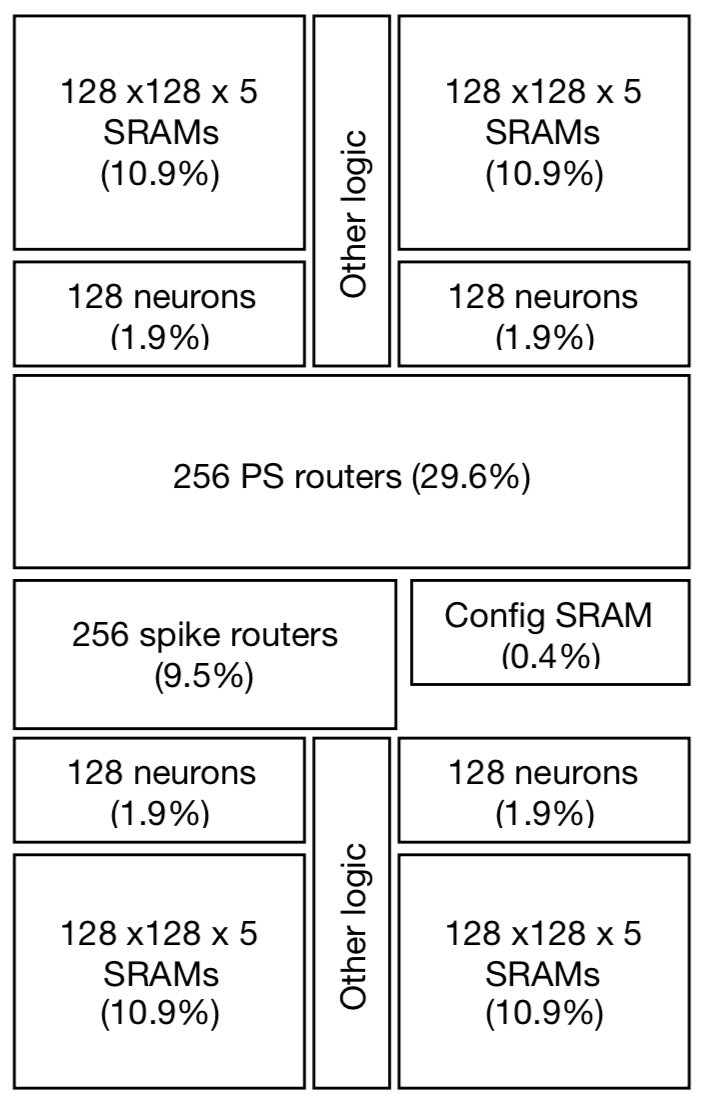
The next wave of on-device AI will likely require energy-efficient deep neural networks. Brain-inspired spiking neural networks (SNN) has been identified to be a promising candidate. Doing away with the need for multipliers significantly reduces energy. For on-device applications, besides computation, communication also incurs a significant amount of energy and time. In this paper, we propose Shenjing, a configurable SNN architecture which fully exposes all on-chip communications to software, enabling software mapping of SNN models with high accuracy at low power. Unlike prior SNN architectures like TrueNorth, Shenjing does not require any model modification and retraining for the mapping. We show that conventional artificial neural networks (ANN) such as multilayer perceptron, convolutional neural networks, as well as the latest residual neural networks can be mapped successfully onto Shenjing, realizing ANNs with SNN s energy efficiency. For the MNIST inference problem using a multilayer perceptron, we were able to achieve an accuracy of 96% while consuming just 1.26mW using 10 Shenjing cores.

paper research
Enhancing Single-Port Memory Performance to Match Multi-Port Capabilities Using Coding Techniques

Enhancing Single-Port Memory Performance to Match Multi-Port Capabilities Using Coding Techniques

Many performance critical systems today must rely on performance enhancements, such as multi-port memories, to keep up with the increasing demand of memory-access capacity. However, the large area footprints and complexity of existing multi-port memory designs limit their applicability. This paper explores a coding theoretic framework to address this problem. In particular, this paper introduces a framework to encode data across multiple single-port memory banks in order to { em algorithmically} realize the functionality of multi-port memory. This paper proposes three code designs with significantly less storage overhead compared to the existing replication based emulations of multi-port memories. To further improve performance, we also demonstrate a memory controller design that utilizes redundancy across coded memory banks to more efficiently schedule read and write requests sent across multiple cores. Furthermore, guided by DRAM traces, the paper explores { em dynamic coding} techniques to improve the efficiency of the coding based memory design. We then show significant performance improvements in critical word read and write latency in the proposed coded-memory design when compared to a traditional uncoded-memory design.

paper research
BRISC-V  An Open-Source Toolbox for Exploring RISC-V Architecture Design Spaces

BRISC-V An Open-Source Toolbox for Exploring RISC-V Architecture Design Spaces

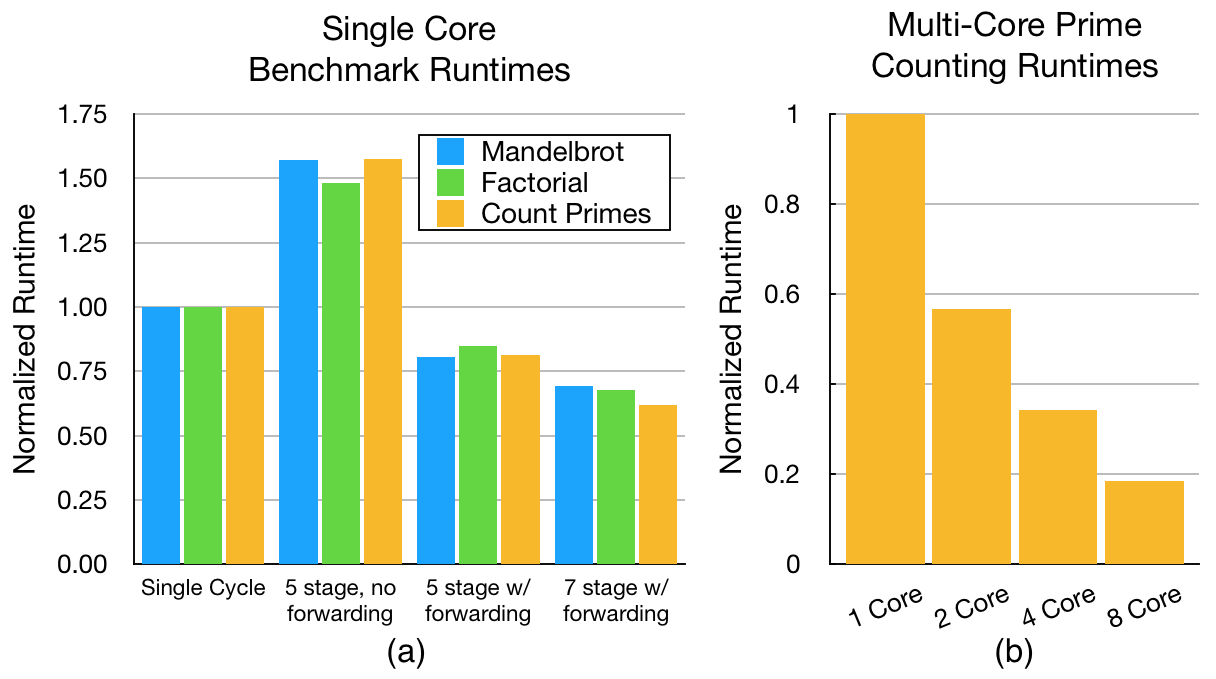
In this work, we introduce a platform for register-transfer level (RTL) architecture design space exploration. The platform is an open-source, parameterized, synthesizable set of RTL modules for designing RISC-V based single and multi-core architecture systems. The platform is designed with a high degree of modularity. It provides highly-parameterized, composable RTL modules for fast and accurate exploration of different RISC-V based core complexities, multi-level caching and memory organizations, system topologies, router architectures, and routing schemes. The platform can be used for both RTL simulation and FPGA based emulation. The hardware modules are implemented in synthesizable Verilog using no vendor-specific blocks. The platform includes a RISC-V compiler toolchain to assist in developing software for the cores, a web-based system configuration graphical user interface (GUI) and a web-based RISC-V assembly simulator. The platform supports a myriad of RISC-V architectures, ranging from a simple single cycle processor to a multi-core SoC with a complex memory hierarchy and a network-on-chip. The modules are designed to support incremental additions and modifications. The interfaces between components are particularly designed to allow parts of the processor such as whole cache modules, cores or individual pipeline stages, to be modified or replaced without impacting the rest of the system. The platform allows researchers to quickly instantiate complete working RISC-V multi-core systems with synthesizable RTL and make targeted modifications to fit their needs. The complete platform (including Verilog source code) can be downloaded at https //ascslab.org/research/briscv/explorer/explorer.html.

paper research

< Category Statistics (Total: 566) >

Quantum Physics
5

Start searching

Enter keywords to search articles

↑↓
ESC
⌘K Shortcut