Computer Science / Emerging Technologies

All posts under category "Computer Science / Emerging Technologies"

4 posts total
Sorted by date
No Image

Channel Characterization for 1D Molecular Communication with Two Absorbing Receivers

This letter develops a one-dimensional (1D) diffusion-based molecular communication system to analyze channel responses between a single transmitter (TX) and two fully-absorbing receivers (RXs). Incorporating molecular degradation in the environment, rigorous analytical formulas for i) the fraction of molecules absorbed, ii) the corresponding hitting rate, and iii) the asymptotic fraction of absorbed molecules as time approaches infinity at each RX are derived when an impulse of molecules are released at the TX. By using particle-based simulations, the derived analytical expressions are validated. Simulations also present the distance ranges of two RXs that do not impact molecular absorption of each other, and demonstrate that the mutual imfluence of two active RXs reduces with the increase in the degradation rate.
paper research
Shenjing  A Low-Power Reconfigurable Neuromorphic Accelerator with Partial-Sum and Spike Networks-on-Chip

Shenjing A Low-Power Reconfigurable Neuromorphic Accelerator with Partial-Sum and Spike Networks-on-Chip

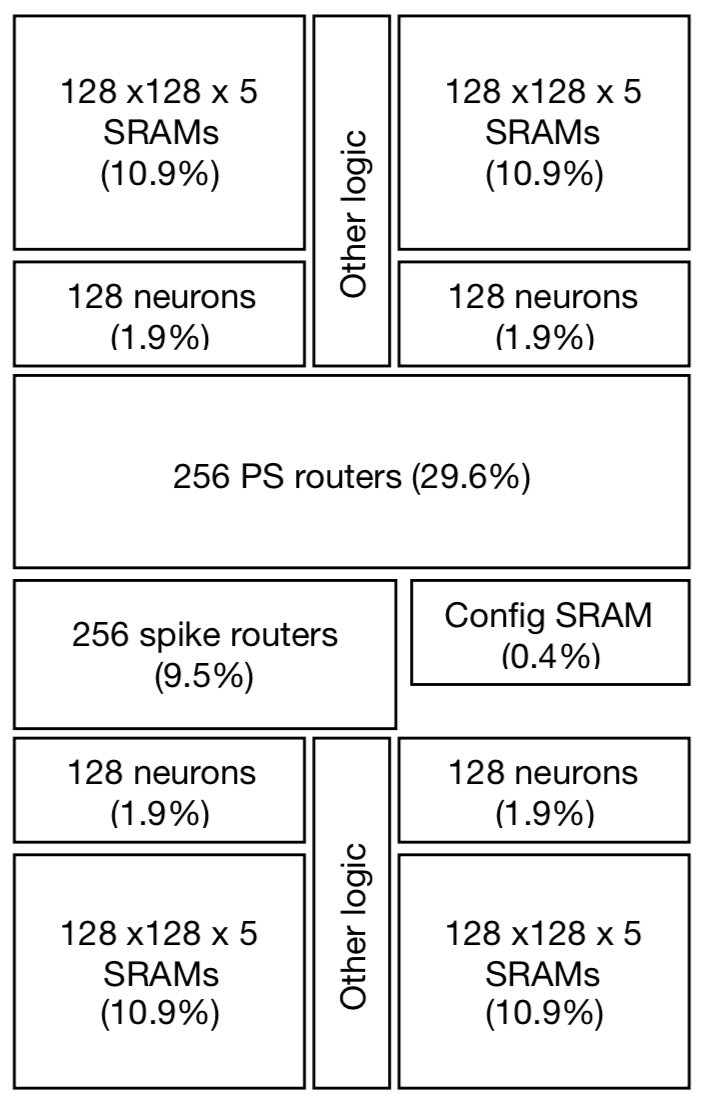
The next wave of on-device AI will likely require energy-efficient deep neural networks. Brain-inspired spiking neural networks (SNN) has been identified to be a promising candidate. Doing away with the need for multipliers significantly reduces energy. For on-device applications, besides computation, communication also incurs a significant amount of energy and time. In this paper, we propose Shenjing, a configurable SNN architecture which fully exposes all on-chip communications to software, enabling software mapping of SNN models with high accuracy at low power. Unlike prior SNN architectures like TrueNorth, Shenjing does not require any model modification and retraining for the mapping. We show that conventional artificial neural networks (ANN) such as multilayer perceptron, convolutional neural networks, as well as the latest residual neural networks can be mapped successfully onto Shenjing, realizing ANNs with SNN s energy efficiency. For the MNIST inference problem using a multilayer perceptron, we were able to achieve an accuracy of 96% while consuming just 1.26mW using 10 Shenjing cores.

paper research
Training DNN IoT Applications for Deployment on Analog NVM Crossbars

Training DNN IoT Applications for Deployment on Analog NVM Crossbars

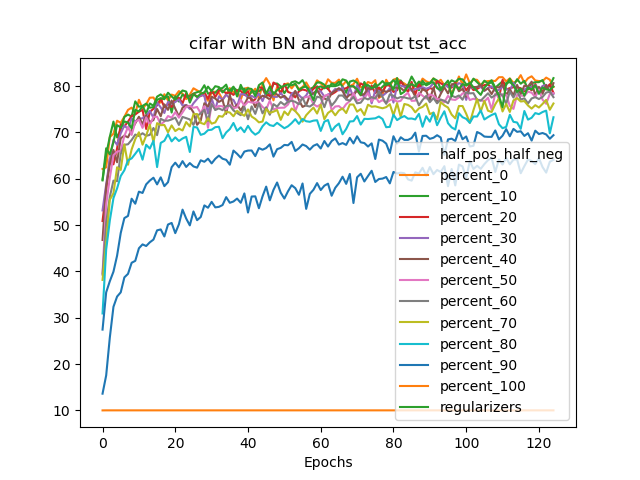
A trend towards energy-efficiency, security and privacy has led to a recent focus on deploying DNNs on microcontrollers. However, limits on compute and memory resources restrict the size and the complexity of the ML models deployable in these systems. Computation-In-Memory architectures based on resistive nonvolatile memory (NVM) technologies hold great promise of satisfying the compute and memory demands of high-performance and low-power, inherent in modern DNNs. Nevertheless, these technologies are still immature and suffer from both the intrinsic analog-domain noise problems and the inability of representing negative weights in the NVM structures, incurring in larger crossbar sizes with concomitant impact on ADCs and DACs. In this paper, we provide a training framework for addressing these challenges and quantitatively evaluate the circuit-level efficiency gains thus accrued. We make two contributions Firstly, we propose a training algorithm that eliminates the need for tuning individual layers of a DNN ensuring uniformity across layer weights and activations. This ensures analog-blocks that can be reused and peripheral hardware substantially reduced. Secondly, using NAS methods, we propose the use of unipolar-weighted (either all-positive or all-negative weights) matrices/sub-matrices. Weight unipolarity obviates the need for doubling crossbar area leading to simplified analog periphery. We validate our methodology with CIFAR10 and HAR applications by mapping to crossbars using 4-bit and 2-bit devices. We achieve up to 92 91% accuracy (95% floating-point) using 2-bit only-positive weights for HAR. A combination of the proposed techniques leads to 80% area improvement and up to 45% energy reduction.

paper research
Using Engineered Neurons in Digital Logic Circuits  A Molecular Communications Analysis

Using Engineered Neurons in Digital Logic Circuits A Molecular Communications Analysis

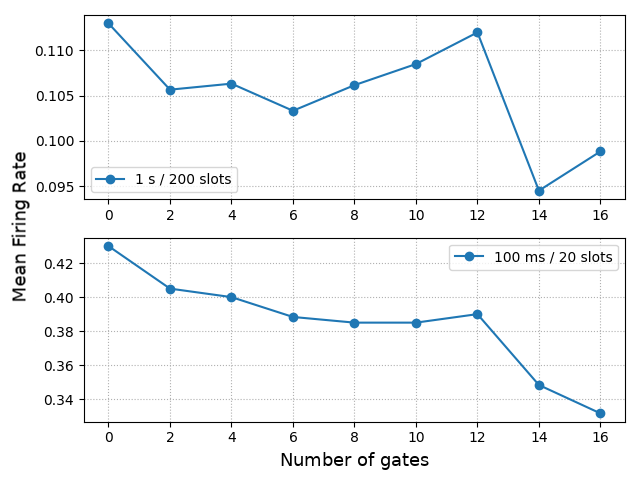
With the advancement of synthetic biology, several new tools have been conceptualized over the years as alternative treatments for current medical procedures. Most of those applications are applied to various chronic diseases. This work investigates how synthetically engineered neurons can operate as digital logic gates that can be used towards bio-computing for the brain. We quantify the accuracy of logic gates under high firing rates amid a network of neurons and by how much it can smooth out uncontrolled neuronal firings. To test the efficacy of our method, simulations composed of computational models of neurons connected in a structure that represents a logic gate are performed. The simulations demonstrated the accuracy of performing the correct logic operation, and how specific properties such as the firing rate can play an important role in the accuracy. As part of the analysis, the Mean squared error is used to quantify the quality of our proposed model and predicting the accurate operation of a gate based on different sampling frequencies. As an application, the logic gates were used to trap epileptic seizures in a neuronal network, where the results demonstrated the effectiveness of reducing the firing rate. Our proposed system has the potential for computing numerous neurological conditions of the brain.

paper research

< Category Statistics (Total: 566) >

Quantum Physics
5

Start searching

Enter keywords to search articles

↑↓
ESC
⌘K Shortcut