Computer Science / Databases

All posts under category "Computer Science / Databases"

7 posts total
Sorted by date
Designing Multi-Level Buffer Management and Storage Systems for Non-Volatile Memory

Designing Multi-Level Buffer Management and Storage Systems for Non-Volatile Memory

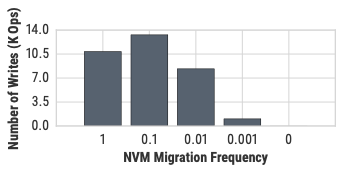
The design of the buffer manager in database management systems (DBMSs) is influenced by the performance characteristics of volatile memory (DRAM) and non-volatile storage (e.g., SSD). The key design assumptions have been that the data must be migrated to DRAM for the DBMS to operate on it and that storage is orders of magnitude slower than DRAM. But the arrival of new non-volatile memory (NVM) technologies that are nearly as fast as DRAM invalidates these previous assumptions. This paper presents techniques for managing and designing a multi-tier storage hierarchy comprising of DRAM, NVM, and SSD. Our main technical contributions are a multi-tier buffer manager and a storage system designer that leverage the characteristics of NVM. We propose a set of optimizations for maximizing the utility of data migration between different devices in the storage hierarchy. We demonstrate that these optimizations have to be tailored based on device and workload characteristics. Given this, we present a technique for adapting these optimizations to achieve a near-optimal buffer management policy for an arbitrary workload and storage hierarchy without requiring any manual tuning. We finally present a recommendation system for designing a multi-tier storage hierarchy for a target workload and system cost budget. Our results show that the NVM-aware buffer manager and storage system designer improve throughput and reduce system cost across different transaction and analytical processing workloads.

paper research
Approximate Query Processing Using Deep Generative Models

Approximate Query Processing Using Deep Generative Models

Data is generated at an unprecedented rate surpassing our ability to analyze them. The database community has pioneered many novel techniques for Approximate Query Processing (AQP) that could give approximate results in a fraction of time needed for computing exact results. In this work, we explore the usage of deep learning (DL) for answering aggregate queries specifically for interactive applications such as data exploration and visualization. We use deep generative models, an unsupervised learning based approach, to learn the data distribution faithfully such that aggregate queries could be answered approximately by generating samples from the learned model. The model is often compact - few hundred KBs - so that arbitrary AQP queries could be answered on the client side without contacting the database server. Our other contributions include identifying model bias and minimizing it through a rejection sampling based approach and an algorithm to build model ensembles for AQP for improved accuracy. Our extensive experiments show that our proposed approach can provide answers with high accuracy and low latency.

paper research
EntropyDB  A Probabilistic Method for Approximate Query Processing

EntropyDB A Probabilistic Method for Approximate Query Processing

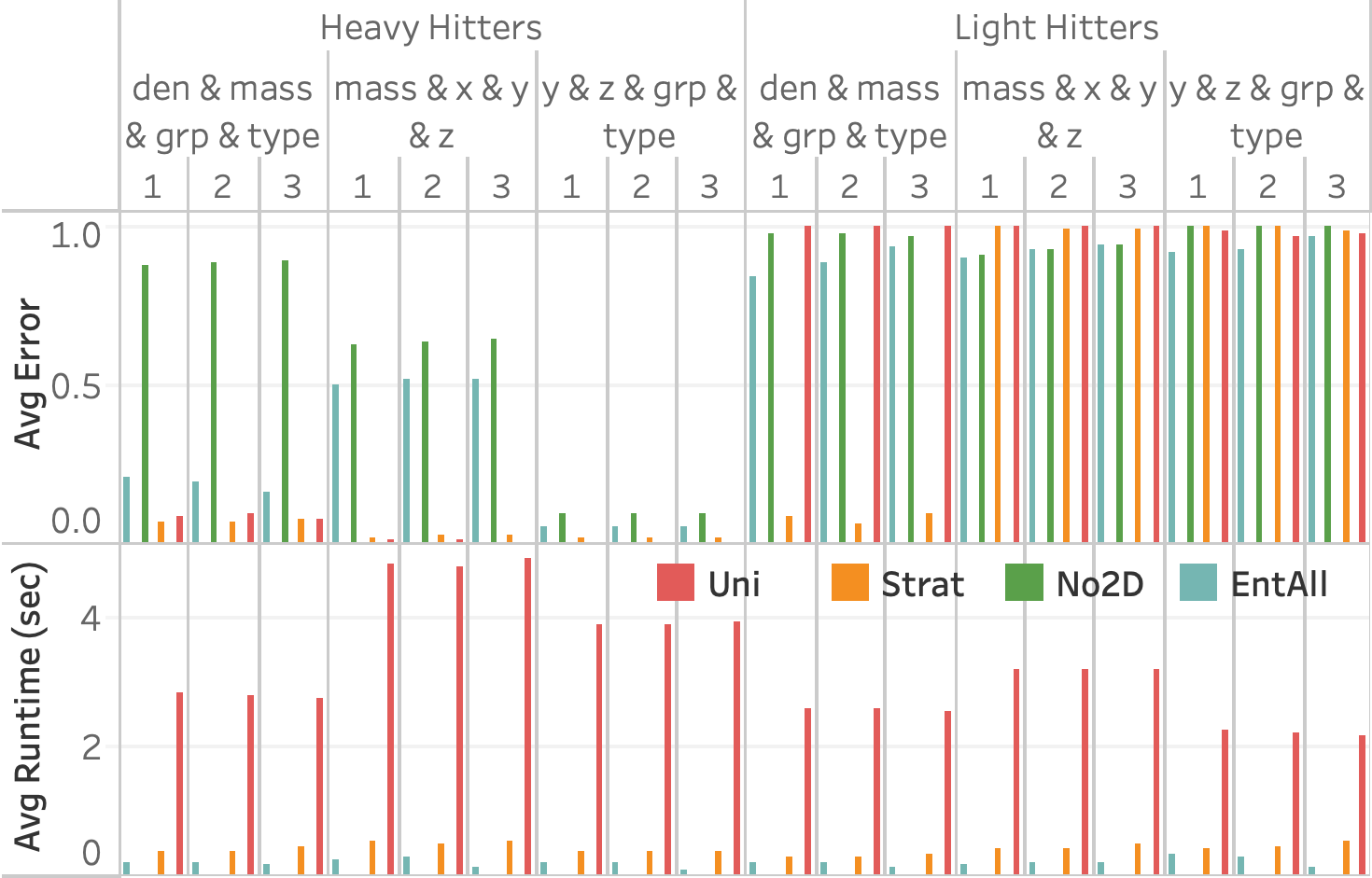
We present EntropyDB, an interactive data exploration system that uses a probabilistic approach to generate a small, query-able summary of a dataset. Departing from traditional summarization techniques, we use the Principle of Maximum Entropy to generate a probabilistic representation of the data that can be used to give approximate query answers. We develop the theoretical framework and formulation of our probabilistic representation and show how to use it to answer queries. We then present solving techniques, give two critical optimizations to improve preprocessing time and query execution time, and explore methods to reduce query error. Lastly, we experimentally evaluate our work using a 5 GB dataset of flights within the United States and a 210 GB dataset from an astronomy particle simulation. While our current work only supports linear queries, we show that our technique can successfully answer queries faster than sampling while introducing, on average, no more error than sampling and can better distinguish between rare and nonexistent values. We also discuss extensions that can allow for data updates and linear queries over joins.

paper research
Efficient Evaluation of Knowledge Graph Accuracy

Efficient Evaluation of Knowledge Graph Accuracy

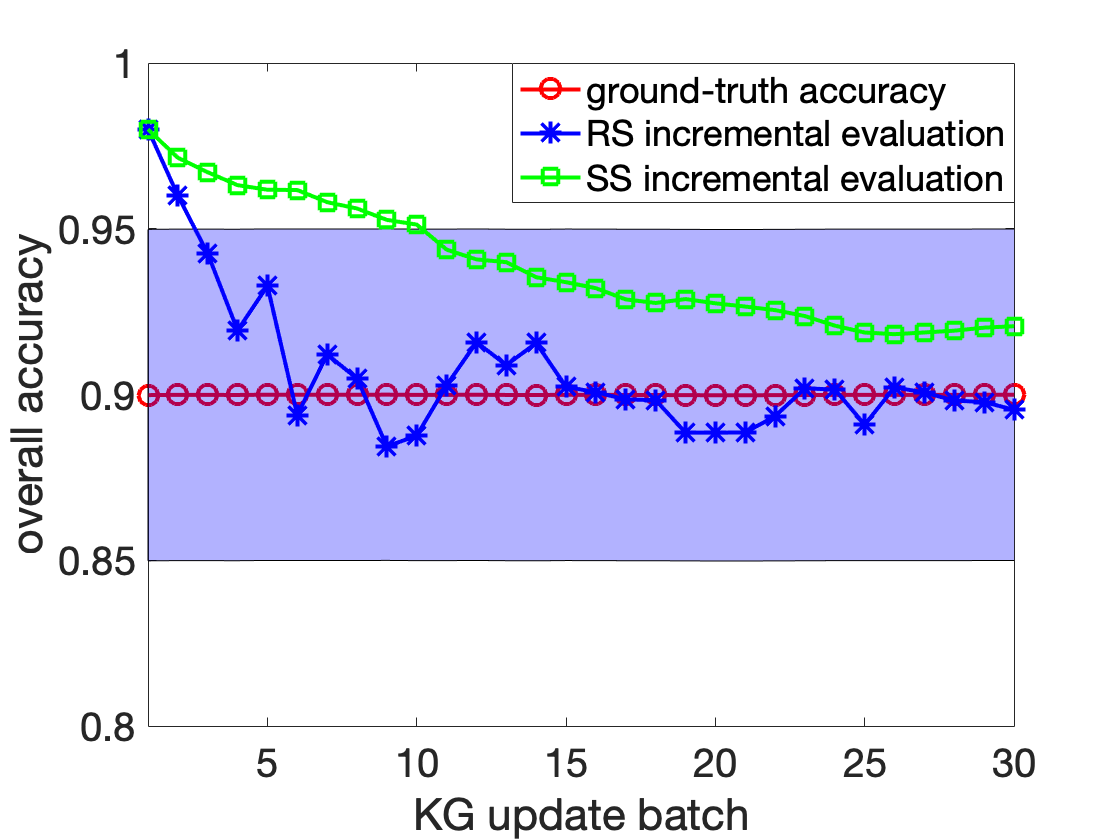
Estimation of the accuracy of a large-scale knowledge graph (KG) often requires humans to annotate samples from the graph. How to obtain statistically meaningful estimates for accuracy evaluation while keeping human annotation costs low is a problem critical to the development cycle of a KG and its practical applications. Surprisingly, this challenging problem has largely been ignored in prior research. To address the problem, this paper proposes an efficient sampling and evaluation framework, which aims to provide quality accuracy evaluation with strong statistical guarantee while minimizing human efforts. Motivated by the properties of the annotation cost function observed in practice, we propose the use of cluster sampling to reduce the overall cost. We further apply weighted and two-stage sampling as well as stratification for better sampling designs. We also extend our framework to enable efficient incremental evaluation on evolving KG, introducing two solutions based on stratified sampling and a weighted variant of reservoir sampling. Extensive experiments on real-world datasets demonstrate the effectiveness and efficiency of our proposed solution. Compared to baseline approaches, our best solutions can provide up to 60% cost reduction on static KG evaluation and up to 80% cost reduction on evolving KG evaluation, without loss of evaluation quality.

paper research
sql4ml  A Declarative End-to-End Workflow for Machine Learning

sql4ml A Declarative End-to-End Workflow for Machine Learning

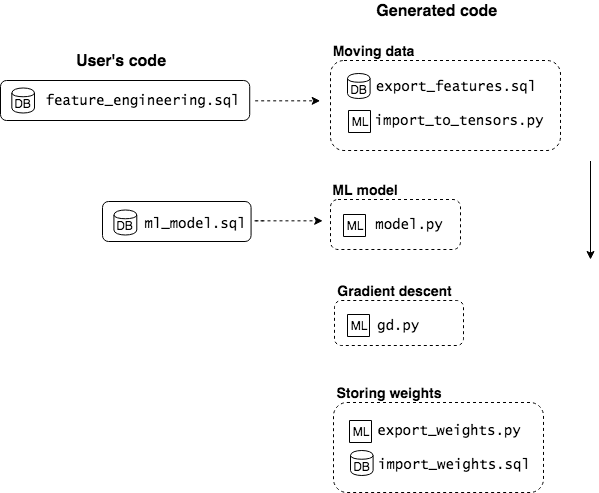
We present sql4ml, a system for expressing supervised machine learning (ML) models in SQL and automatically training them in TensorFlow. The primary motivation for this work stems from the observation that in many data science tasks there is a back-and-forth between a relational database that stores the data and a machine learning framework. Data preprocessing and feature engineering typically happen in a database, whereas learning is usually executed in separate ML libraries. This fragmented workflow requires from the users to juggle between different programming paradigms and software systems. With sql4ml the user can express both feature engineering and ML algorithms in SQL, while the system translates this code to an appropriate representation for training inside a machine learning framework. We describe our translation method, present experimental results from applying it on three well-known ML algorithms and discuss the usability benefits from concentrating the entire workflow on the database side.

paper research
The Demise of the Filesystem and Multi-Level Service Architecture

The Demise of the Filesystem and Multi-Level Service Architecture

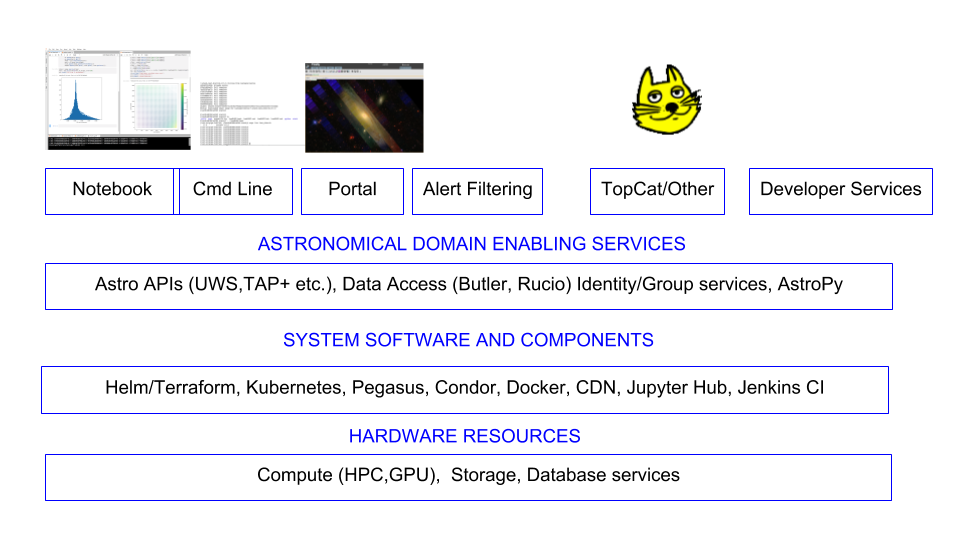
Many astronomy data centres still work on filesystems. Industry has moved on; current practice in computing infrastructure is to achieve Big Data scalability using object stores rather than POSIX file systems. This presents us with opportunities for portability and reuse of software underlying processing and archive systems but it also causes problems for legacy implementations in current data centers.

paper research
Synthetic SQL Mastery  Bridging Data Quality and Complex Reasoning Gaps

Synthetic SQL Mastery Bridging Data Quality and Complex Reasoning Gaps

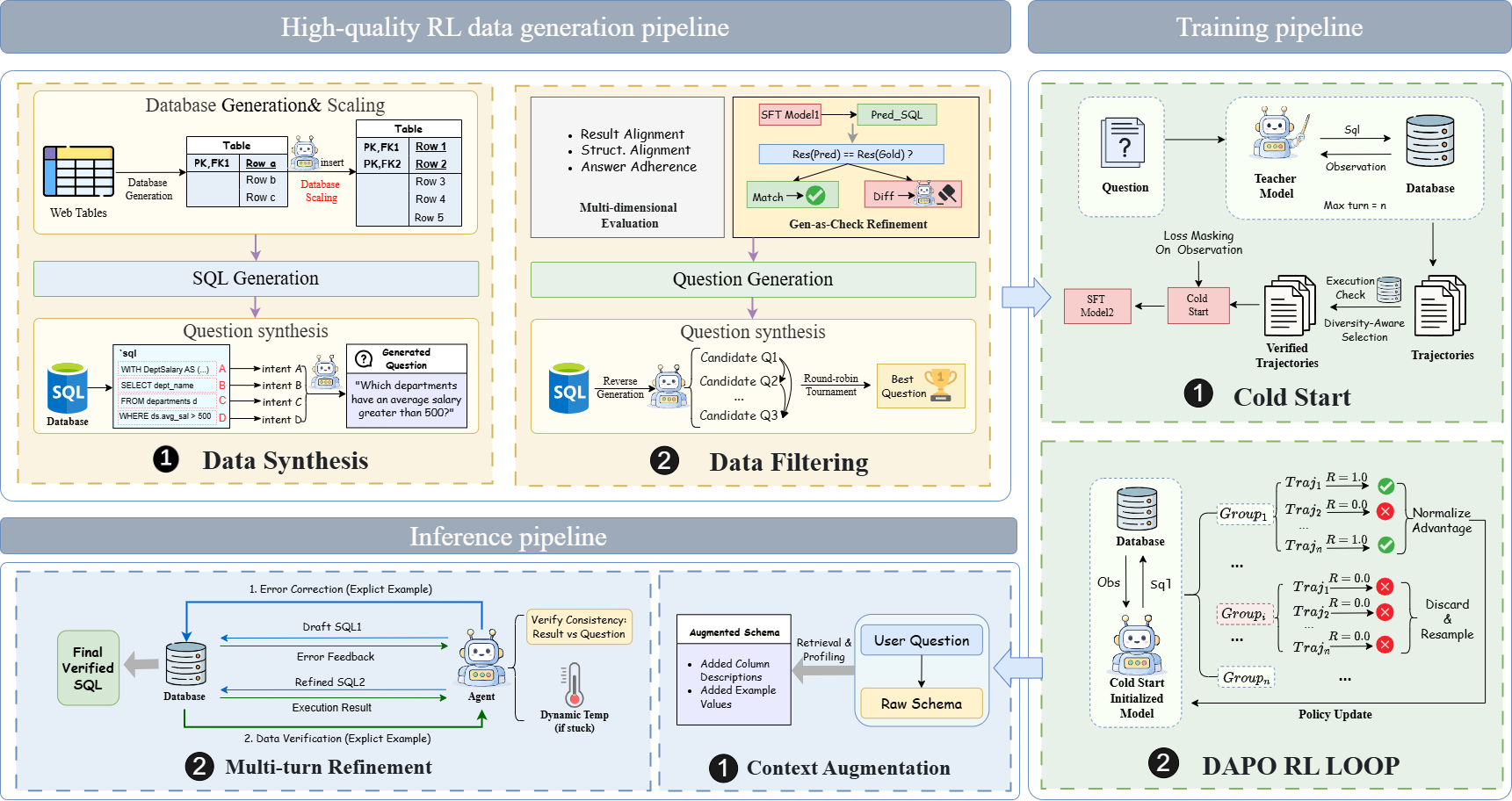
The advancement of Text-to-SQL systems is currently hindered by the scarcity of high-quality training data and the limited reasoning capabilities of models in complex scenarios. In this paper, we propose a holistic framework that addresses these issues through a dual-centric approach. From a Data-Centric perspective, we construct an iterative data factory that synthesizes RL-ready data characterized by high correctness and precise semantic-logic alignment, ensured by strict verification. From a Model-Centric perspective, we introduce a novel Agentic Reinforcement Learning framework. This framework employs a Diversity-Aware Cold Start stage to initialize a robust policy, followed by Group Relative Policy Optimization (GRPO) to refine the agent s reasoning via environmental feedback. Extensive experiments on BIRD and Spider benchmarks demonstrate that our synergistic approach achieves state-of-the-art performance among single-model methods.

paper research

< Category Statistics (Total: 566) >

Quantum Physics
5

Start searching

Enter keywords to search articles

↑↓
ESC
⌘K Shortcut