Computer Science / Computers and Society

All posts under category "Computer Science / Computers and Society"

4 posts total
Sorted by date
Bridging Information Security and Environmental Criminology to Better Mitigate Cybercrime

Bridging Information Security and Environmental Criminology to Better Mitigate Cybercrime

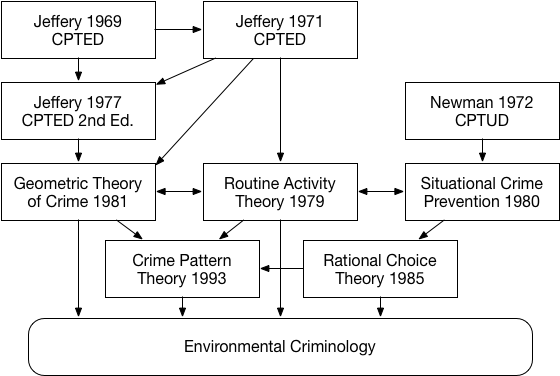
Cybercrime is a complex phenomenon that spans both technical and human aspects. As such, two disjoint areas have been studying the problem from separate angles the information security community and the environmental criminology one. Despite the large body of work produced by these communities in the past years, the two research efforts have largely remained disjoint, with researchers on one side not benefitting from the advancements proposed by the other. In this paper, we argue that it would be beneficial for the information security community to look at the theories and systematic frameworks developed in environmental criminology to develop better mitigations against cybercrime. To this end, we provide an overview of the research from environmental criminology and how it has been applied to cybercrime. We then survey some of the research proposed in the information security domain, drawing explicit parallels between the proposed mitigations and environmental criminology theories, and presenting some examples of new mitigations against cybercrime. Finally, we discuss the concept of cyberplaces and propose a framework in order to define them. We discuss this as a potential research direction, taking into account both fields of research, in the hope of broadening interdisciplinary efforts in cybercrime research.

paper research
AI Bias in Climate Opinion  Intersectional Mismatches

AI Bias in Climate Opinion Intersectional Mismatches

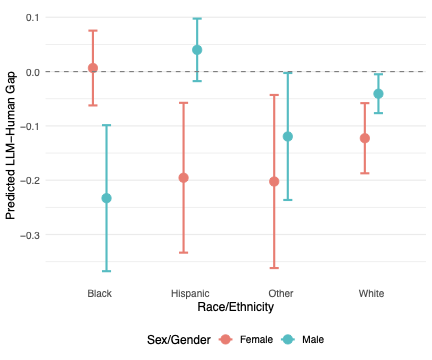
Federal agencies and researchers increasingly use large language models to analyze and simulate public opinion. When AI mediates between the public and policymakers, accuracy across intersecting identities becomes consequential; inaccurate group-level estimates can mislead outreach, consultation, and policy design. While research examines intersectionality in LLM outputs, no study has compared these outputs against real human responses across intersecting identities. Climate policy is one such domain, and this is particularly urgent for climate change, where opinion is contested and diverse. We investigate how LLMs represent intersectional patterns in U.S. climate opinions. We prompted six LLMs with profiles of 978 respondents from a nationally representative U.S. climate opinion survey and compared AI-generated responses to actual human answers across 20 questions. We find that LLMs appear to compress the diversity of American climate opinions, predicting less-concerned groups as more concerned and vice versa. This compression is intersectional LLMs apply uniform gender assumptions that match reality for White and Hispanic Americans but misrepresent Black Americans, where actual gender patterns differ. These patterns, which may be invisible to standard auditing approaches, could undermine equitable climate governance.

paper research
The Generative AI Paradox  Erosion of Truth and Corrosion of Information Verification

The Generative AI Paradox Erosion of Truth and Corrosion of Information Verification

Generative AI (GenAI) now produces text, images, audio, and video that can be perceptually convincing at scale and at negligible marginal cost. While public debate often frames the associated harms as deepfakes or incremental extensions of misinformation and fraud, this view misses a broader socio-technical shift GenAI enables synthetic realities; coherent, interactive, and potentially personalized information environments in which content, identity, and social interaction are jointly manufactured and mutually reinforcing. We argue that the most consequential risk is not merely the production of isolated synthetic artifacts, but the progressive erosion of shared epistemic ground and institutional verification practices as synthetic content, synthetic identity, and synthetic interaction become easy to generate and hard to audit. This paper (i) formalizes synthetic reality as a layered stack (content, identity, interaction, institutions), (ii) expands a taxonomy of GenAI harms spanning personal, economic, informational, and socio-technical risks, (iii) articulates the qualitative shifts introduced by GenAI (cost collapse, throughput, customization, micro-segmentation, provenance gaps, and trust erosion), and (iv) synthesizes recent risk realizations (2023-2025) into a compact case bank illustrating how these mechanisms manifest in fraud, elections, harassment, documentation, and supply-chain compromise. We then propose a mitigation stack that treats provenance infrastructure, platform governance, institutional workflow redesign, and public resilience as complementary rather than substitutable, and outline a research agenda focused on measuring epistemic security. We conclude with the Generative AI Paradox as synthetic media becomes ubiquitous, societies may rationally discount digital evidence altogether.

paper research
VEAT Measures Implicit Associations in Text-to-Video Generator Sora and Reveals Bias Mitigation Challenges

VEAT Measures Implicit Associations in Text-to-Video Generator Sora and Reveals Bias Mitigation Challenges

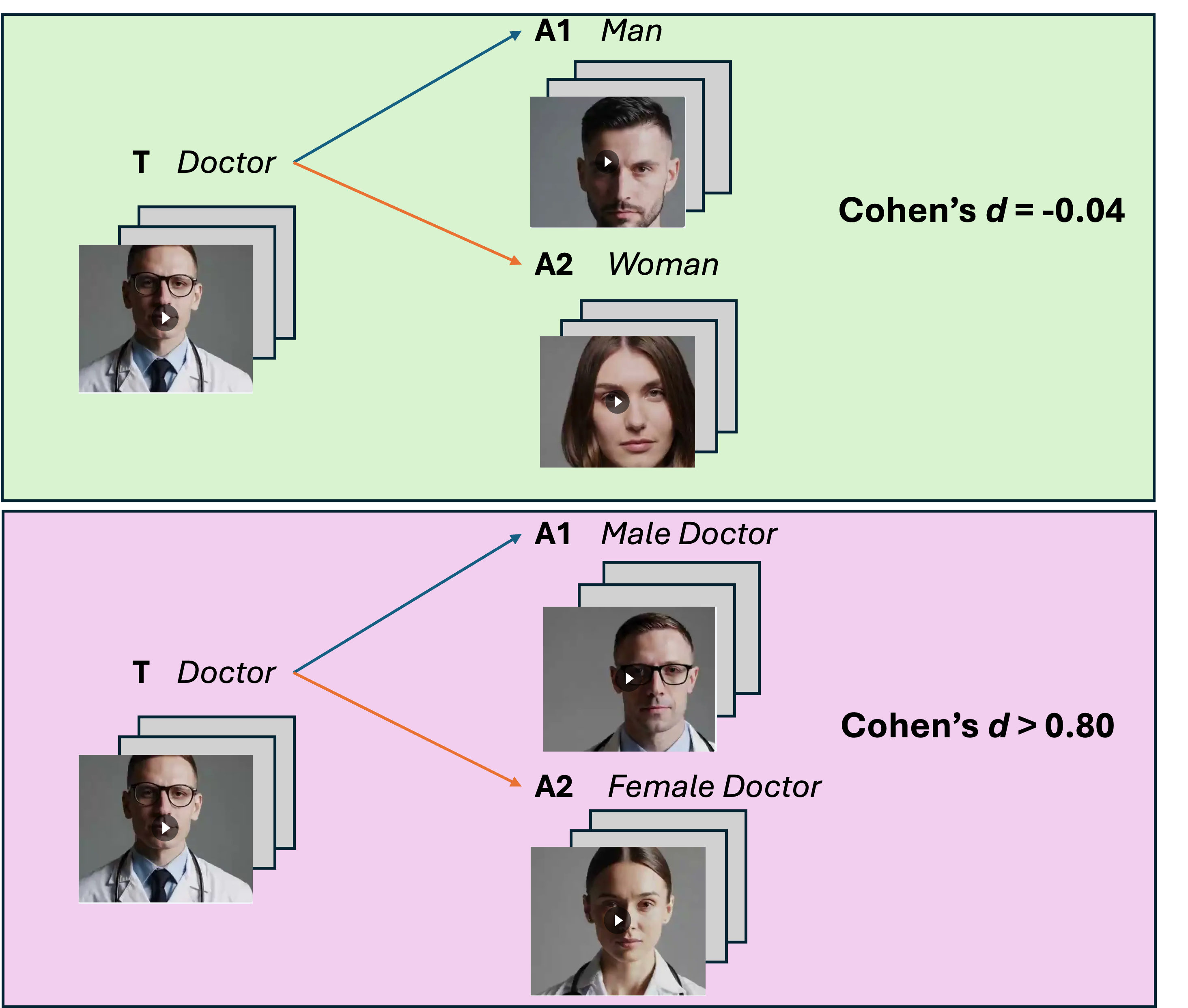
Text-to-Video (T2V) generators such as Sora raise concerns about whether generated content reflects societal bias. We extend embedding-association tests from words and images to video by introducing the Video Embedding Association Test (VEAT) and Single-Category VEAT (SC-VEAT). We validate these methods by reproducing the direction and magnitude of associations from widely used baselines, including Implicit Association Test (IAT) scenarios and OASIS image categories. We then quantify race (African American vs. European American) and gender (women vs. men) associations with valence (pleasant vs. unpleasant) across 17 occupations and 7 awards. Sora videos associate European Americans and women more with pleasantness (both d>0.8). Effect sizes correlate with real-world demographic distributions percent men and White in occupations (r=0.93, r=0.83) and percent male and non-Black among award recipients (r=0.88, r=0.99). Applying explicit debiasing prompts generally reduces effect-size magnitudes, but can backfire two Black-associated occupations (janitor, postal service) become more Black-associated after debiasing. Together, these results reveal that easily accessible T2V generators can actually amplify representational harms if not rigorously evaluated and responsibly deployed.

paper research

< Category Statistics (Total: 566) >

Quantum Physics
5

Start searching

Enter keywords to search articles

↑↓
ESC
⌘K Shortcut