Computational Physics

All posts under category "Computational Physics"

1 posts total
Sorted by date
PINNs Revolutionize Electromagnetic Wave Modeling

PINNs Revolutionize Electromagnetic Wave Modeling

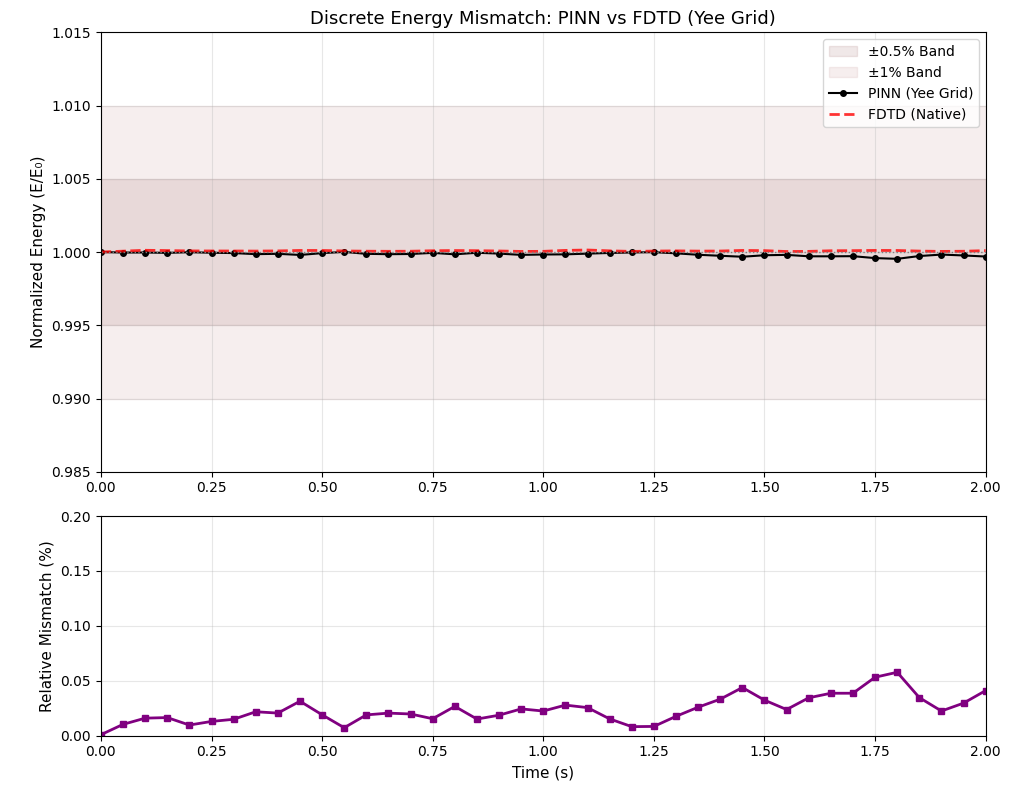
Physics-Informed Neural Networks (PINNs) are a methodology that aims to solve physical systems by directly embedding PDE constraints into the neural network training process. In electromagnetism, where well-established methodologies such as FDTD and FEM already exist, new methodologies are expected to provide clear advantages to be accepted. Despite their mesh-free nature and applicability to inverse problems, PINNs can exhibit deficiencies in terms of accuracy and energy metrics when compared to FDTD solutions. This study demonstrates hybrid training strategies can bring PINNs closer to FDTD-level accuracy and energy consistency. This study presents a hybrid methodology addressing common challenges in wave propagation scenarios. The causality collapse problem in time-dependent PINN training is addressed via time marching and causality-aware weighting. In order to mitigate the discontinuities that are introduced by time marching, a two-stage interface continuity loss is applied. In order to suppress loss accumulation, which is manifested as cumulative energy drift in electromagnetic waves, a local Poynting-based regularizer has been developed. In the developed PINN model, high field accuracy is achieved with an average 0.09 % $NRMSE$ and 1.01 % $L^2$ error over time. Energy conservation is achieved on the PINN side with only a 0.024 % relative energy mismatch in the 2D PEC cavity scenario. Training is performed without labeled field data, using only physics-based residual losses; FDTD is used solely for post-training evaluation. The results demonstrate that PINNs can achieve competitive results with FDTD in canonical electromagnetic examples and are a viable alternative.

paper research

< Category Statistics (Total: 566) >

Computer Science (514) Machine Learning (117) Artificial Intelligence (89) Computer Vision (71) Computation and Language (NLP) (62) Electrical Engineering and Systems Science (36) Cryptography and Security (24) Robotics (22) Systems and Control (22) Software Engineering (20) Mathematics (18) Statistics (17) Economics (16) Information Retrieval (15) Distributed, Parallel, and Cluster Computing (14) Human-Computer Interaction (14) Neural and Evolutionary Computing (13) Computer Science and Game Theory (11) Econometrics (11) Image and Video Processing (10) Physics (10) Sound (10) Multiagent Systems (9) Optimization and Control (8) Computational Geometry (7) Databases (7) Graphics (6) Networking and Internet Architecture (6) Quantitative Biology (6) Quantum Physics (5) Theoretical Economics (5) Computational Complexity (4) Computational Engineering, Finance, and Science (4) Computers and Society (4) Emerging Technologies (4) Information Theory (4) Methodology (4) Multimedia (4) Programming Languages (4) Quantitative Finance (4) Signal Processing (4) Audio and Speech Processing (3) Data Structures and Algorithms (3) Hardware Architecture (3) History and Philosophy of Physics (3) Logic in Computer Science (3) Neurons and Cognition (3) Social and Information Networks (3) Statistics Theory (3) Computation (2) Condensed Matter (2) Dynamical Systems (2) Formal Languages and Automata Theory (2) General Finance (2) Operating Systems (2) Optics (2) Quantitative Methods (2) Applications (1) Astrophysics (1) Combinatorics (1) Computational Physics (1) Digital Libraries (1) Disordered Systems and Neural Networks (1) General Economics (1) Genomics (1) Geophysics (1) Instrumentation and Methods for Astrophysics (1) Logic (1) Mathematical Finance (1) Mathematical Software (1) Medical Physics (1) Mesoscale and Nanoscale Physics (1) Metric Geometry (1) Other Statistics (1) Performance (1) Physics and Society (1) Plasma Physics (1) Probability (1) Trading and Market Microstructure (1)

Start searching

Enter keywords to search articles

↑↓
ESC
⌘K Shortcut