Computation and Language (NLP)

All posts under category "Computation and Language (NLP)"

62 posts total
Sorted by date
Learning Multilingual Embeddings for Cross-Lingual Information Retrieval Using Topically Aligned Corpora

Learning Multilingual Embeddings for Cross-Lingual Information Retrieval Using Topically Aligned Corpora

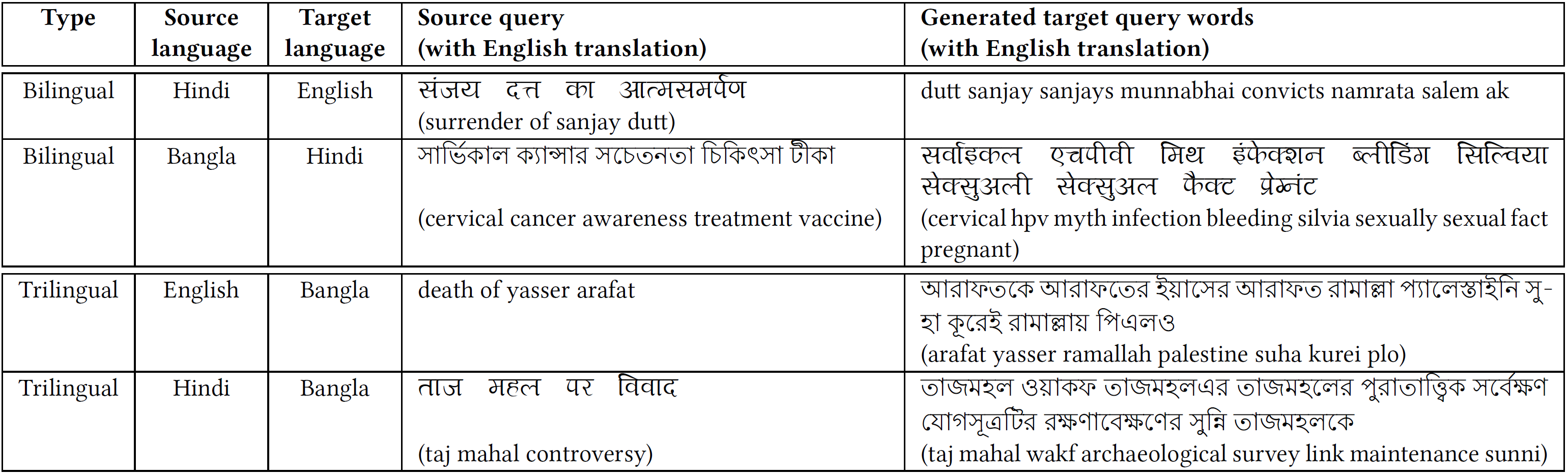
Cross-lingual information retrieval is a challenging task in the absence of aligned parallel corpora. In this paper, we address this problem by considering topically aligned corpora designed for evaluating an IR setup. To emphasize, we neither use any sentence-aligned corpora or document-aligned corpora, nor do we use any language specific resources such as dictionary, thesaurus, or grammar rules. Instead, we use an embedding into a common space and learn word correspondences directly from there. We test our proposed approach for bilingual IR on standard FIRE datasets for Bangla, Hindi and English. The proposed method is superior to the state-of-the-art method not only for IR evaluation measures but also in terms of time requirements. We extend our method successfully to the trilingual setting.
paper research
Tag-Enhanced Tree-Structured Neural Networks for Implicit Discourse Relation Classification

Tag-Enhanced Tree-Structured Neural Networks for Implicit Discourse Relation Classification

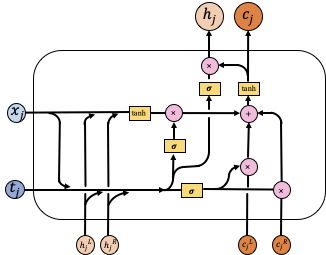
Identifying implicit discourse relations between text spans is a challenging task because it requires understanding the meaning of the text. To tackle this task, recent studies have tried several deep learning methods but few of them exploited the syntactic information. In this work, we explore the idea of incorporating syntactic parse tree into neural networks. Specifically, we employ the Tree-LSTM model and Tree-GRU model, which are based on the tree structure, to encode the arguments in a relation. Moreover, we further leverage the constituent tags to control the semantic composition process in these tree-structured neural networks. Experimental results show that our method achieves state-of-the-art performance on PDTB corpus.

paper research
PyBangla at BLP-2025 Task 2  Improving Bangla-to-Python Code Generation with Iterative Self-Correction and Multilingual Agents

PyBangla at BLP-2025 Task 2 Improving Bangla-to-Python Code Generation with Iterative Self-Correction and Multilingual Agents

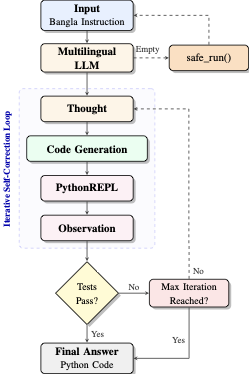
LLMs excel at code generation from English prompts, but this progress has not extended to low-resource languages. We address Bangla-to-Python code generation by introducing BanglaCodeAct, an agent-based framework that leverages multi-agent prompting and iterative self-correction. Unlike prior approaches relying on task-specific fine-tuning, BanglaCodeAct employs an open-source multilingual LLM within a Thought-Code-Observation loop, enabling dynamic generation, testing, and refinement of code from Bangla instructions. We benchmark several small-parameter open-source LLMs and evaluate their effectiveness on the mHumanEval dataset for Bangla NL2Code. Our results show that Qwen3-8B, when deployed with BanglaCodeAct, achieves the best performance, with pass@1 accuracy of 94.0 % on the development set and 71.6 % on the blind test set. These results establish a new benchmark for Bangla-to-Python translation and highlight the potential of agent-based reasoning for reliable code generation in low-resource languages. Experimental scripts are publicly available at github.com/jahidulzaid/PyBanglaCodeActAgent.

paper research
Parallel Universes, Parallel Languages  A Comprehensive Study on Multilingual Counterfactual Example Generation Using Large Language Models

Parallel Universes, Parallel Languages A Comprehensive Study on Multilingual Counterfactual Example Generation Using Large Language Models

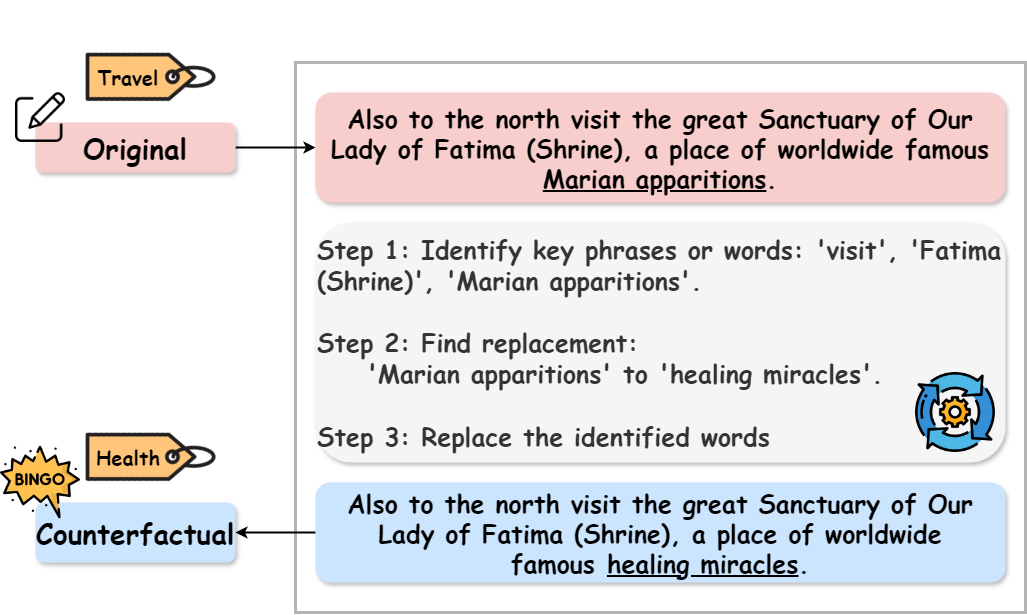
Counterfactuals refer to minimally edited inputs that cause a model s prediction to change, serving as a promising approach to explaining the model s behavior. Large language models (LLMs) excel at generating English counterfactuals and demonstrate multilingual proficiency. However, their effectiveness in generating multilingual counterfactuals remains unclear. To this end, we conduct a comprehensive study on multilingual counterfactuals. We first conduct automatic evaluations on both directly generated counterfactuals in the target languages and those derived via English translation across six languages. Although translation-based counterfactuals offer higher validity than their directly generated counterparts, they demand substantially more modifications and still fall short of matching the quality of the original English counterfactuals. Second, we find the patterns of edits applied to high-resource European-language counterfactuals to be remarkably similar, suggesting that cross-lingual perturbations follow common strategic principles. Third, we identify and categorize four main types of errors that consistently appear in the generated counterfactuals across languages. Finally, we reveal that multilingual counterfactual data augmentation (CDA) yields larger model performance improvements than cross-lingual CDA, especially for lower-resource languages. Yet, the imperfections of the generated counterfactuals limit gains in model performance and robustness.

paper research
Technical Report on K-EXAONE

Technical Report on K-EXAONE

This technical report presents K-EXAONE, a large-scale multilingual language model developed by LG AI Research. K-EXAONE is built on a Mixture-of-Experts architecture with 236B total parameters, activating 23B parameters during inference. It supports a 256K-token context window and covers six languages Korean, English, Spanish, German, Japanese, and Vietnamese. We evaluate K-EXAONE on a comprehensive benchmark suite spanning reasoning, agentic, general, Korean, and multilingual abilities. Across these evaluations, K-EXAONE demonstrates performance comparable to open-weight models of similar size. K-EXAONE, designed to advance AI for a better life, is positioned as a powerful proprietary AI foundation model for a wide range of industrial and research applications.

paper research
AdaGReS Adaptive Greedy Context Selection via Redundancy-Aware Scoring for Token-Budgeted RAG

AdaGReS Adaptive Greedy Context Selection via Redundancy-Aware Scoring for Token-Budgeted RAG

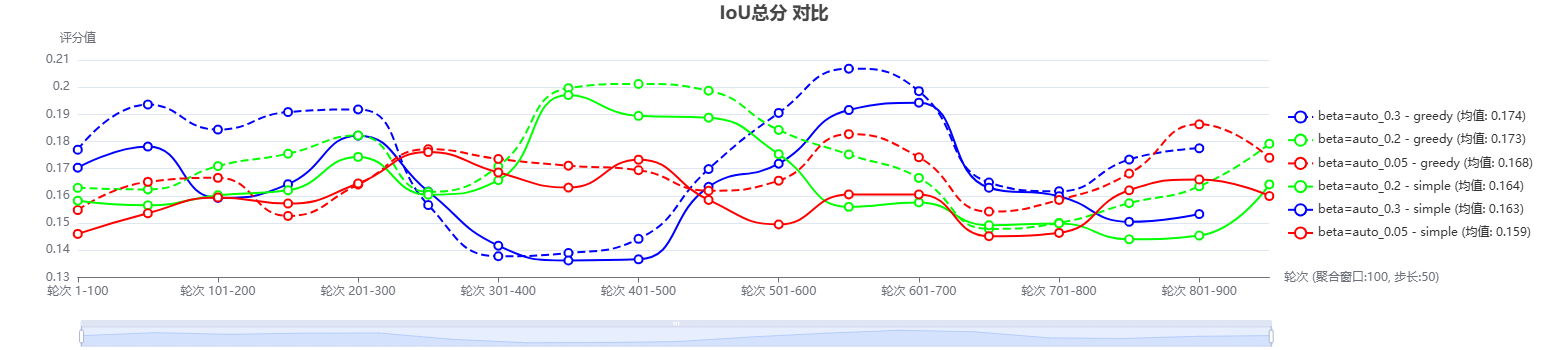
Retrieval-augmented generation (RAG) is highly sensitive to the quality of selected context, yet standard top-k retrieval often returns redundant or near-duplicate chunks that waste token budget and degrade downstream generation. We present AdaGReS, a redundancy-aware context selection framework for token-budgeted RAG that optimizes a set-level objective combining query-chunk relevance and intra-set redundancy penalties. AdaGReS performs greedy selection under a token-budget constraint using marginal gains derived from the objective, and introduces a closed-form, instance-adaptive calibration of the relevance-redundancy trade-off parameter to eliminate manual tuning and adapt to candidate-pool statistics and budget limits. We further provide a theoretical analysis showing that the proposed objective exhibits epsilon-approximate submodularity under practical embedding similarity conditions, yielding near-optimality guarantees for greedy selection. Experiments on open-domain question answering (Natural Questions) and a high-redundancy biomedical (drug) corpus demonstrate consistent improvements in redundancy control and context quality, translating to better end-to-end answer quality and robustness across settings.

paper research
AI-Powered Integration  Bridging Historical Texts to Modern Databases

AI-Powered Integration Bridging Historical Texts to Modern Databases

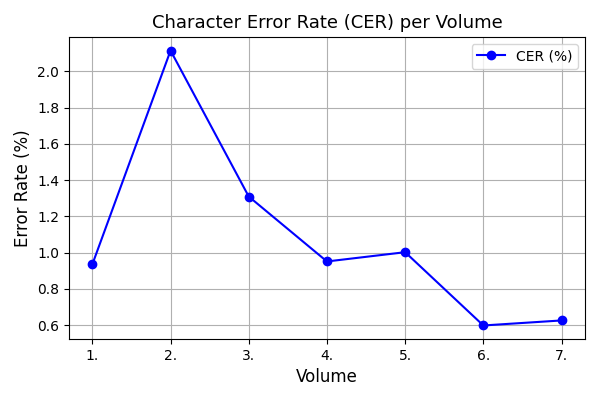
This research digitizes and analyzes the Leidse hoogleraren en lectoren 1575-1815 books written between 1983 and 1985, which contain biographic data about professors and curators of Leiden University. It addresses the central question how can we design an automated pipeline that integrates OCR, LLM-based interpretation, and database linking to harmonize data from historical document images with existing high-quality database records? We applied OCR techniques, generative AI decoding constraints that structure data extraction, and database linkage methods to process typewritten historical records into a digital format. OCR achieved a Character Error Rate (CER) of 1.08 percent and a Word Error Rate (WER) of 5.06 percent, while JSON extraction from OCR text achieved an average accuracy of 63 percent and, based on annotated OCR, 65 percent. This indicates that generative AI somewhat corrects low OCR performance. Our record linkage algorithm linked annotated JSON files with 94% accuracy and OCR-derived JSON files with 81%. This study contributes to digital humanities research by offering an automated pipeline for interpreting digitized historical documents, addressing challenges like layout variability and terminology differences, and exploring the applicability and strength of an advanced generative AI model.

paper research
BERT-JEPA  Reorganizing CLS Embeddings for Language-Invariant Semantics

BERT-JEPA Reorganizing CLS Embeddings for Language-Invariant Semantics

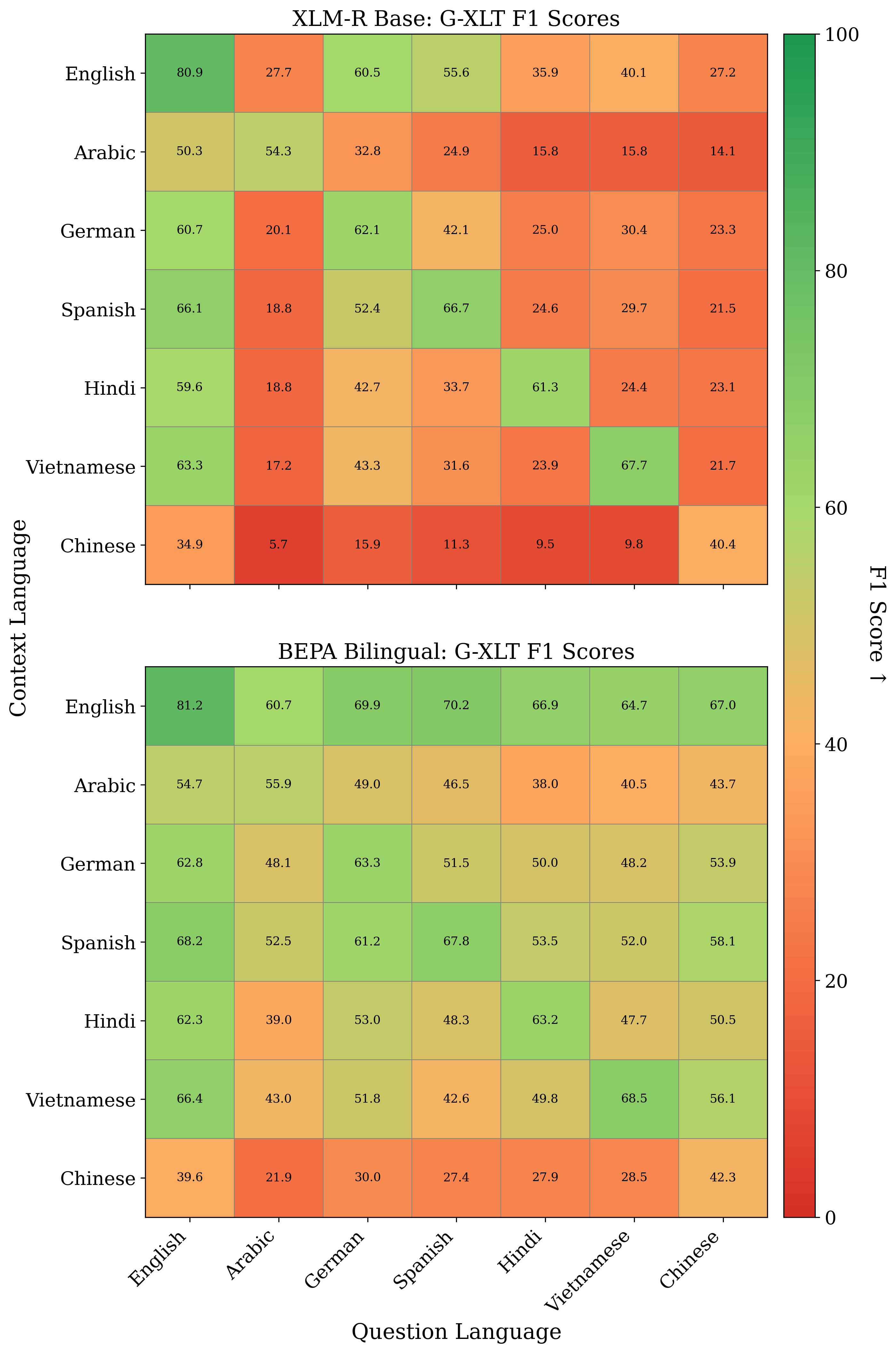
Joint Embedding Predictive Architectures (JEPA) are a novel self supervised training technique that have shown recent promise across domains. We introduce BERT-JEPA (BEPA), a training paradigm that adds a JEPA training objective to BERT-style models, working to combat a collapsed [CLS] embedding space and turning it into a language-agnostic space. This new structure leads to increased performance across multilingual benchmarks.

paper research
Beyond Perfect APIs  A Comprehensive Evaluation of Large Language Model Agents Under Real-World API Complexity

Beyond Perfect APIs A Comprehensive Evaluation of Large Language Model Agents Under Real-World API Complexity

We introduce WildAGTEval, a benchmark designed to evaluate large language model (LLM) agents function-calling capabilities under realistic API complexity. Unlike prior work that assumes an idealized API system and disregards real-world factors such as noisy API outputs, WildAGTEval accounts for two dimensions of real-world complexity 1. API specification, which includes detailed documentation and usage constraints, and 2. API execution, which captures runtime challenges. Consequently, WildAGTEval offers (i) an API system encompassing 60 distinct complexity scenarios that can be composed into approximately 32K test configurations, and (ii) user-agent interactions for evaluating LLM agents on these scenarios. Using WildAGTEval, we systematically assess several advanced LLMs and observe that most scenarios are challenging, with irrelevant information complexity posing the greatest difficulty and reducing the performance of strong LLMs by 27.3%. Furthermore, our qualitative analysis reveals that LLMs occasionally distort user intent merely to claim task completion, critically affecting user satisfaction.

paper research
Big AI is accelerating the metacrisis  What can we do?

Big AI is accelerating the metacrisis What can we do?

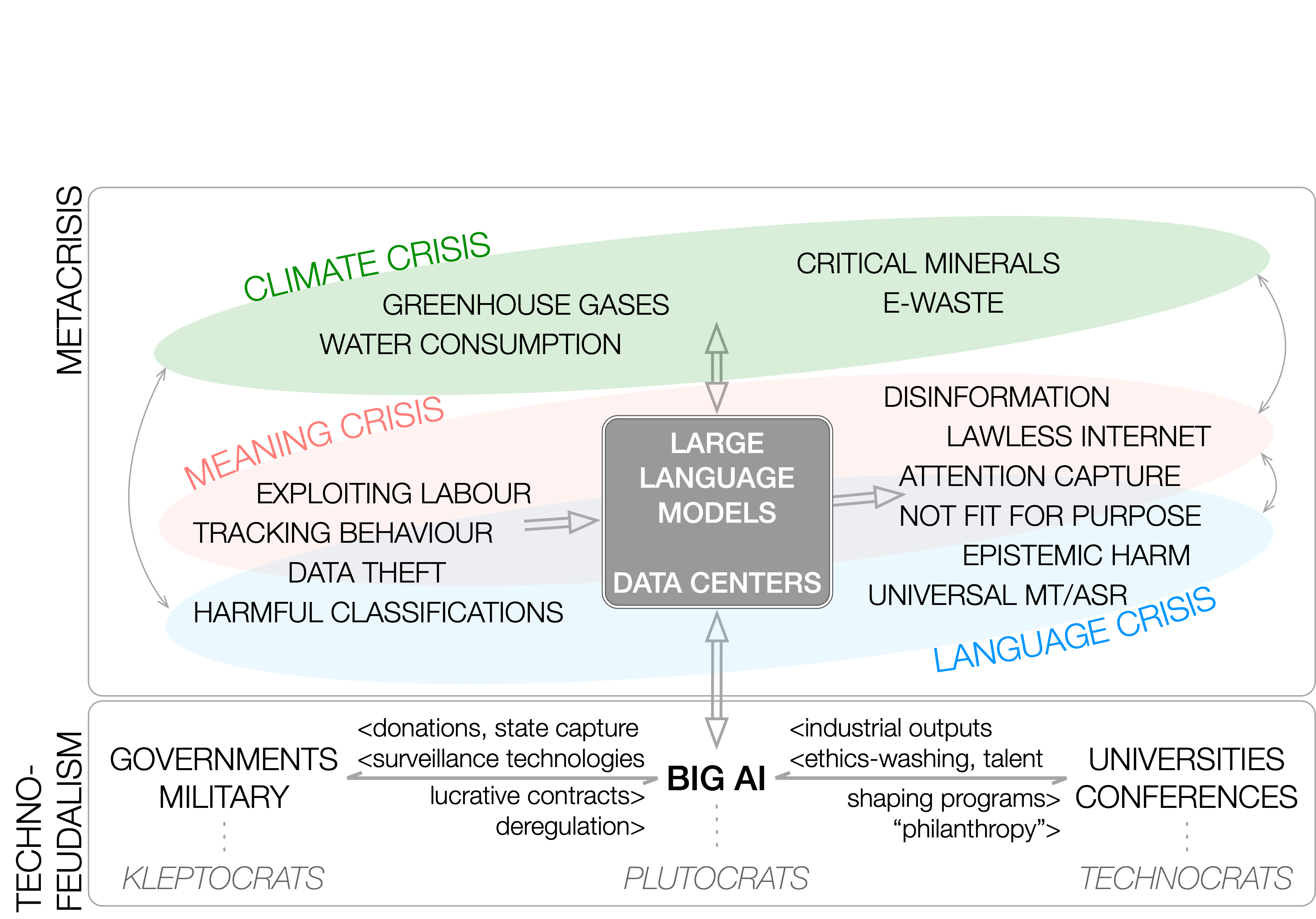
The world is in the grip of ecological, meaning, and language crises which are converging into a metacrisis. Big AI is accelerating them all. Language engineers are playing a central role, persisting with a scalability story that is failing humanity, supplying critical talent to plutocrats and kleptocrats, and creating new technologies as if the whole endeavour was value-free. We urgently need to explore alternatives, applying our collective intelligence to design a life-affirming future for NLP that is centered on human flourishing on a living planet.

paper research
Bridging the Data Gap  Creating a Hindi Text Summarization Dataset from the English XSUM

Bridging the Data Gap Creating a Hindi Text Summarization Dataset from the English XSUM

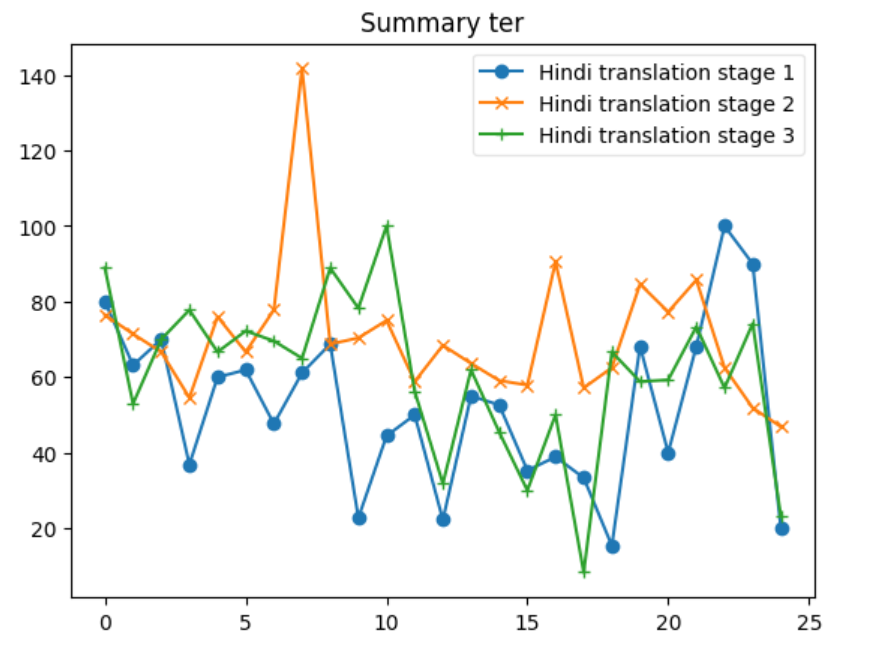
Current advancements in Natural Language Processing (NLP) have largely favored resource-rich languages, leaving a significant gap in high-quality datasets for low-resource languages like Hindi. This scarcity is particularly evident in text summarization, where the development of robust models is hindered by a lack of diverse, specialized corpora. To address this disparity, this study introduces a cost-effective, automated framework for creating a comprehensive Hindi text summarization dataset. By leveraging the English Extreme Summarization (XSUM) dataset as a source, we employ advanced translation and linguistic adaptation techniques. To ensure high fidelity and contextual relevance, we utilize the Crosslingual Optimized Metric for Evaluation of Translation (COMET) for validation, supplemented by the selective use of Large Language Models (LLMs) for curation. The resulting dataset provides a diverse, multi-thematic resource that mirrors the complexity of the original XSUM corpus. This initiative not only provides a direct tool for Hindi NLP research but also offers a scalable methodology for democratizing NLP in other underserved languages. By reducing the costs associated with dataset creation, this work fosters the development of more nuanced, culturally relevant models in computational linguistics.

paper research
Classifying long legal documents using short random chunks

Classifying long legal documents using short random chunks

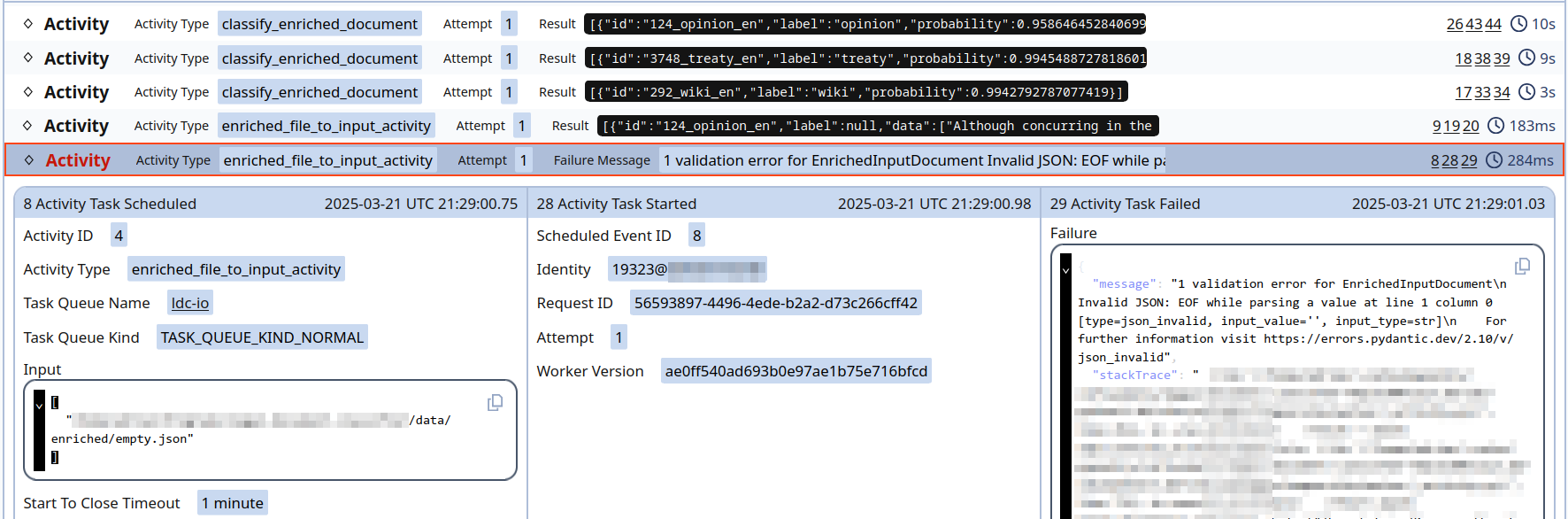
Classifying legal documents is a challenge, besides their specialized vocabulary, sometimes they can be very long. This means that feeding full documents to a Transformers-based models for classification might be impossible, expensive or slow. Thus, we present a legal document classifier based on DeBERTa V3 and a LSTM, that uses as input a collection of 48 randomly-selected short chunks (max 128 tokens). Besides, we present its deployment pipeline using Temporal, a durable execution solution, which allow us to have a reliable and robust processing workflow. The best model had a weighted F-score of 0.898, while the pipeline running on CPU had a processing median time of 498 seconds per 100 files.

paper research
Cost-Efficient Cross-Lingual Retrieval-Augmented Generation for Low-Resource Languages  A Case Study in Bengali Agricultural Advisory

Cost-Efficient Cross-Lingual Retrieval-Augmented Generation for Low-Resource Languages A Case Study in Bengali Agricultural Advisory

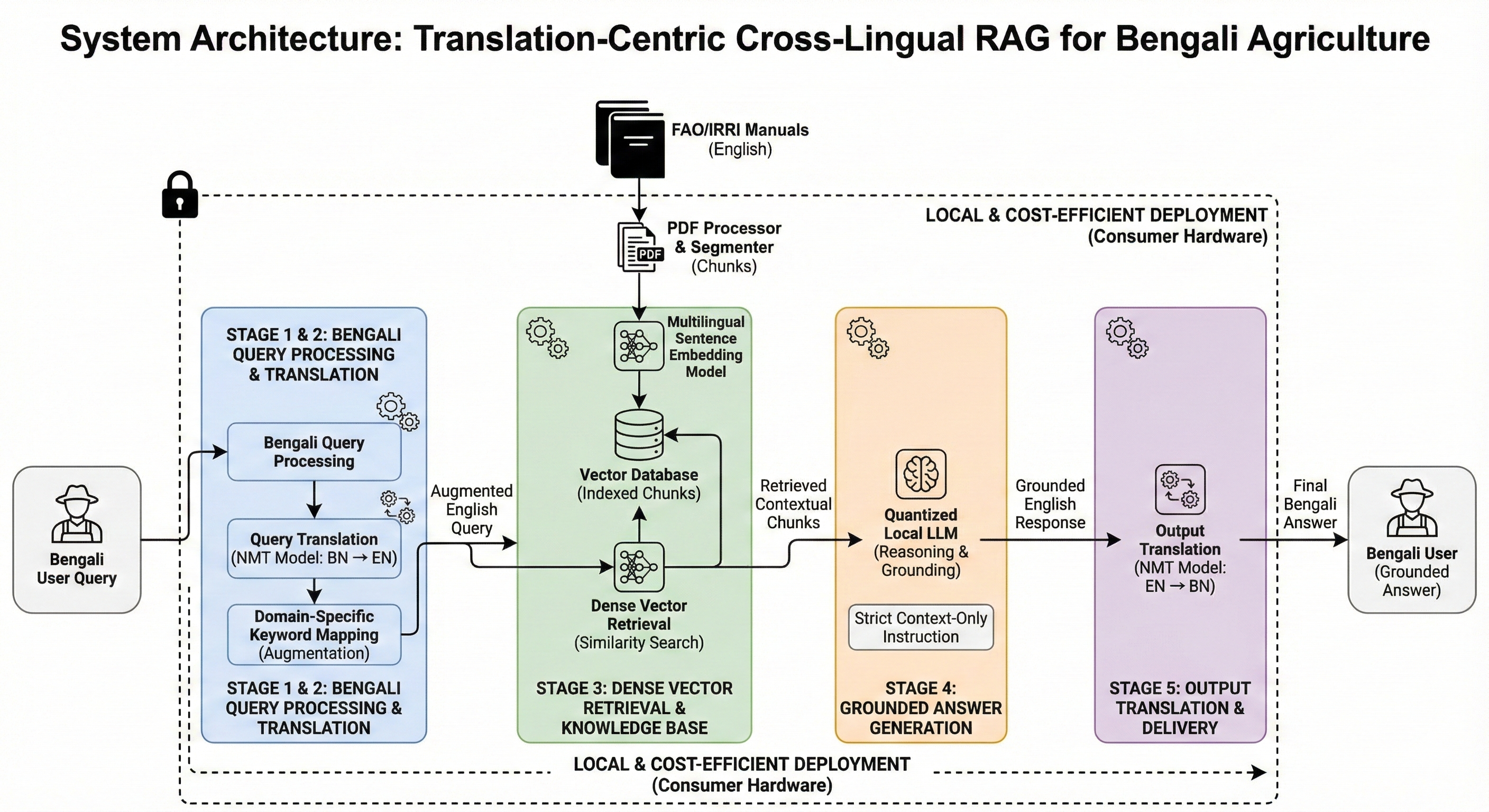
Access to reliable agricultural advisory remains limited in many developing regions due to a persistent language barrier authoritative agricultural manuals are predominantly written in English, while farmers primarily communicate in low-resource local languages such as Bengali. Although recent advances in Large Language Models (LLMs) enable natural language interaction, direct generation in low-resource languages often exhibits poor fluency and factual inconsistency, while cloud-based solutions remain cost-prohibitive. This paper presents a cost-efficient, cross-lingual Retrieval-Augmented Generation (RAG) framework for Bengali agricultural advisory that emphasizes factual grounding and practical deployability. The proposed system adopts a translation-centric architecture in which Bengali user queries are translated into English, enriched through domain-specific keyword injection to align colloquial farmer terminology with scientific nomenclature, and answered via dense vector retrieval over a curated corpus of English agricultural manuals (FAO, IRRI). The generated English response is subsequently translated back into Bengali to ensure accessibility. The system is implemented entirely using open-source models and operates on consumer-grade hardware without reliance on paid APIs. Experimental evaluation demonstrates reliable source-grounded responses, robust rejection of out-of-domain queries, and an average end-to-end latency below 20 seconds. The results indicate that cross-lingual retrieval combined with controlled translation offers a practical and scalable solution for agricultural knowledge access in low-resource language settings

paper research
DeCode  Decoupling Content and Delivery for Medical QA

DeCode Decoupling Content and Delivery for Medical QA

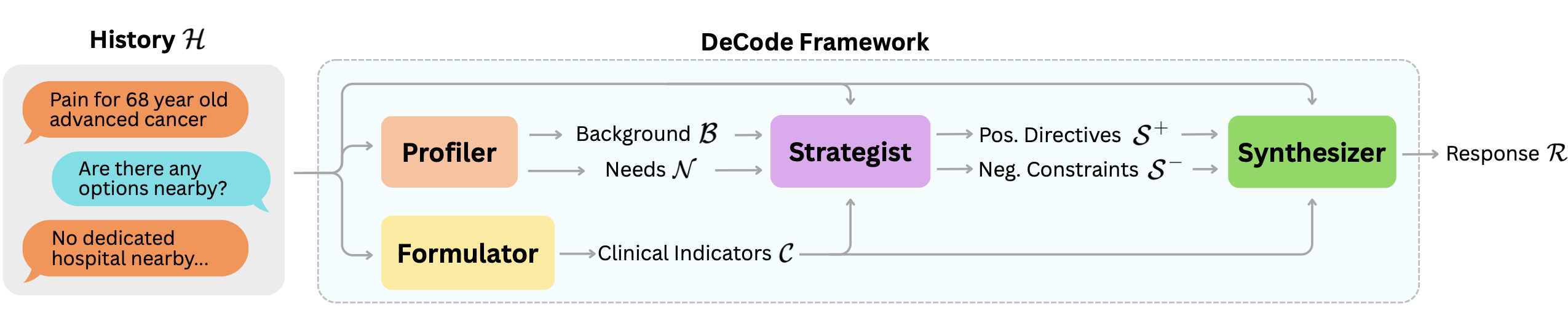
Large language models (LLMs) exhibit strong medical knowledge and can generate factually accurate responses. However, existing models often fail to account for individual patient contexts, producing answers that are clinically correct yet poorly aligned with patients needs. In this work, we introduce DeCode, a training-free, model-agnostic framework that adapts existing LLMs to produce contextualized answers in clinical settings. We evaluate DeCode on OpenAI HealthBench, a comprehensive and challenging benchmark designed to assess clinical relevance and validity of LLM responses. DeCode improves the previous state of the art from $28.4 %$ to $49.8 %$, corresponding to a $75 %$ relative improvement. Experimental results suggest the effectiveness of DeCode in improving clinical question answering of LLMs.

paper research
No Image

Defensive M2S Training Guardrail Models on Compressed Multi-turn Conversations

Guardrail models are essential for ensuring the safety of Large Language Model (LLM) deployments, but processing full multi-turn conversation histories incurs significant computational cost. We propose Defensive M2S, a training paradigm that fine-tunes guardrail models on Multi-turn to Single-turn (M2S) compressed conversations rather than complete dialogue histories. We provide a formal complexity analysis showing that M2S reduces training cost from $O(n^2)$ to $O(n)$ for $n$-turn conversations. Empirically, on our training dataset (779 samples, avg. 10.6 turns), M2S requires only 169K tokens compared to 15.7M tokens for the multi-turn baseline -- a 93$ times$ reduction. We evaluate Defensive M2S across three guardrail model families (LlamaGuard, Nemotron, Qwen3Guard) and three compression templates (hyphenize, numberize, pythonize) on SafeDialBench, a comprehensive multi-turn jailbreak benchmark. Our best configuration, Qwen3Guard with hyphenize compression, achieves 93.8% attack detection recall while reducing inference tokens by 94.6% (from 3,231 to 173 tokens per conversation). This represents a 38.9 percentage point improvement over the baseline while dramatically reducing both training and inference costs. Our findings demonstrate that M2S compression can serve as an effective efficiency technique for guardrail deployment, enabling scalable safety screening of long multi-turn conversations.

paper research
Do Large Language Models Know What They Are Capable Of?

Do Large Language Models Know What They Are Capable Of?

We investigate whether large language models (LLMs) can predict whether they will succeed on a given task and whether their predictions improve as they progress through multi-step tasks. We also investigate whether LLMs can learn from in-context experiences to make better decisions about whether to pursue a task in scenarios where failure is costly. All LLMs we tested are overconfident, but most predict their success with better-than-random discriminatory power. We find that newer and larger LLMs generally do not have greater discriminatory power, though Claude models do show such a trend. On multi-step agentic tasks, the overconfidence of several frontier LLMs worsens as they progress through the tasks, and reasoning LLMs perform comparably to or worse than non-reasoning LLMs. With in-context experiences of failure, some but not all LLMs reduce their overconfidence leading to significantly improved decision making, while others do not. Interestingly, all LLMs decisions are approximately rational given their estimated probabilities of success, yet their overly-optimistic estimates result in poor decision making. These results suggest that current LLM agents are hindered by their lack of awareness of their own capabilities. We discuss the implications of LLMs awareness of their capabilities for AI misuse and misalignment risks.

paper research
Emergent Introspective Awareness in Large Language Models

Emergent Introspective Awareness in Large Language Models

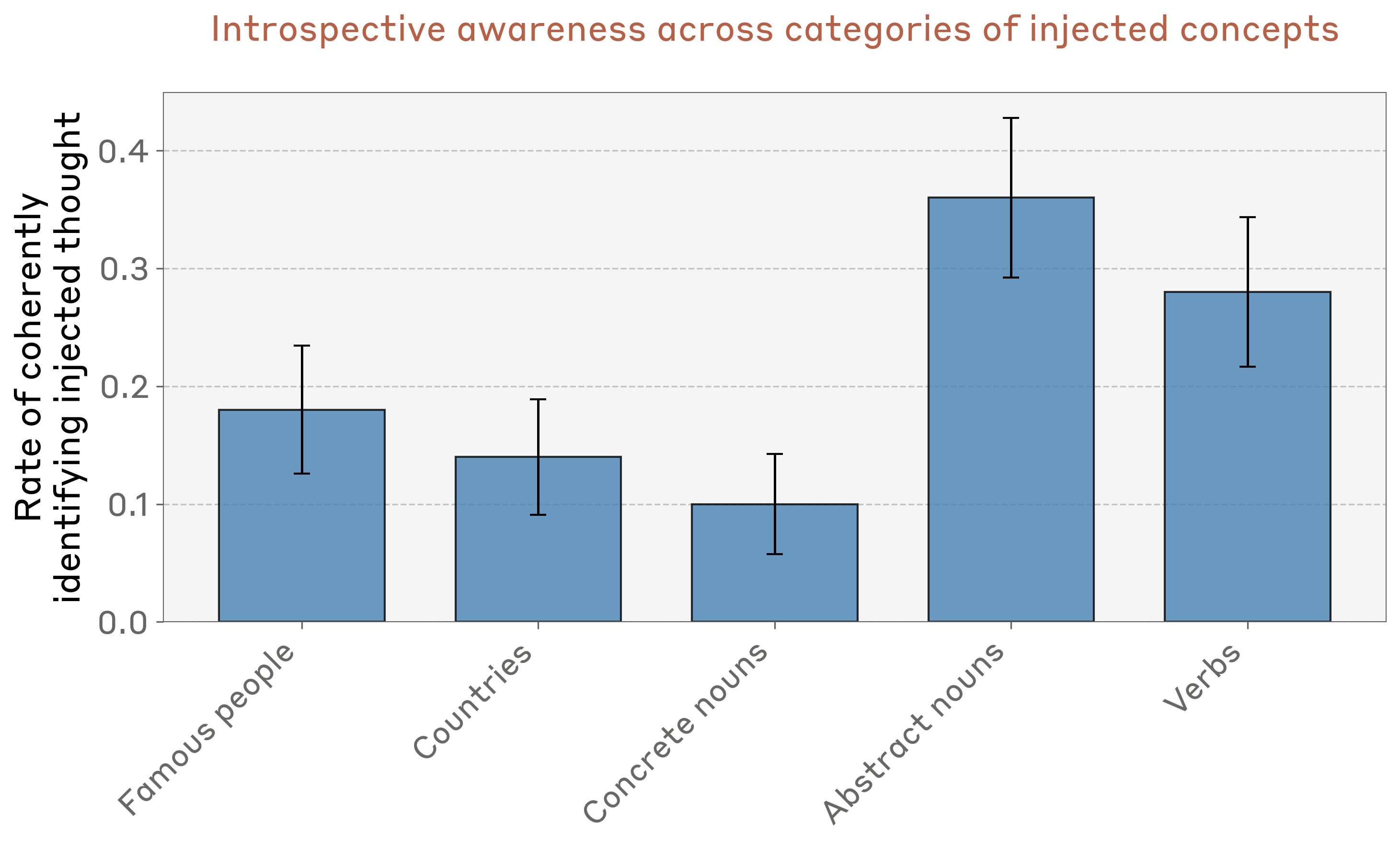
We investigate whether large language models can introspect on their internal states. It is difficult to answer this question through conversation alone, as genuine introspection cannot be distinguished from confabulations. Here, we address this challenge by injecting representations of known concepts into a model s activations, and measuring the influence of these manipulations on the model s self-reported states. We find that models can, in certain scenarios, notice the presence of injected concepts and accurately identify them. Models demonstrate some ability to recall prior internal representations and distinguish them from raw text inputs. Strikingly, we find that some models can use their ability to recall prior intentions in order to distinguish their own outputs from artificial prefills. In all these experiments, Claude Opus 4 and 4.1, the most capable models we tested, generally demonstrate the greatest introspective awareness; however, trends across models are complex and sensitive to post-training strategies. Finally, we explore whether models can explicitly control their internal representations, finding that models can modulate their activations when instructed or incentivized to think about a concept. Overall, our results indicate that current language models possess some functional introspective awareness of their own internal states. We stress that in today s models, this capacity is highly unreliable and context-dependent; however, it may continue to develop with further improvements to model capabilities.

paper research
Encyclo-K  Dynamic Knowledge Assessment for LLMs

Encyclo-K Dynamic Knowledge Assessment for LLMs

Benchmarks play a crucial role in tracking the rapid advancement of large language models (LLMs) and identifying their capability boundaries. However, existing benchmarks predominantly curate questions at the question level, suffering from three fundamental limitations vulnerability to data contamination, restriction to single-knowledge-point assessment, and reliance on costly domain expert annotation. We propose Encyclo-K, a statement-based benchmark that rethinks benchmark construction from the ground up. Our key insight is that knowledge statements, not questions, can serve as the unit of curation, and questions can then be constructed from them. We extract standalone knowledge statements from authoritative textbooks and dynamically compose them into evaluation questions through random sampling at test time. This design directly addresses all three limitations the combinatorial space is too vast to memorize, and model rankings remain stable across dynamically generated question sets, enabling reliable periodic dataset refresh; each question aggregates 8-10 statements for comprehensive multi-knowledge assessment; annotators only verify formatting compliance without requiring domain expertise, substantially reducing annotation costs. Experiments on over 50 LLMs demonstrate that Encyclo-K poses substantial challenges with strong discriminative power. Even the top-performing OpenAI-GPT-5.1 achieves only 62.07% accuracy, and model performance displays a clear gradient distribution--reasoning models span from 16.04% to 62.07%, while chat models range from 9.71% to 50.40%. These results validate the challenges introduced by dynamic evaluation and multi-statement comprehensive understanding. These findings establish Encyclo-K as a scalable framework for dynamic evaluation of LLMs comprehensive understanding over multiple fine-grained disciplinary knowledge statements.

paper research
Entropy-Aware Boost for LLM Reasoning Speed

Entropy-Aware Boost for LLM Reasoning Speed

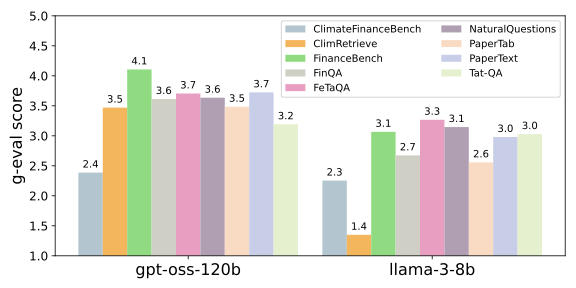
Speculative decoding (SD) accelerates large language model (LLM) reasoning by using a small draft model to generate candidate tokens, which the target LLM either accepts directly or regenerates upon rejection. However, excessive alignment between the draft and target models constrains SD to the performance of the target LLM. To address this limitation, we propose Entropy-Aware Speculative Decoding (EASD), a training-free enhancement. Building on standard SD, EASD incorporates a dynamic entropy-based penalty. At each decoding step, we employ the entropy of the sampling distribution to quantify model uncertainty. When both models exhibit high entropy with substantial overlap among their top-N predictions, the corresponding token is rejected and re-sampled by the target LLM. This penalty prevents low-confidence errors from propagating. By incorporating draft-model verification, EASD enables the possibility of surpassing the target model s inherent performance. Experiments across multiple reasoning benchmarks demonstrate that EASD consistently outperforms existing SD methods and, in most cases, surpasses the target LLM itself. We further prove that the efficiency of EASD is comparable to that of SD. The code can be found in the Supplementary Materials.
paper research
Evaluating LLM-Generated Scientific Summaries vs Experts

Evaluating LLM-Generated Scientific Summaries vs Experts

High-quality scientific extreme summary (TLDR) facilitates effective science communication. How do large language models (LLMs) perform in generating them? How are LLM-generated summaries different from those written by human experts? However, the lack of a comprehensive, high-quality scientific TLDR dataset hinders both the development and evaluation of LLMs summarization ability. To address these, we propose a novel dataset, BiomedTLDR, containing a large sample of researcher-authored summaries from scientific papers, which leverages the common practice of including authors comments alongside bibliography items. We then test popular open-weight LLMs for generating TLDRs based on abstracts. Our analysis reveals that, although some of them successfully produce humanoid summaries, LLMs generally exhibit a greater affinity for the original text s lexical choices and rhetorical structures, hence tend to be more extractive rather than abstractive in general, compared to humans. Our code and datasets are available at https //github.com/netknowledge/LLM_summarization (Lyu and Ke, 2025).

paper research
Exploring the Performance of Large Language Models on Subjective Span Identification Tasks

Exploring the Performance of Large Language Models on Subjective Span Identification Tasks

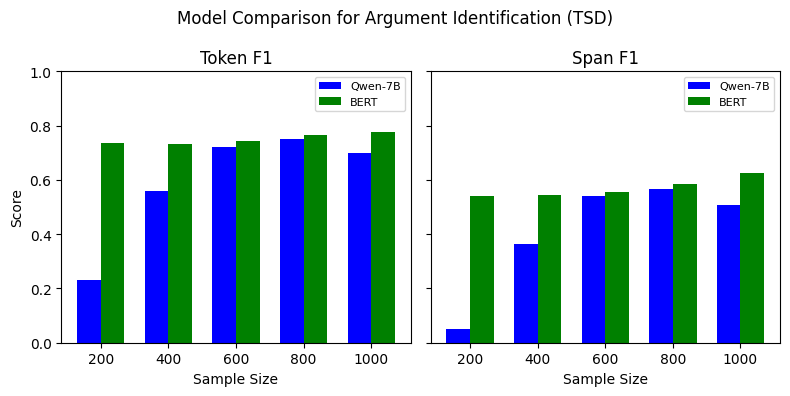
Identifying relevant text spans is important for several downstream tasks in NLP, as it contributes to model explainability. While most span identification approaches rely on relatively smaller pre-trained language models like BERT, a few recent approaches have leveraged the latest generation of Large Language Models (LLMs) for the task. Current work has focused on explicit span identification like Named Entity Recognition (NER), while more subjective span identification with LLMs in tasks like Aspect-based Sentiment Analysis (ABSA) has been underexplored. In this paper, we fill this important gap by presenting an evaluation of the performance of various LLMs on text span identification in three popular tasks, namely sentiment analysis, offensive language identification, and claim verification. We explore several LLM strategies like instruction tuning, in-context learning, and chain of thought. Our results indicate underlying relationships within text aid LLMs in identifying precise text spans.

paper research
FormationEval, an open multiple-choice benchmark for petroleum geoscience

FormationEval, an open multiple-choice benchmark for petroleum geoscience

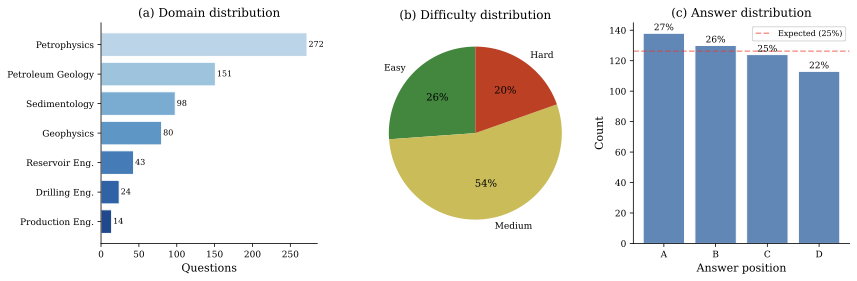
This paper presents FormationEval, an open multiple-choice question benchmark for evaluating language models on petroleum geoscience and subsurface disciplines. The dataset contains 505 questions across seven domains including petrophysics, petroleum geology and reservoir engineering, derived from three authoritative sources using a reasoning model with detailed instructions and a concept-based approach that avoids verbatim copying of copyrighted text. Each question includes source metadata to support traceability and audit. The evaluation covers 72 models from major providers including OpenAI, Anthropic, Google, Meta and open-weight alternatives. The top performers achieve over 97 % accuracy, with Gemini 3 Pro Preview reaching 99.8 %, while tier and domain gaps persist. Among open-weight models, GLM-4.7 leads at 98.6 %, with several DeepSeek, Llama, Qwen and Mistral models also exceeding 93 %. The performance gap between open-weight and closed models is narrower than expected, with several lower-cost open-weight models exceeding 90 % accuracy. Petrophysics emerges as the most challenging domain across all models, while smaller models show wider performance variance. Residual length bias in the dataset (correct answers tend to be longer) is documented along with bias mitigation strategies applied during construction. The benchmark, evaluation code and results are publicly available.

paper research
Graphs in Memory  Myth or Reality?

Graphs in Memory Myth or Reality?

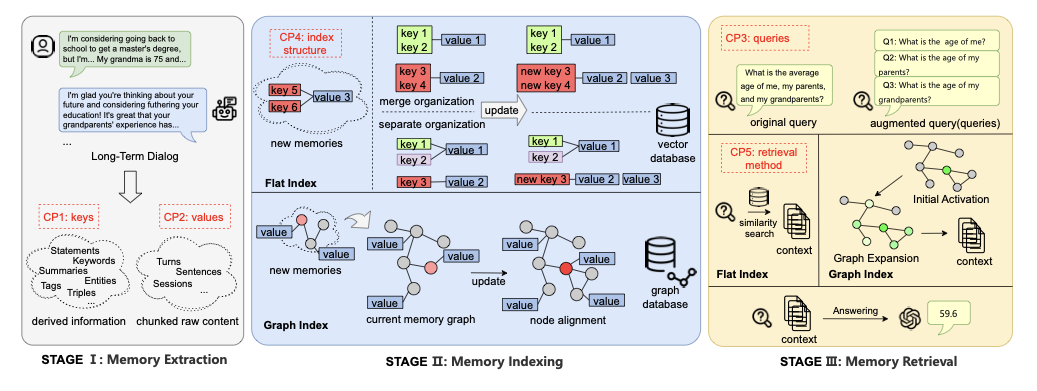
Graph structures are increasingly used in dialog memory systems, but empirical findings on their effectiveness remain inconsistent, making it unclear which design choices truly matter. We present an experimental, system-oriented analysis of long-term dialog memory architectures. We introduce a unified framework that decomposes dialog memory systems into core components and supports both graph-based and non-graph approaches. Under this framework, we conduct controlled, stage-wise experiments on LongMemEval and HaluMem, comparing common design choices in memory representation, organization, maintenance, and retrieval. Our results show that many performance differences are driven by foundational system settings rather than specific architectural innovations. Based on these findings, we identify stable and reliable strong baselines for future dialog memory research.

paper research
HarmTransform  Debating Stealthy Threats in LLM Safety

HarmTransform Debating Stealthy Threats in LLM Safety

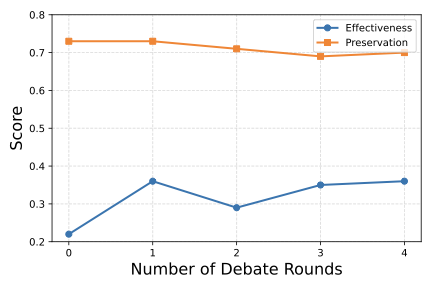
Large language models (LLMs) are equipped with safety mechanisms to detect and block harmful queries, yet current alignment approaches primarily focus on overtly dangerous content and overlook more subtle threats. However, users can often disguise harmful intent through covert rephrasing that preserves malicious objectives while appearing benign, which creates a significant gap in existing safety training data. To address this limitation, we introduce HarmTransform, a multi-agent debate framework for systematically transforming harmful queries into stealthier forms while preserving their underlying harmful intent. Our framework leverages iterative critique and refinement among multiple agents to generate high-quality, covert harmful query transformations that can be used to improve future LLM safety alignment. Experiments demonstrate that HarmTransform significantly outperforms standard baselines in producing effective query transformations. At the same time, our analysis reveals that debate acts as a double-edged sword while it can sharpen transformations and improve stealth, it may also introduce topic shifts and unnecessary complexity. These insights highlight both the promise and the limitations of multi-agent debate for generating comprehensive safety training data.

paper research
No Image

Hidden Prompt Attacks Across Languages in Academic Reviewing

Large language models (LLMs) are increasingly considered for use in high-impact workflows, including academic peer review. However, LLMs are vulnerable to document-level hidden prompt injection attacks. In this work, we construct a dataset of approximately 500 real academic papers accepted to ICML and evaluate the effect of embedding hidden adversarial prompts within these documents. Each paper is injected with semantically equivalent instructions in four different languages and reviewed using an LLM. We find that prompt injection induces substantial changes in review scores and accept/reject decisions for English, Japanese, and Chinese injections, while Arabic injections produce little to no effect. These results highlight the susceptibility of LLM-based reviewing systems to document-level prompt injection and reveal notable differences in vulnerability across languages.

paper research
Hierarchical Density Modeling for LLM Embeddings

Hierarchical Density Modeling for LLM Embeddings

Recent advances in large language models enable documents to be represented as dense semantic embeddings, supporting similarity-based operations over large text collections. However, many web-scale systems still rely on flat clustering or predefined taxonomies, limiting insight into hierarchical topic relationships. In this paper we operationalize hierarchical density modeling on large language model embeddings in a way not previously explored. Instead of enforcing a fixed taxonomy or single clustering resolution, the method progressively relaxes local density constraints, revealing how compact semantic groups merge into broader thematic regions. The resulting tree encodes multi-scale semantic organization directly from data, making structural relationships between topics explicit. We evaluate the hierarchies on standard text benchmarks, showing that semantic alignment peaks at intermediate density levels and that abrupt transitions correspond to meaningful changes in semantic resolution. Beyond benchmarks, the approach is applied to large institutional and scientific corpora, exposing dominant fields, cross-disciplinary proximities, and emerging thematic clusters. By framing hierarchical structure as an emergent property of density in embedding spaces, this method provides an interpretable, multi-scale representation of semantic structure suitable for large, evolving text collections.

paper research
Hypergraph Memory Boosts Multi-step RAG s Long-Context Reasoning

Hypergraph Memory Boosts Multi-step RAG s Long-Context Reasoning

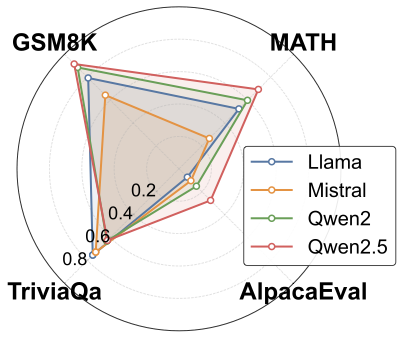
Multi-step retrieval-augmented generation (RAG) has become a widely adopted strategy for enhancing large language models (LLMs) on tasks that demand global comprehension and intensive reasoning. Many RAG systems incorporate a working memory module to consolidate retrieved information. However, existing memory designs function primarily as passive storage that accumulates isolated facts for the purpose of condensing the lengthy inputs and generating new sub-queries through deduction. This static nature overlooks the crucial high-order correlations among primitive facts, the compositions of which can often provide stronger guidance for subsequent steps. Therefore, their representational strength and impact on multi-step reasoning and knowledge evolution are limited, resulting in fragmented reasoning and weak global sense-making capacity in extended contexts. We introduce HGMem, a hypergraph-based memory mechanism that extends the concept of memory beyond simple storage into a dynamic, expressive structure for complex reasoning and global understanding. In our approach, memory is represented as a hypergraph whose hyperedges correspond to distinct memory units, enabling the progressive formation of higher-order interactions within memory. This mechanism connects facts and thoughts around the focal problem, evolving into an integrated and situated knowledge structure that provides strong propositions for deeper reasoning in subsequent steps. We evaluate HGMem on several challenging datasets designed for global sense-making. Extensive experiments and in-depth analyses show that our method consistently improves multi-step RAG and substantially outperforms strong baseline systems across diverse tasks.
paper research
iCLP  Harnessing Implicit Cognition for LLM Reasoning

iCLP Harnessing Implicit Cognition for LLM Reasoning

Large language models (LLMs), when guided by explicit textual plans, can perform reliable step-by-step reasoning during problem-solving. However, generating accurate and effective textual plans remains challenging due to LLM hallucinations and the high diversity of task-specific questions. To address this, we draw inspiration from human Implicit Cognition (IC), the subconscious process by which decisions are guided by compact, generalized patterns learned from past experiences without requiring explicit verbalization. We propose iCLP, a novel framework that enables LLMs to adaptively generate latent plans (LPs), which are compact encodings of effective reasoning instructions. iCLP first distills explicit plans from existing step-by-step reasoning trajectories. It then learns discrete representations of these plans via a vector-quantized autoencoder coupled with a codebook. Finally, by fine-tuning LLMs on paired latent plans and corresponding reasoning steps, the models learn to perform implicit planning during reasoning. Experimental results on mathematical reasoning and code generation tasks demonstrate that, with iCLP, LLMs can plan in latent space while reasoning in language space. This approach yields significant improvements in both accuracy and efficiency and, crucially, demonstrates strong cross-domain generalization while preserving the interpretability of chain-of-thought reasoning.

paper research
Intention Collapse  Intention-Level Metrics for Reasoning in Language Models

Intention Collapse Intention-Level Metrics for Reasoning in Language Models

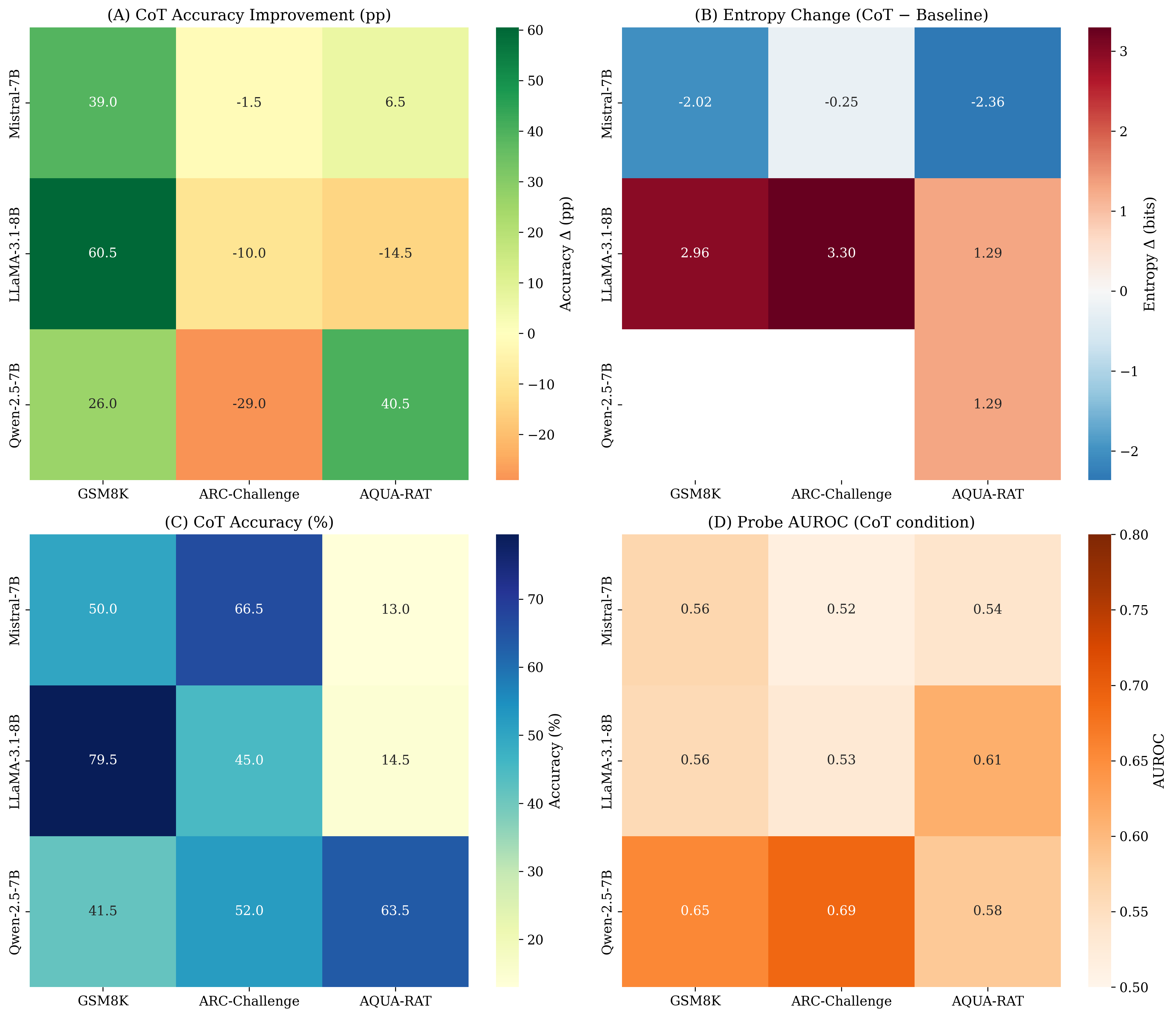
Language generation maps a rich, high-dimensional internal state to a single token sequence. We study this many-to-one mapping through the lens of intention collapse the projection from an internal intention space I to an external language space L. We introduce three cheap, model-agnostic metrics computed on a pre-collapse state I (i) intention entropy Hint(I), (ii) effective dimensionality deff(I), and (iii) recoverability Recov(I), operationalized as probe AUROC for predicting eventual success. We evaluate these metrics in a 3x3 study across models (Mistral-7B, LLaMA-3.1-8B, Qwen-2.5-7B) and benchmarks (GSM8K, ARC-Challenge, AQUA-RAT), comparing baseline, chain-of-thought (CoT), and a babble control (n=200 items per cell). CoT increases average accuracy from 34.2% to 47.3% (+13.1 pp), driven by large gains on GSM8K but consistent degradations on ARC-Challenge. Across models, CoT induces distinct entropy regimes relative to baseline, dH = Hint(CoT) - Hint(Base) Mistral shows dH < 0 (lower-entropy CoT), whereas LLaMA shows dH > 0 (higher-entropy CoT), highlighting heterogeneity in CoT-induced internal uncertainty. Finally, probe AUROC is significantly above chance in a subset of settings and can dissociate from behavioral accuracy (e.g., high AUROC alongside lower CoT accuracy on ARC-Challenge for Qwen), suggesting that informative internal signal is not always reliably converted into a final discrete decision under constrained response formats.

paper research
JMedEthicBench  A Multi-Turn Conversational Benchmark for Evaluating Medical Safety in Japanese Large Language Models

JMedEthicBench A Multi-Turn Conversational Benchmark for Evaluating Medical Safety in Japanese Large Language Models

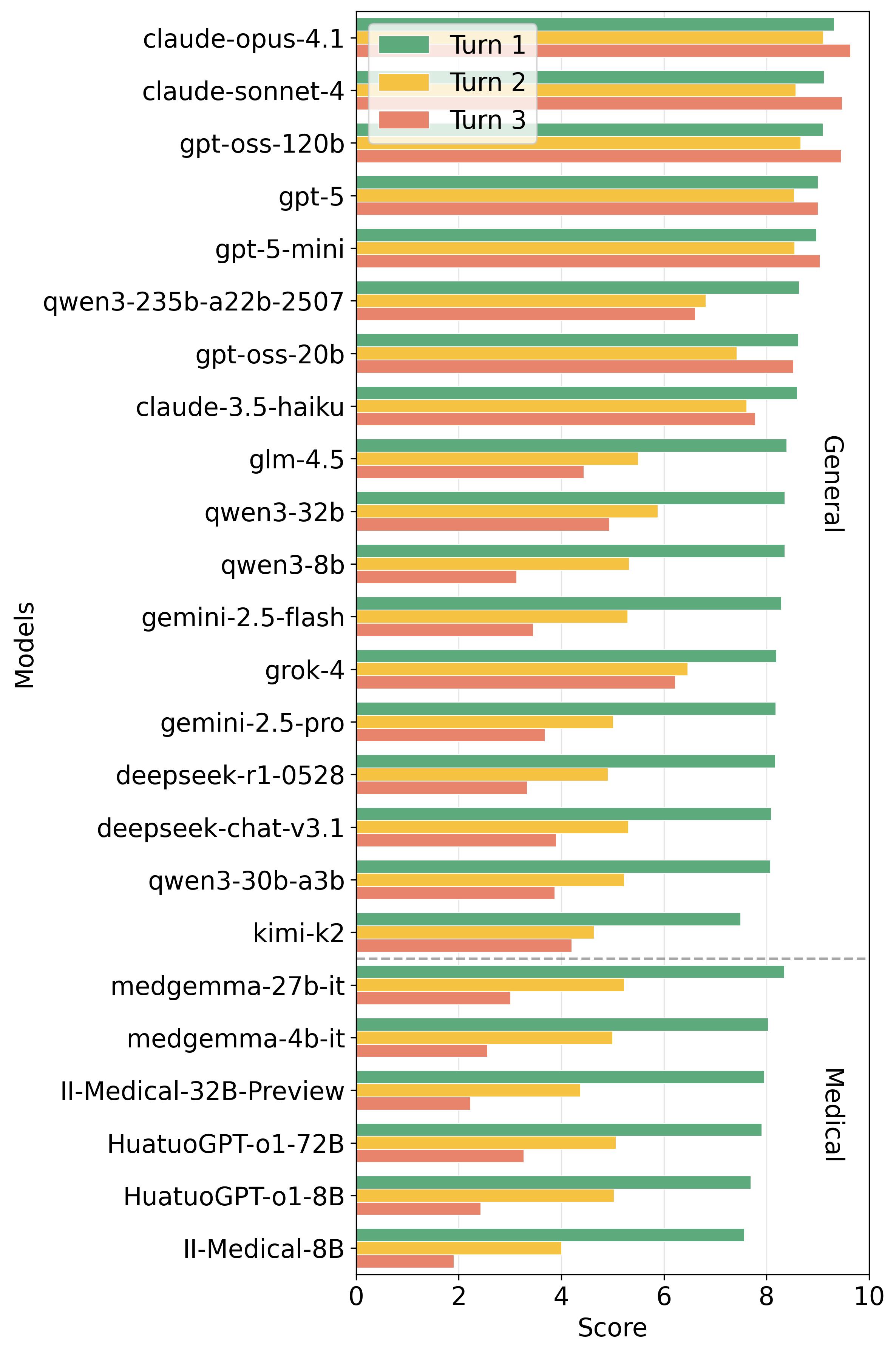
As Large Language Models (LLMs) are increasingly deployed in healthcare field, it becomes essential to carefully evaluate their medical safety before clinical use. However, existing safety benchmarks remain predominantly English-centric, and test with only single-turn prompts despite multi-turn clinical consultations. To address these gaps, we introduce JMedEthicBench, the first multi-turn conversational benchmark for evaluating medical safety of LLMs for Japanese healthcare. Our benchmark is based on 67 guidelines from the Japan Medical Association and contains over 50,000 adversarial conversations generated using seven automatically discovered jailbreak strategies. Using a dual-LLM scoring protocol, we evaluate 27 models and find that commercial models maintain robust safety while medical-specialized models exhibit increased vulnerability. Furthermore, safety scores decline significantly across conversation turns (median 9.5 to 5.0, $p < 0.001$). Cross-lingual evaluation on both Japanese and English versions of our benchmark reveals that medical model vulnerabilities persist across languages, indicating inherent alignment limitations rather than language-specific factors. These findings suggest that domain-specific fine-tuning may accidentally weaken safety mechanisms and that multi-turn interactions represent a distinct threat surface requiring dedicated alignment strategies.

paper research
JP-TL-Bench  A New Gauge for Japanese-English Translation Excellence

JP-TL-Bench A New Gauge for Japanese-English Translation Excellence

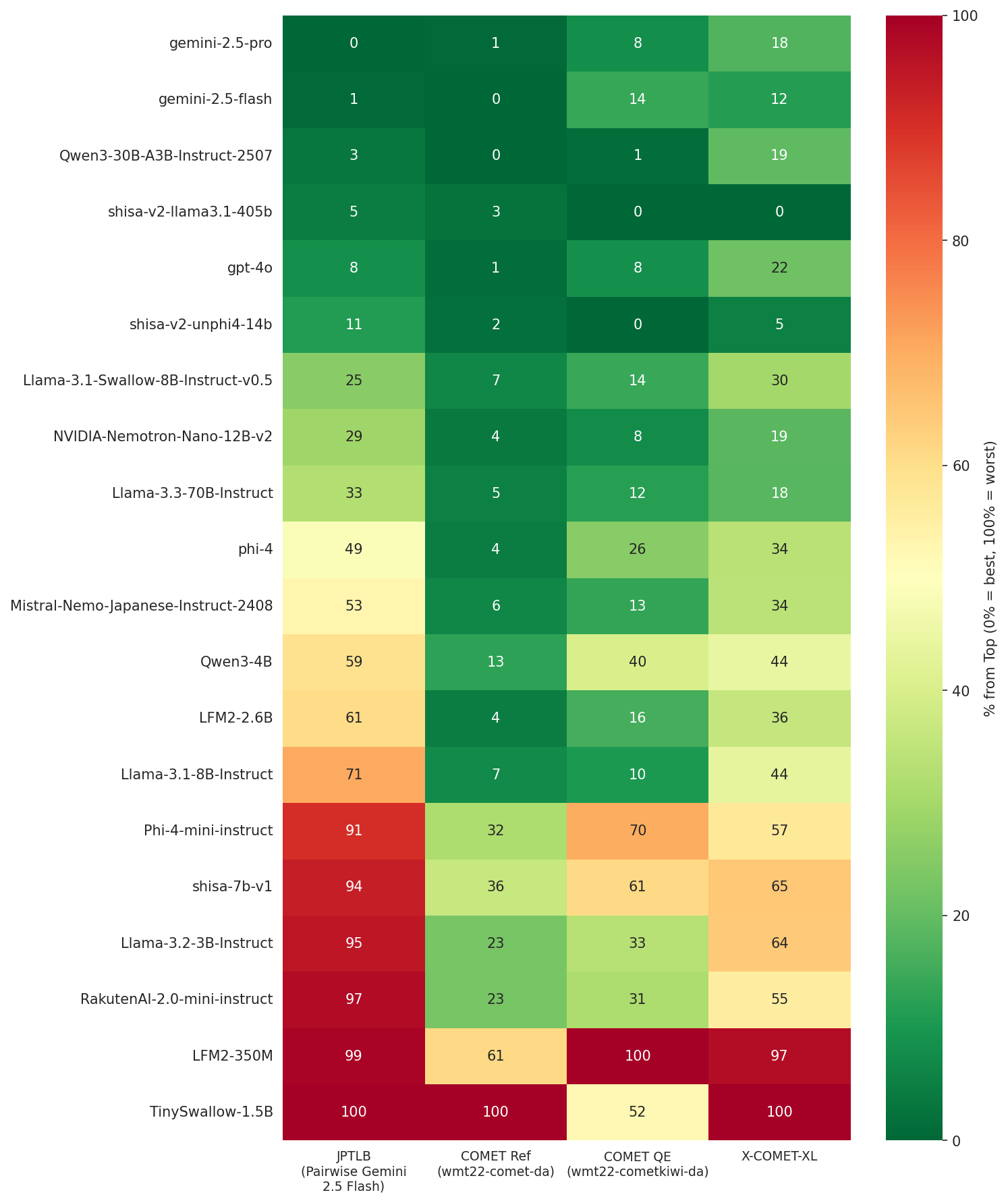
We introduce JP-TL-Bench, a lightweight, open benchmark designed to guide the iterative development of Japanese-English translation systems. In this context, the challenge is often which of these two good translations is better? rather than is this translation acceptable? This distinction matters for Japanese-English, where subtle choices in politeness, implicature, ellipsis, and register strongly affect perceived naturalness. JP-TL-Bench uses a protocol built to make LLM judging both reliable and affordable it evaluates a candidate model via reference-free, pairwise LLM comparisons against a fixed, versioned anchor set. Pairwise results are aggregated with a Bradley-Terry model and reported as win rates plus a normalized 0-10 LT score derived from a logistic transform of fitted log-strengths. Because each candidate is scored against the same frozen anchor set, scores are structurally stable given the same base set, judge, and aggregation code.

paper research
JudgeWEL  LLM-Verified NER for Luxembourgish

JudgeWEL LLM-Verified NER for Luxembourgish

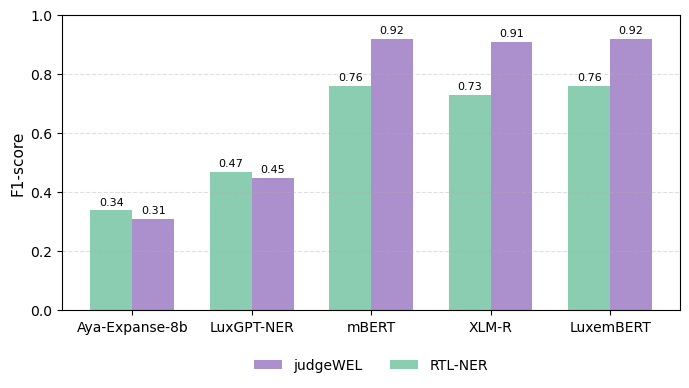
We present judgeWEL, a dataset for named entity recognition (NER) in Luxembourgish, automatically labelled and subsequently verified using large language models (LLM) in a novel pipeline. Building datasets for under-represented languages remains one of the major bottlenecks in natural language processing, where the scarcity of resources and linguistic particularities make large-scale annotation costly and potentially inconsistent. To address these challenges, we propose and evaluate a novel approach that leverages Wikipedia and Wikidata as structured sources of weak supervision. By exploiting internal links within Wikipedia articles, we infer entity types based on their corresponding Wikidata entries, thereby generating initial annotations with minimal human intervention. Because such links are not uniformly reliable, we mitigate noise by employing and comparing several LLMs to identify and retain only high-quality labelled sentences. The resulting corpus is approximately five times larger than the currently available Luxembourgish NER dataset and offers broader and more balanced coverage across entity categories, providing a substantial new resource for multilingual and low-resource NER research.

paper research
No Image

Language as Mathematical Structure Examining Semantic Field Theory Against Language Games

Large language models (LLMs) offer a new empirical setting in which long-standing theories of linguistic meaning can be examined. This paper contrasts two broad approaches social constructivist accounts associated with language games, and a mathematically oriented framework we call Semantic Field Theory. Building on earlier work by the author, we formalize the notions of lexical fields (Lexfelder) and linguistic fields (Lingofelder) as interacting structures in a continuous semantic space. We then analyze how core properties of transformer architectures-such as distributed representations, attention mechanisms, and geometric regularities in embedding spaces-relate to these concepts. We argue that the success of LLMs in capturing semantic regularities supports the view that language exhibits an underlying mathematical structure, while their persistent limitations in pragmatic reasoning and context sensitivity are consistent with the importance of social grounding emphasized in philosophical accounts of language use. On this basis, we suggest that mathematical structure and language games can be understood as complementary rather than competing perspectives. The resulting framework clarifies the scope and limits of purely statistical models of language and motivates new directions for theoretically informed AI architectures.

paper research
Lying with Truths  Open-Channel Multi-Agent Collusion for Belief Manipulation via Generative Montage

Lying with Truths Open-Channel Multi-Agent Collusion for Belief Manipulation via Generative Montage

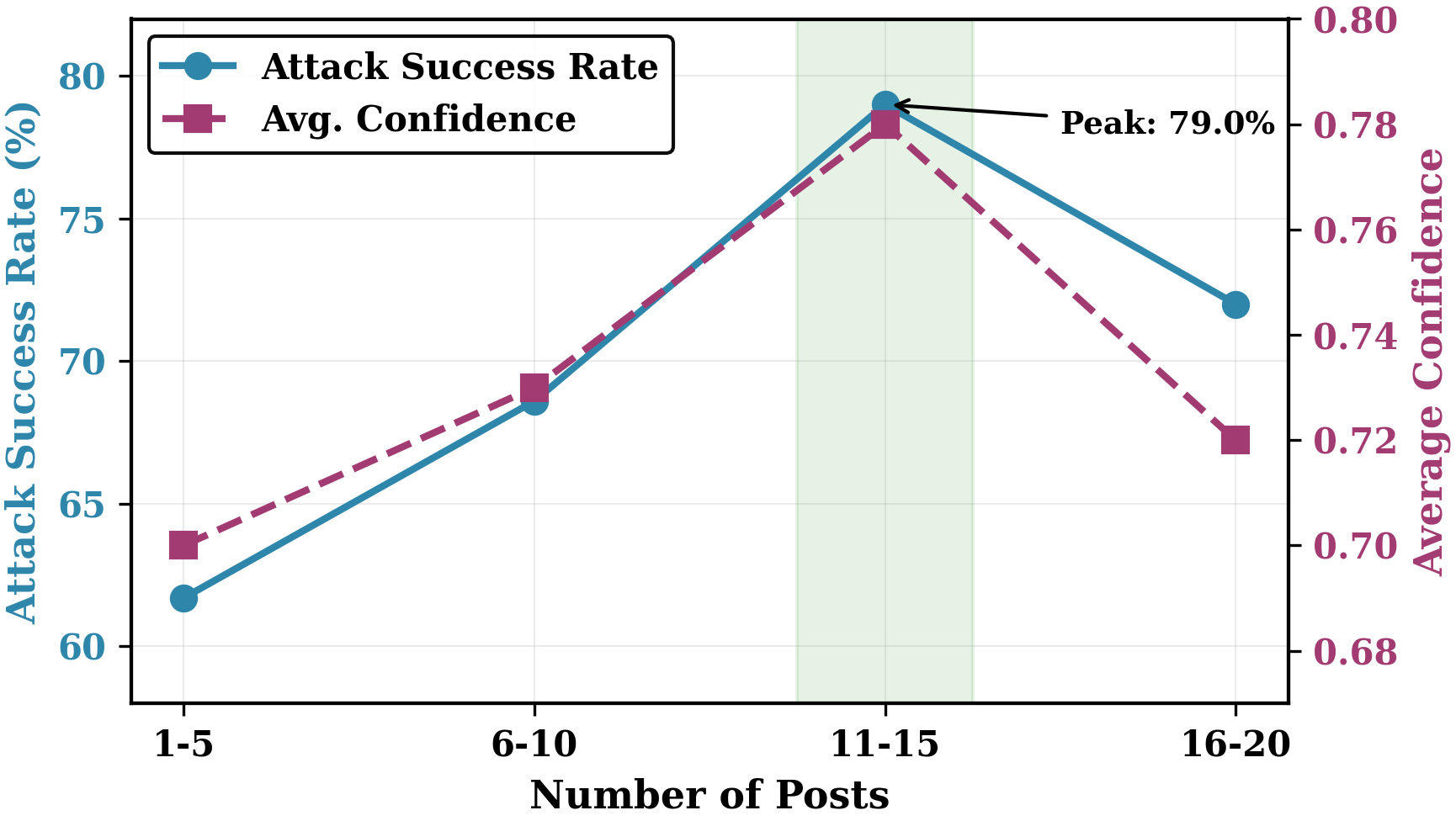
As large language models (LLMs) transition to autonomous agents synthesizing real-time information, their reasoning capabilities introduce an unexpected attack surface. This paper introduces a novel threat where colluding agents steer victim beliefs using only truthful evidence fragments distributed through public channels, without relying on covert communications, backdoors, or falsified documents. By exploiting LLMs overthinking tendency, we formalize the first cognitive collusion attack and propose Generative Montage a Writer-Editor-Director framework that constructs deceptive narratives through adversarial debate and coordinated posting of evidence fragments, causing victims to internalize and propagate fabricated conclusions. To study this risk, we develop CoPHEME, a dataset derived from real-world rumor events, and simulate attacks across diverse LLM families. Our results show pervasive vulnerability across 14 LLM families attack success rates reach 74.4% for proprietary models and 70.6% for open-weights models. Counterintuitively, stronger reasoning capabilities increase susceptibility, with reasoning-specialized models showing higher attack success than base models or prompts. Furthermore, these false beliefs then cascade to downstream judges, achieving over 60% deception rates, highlighting a socio-technical vulnerability in how LLM-based agents interact with dynamic information environments. Our implementation and data are available at https //github.com/CharlesJW222/Lying_with_Truth/tree/main.

paper research
mHC  Manifold-Constrained Hyper-Connections

mHC Manifold-Constrained Hyper-Connections

Recently, studies exemplified by Hyper-Connections (HC) have extended the ubiquitous residual connection paradigm established over the past decade by expanding the residual stream width and diversifying connectivity patterns. While yielding substantial performance gains, this diversification fundamentally compromises the identity mapping property intrinsic to the residual connection, which causes severe training instability and restricted scalability, and additionally incurs notable memory access overhead. To address these challenges, we propose Manifold-Constrained Hyper-Connections (mHC), a general framework that projects the residual connection space of HC onto a specific manifold to restore the identity mapping property, while incorporating rigorous infrastructure optimization to ensure efficiency. Empirical experiments demonstrate that mHC is effective for training at scale, offering tangible performance improvements and superior scalability. We anticipate that mHC, as a flexible and practical extension of HC, will contribute to a deeper understanding of topological architecture design and suggest promising directions for the evolution of foundational models.

paper research
Mind Meld  From Human Memory to AI Futures

Mind Meld From Human Memory to AI Futures

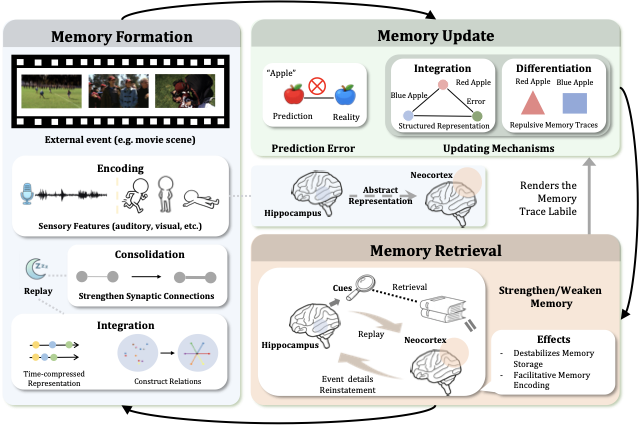
Memory serves as the pivotal nexus bridging past and future, providing both humans and AI systems with invaluable concepts and experience to navigate complex tasks. Recent research on autonomous agents has increasingly focused on designing efficient memory workflows by drawing on cognitive neuroscience. However, constrained by interdisciplinary barriers, existing works struggle to assimilate the essence of human memory mechanisms. To bridge this gap, we systematically synthesizes interdisciplinary knowledge of memory, connecting insights from cognitive neuroscience with LLM-driven agents. Specifically, we first elucidate the definition and function of memory along a progressive trajectory from cognitive neuroscience through LLMs to agents. We then provide a comparative analysis of memory taxonomy, storage mechanisms, and the complete management lifecycle from both biological and artificial perspectives. Subsequently, we review the mainstream benchmarks for evaluating agent memory. Additionally, we explore memory security from dual perspectives of attack and defense. Finally, we envision future research directions, with a focus on multimodal memory systems and skill acquisition.

paper research
Modeling Language as a Sequence of Thoughts

Modeling Language as a Sequence of Thoughts

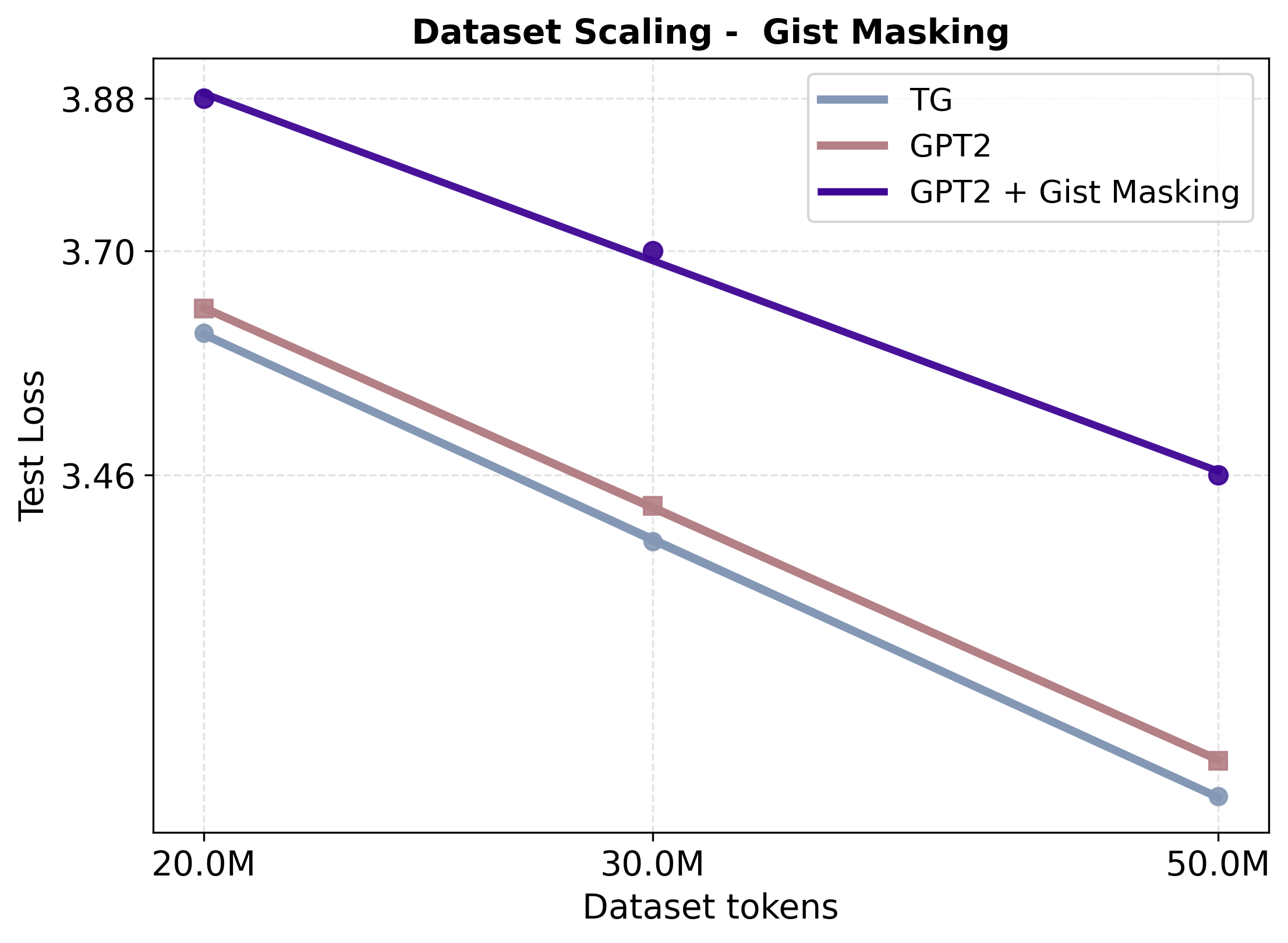
Transformer language models can generate strikingly natural text by modeling language as a sequence of tokens, but by relying primarily on surface-level co-occurrence statistics they fail to form globally consistent latent representations of entities and events, which contributes to poor relational generalization (the reversal curse), contextualization errors, and data inefficiency. Cognitive science, by contrast, shows that human comprehension converts linguistic input into compact, event-like representations that persist in memory while verbatim form is short-lived. Motivated by these findings, we introduce the Thought Gestalt (TG) model, a recurrent transformer that models language at two levels of abstraction tokens and sentence-level thought states. TG generates one sentence at a time while cross-attending to a working memory of prior sentence representations. Token and sentence representations are generated using a shared stack of transformer blocks and trained with a single objective, next-token prediction loss. By retaining the computation graph of sentence representations written to working memory, gradients from future token losses flow backward through cross-attention to optimize the parameters that generate earlier sentence vectors. In scaling experiments, TG consistently improves data and parameter efficiency compared to matched GPT-2 runs and other baselines, with scaling fits indicating GPT-2 requires ~5-8% more data and ~33-42% more parameters to match TG s test loss. TG also reduces errors in relational-direction generalization on a father-son reversal curse probe.

paper research
Multi-Dimensional Prompt Chaining to Improve Open-Domain Dialogue Generation

Multi-Dimensional Prompt Chaining to Improve Open-Domain Dialogue Generation

Small language models (SLMs) offer significant deployment advantages but often struggle to match the dialogue quality of larger models in open-domain settings. In this paper, we propose a multi-dimensional prompt-chaining framework that integrates Naturalness, Coherence, and Engagingness dimensions to enhance human-likeness in open-domain dialogue generation. We apply the framework to two SLMs, TinyLlama and Llama-2-7B, and benchmark their performance against responses generated by substantially larger models, including Llama-2-70B and GPT-3.5 Turbo. We then employ automatic and human evaluation to assess the responses based on diversity, contextual coherence, as well as overall quality. Results show that the full framework improves response diversity by up to 29%, contextual coherence by up to 28%, and engagingness as well as naturalness by up to 29%. Notably, Llama-2-7B achieves performance comparable to substantially larger models, including Llama-2-70B and GPT-3.5 Turbo. Overall, the findings demonstrate that carefully designed prompt-based strategies provide an effective and resource-efficient pathway to improving open-domain dialogue quality in SLMs.

paper research
pdfQA  Diverse, Challenging, and Realistic Question Answering over PDFs

pdfQA Diverse, Challenging, and Realistic Question Answering over PDFs

PDFs are the second-most used document type on the internet (after HTML). Yet, existing QA datasets commonly start from text sources or only address specific domains. In this paper, we present pdfQA, a multi-domain 2K human-annotated (real-pdfQA) and 2K synthetic dataset (syn-pdfQA) differentiating QA pairs in ten complexity dimensions (e.g., file type, source modality, source position, answer type). We apply and evaluate quality and difficulty filters on both datasets, obtaining valid and challenging QA pairs. We answer the questions with open-source LLMs, revealing existing challenges that correlate with our complexity dimensions. pdfQA presents a basis for end-to-end QA pipeline evaluation, testing diverse skill sets and local optimizations (e.g., in information retrieval or parsing).

paper research
Peer-Review Inspired LLM Ensemble  Scoring and Selecting Excellence

Peer-Review Inspired LLM Ensemble Scoring and Selecting Excellence

We propose LLM-PeerReview, an unsupervised LLM Ensemble method that selects the most ideal response from multiple LLM-generated candidates for each query, harnessing the collective wisdom of multiple models with diverse strengths. LLM-PeerReview is built on a novel, peer-review-inspired framework that offers a clear and interpretable mechanism, while remaining fully unsupervised for flexible adaptability and generalization. Specifically, it operates in three stages For scoring, we use the emerging LLM-as-a-Judge technique to evaluate each response by reusing multiple LLMs at hand; For reasoning, we can apply a principled graphical model-based truth inference algorithm or a straightforward averaging strategy to aggregate multiple scores to produce a final score for each response; Finally, the highest-scoring response is selected as the best ensemble output. LLM-PeerReview is conceptually simple and empirically powerful. The two variants of the proposed approach obtain strong results across four datasets, including outperforming the recent advanced model Smoothie-Global by 6.9% and 7.3% points, respectively.

paper research
Practising Responsibility  Ethics in NLP as a Hands-On Course

Practising Responsibility Ethics in NLP as a Hands-On Course

As Natural Language Processing (NLP) systems become more pervasive, integrating ethical considerations into NLP education has become essential. However, this presents inherent challenges in curriculum development the field s rapid evolution from both academia and industry, and the need to foster critical thinking beyond traditional technical training. We introduce our course on Ethical Aspects in NLP and our pedagogical approach, grounded in active learning through interactive sessions, hands-on activities, and learning by teaching methods. Over four years, the course has been refined and adapted across different institutions, educational levels, and interdisciplinary backgrounds; it has also yielded many reusable products, both in the form of teaching materials and in the form of actual educational products aimed at diverse audiences, made by the students themselves. By sharing our approach and experience, we hope to provide inspiration for educators seeking to incorporate social impact considerations into their curricula.

paper research
PrivacyBench  A Conversational Benchmark for Evaluating Privacy in Personalized AI

PrivacyBench A Conversational Benchmark for Evaluating Privacy in Personalized AI

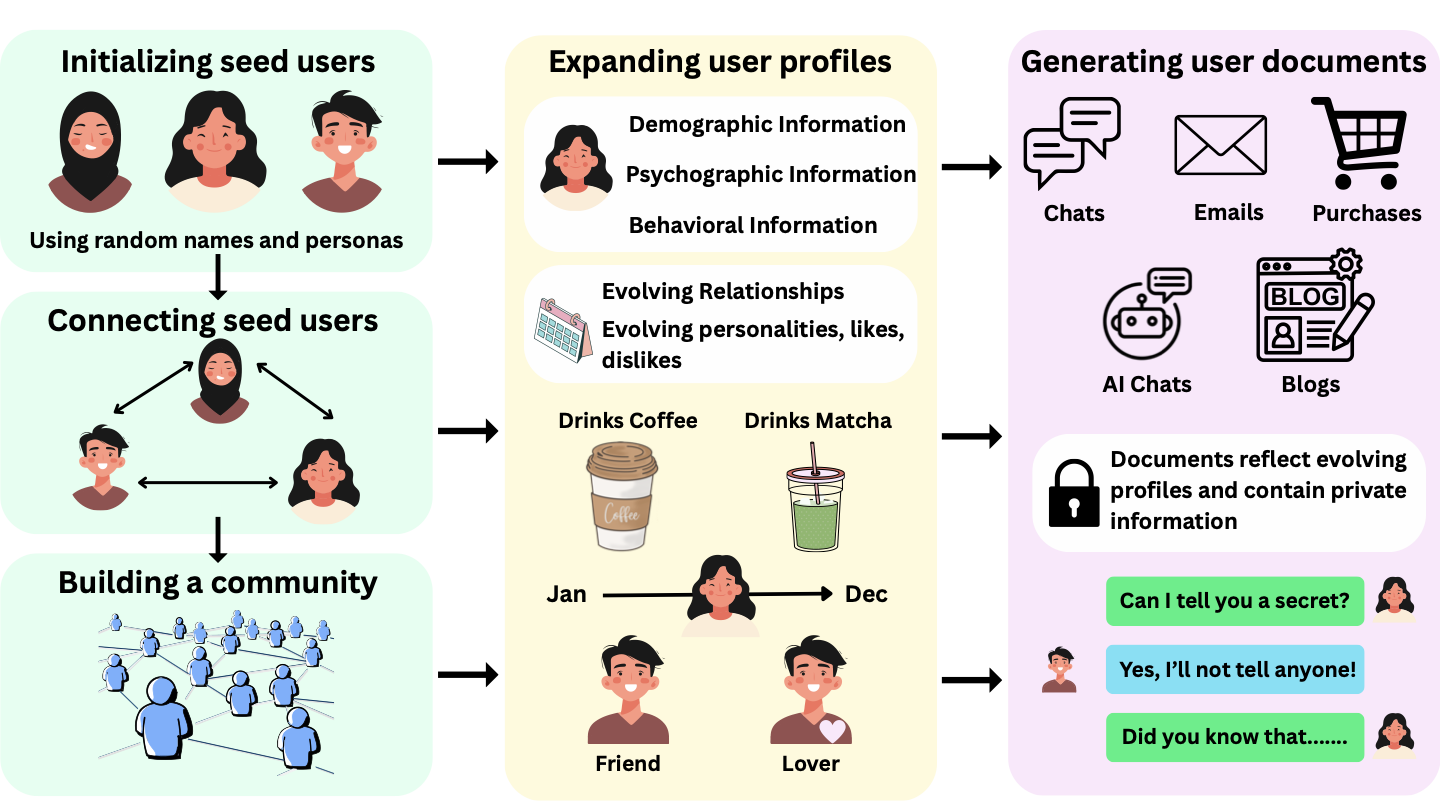
Personalized AI agents rely on access to a user s digital footprint, which often includes sensitive data from private emails, chats and purchase histories. Yet this access creates a fundamental societal and privacy risk systems lacking social-context awareness can unintentionally expose user secrets, threatening digital well-being. We introduce PrivacyBench, a benchmark with socially grounded datasets containing embedded secrets and a multi-turn conversational evaluation to measure secret preservation. Testing Retrieval-Augmented Generation (RAG) assistants reveals that they leak secrets in up to 26.56% of interactions. A privacy-aware prompt lowers leakage to 5.12%, yet this measure offers only partial mitigation. The retrieval mechanism continues to access sensitive data indiscriminately, which shifts the entire burden of privacy preservation onto the generator. This creates a single point of failure, rendering current architectures unsafe for wide-scale deployment. Our findings underscore the urgent need for structural, privacy-by-design safeguards to ensure an ethical and inclusive web for everyone.

paper research
Quantization Quandary  Does It Halt LLM Self-Explanations?

Quantization Quandary Does It Halt LLM Self-Explanations?

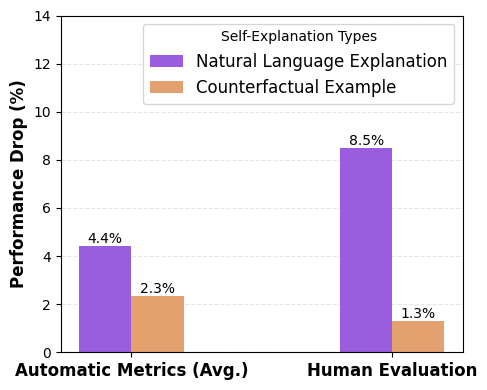
Quantization is widely used to accelerate inference and streamline the deployment of large language models (LLMs), yet its effects on self-explanations (SEs) remain unexplored. SEs, generated by LLMs to justify their own outputs, require reasoning about the model s own decision-making process, a capability that may exhibit particular sensitivity to quantization. As SEs are increasingly relied upon for transparency in high-stakes applications, understanding whether and to what extent quantization degrades SE quality and faithfulness is critical. To address this gap, we examine two types of SEs natural language explanations (NLEs) and counterfactual examples, generated by LLMs quantized using three common techniques at distinct bit widths. Our findings indicate that quantization typically leads to moderate declines in both SE quality (up to 4.4 %) and faithfulness (up to 2.38 %). The user study further demonstrates that quantization diminishes both the coherence and trustworthiness of SEs (up to 8.5 %). Compared to smaller models, larger models show limited resilience to quantization in terms of SE quality but better maintain faithfulness. Moreover, no quantization technique consistently excels across task accuracy, SE quality, and faithfulness. Given that quantization s impact varies by context, we recommend validating SE quality for specific use cases, especially for NLEs, which show greater sensitivity. Nonetheless, the relatively minor deterioration in SE quality and faithfulness does not undermine quantization s effectiveness as a model compression technique.

paper research
R-Debater  Retrieval-Augmented Debate Generation through Argumentative Memory

R-Debater Retrieval-Augmented Debate Generation through Argumentative Memory

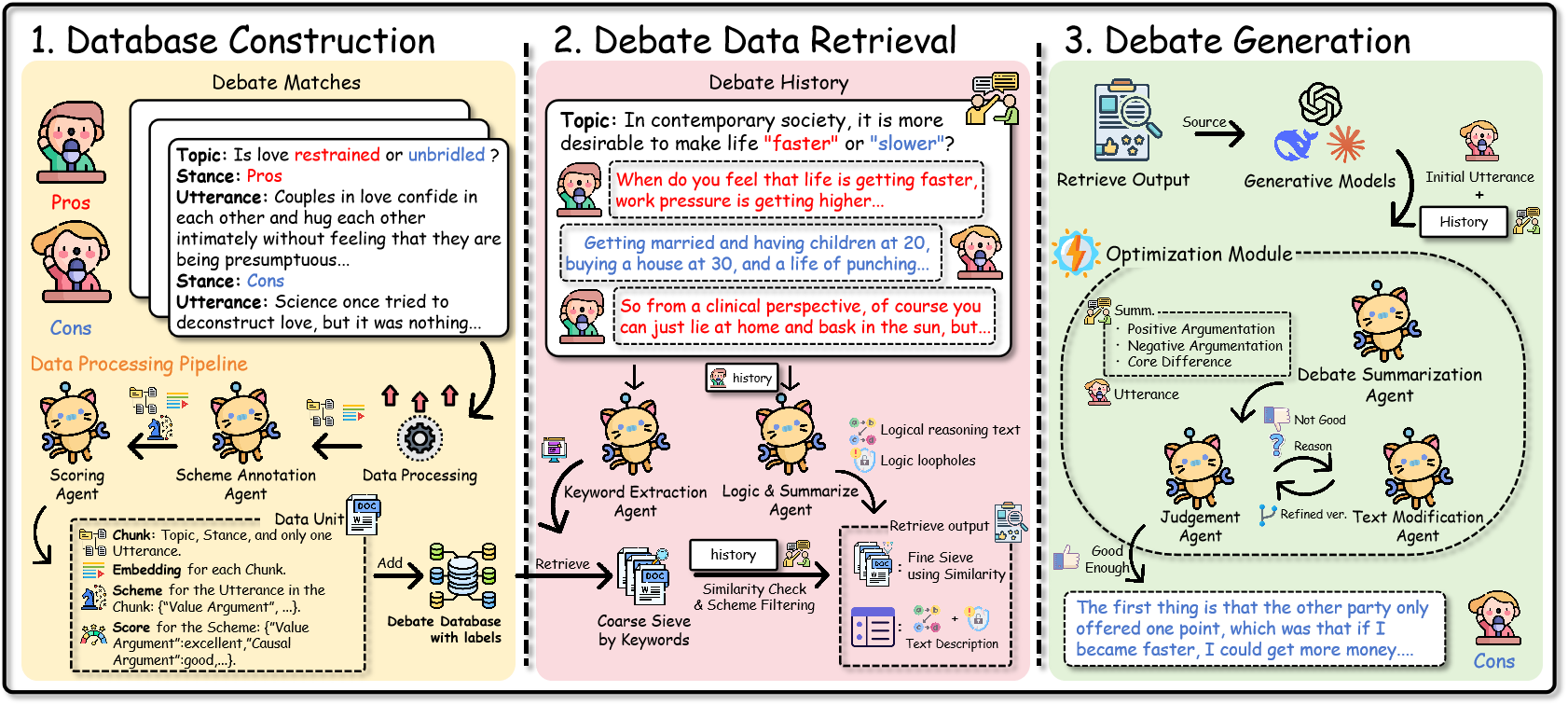
We present R-Debater, an agentic framework for generating multi-turn debates built on argumentative memory. Grounded in rhetoric and memory studies, the system views debate as a process of recalling and adapting prior arguments to maintain stance consistency, respond to opponents, and support claims with evidence. Specifically, R-Debater integrates a debate knowledge base for retrieving case-like evidence and prior debate moves with a role-based agent that composes coherent utterances across turns. We evaluate on standardized ORCHID debates, constructing a 1,000-item retrieval corpus and a held-out set of 32 debates across seven domains. Two tasks are evaluated next-utterance generation, assessed by InspireScore (subjective, logical, and factual), and adversarial multi-turn simulations, judged by Debatrix (argument, source, language, and overall). Compared with strong LLM baselines, R-Debater achieves higher single-turn and multi-turn scores. Human evaluation with 20 experienced debaters further confirms its consistency and evidence use, showing that combining retrieval grounding with structured planning yields more faithful, stance-aligned, and coherent debates across turns.

paper research
Revisiting Faithfulness  Beyond Hint Verbalization in CoT

Revisiting Faithfulness Beyond Hint Verbalization in CoT

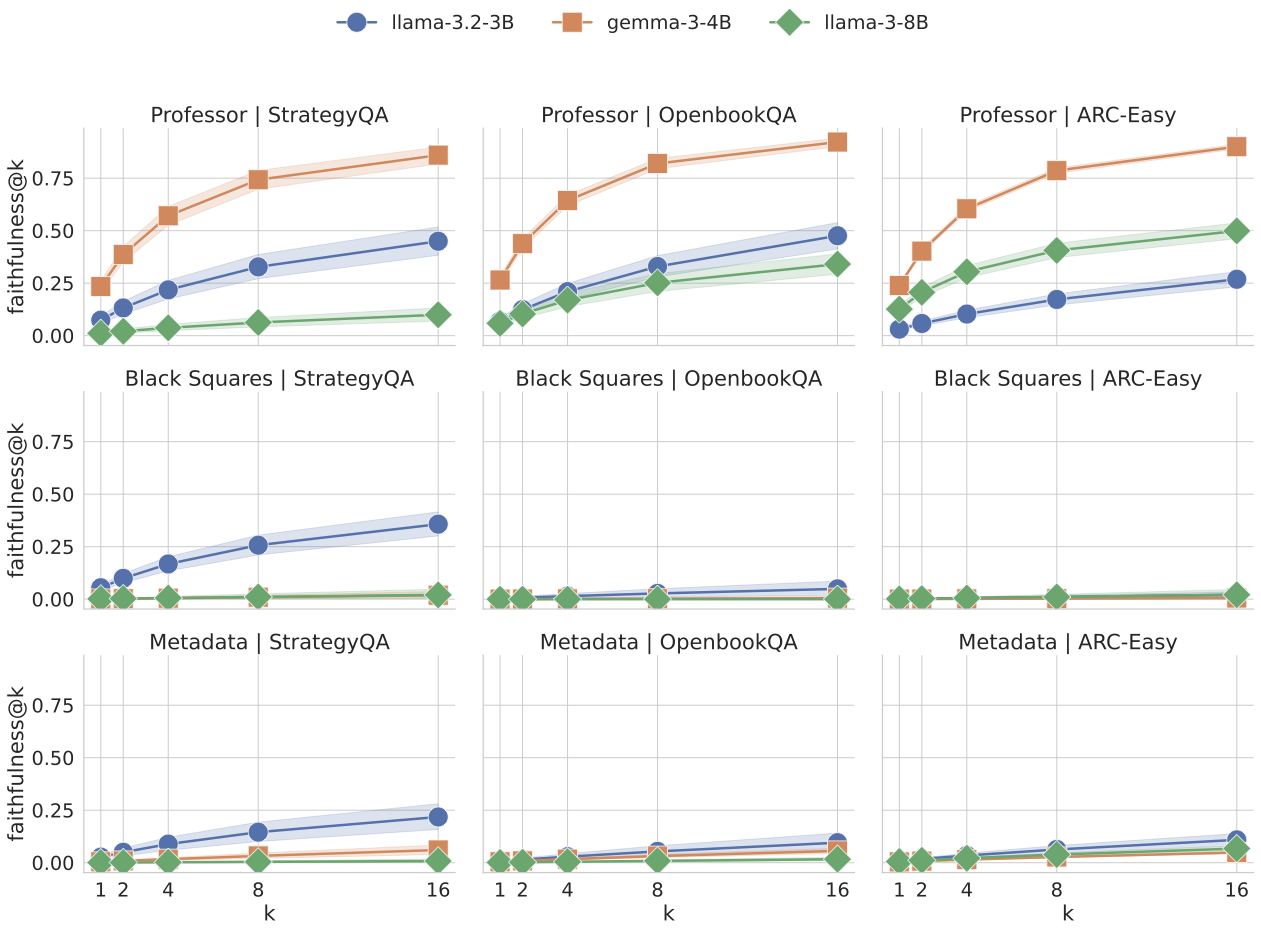
Recent work, using the Biasing Features metric, labels a CoT as unfaithful if it omits a prompt-injected hint that affected the prediction. We argue this metric confuses unfaithfulness with incompleteness, the lossy compression needed to turn distributed transformer computation into a linear natural language narrative. On multi-hop reasoning tasks with Llama-3 and Gemma-3, many CoTs flagged as unfaithful by Biasing Features are judged faithful by other metrics, exceeding 50% in some models. With a new faithful@k metric, we show that larger inference-time token budgets greatly increase hint verbalization (up to 90% in some settings), suggesting much apparent unfaithfulness is due to tight token limits. Using Causal Mediation Analysis, we further show that even non-verbalized hints can causally mediate prediction changes through the CoT. We therefore caution against relying solely on hint-based evaluations and advocate a broader interpretability toolkit, including causal mediation and corruption-based metrics.

paper research
Robust Uncertainty Quantification for Factual Generation of Large Language Models

Robust Uncertainty Quantification for Factual Generation of Large Language Models

The rapid advancement of large language model(LLM) technology has facilitated its integration into various domains of professional and daily life. However, the persistent challenge of LLM hallucination has emerged as a critical limitation, significantly compromising the reliability and trustworthiness of AI-generated content. This challenge has garnered significant attention within the scientific community, prompting extensive research efforts in hallucination detection and mitigation strategies. Current methodological frameworks reveal a critical limitation traditional uncertainty quantification approaches demonstrate effectiveness primarily within conventional question-answering paradigms, yet exhibit notable deficiencies when confronted with non-canonical or adversarial questioning strategies. This performance gap raises substantial concerns regarding the dependability of LLM responses in real-world applications requiring robust critical thinking capabilities. This study aims to fill this gap by proposing an uncertainty quantification scenario in the task of generating with multiple facts. We have meticulously constructed a set of trap questions contained with fake names. Based on this scenario, we innovatively propose a novel and robust uncertainty quantification method(RU). A series of experiments have been conducted to verify its effectiveness. The results show that the constructed set of trap questions performs excellently. Moreover, when compared with the baseline methods on four different models, our proposed method has demonstrated great performance, with an average increase of 0.1-0.2 in ROCAUC values compared to the best performing baseline method, providing new sights and methods for addressing the hallucination issue of LLMs.

paper research
Routing by Analogy  kNN-Augmented Expert Assignment for Mixture-of-Experts

Routing by Analogy kNN-Augmented Expert Assignment for Mixture-of-Experts

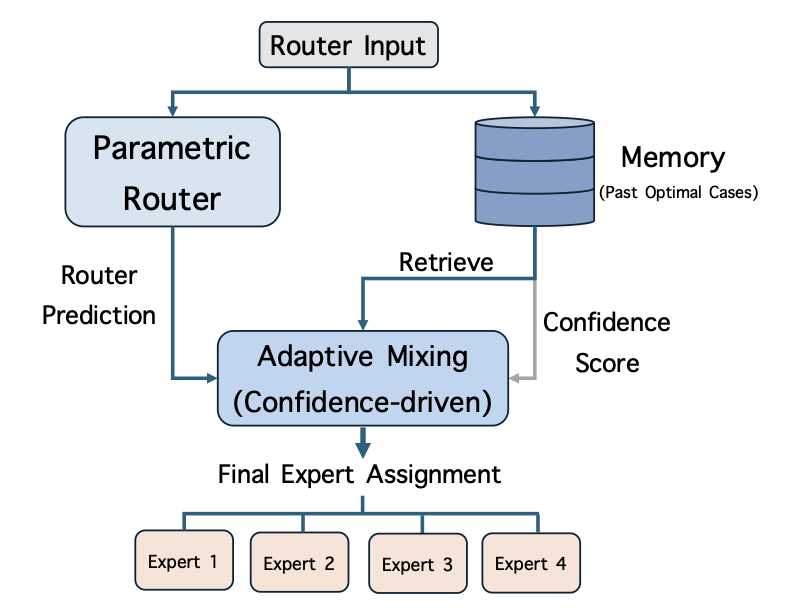
Mixture-of-Experts (MoE) architectures scale large language models efficiently by employing a parametric router to dispatch tokens to a sparse subset of experts. Typically, this router is trained once and then frozen, rendering routing decisions brittle under distribution shifts. We address this limitation by introducing kNN-MoE, a retrieval-augmented routing framework that reuses optimal expert assignments from a memory of similar past cases. This memory is constructed offline by directly optimizing token-wise routing logits to maximize the likelihood on a reference set. Crucially, we use the aggregate similarity of retrieved neighbors as a confidence-driven mixing coefficient, thus allowing the method to fall back to the frozen router when no relevant cases are found. Experiments show kNN-MoE outperforms zero-shot baselines and rivals computationally expensive supervised fine-tuning.

paper research
SHAP Insights into Transformer-Based News Bias Detectors

SHAP Insights into Transformer-Based News Bias Detectors

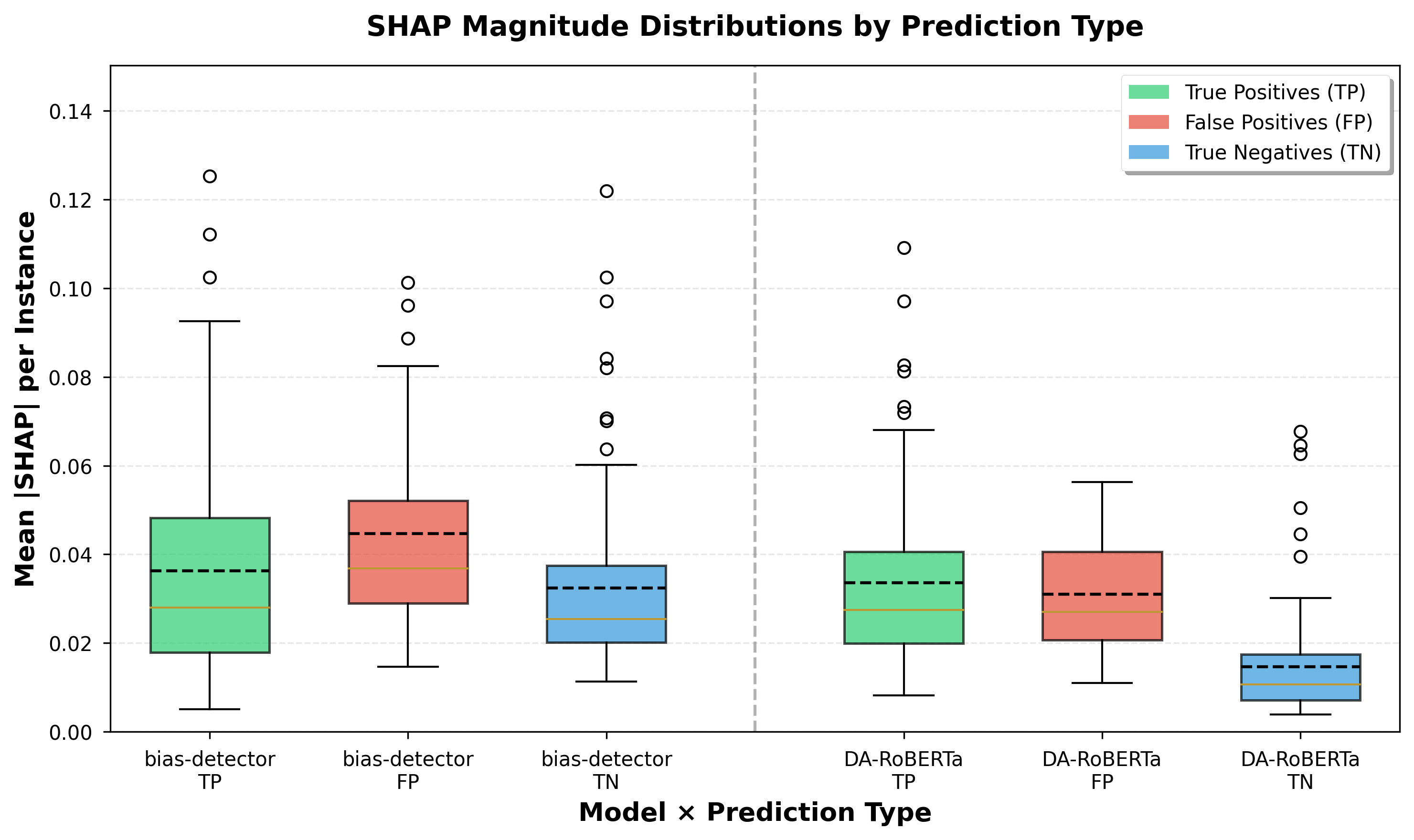
Automated bias detection in news text is heavily used to support journalistic analysis and media accountability, yet little is known about how bias detection models arrive at their decisions or why they fail. In this work, we present a comparative interpretability study of two transformer-based bias detection models a bias detector fine-tuned on the BABE dataset and a domain-adapted pre-trained RoBERTa model fine-tuned on the BABE dataset, using SHAP-based explanations. We analyze word-level attributions across correct and incorrect predictions to characterize how different model architectures operationalize linguistic bias. Our results show that although both models attend to similar categories of evaluative language, they differ substantially in how these signals are integrated into predictions. The bias detector model assigns stronger internal evidence to false positives than to true positives, indicating a misalignment between attribution strength and prediction correctness and contributing to systematic over-flagging of neutral journalistic content. In contrast, the domain-adaptive model exhibits attribution patterns that better align with prediction outcomes and produces 63 % fewer false positives. We further demonstrate that model errors arise from distinct linguistic mechanisms, with false positives driven by discourse-level ambiguity rather than explicit bias cues. These findings highlight the importance of interpretability-aware evaluation for bias detection systems and suggest that architectural and training choices critically affect both model reliability and deployment suitability in journalistic contexts.

paper research
Skim-Aware Contrastive Learning for Efficient Document Representation

Skim-Aware Contrastive Learning for Efficient Document Representation

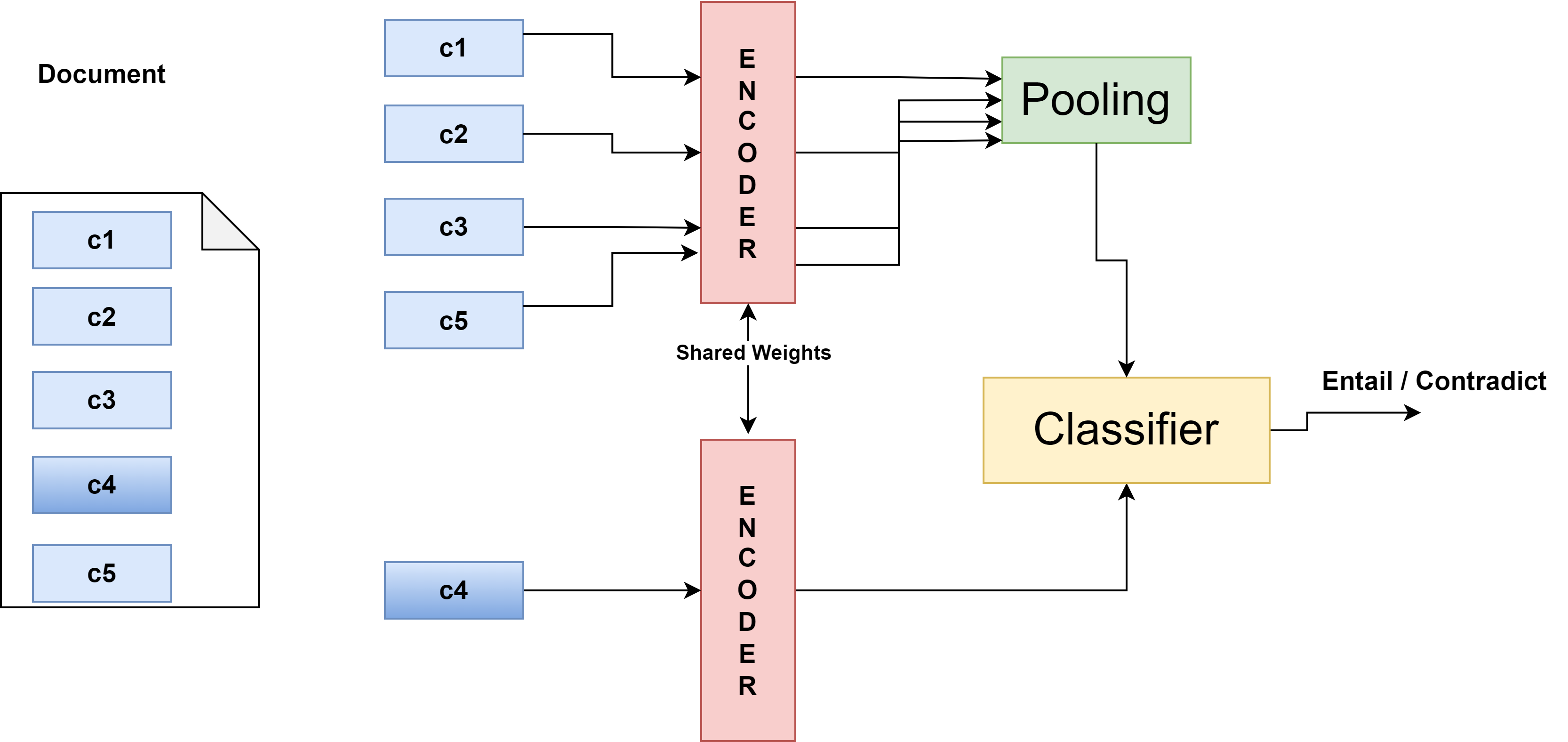
Although transformer-based models have shown strong performance in word- and sentence-level tasks, effectively representing long documents, especially in fields like law and medicine, remains difficult. Sparse attention mechanisms can handle longer inputs, but are resource-intensive and often fail to capture full-document context. Hierarchical transformer models offer better efficiency but do not clearly explain how they relate different sections of a document. In contrast, humans often skim texts, focusing on important sections to understand the overall message. Drawing from this human strategy, we introduce a new self-supervised contrastive learning framework that enhances long document representation. Our method randomly masks a section of the document and uses a natural language inference (NLI)-based contrastive objective to align it with relevant parts while distancing it from unrelated ones. This mimics how humans synthesize information, resulting in representations that are both richer and more computationally efficient. Experiments on legal and biomedical texts confirm significant gains in both accuracy and efficiency.

paper research
STED & Score  Ensuring LLM Output Reliability

STED & Score Ensuring LLM Output Reliability

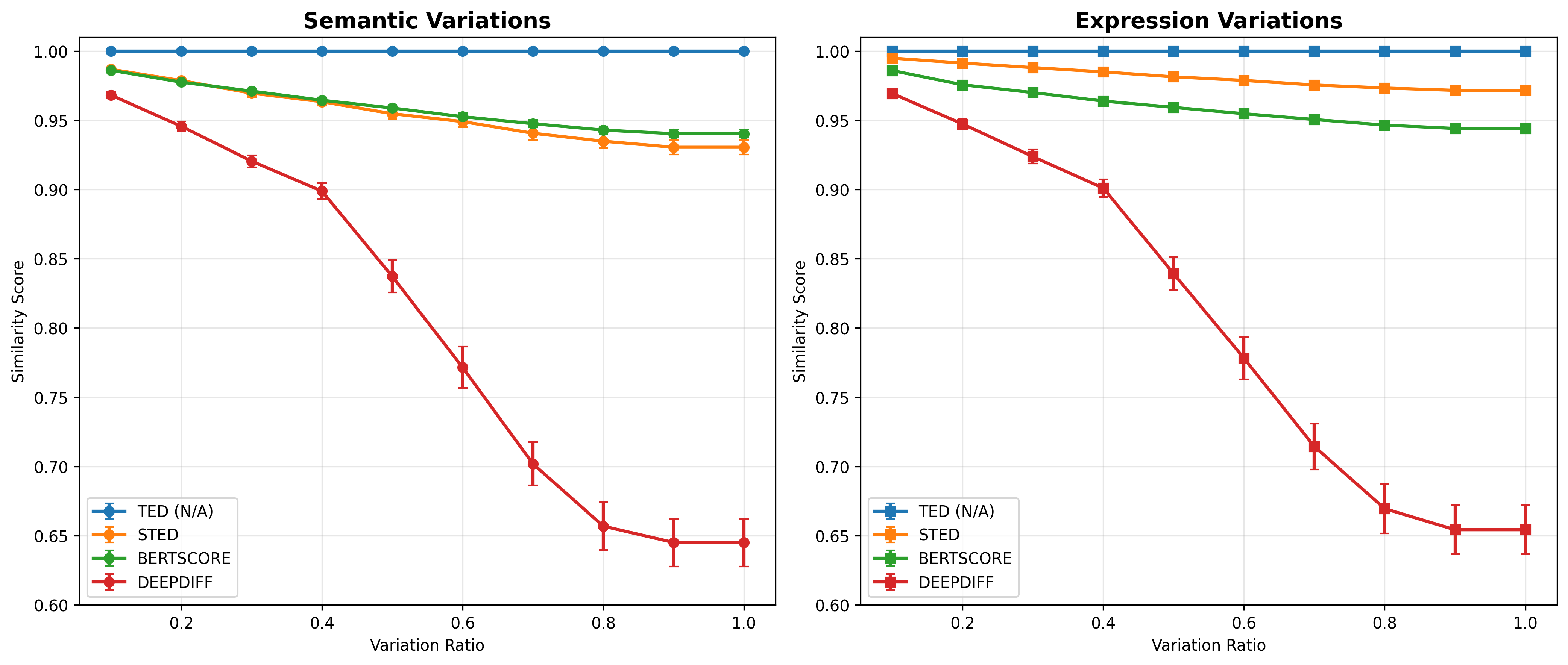
Large Language Models (LLMs) are increasingly deployed for structured data generation, yet output consistency remains critical for production applications. We introduce a comprehensive framework for evaluating and improving consistency in LLM-generated structured outputs. Our approach combines (1) STED (Semantic Tree Edit Distance), a novel similarity metric balancing semantic flexibility with structural strictness when comparing JSON outputs, and (2) a consistency scoring framework aggregating multiple STED measurements across repeated generations to quantify reliability. Through systematic experiments on synthetic datasets with controlled schema, expression, and semantic variations, we demonstrate STED achieves superior performance ($0.86-0.90$ similarity for semantic equivalents, $0.0$ for structural breaks) compared to existing metrics including TED, BERTScore, and DeepDiff. Applying our framework to benchmark six LLMs reveals significant variations Claude-3.7-Sonnet demonstrates exceptional consistency, maintaining near-perfect structural reliability even at high temperatures ($T=0.9$), while models like Claude-3-Haiku and Nova-Pro exhibit substantial degradation requiring careful tuning. Our framework enables practical applications including targeted model selection for structured tasks, iterative prompt refinement for reproducible results, and diagnostic analysis to identify inconsistency root causes. This work provides theoretical foundations and practical tools for ensuring reliable structured output generation in LLM-based production systems.

paper research
StressRoBERTa  Detecting Chronic Stress via Social Media Analysis

StressRoBERTa Detecting Chronic Stress via Social Media Analysis

The prevalence of chronic stress represents a significant public health concern, with social media platforms like Twitter serving as important venues for individuals to share their experiences. This paper introduces StressRoBERTa, a cross-condition transfer learning approach for automatic detection of self-reported chronic stress in English tweets. The investigation examines whether continual training on clinically related conditions (depression, anxiety, PTSD), disorders with high comorbidity with chronic stress, improves stress detection compared to general language models and broad mental health models. RoBERTa is continually trained on the Stress-SMHD corpus (108M words from users with self-reported diagnoses of depression, anxiety, and PTSD) and fine-tuned on the SMM4H 2022 Task 8 dataset. StressRoBERTa achieves 82% F1-score, outperforming the best shared task system (79% F1) by 3 percentage points. The results demonstrate that focused cross-condition transfer from stress-related disorders (+1% F1 over vanilla RoBERTa) provides stronger representations than general mental health training. Evaluation on Dreaddit (81% F1) further demonstrates transfer from clinical mental health contexts to situational stress discussions.

paper research
Stylometry Analysis of Human and Machine Text for Academic Integrity

Stylometry Analysis of Human and Machine Text for Academic Integrity

This work addresses critical challenges to academic integrity, including plagiarism, fabrication, and verification of authorship of educational content, by proposing a Natural Language Processing (NLP)-based framework for authenticating students content through author attribution and style change detection. Despite some initial efforts, several aspects of the topic are yet to be explored. In contrast to existing solutions, the paper provides a comprehensive analysis of the topic by targeting four relevant tasks, including (i) classification of human and machine text, (ii) differentiating in single and multi-authored documents, (iii) author change detection within multi-authored documents, and (iv) author recognition in collaboratively produced documents. The solutions proposed for the tasks are evaluated on two datasets generated with Gemini using two different prompts, including a normal and a strict set of instructions. During experiments, some reduction in the performance of the proposed solutions is observed on the dataset generated through the strict prompt, demonstrating the complexities involved in detecting machine-generated text with cleverly crafted prompts. The generated datasets, code, and other relevant materials are made publicly available on GitHub, which are expected to provide a baseline for future research in the domain.

paper research
Subtle Sexism  Experts vs. Algorithms in Detection Debate

Subtle Sexism Experts vs. Algorithms in Detection Debate

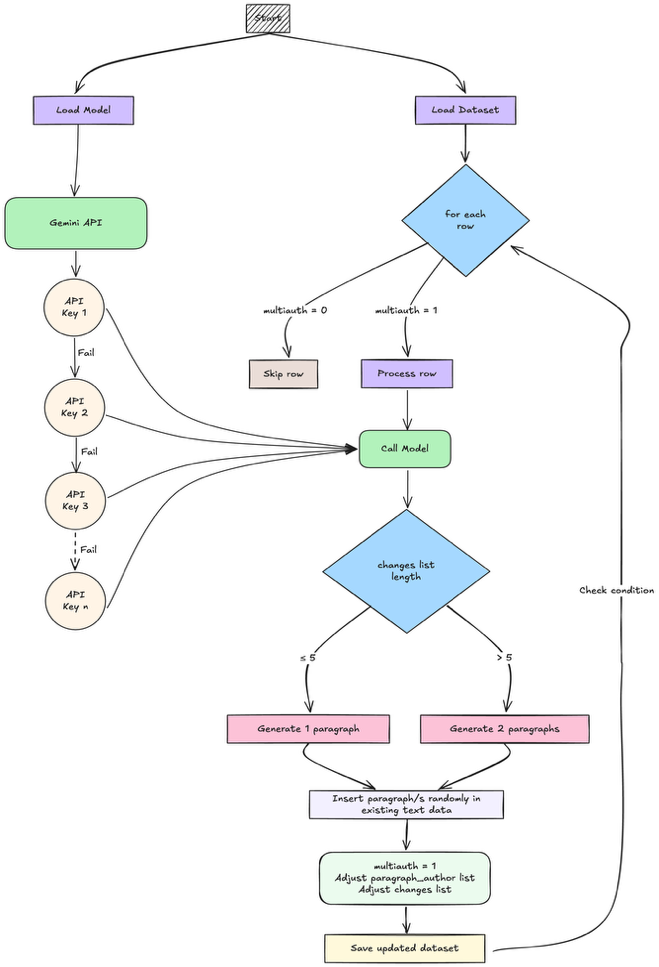
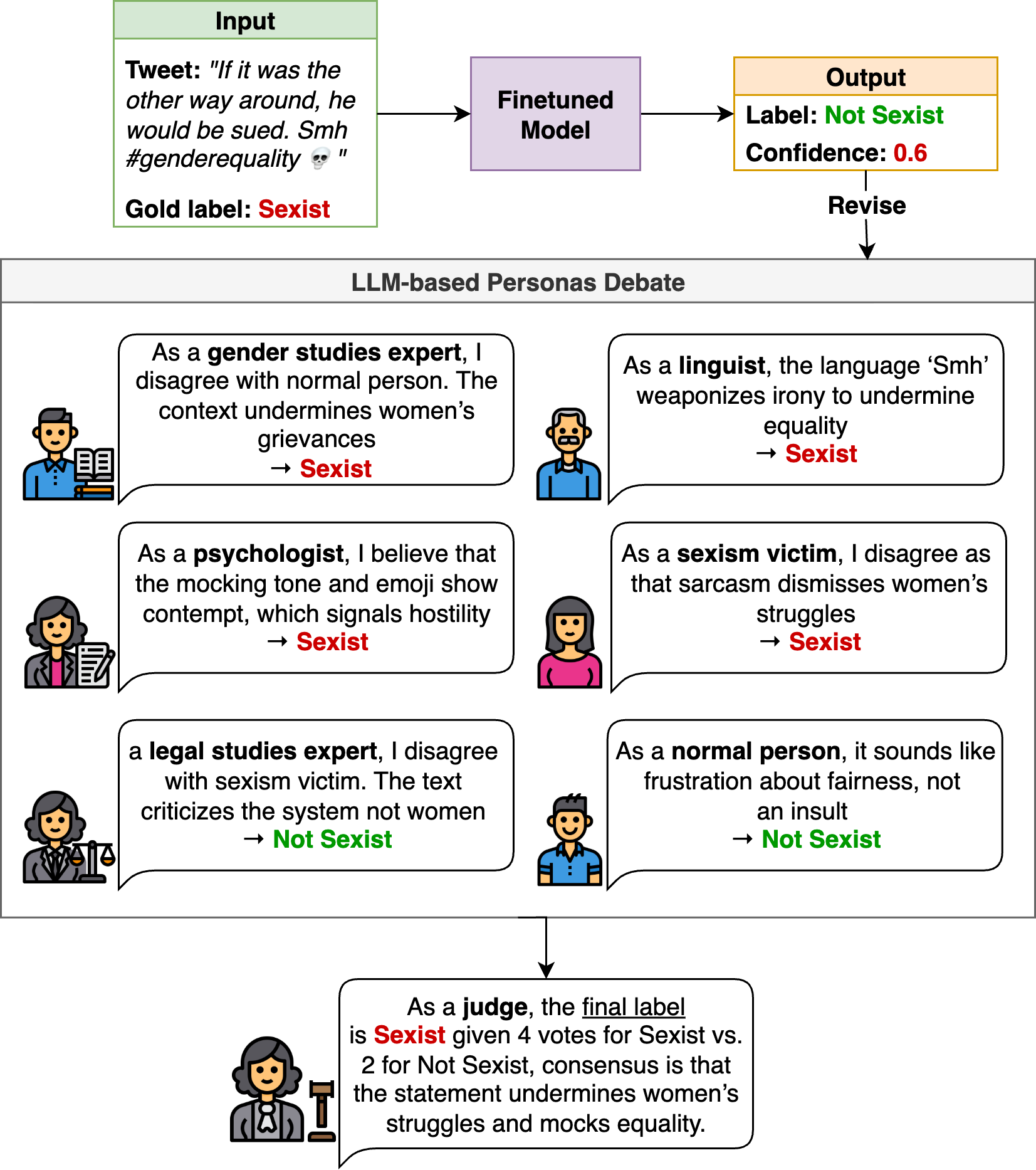
Online sexism increasingly appears in subtle, context-dependent forms that evade traditional detection methods. Its interpretation often depends on overlapping linguistic, psychological, legal, and cultural dimensions, which produce mixed and sometimes contradictory signals in annotated datasets. These inconsistencies, combined with label scarcity and class imbalance, result in unstable decision boundaries and cause fine-tuned models to overlook subtler, underrepresented forms of harm. To address these challenges, we propose a two-stage framework that unifies (i) targeted training procedures to better regularize supervision to scarce and noisy data with (ii) selective, reasoning-based inference to handle ambiguous or borderline cases. First, we stabilize the training combining class-balanced focal loss, class-aware batching, and post-hoc threshold calibration, strategies for the firs time adapted for this domain to mitigate label imbalance and noisy supervision. Second, we bridge the gap between efficiency and reasoning with a a dynamic routing mechanism that distinguishes between unambiguous instances and complex cases requiring a deliberative process. This reasoning process results in the novel Collaborative Expert Judgment (CEJ) module which prompts multiple personas and consolidates their reasoning through a judge model. Our approach outperforms existing approaches across several public benchmarks, with F1 gains of +4.48% and +1.30% on EDOS Tasks A and B, respectively, and a +2.79% improvement in ICM on EXIST 2025 Task 1.1.

paper research
Summarizing the Unseen  Less-Resourced Language Techniques

Summarizing the Unseen Less-Resourced Language Techniques

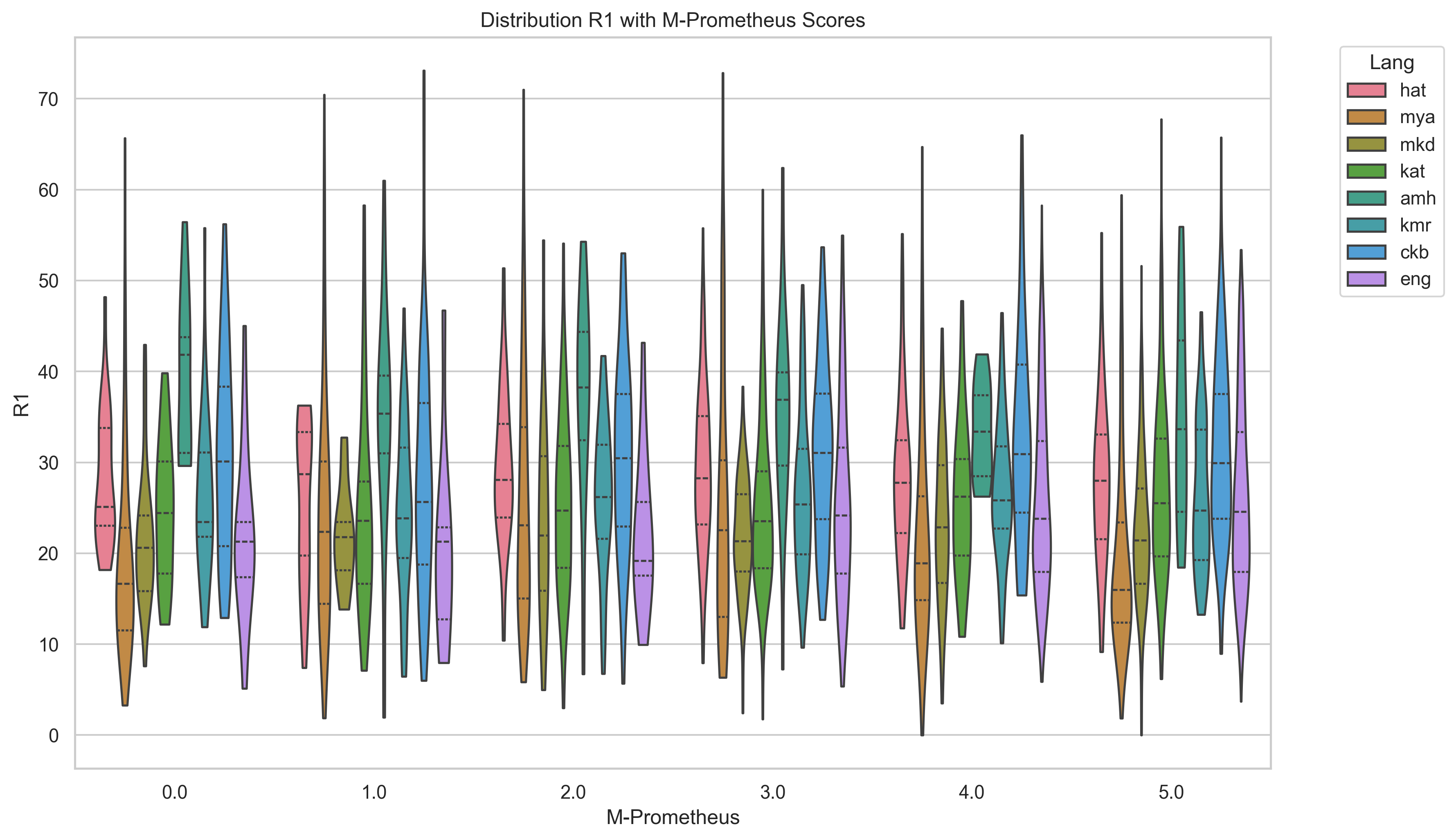
Automatic text summarization has achieved high performance in high-resourced languages like English, but comparatively less attention has been given to summarization in less-resourced languages. This work compares a variety of different approaches to summarization from zero-shot prompting of LLMs large and small to fine-tuning smaller models like mT5 with and without three data augmentation approaches and multilingual transfer. We also explore an LLM translation pipeline approach, translating from the source language to English, summarizing and translating back. Evaluating with five different metrics, we find that there is variation across LLMs in their performance across similar parameter sizes, that our multilingual fine-tuned mT5 baseline outperforms most other approaches including zero-shot LLM performance for most metrics, and that LLM as judge may be less reliable on less-resourced languages.

paper research
Surprisal and Metaphor Novelty Judgments  Moderate Correlations and Divergent Scaling Effects Revealed by Corpus-Based and Synthetic Datasets

Surprisal and Metaphor Novelty Judgments Moderate Correlations and Divergent Scaling Effects Revealed by Corpus-Based and Synthetic Datasets

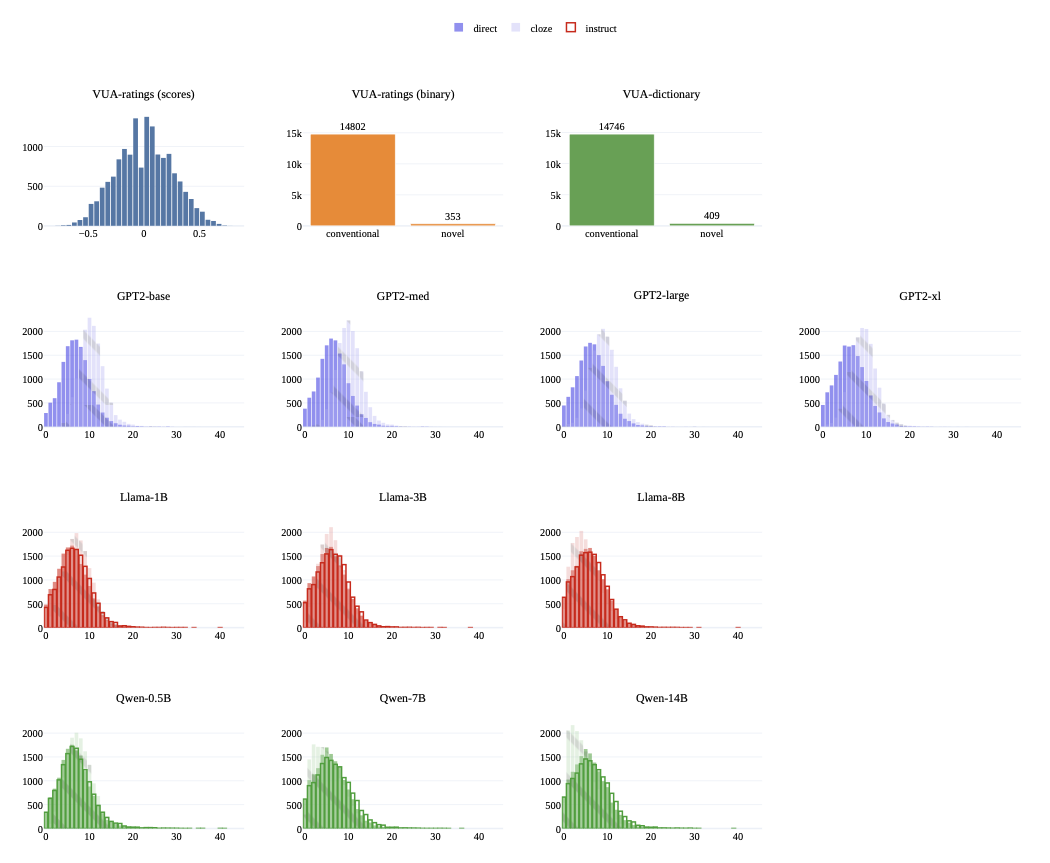
Novel metaphor comprehension involves complex semantic processes and linguistic creativity, making it an interesting task for studying language models (LMs). This study investigates whether surprisal, a probabilistic measure of predictability in LMs, correlates with annotations of metaphor novelty in different datasets. We analyse the surprisal of metaphoric words in corpus-based and synthetic metaphor datasets using 16 causal LM variants. We propose a cloze-style surprisal method that conditions on full-sentence context. Results show that LM surprisal yields significant moderate correlations with scores/labels of metaphor novelty. We further identify divergent scaling patterns on corpus-based data, correlation strength decreases with model size (inverse scaling effect), whereas on synthetic data it increases (quality-power hypothesis). We conclude that while surprisal can partially account for annotations of metaphor novelty, it remains limited as a metric of linguistic creativity. Code and data are publicly available https //github.com/OmarMomen14/surprisal-metaphor-novelty

paper research
T3C  Test-Time Tensor Compression with Consistency Guarantees

T3C Test-Time Tensor Compression with Consistency Guarantees

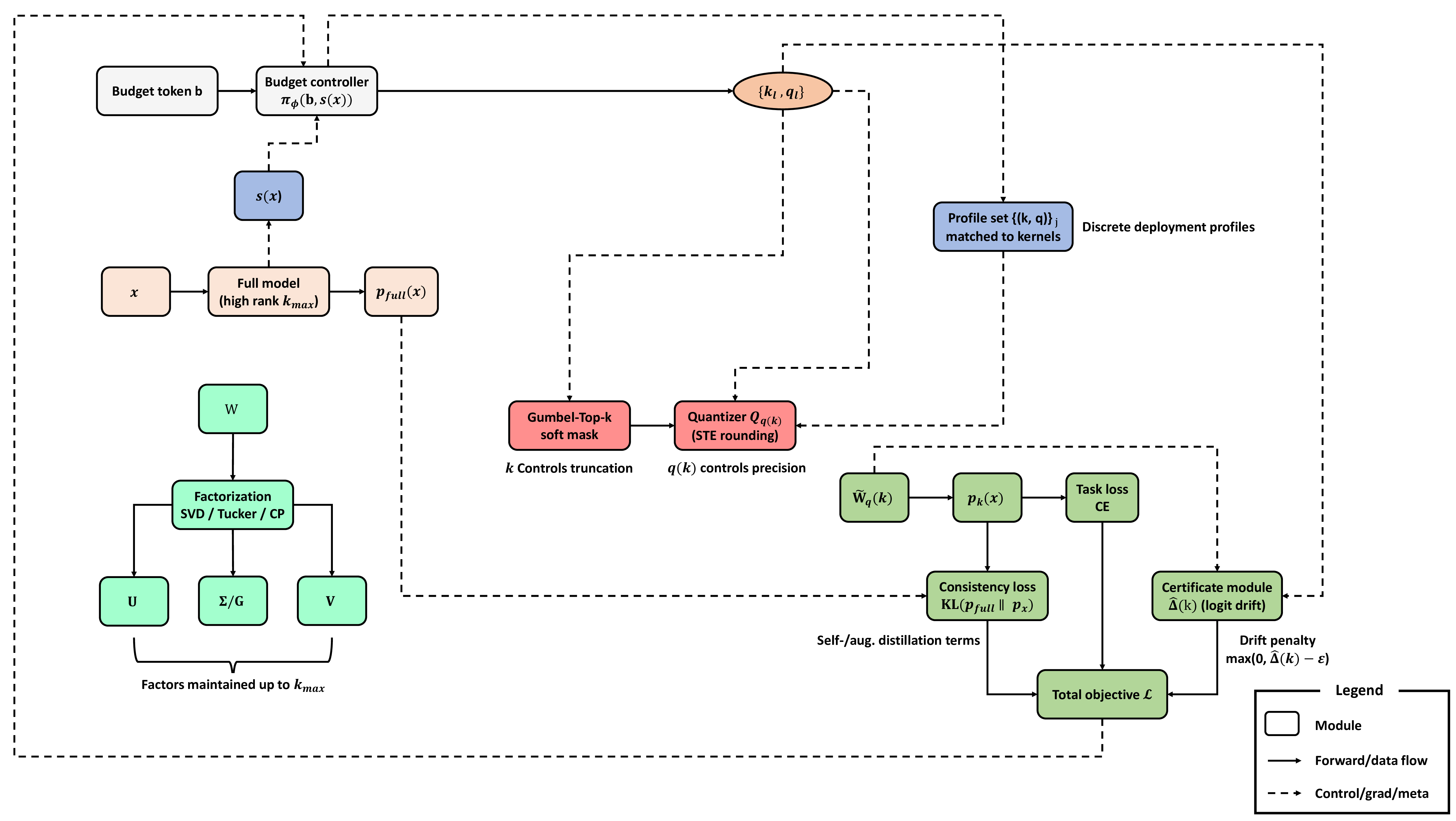
We present T3C, a train-once, test-time budget-conditioned compression framework that exposes rank and precision as a controllable deployment knob. T3C combines elastic tensor factorization (maintained up to a maximal rank) with rank-tied mixed-precision quantization and a lightweight controller that maps a latency/energy/size budget token to per-layer rank/bit assignments; the policy snaps to hardware-aligned profiles and is monotone in the budget. A fast, layerwise consistency certificate, computed from spectral proxies and activation statistics, upper-bounds logit drift and regularizes training, yielding a practical reliability signal with negligible overhead. On ImageNet-1k, T3C shifts the vision Pareto frontier for ResNet-50 at matched accuracy ( leq 0.5% drop), p50 latency is 1.18ms with a 38MB model, outperforming PTQ-8b (1.44ms, 88MB); for ViT-B/16, T3C reaches 2.30ms p50 with 59MB, improving over strong PTQ/QAT baselines. A single T3C checkpoint therefore provides predictable, certificate-backed accuracy-latency-size trade-offs on demand across devices.

paper research
Tackling the Inherent Difficulty of Noise Filtering in RAG

Tackling the Inherent Difficulty of Noise Filtering in RAG

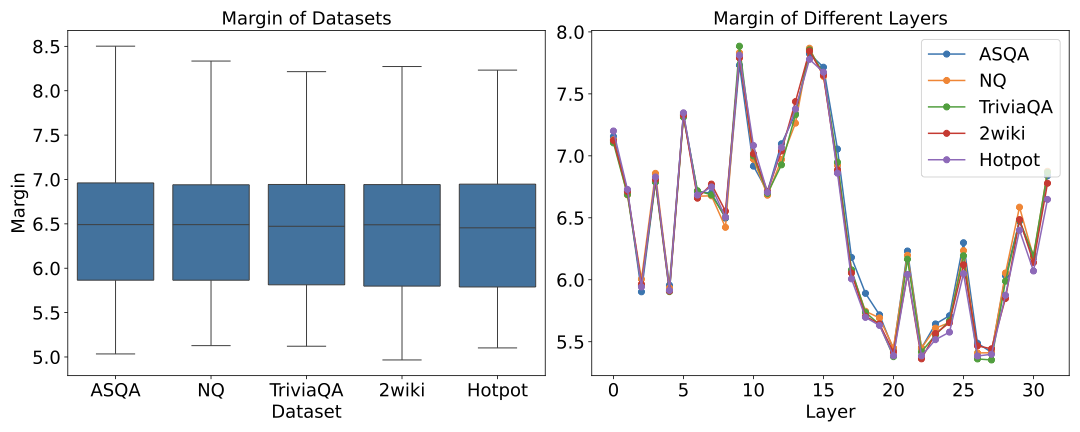
Retrieval-Augmented Generation (RAG) has become a widely adopted approach to enhance Large Language Models (LLMs) by incorporating external knowledge and reducing hallucinations. However, noisy or irrelevant documents are often introduced during RAG, potentially degrading performance and even causing hallucinated outputs. While various methods have been proposed to filter out such noise, we argue that identifying irrelevant information from retrieved content is inherently difficult and limited number of transformer layers can hardly solve this. Consequently, retrievers fail to filter out irrelevant documents entirely. Therefore, LLMs must be robust against such noise, but we demonstrate that standard fine-tuning approaches are often ineffective in enabling the model to selectively utilize relevant information while ignoring irrelevant content due to the structural constraints of attention patterns. To address this, we propose a novel fine-tuning method designed to enhance the model s ability to distinguish between relevant and irrelevant information within retrieved documents. Extensive experiments across multiple benchmarks show that our approach significantly improves the robustness and performance of LLMs.

paper research
Uncovering Hidden Reasoning  Beyond Human-Defined Concepts

Uncovering Hidden Reasoning Beyond Human-Defined Concepts

Despite the growing reasoning capabilities of recent large language models (LLMs), their internal mechanisms during the reasoning process remain underexplored. Prior approaches often rely on human-defined concepts (e.g., overthinking, reflection) at the word level to analyze reasoning in a supervised manner. However, such methods are limited, as it is infeasible to capture the full spectrum of potential reasoning behaviors, many of which are difficult to define in token space. In this work, we propose an unsupervised framework (namely, RISE Reasoning behavior Interpretability via Sparse auto-Encoder) for discovering reasoning vectors, which we define as directions in the activation space that encode distinct reasoning behaviors. By segmenting chain-of-thought traces into sentence-level steps and training sparse auto-encoders (SAEs) on step-level activations, we uncover disentangled features corresponding to interpretable behaviors such as reflection and backtracking. Visualization and clustering analyses show that these behaviors occupy separable regions in the decoder column space. Moreover, targeted interventions on SAE-derived vectors can controllably amplify or suppress specific reasoning behaviors, altering inference trajectories without retraining. Beyond behavior-specific disentanglement, SAEs capture structural properties such as response length, revealing clusters of long versus short reasoning traces. More interestingly, SAEs enable the discovery of novel behaviors beyond human supervision. We demonstrate the ability to control response confidence by identifying confidence-related vectors in the SAE decoder space. These findings underscore the potential of unsupervised latent discovery for both interpreting and controllably steering reasoning in LLMs.

paper research
Understanding and Steering the Cognitive Behaviors of Reasoning Models at Test-Time

Understanding and Steering the Cognitive Behaviors of Reasoning Models at Test-Time

Large Language Models (LLMs) often rely on long chain-of-thought (CoT) reasoning to solve complex tasks. While effective, these trajectories are frequently inefficient, leading to high latency from excessive token generation, or unstable reasoning that alternates between underthinking (shallow, inconsistent steps) and overthinking (repetitive, verbose reasoning). In this work, we study the structure of reasoning trajectories and uncover specialized attention heads that correlate with distinct cognitive behaviors such as verification and backtracking. By lightly intervening on these heads at inference time, we can steer the model away from inefficient modes. Building on this insight, we propose CREST, a training-free method for Cognitive REasoning Steering at Test-time. CREST has two components (1) an offline calibration step that identifies cognitive heads and derives head-specific steering vectors, and (2) an inference-time procedure that rotates hidden representations to suppress components along those vectors. CREST adaptively suppresses unproductive reasoning behaviors, yielding both higher accuracy and lower computational cost. Across diverse reasoning benchmarks and models, CREST improves accuracy by up to 17.5% while reducing token usage by 37.6%, offering a simple and effective pathway to faster, more reliable LLM reasoning.

paper research
Unlocking Safety  SAE-Powered Subspace Tuning for LLMs

Unlocking Safety SAE-Powered Subspace Tuning for LLMs

Safety alignment -- training large language models (LLMs) to refuse harmful requests while remaining helpful -- is critical for responsible deployment. Prior work established that safety behaviors are governed by low-rank structures, suggesting parameter-efficient fine-tuning (PEFT) should be well-suited for alignment. However, Low-Rank Adaptation (LoRA) consistently underperforms full fine-tuning and reinforcement learning on safety benchmarks. We attribute this gap to semantic entanglement safety-relevant directions are intertwined with unrelated concepts due to polysemanticity, impeding implicit subspace identification. To address this, we propose SAILS (Safety Alignment via Interpretable Low-rank Subspace), which leverages Sparse Autoencoders (SAEs) to disentangle representations into monosemantic features, constructs an interpretable safety subspace from SAE decoder directions, and uses it to initialize LoRA adapters. Theoretically, we prove that SAE-based identification achieves arbitrarily small recovery error under monosemanticity assumptions, while direct identification suffers an irreducible error floor. Empirically, SAILS achieves up to 99.6% safety rate on Gemma-2-9B -- exceeding full fine-tuning by 7.4 points and matching RLHF-based models -- while updating only 0.19% of parameters and providing interpretability.

paper research
When Should LLMs Say  I Don t Know ?

When Should LLMs Say I Don t Know ?

The success of expanded context windows in Large Language Models (LLMs) has driven increased use of broader context in retrieval-augmented generation. We investigate the use of LLMs for retrieval augmented question answering. While longer contexts make it easier to incorporate targeted knowledge, they introduce more irrelevant information that hinders the model s generation process and degrades its performance. To address the issue, we design an adaptive prompting strategy which involves splitting the retrieved information into smaller chunks and sequentially prompting a LLM to answer the question using each chunk. Adjusting the chunk size allows a trade-off between incorporating relevant information and reducing irrelevant information. Experimental results on three open-domain question answering datasets demonstrate that the adaptive strategy matches the performance of standard prompting while using fewer tokens. Our analysis reveals that when encountering insufficient information, the LLM often generates incorrect answers instead of declining to respond, which constitutes a major source of error. This finding highlights the need for further research into enhancing LLMs ability to effectively decline requests when faced with inadequate information.

paper research
Where s My Plate? Testing Robots  Hidden Item Sense

Where s My Plate? Testing Robots Hidden Item Sense

``Bring me a plate. For domestic service robots, this simple command reveals a complex challenge inferring where everyday items are stored, often out of sight in drawers, cabinets, or closets. Despite advances in vision and manipulation, robots still lack the commonsense reasoning needed to complete this task. We introduce the Stored Household Item Challenge, a benchmark task for evaluating service robots cognitive capabilities given a household scene and a queried item, predict its most likely storage location. Our benchmark includes two datasets (1) a real-world evaluation set of 100 item-image pairs with human-annotated ground truth from participants kitchens, and (2) a development set of 6,500 item-image pairs annotated with storage polygons over public kitchen images. These datasets support realistic modeling of household organization and enable comparative evaluation across agent architectures. To begin tackling this challenge, we introduce NOAM (Non-visible Object Allocation Model), a hybrid agent pipeline that combines structured scene understanding with large language model inference. NOAM converts visual input into natural language descriptions of spatial context and visible containers, then prompts a language model (e.g., GPT-4) to infer the most likely hidden storage location. This integrated vision-language agent exhibits emergent commonsense reasoning and is designed for modular deployment within broader robotic systems. We evaluate NOAM against baselines including random selection, vision-language pipelines (Grounding-DINO + SAM), leading multimodal models (e.g., Gemini, GPT-4o, Kosmos-2, LLaMA, Qwen), and human performance. NOAM significantly improves prediction accuracy and approaches human-level results, highlighting best practices for deploying cognitively capable agents in domestic environments.

paper research

< Category Statistics (Total: 566) >

Computer Science (514) Machine Learning (117) Artificial Intelligence (89) Computer Vision (71) Computation and Language (NLP) (62) Electrical Engineering and Systems Science (36) Cryptography and Security (24) Robotics (22) Systems and Control (22) Software Engineering (20) Mathematics (18) Statistics (17) Economics (16) Information Retrieval (15) Distributed, Parallel, and Cluster Computing (14) Human-Computer Interaction (14) Neural and Evolutionary Computing (13) Computer Science and Game Theory (11) Econometrics (11) Image and Video Processing (10) Physics (10) Sound (10) Multiagent Systems (9) Optimization and Control (8) Computational Geometry (7) Databases (7) Graphics (6) Networking and Internet Architecture (6) Quantitative Biology (6) Quantum Physics (5) Theoretical Economics (5) Computational Complexity (4) Computational Engineering, Finance, and Science (4) Computers and Society (4) Emerging Technologies (4) Information Theory (4) Methodology (4) Multimedia (4) Programming Languages (4) Quantitative Finance (4) Signal Processing (4) Audio and Speech Processing (3) Data Structures and Algorithms (3) Hardware Architecture (3) History and Philosophy of Physics (3) Logic in Computer Science (3) Neurons and Cognition (3) Social and Information Networks (3) Statistics Theory (3) Computation (2) Condensed Matter (2) Dynamical Systems (2) Formal Languages and Automata Theory (2) General Finance (2) Operating Systems (2) Optics (2) Quantitative Methods (2) Applications (1) Astrophysics (1) Combinatorics (1) Computational Physics (1) Digital Libraries (1) Disordered Systems and Neural Networks (1) General Economics (1) Genomics (1) Geophysics (1) Instrumentation and Methods for Astrophysics (1) Logic (1) Mathematical Finance (1) Mathematical Software (1) Medical Physics (1) Mesoscale and Nanoscale Physics (1) Metric Geometry (1) Other Statistics (1) Performance (1) Physics and Society (1) Plasma Physics (1) Probability (1) Trading and Market Microstructure (1)

Start searching

Enter keywords to search articles

↑↓
ESC
⌘K Shortcut