Title: 그리디 최적화와 ADM 기반 데이터 구동 솔버를 결합한 비선형 구조 해석 전략
ArXiv ID: 2512.19912
Date: Pending
Authors: - Thi‑Hoa Nguyen (Geophysical Institute and Bergen Offshore Wind Centre, University of Bergen, Norway) - Viljar H. Gjerde (Eviny Fornybar AS, Norway) - Bruno A. Roccia (Geophysical Institute and Bergen Offshore Wind Centre, University of Bergen, Norway) - Cristian G. Gebhardt (Geophysical Institute and Bergen Offshore Wind Centre, University of Bergen, Norway)
📝 Abstract
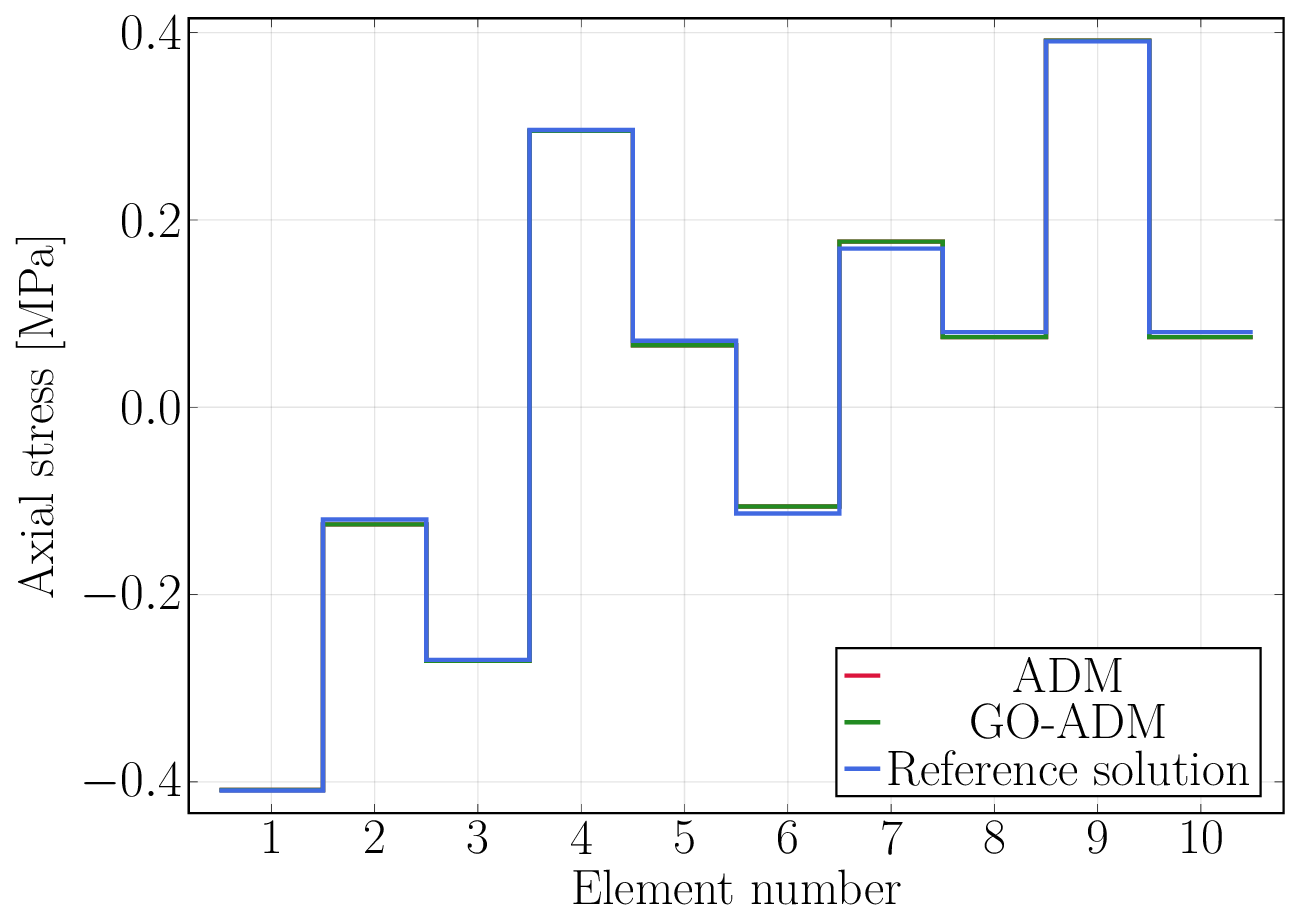
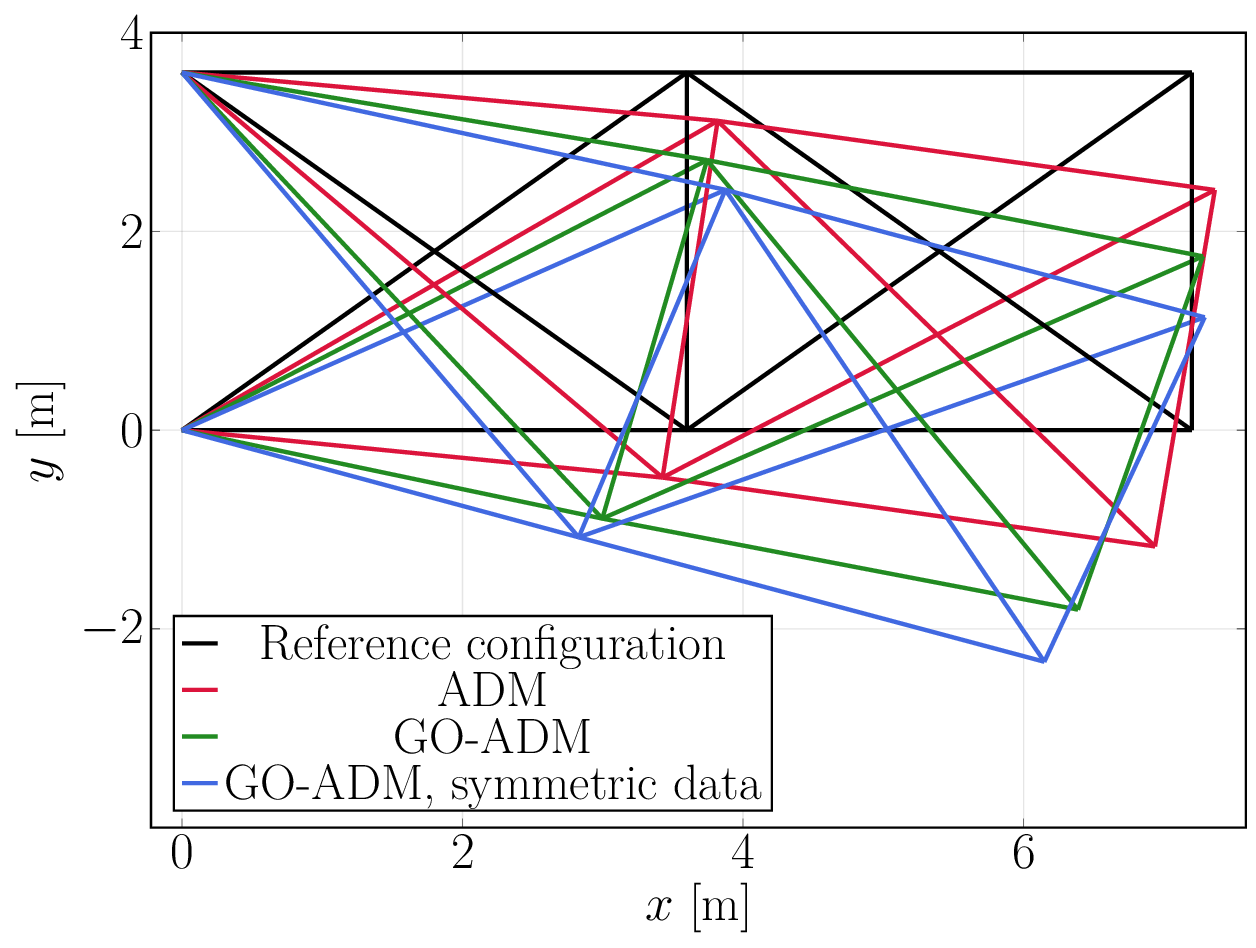
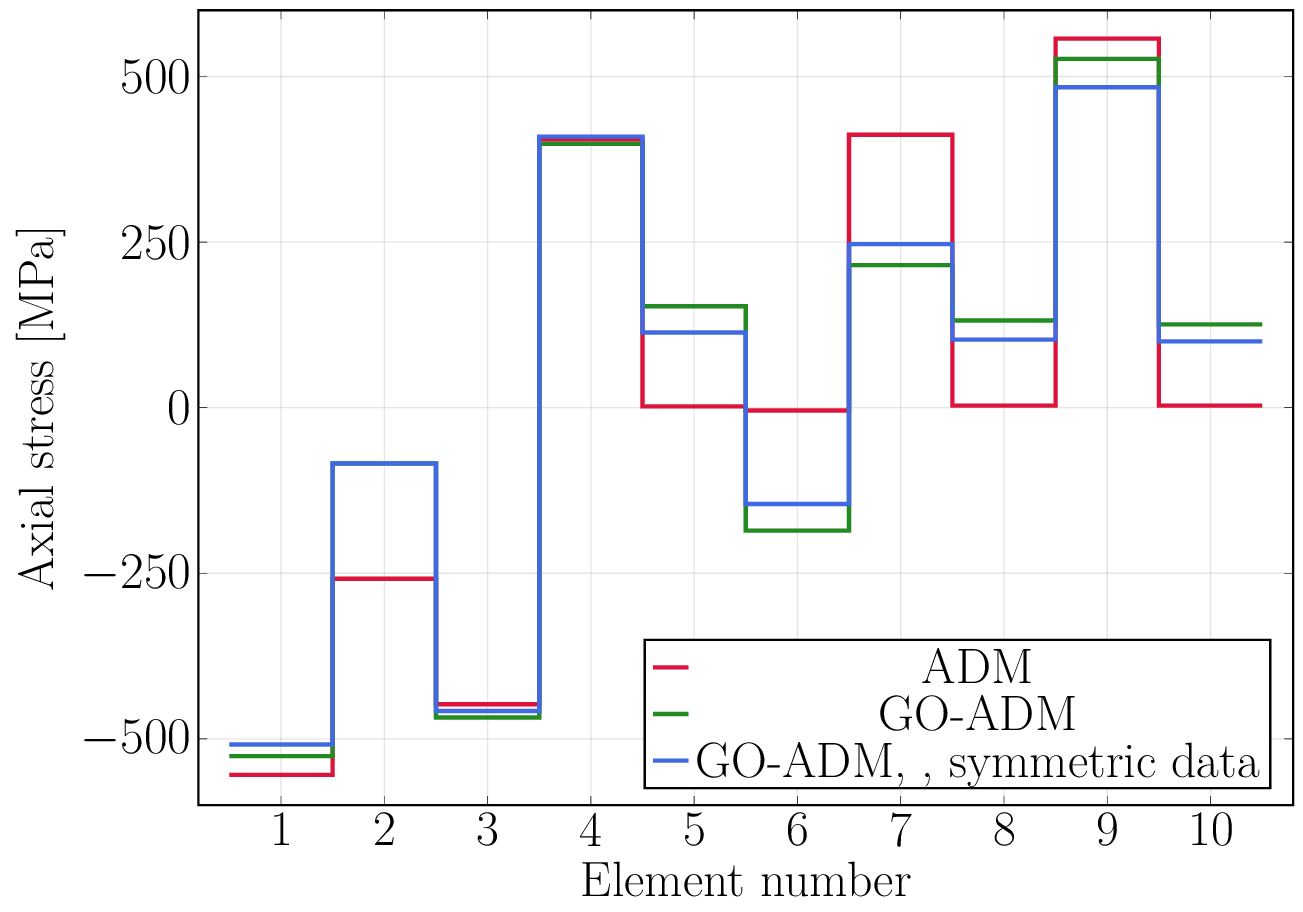
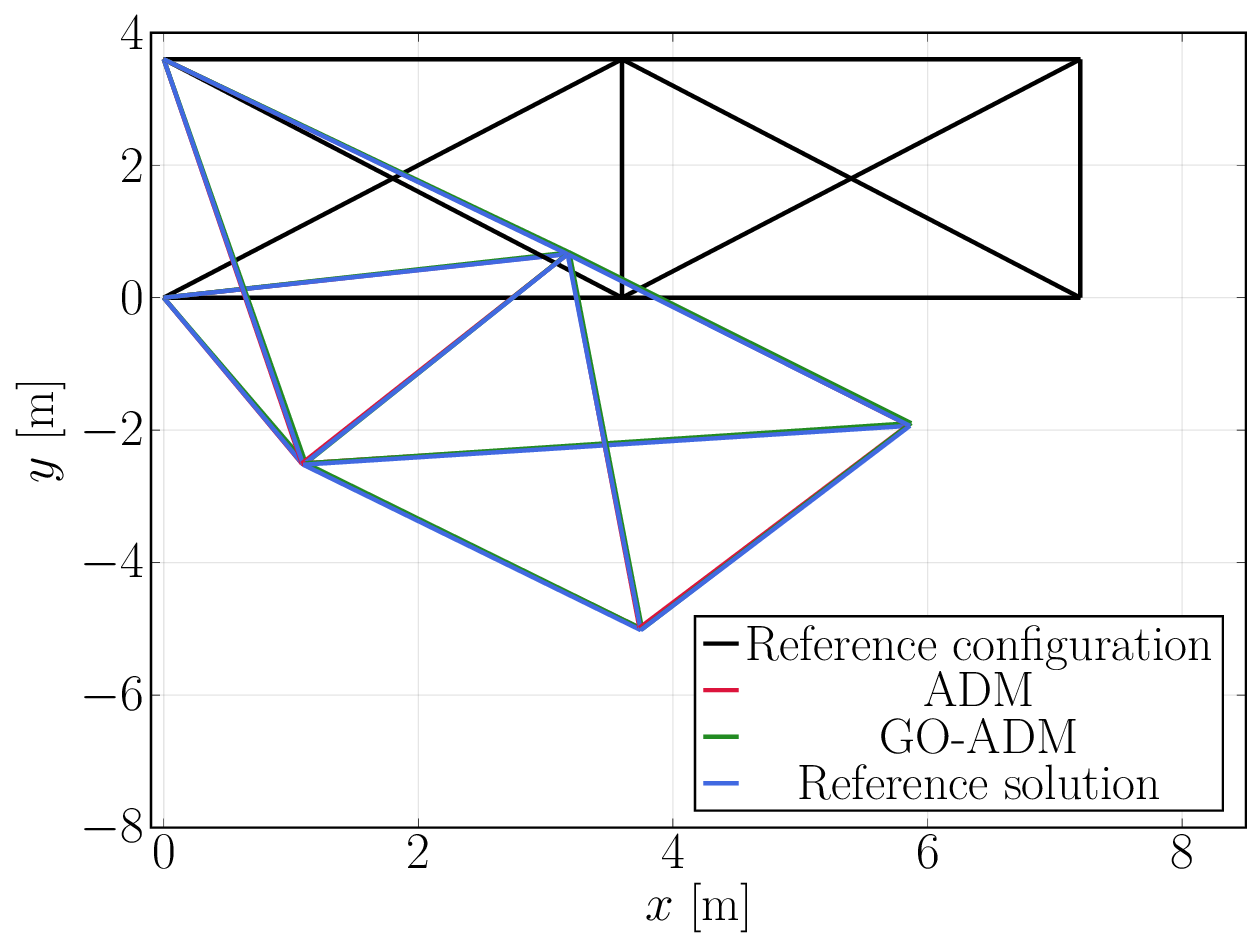
In this work, we extend and generalize our solving strategy, first introduced in [1], based on a greedy optimization algorithm and the alternating direction method (ADM) for nonlinear systems computed with multiple load steps. In particular, we combine the greedy optimization algorithm with the direct data-driven solver based on ADM which is firstly introduced in [2] and combined with the Newton-Raphson method for nonlinear elasticity in [3] . We numerically illustrate via oneand two-dimensional bar and truss structures exhibiting nonlinear strain measures and different constitutive datasets that our solving strategy generally achieves a better approximation of the globally optimal solution. This, however, comes at the expense of higher computational cost which is scaled by the number of "greedy" searches. Using this solving strategy, we reproduce the first cycle of the cyclic testing for a nylon rope that was performed at industrial testing facilities for mooring lines manufacturers. We also numerically illustrate for a truss structure that our solving strategy generally improves the accuracy and robustness in cases of an unsymmetrical data distribution and noisy data.
💡 Deep Analysis
📄 Full Content
Highlights
Solving strategies for data-driven one-dimensional elasticity exhibiting nonlinear strains
Thi-Hoa Nguyen, Viljar H. Gjerde, Bruno A. Roccia, Cristian G. Gebhardt
• We extend and generalize our solving strategy based on a greedy optimization algorithm and
the alternating direction method for nonlinear systems computed with multiple load steps.
• We numerically illustrate that our solving strategy leads to a better approximation of the
global optima for both one- and two-dimensional structures exhibiting nonlinear strains and
different constitutive datasets.
• We apply our solving strategy to a real experimental dataset of a cyclic testing of a nylon
rope performed in industrial testing facilities for mooring line manufacturers.
• We numerically illustrate that our solving strategy generally improves the accuracy and ro-
bustness in cases of an unsymmetrical data distribution and noisy data.
arXiv:2512.19912v1 [cs.CE] 22 Dec 2025
Solving strategies for data-driven one-dimensional elasticity exhibiting
nonlinear strains
Thi-Hoa Nguyena,∗, Viljar H. Gjerdea,b, Bruno A. Rocciaa, Cristian G. Gebhardta
aGeophysical Institute and Bergen Offshore Wind Centre, University of Bergen, Norway
bEviny Fornybar AS, Norway
Abstract
In this work, we extend and generalize our solving strategy, first introduced in [1], based on a
greedy optimization algorithm and the alternating direction method (ADM) for nonlinear systems
computed with multiple load steps. In particular, we combine the greedy optimization algorithm
with the direct data-driven solver based on ADM which is firstly introduced in [2] and combined
with the Newton-Raphson method for nonlinear elasticity in [3]. We numerically illustrate via one-
and two-dimensional bar and truss structures exhibiting nonlinear strain measures and different
constitutive datasets that our solving strategy generally achieves a better approximation of the
globally optimal solution. This, however, comes at the expense of higher computational cost which
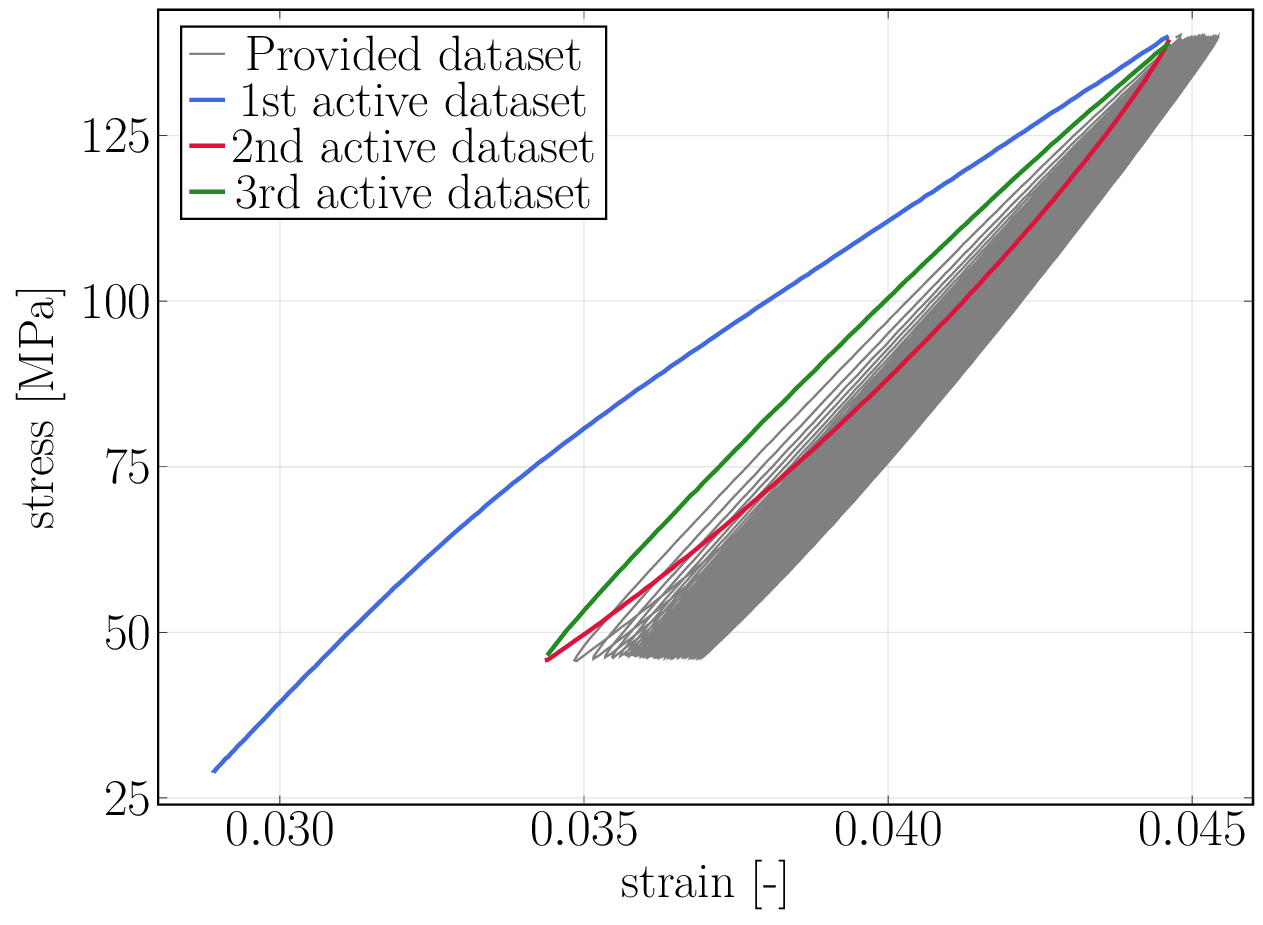
is scaled by the number of “greedy” searches. Using this solving strategy, we reproduce the first cycle
of the cyclic testing for a nylon rope that was performed at industrial testing facilities for mooring
lines manufacturers. We also numerically illustrate for a truss structure that our solving strategy
generally improves the accuracy and robustness in cases of an unsymmetrical data distribution and
noisy data.
Keywords:
One-dimensional elasticity, Data-driven computational mechanics, Alternating
direction method, Discrete-continuous nonlinear optimization problems, Greedy optimization,
Statics structural analysis
1. Introduction
Data-driven computational mechanics (DDCM) emerged nearly a decade ago as a novel numer-
ical approach in the field of computational mechanics. Firstly introduced in [2], the direct DDCM
approach enables the use of constitutive data (i.e. stress-strain pairs) obtained from experiments,
bypassing the need for ad-hoc material models and avoiding information loss. The main idea is
to formulate the boundary-value or initial-boundary-value problem as an optimization problem,
seeking the stress-strain pairs from a given dataset that are closest to those pairs satisfying the
equilibrium, compatibility, boundary, and initial conditions [2, 4, 5]. Minimizing the distance be-
tween these two pairs is obtained by finding the global minima of an objective function that is the
weighted sum of the square L2-norm of this distance. Hence, the resulting optimization problem is
∗Corresponding author
Email addresses: hoa.nguyen@uib.no (Thi-Hoa Nguyen ), viljargjerde@gmail.com (Viljar H. Gjerde),
bruno.roccia@uib.no (Bruno A. Roccia), cristian.gebhardt@uib.no (Cristian G. Gebhardt)
often considered as a distance-minimizing problem, or a discrete–continuous quadratic optimization
problem due to the discrete and continuous nature of the dataset and the variable fields, respec-
tively. In [2], the authors proposed a solving strategy that begins with randomly chosen but fixed
initial stress-strain pairs and solves for solution that satisfies the constraint set and are simulta-
neously closest to these initial pairs. It then searches for new stress-strain pairs from the dataset
that are closest to those from the obtained variable fields, i.e. the obtained structural solution, and
repeats these steps until the stress-strain data converges to the same value. This idea is the same
as the alternating direction method (ADM) without initialization [6, 7]. There exist alternatives to
the direct DDCM approach that include the inverse DDCM approach [8, 9, 10], which reconstructs
the material model based on the given dataset as a traditional energy functional for the computa-
tions, and the hybrid DDCM approach [11, 12, 13, 14], which combines both the direct and inverse
approaches. The direct DDCM approach has been extended by numerous other works to noisy
data [5, 15], dynamics [4], large deformations [3, 16, 17], inelasticity [18