Authors: ** - Chutian Ma - Grigorii Pomazkin - Giancinto Paolo (GP) Saggese - Paul Smith **
📝 Abstract
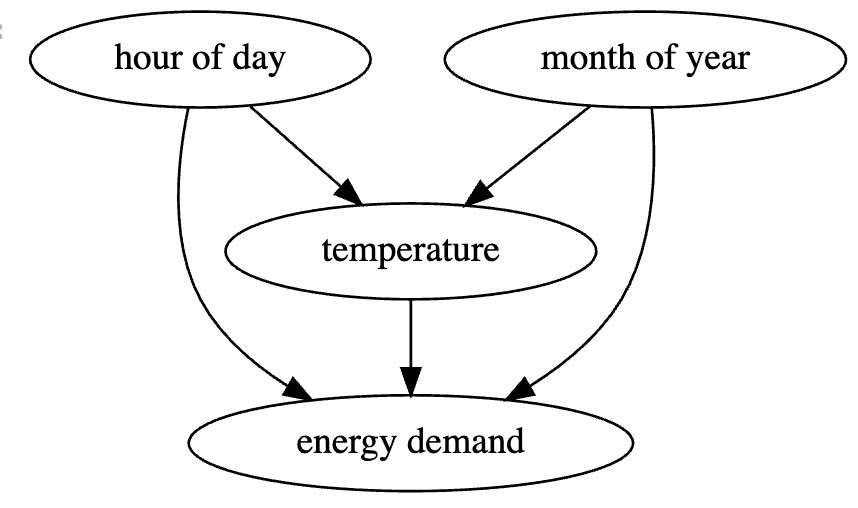
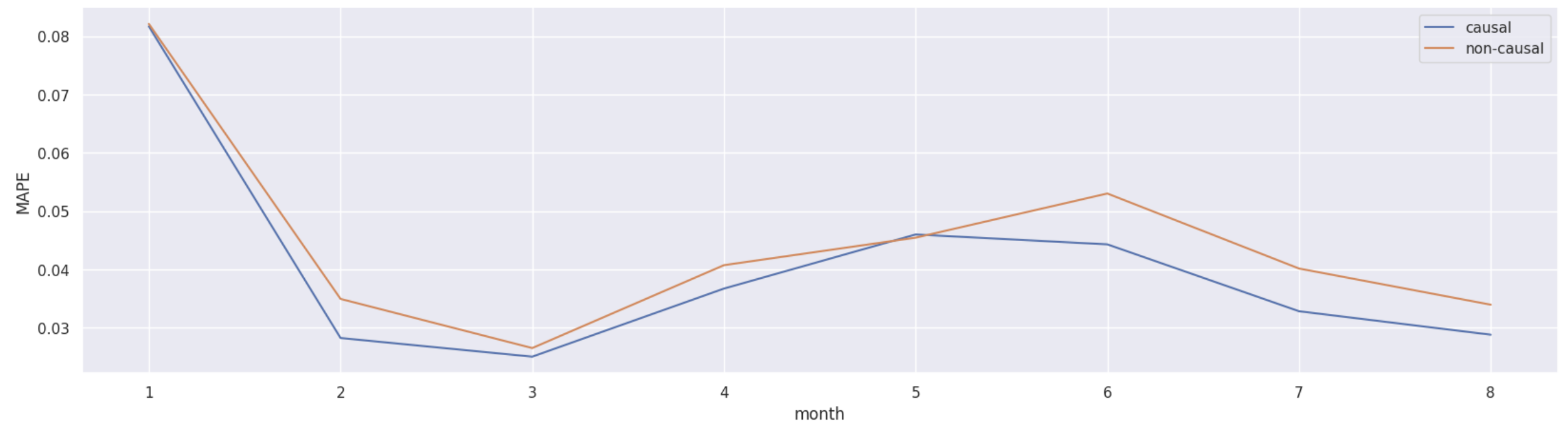
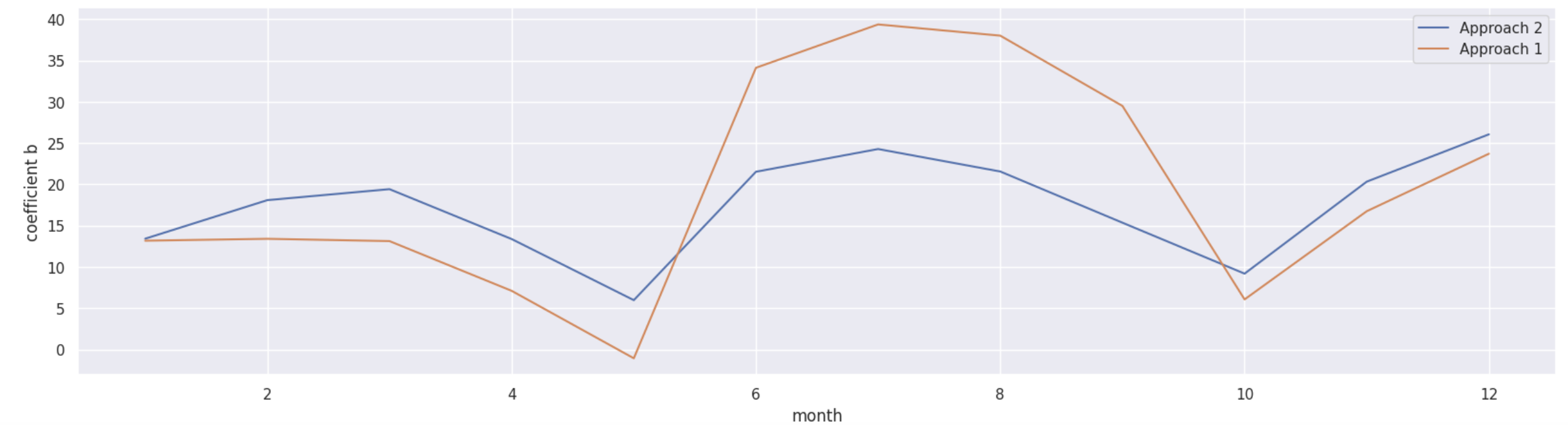
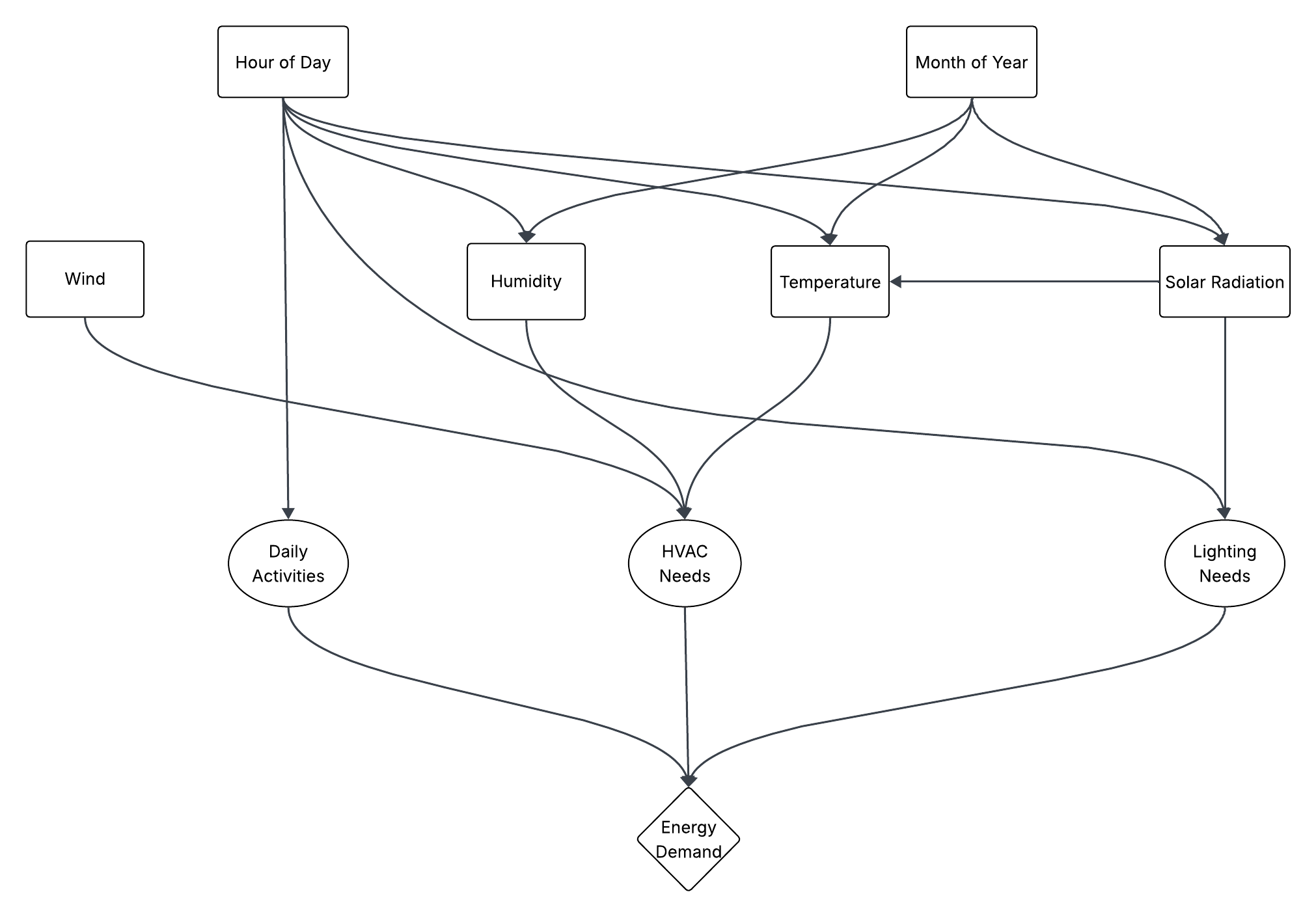
Energy demand prediction is critical for grid operators, industrial energy consumers, and service providers. Energy demand is influenced by multiple factors, including weather conditions (e.g. temperature, humidity, wind speed, solar radiation), and calendar information (e.g. hour of day and month of year), which further affect daily work and life schedules. These factors are causally interdependent, making the problem more complex than simple correlation-based learning techniques satisfactorily allow for. We propose a structural causal model that explains the causal relationship between these variables. A full analysis is performed to validate our causal beliefs, also revealing important insights consistent with prior studies. For example, our causal model reveals that energy demand responds to temperature fluctuations with season-dependent sensitivity. Additionally, we find that energy demand exhibits lower variance in winter due to the decoupling effect between temperature changes and daily activity patterns. We then build a Bayesian model, which takes advantage of the causal insights we learned as prior knowledge. The model is trained and tested on unseen data and yields state-of-the-art performance in the form of a 3.84% MAPE on the test set. The model also demonstrates strong robustness, as the cross-validation across two years of data yields an average MAPE of 3.88%.
💡 Deep Analysis
📄 Full Content
CAUSAL INFERENCE IN ENERGY DEMAND PREDICTION
CHUTIAN MA, GRIGORII POMAZKIN, GIANCINTO PAOLO (GP) SAGGESE,
AND PAUL SMITH
Abstract. Energy demand prediction is critical for grid operators, indus-
trial energy consumers, and service providers. Energy demand is influenced
by multiple factors, including weather conditions (e.g. temperature, humid-
ity, wind speed, solar radiation), and calendar information (e.g. hour of day
and month of year), which further affect daily work and life schedules. These
factors are causally interdependent, making the problem more complex than
simple correlation-based learning techniques satisfactorily allow for. We pro-
pose a structural causal model that explains the causal relationship between
these variables. A full analysis is performed to validate our causal beliefs, also
revealing important insights consistent with prior studies. For example, our
causal model reveals that energy demand responds to temperature fluctuations
with season-dependent sensitivity. Additionally, we find that energy demand
exhibits lower variance in winter due to the decoupling effect between temper-
ature changes and daily activity patterns. We then build a Bayesian model,
which takes advantage of the causal insights we learned as prior knowledge.
The model is trained and tested on unseen data and yields state-of-the-art
performance in the form of a 3.84% MAPE on the test set. The model also
demonstrates strong robustness, as the cross-validation across two years of
data yields an average MAPE of 3.88%.
Contents
1.
Introduction
1
2.
Analysis of Causal Structure
2
3.
A Full Bayesian Treatment
10
4.
Conclusion
16
5.
Future Directions
16
Appendix A.
Legitimacy of Approach 2
16
Appendix B.
Parameters and Priors
17
References
19
1. Introduction
While machine learning (ML) has achieved enormous success in recent decades,
most modern machine learning systems operate purely on statistical correlation,
without any understanding of causation. They excel at detecting patterns in train-
ing data, but cannot distinguish between relationships that merely happen to occur
together and those that represent genuine cause-and-effect mechanisms. As Bern-
hard pointed out in [15], this distinction represents one of the most profound gaps
1
arXiv:2512.11653v2 [cs.AI] 17 Dec 2025
2
MA, POMAZKIN, SAGGESE, AND SMITH
between current AI capabilities and human intelligence and it hinders the ability
of AI systems to generalize what they have learned to new problems.
Due to the these limitations of correlation-based AI, the machine learning com-
munity has shown increasing interest in incorporating causal inference in machine
learning [7, 17, 6, 3], and particularly for time series prediction [9, 14].
In terms of “hindering the generalization ability”, the presence of confounder
bias stands as one of the most common challenges.
In this paper, we define a
confounder in the same way as in Pearl’s work on causality (e.g., [11]).
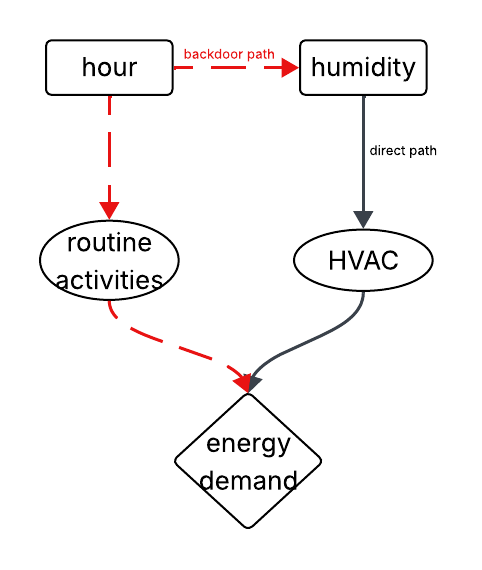
Definition 1.1 (Confounder). Suppose the random variables X, Y, Z are causally
connected by the following relation X ←Z →Y (Z affects X and Y causally).
Then we say that Z confounds X and Y , or that Z is a confounder of the other
two variables.
The existence of confounders is often problematic because they create spurious
associations between predictors and outcomes. Models learn these non-causal cor-
relations rather than genuine causal effects. This hinders generalization: when the
distribution of predictors shifts in deployment environments or under interventions,
the spurious patterns learned from confounded training data fail to hold, leading to
poor predictive performance in new settings. This is a major limitation of purely
statistical approaches operating at the associational level, as Pearl emphasizes in
his discussion of the causal hierarchy [12].
In this paper, we study an energy demand prediction problem in which we model
the system load using ML approaches. We present a full analysis of the interdepen-
dency structure of the various predictors (including weather conditions and calendar
information) and energy demand. At the same time, we list common mistakes and
consequences originating from confounder bias and misspecified causal structure.
A Bayesian causal model is later built based on the causal insights, trained on real-
world energy demand data and tested on unseen data. The model is able to produce
state-of-the-art predictions, with an average MAPE of 3.88% generated from a K-
fold cross validation test. In addition, the model is able to explain the variability
found in the data, such as the seasonal-dependent variance (heteroscedasticity) and
temperature sensitivity.
This paper is structured as follows. Section 2 presents a full analysis of the inter-
dependency between calendar, weather and energy demand variables. We show that
ignoring causal structure can cause a trained model to show confounder bias, se-
verely jeopardizing its generalization to unseen data. Section 3 develops a