Memory as Resonance: A Biomimetic Architecture for Infinite Context Memory on Ergodic Phonetic Manifolds
Reading time: 5 minute
...
📝 Original Info
Title: Memory as Resonance: A Biomimetic Architecture for Infinite Context Memory on Ergodic Phonetic Manifolds
ArXiv ID: 2512.20245
Date: 2025-12-23
Authors: ** Tarik Houichime¹²*, Abdelghani Souhar³, Younes El Amrani² ¹ System Research & Development Laboratory, 5EME AXE LLC, Kenitra, Morocco ² LRIT, Faculty of Science, Mohammed V University, Rabat, Morocco ³ Computer Science Research Laboratory (LaRI), Ibn Tofail University, Kenitra, Morocco *Corresponding author: tarik_houichime@um5.ac.ma **
📝 Abstract
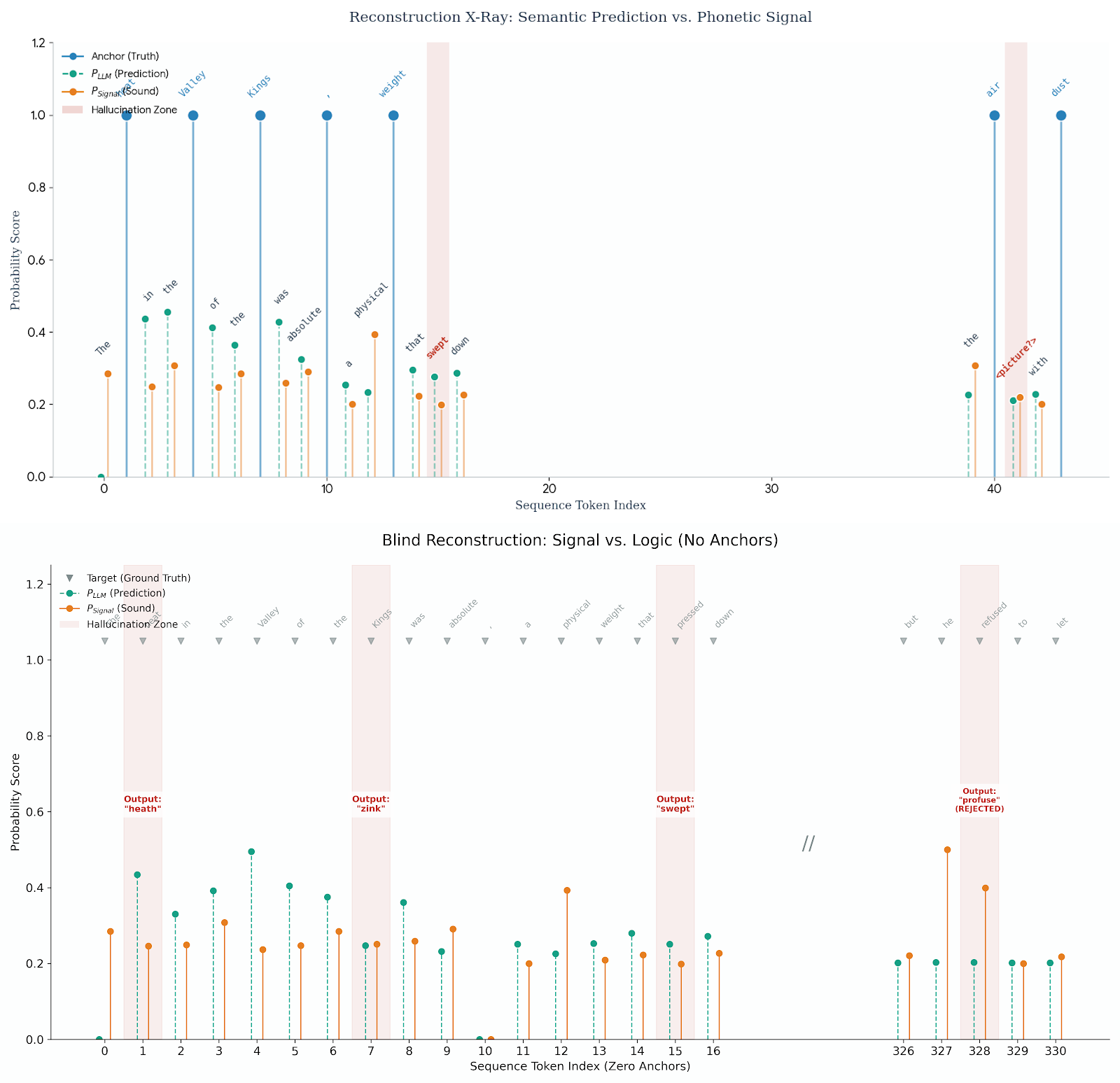
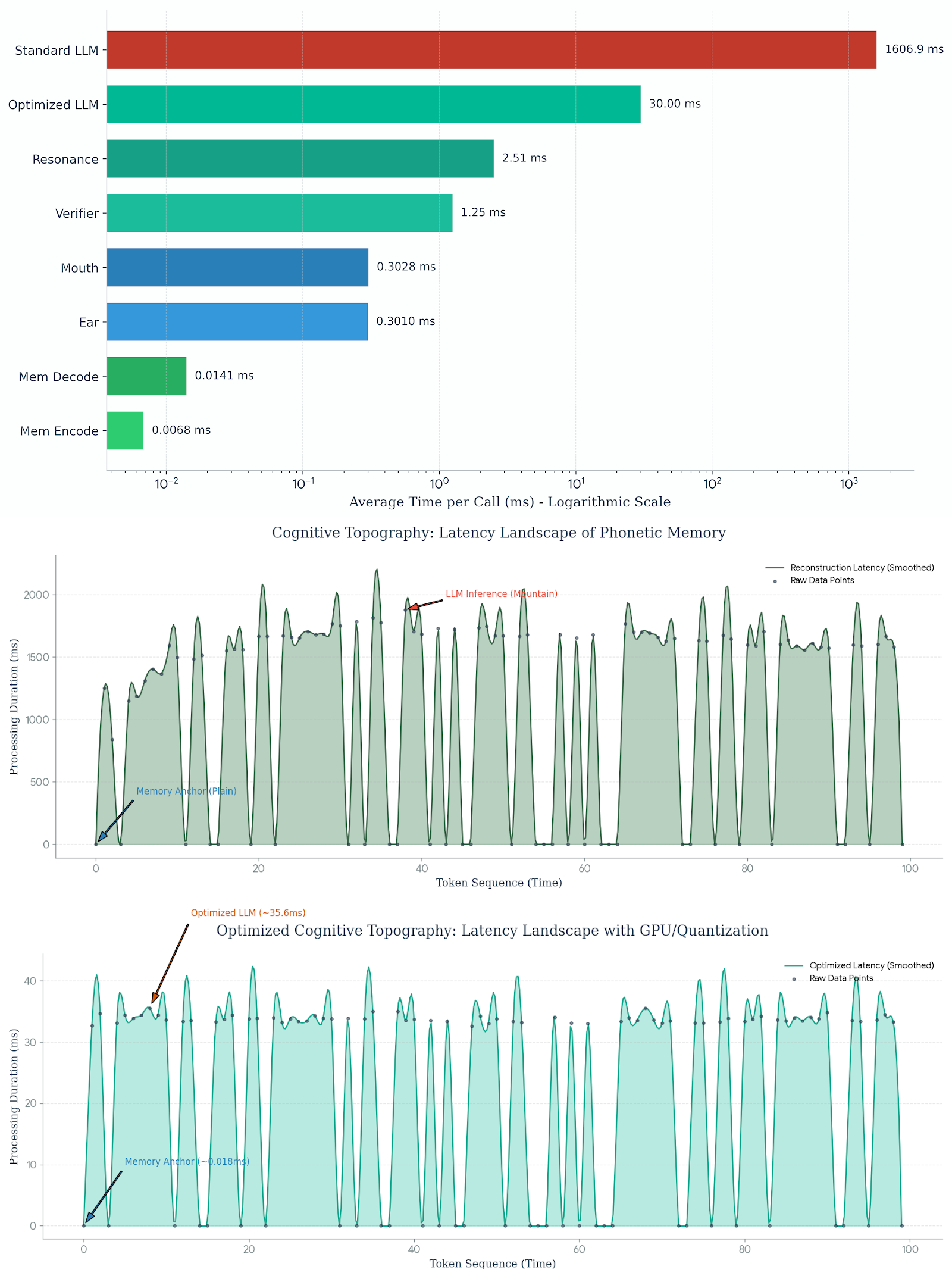
The memory of contemporary Large Language Models is bound by a physical paradox: as they learn, they fill up. The linear accumulation (O(N)) of Key-Value states treats context as a warehouse of static artifacts, eventually forcing a destructive choice between amnesia and latency. We challenge this discrete orthodoxy, proposing that long-term memory is not the storage of items, but the persistence of a trajectory. We introduce Phonetic Trajectory Memory (PTM), a neuro-symbolic architecture that encodes language not as a sequence of tensors, but as a continuous path on an ergodic manifold governed by irrational rotation matrices. By decoupling the navigation (an invariant O(1) geometric signal) from the reconstruction (a probabilistic generative act), PTM achieves a compression magnitude of greater than 3,000x relative to dense caches. We demonstrate that retrieval becomes a process of resonance: the phonetic trace stabilizes the model against hallucination via "Signal Consensus" mechanism, securing up to approximately 92% factual accuracy. While this aggressive abstraction alters generative texture, it unlocks immediate access latency (approximately 34ms) independent of depth. Our results suggest that infinite context does not require infinite silicon; it requires treating memory not as data to be stored, but as a reconstructive process acting on a conserved, undying physical signal.
💡 Deep Analysis
📄 Full Content
Memory as Resonance: A Biomimetic Architecture
for Infinite Context Memory on Ergodic Phonetic
Manifolds
Tarik HOUICHIME1,2*, Abdelghani Souhar3 and
Younes El Amrani2
1*System Research & Development Laboratory, 5EME AXE LLC,
Kenitra, 14000, Morocco.
2LRIT, Faculty of Science, Mohammed V University In Rabat„ Rabat,
10112, Morocco.
3Computer Science Research Laboratory (LaRI), Faculty of Science, Ibn
Tofail University, Street, Kenitra, 14000, Morocco.
*Corresponding author(s). E-mail(s): tarik_houichime@um5.ac.ma;
Contributing authors: houssouhar@gmail.com; y.elamrani@um5r.ac.ma;
Abstract
The memory of contemporary Large Language Models is bound by a physical
paradox: as they learn, they fill up. The linear accumulation (O(N)) of Key-
Value states treats context as a warehouse of static artifacts, eventually forcing
a destructive choice between amnesia and latency. We challenge this discrete
orthodoxy, proposing that long-term memory is not the storage of items, but the
persistence of a trajectory. We introduce Phonetic Trajectory Memory (PTM), a
neuro-symbolic architecture that encodes language not as a sequence of tensors,
but as a continuous path on an ergodic manifold governed by irrational rotation
matrices. By decoupling the navigation (an invariant O(1) geometric signal) from
the reconstruction (a probabilistic generative act), PTM achieves a compression
magnitude of > 3, 000× relative to dense caches. We demonstrate that retrieval
becomes a process of resonance: the phonetic trace stabilizes the model against
hallucination via a “Signal Consensus” mechanism, securing up to ≈92% factual
accuracy. While this aggressive abstraction alters generative texture, it unlocks
immediate access latency(≈34ms) independent of depth. Our results suggest
that infinite context does not require infinite silicon; it requires treating memory
not as data to be stored, but as a reconstructive process acting on a conserved,
undying physical signal.
1
arXiv:2512.20245v1 [cs.NE] 23 Dec 2025
Keywords: Large Language Models, Long Context Memory, Neuro-Symbolic
Architecture, Unitary Manifolds, KV Cache Compression, Phonetic Embeddings,
Reconstructive Memory, Dynamical Systems.
1 Introduction
The central paradox of modern Artificial Intelligence is that we have engineered "infi-
nite" reasoning capabilities but trapped them within a finite vessel. While the neural
parameters of Large Language Models (LLMs) encode a vast, static representation
of the world, their ability to navigate a specific, evolving context is crippled by the
Memory Wall [1–6]. This wall is built of discrete bricks: the Key-Value (KV) cache.
Current architectures treat memory as a warehouse. To retain a sequence, the model
must stack tensors linearly, creating a structure that grows O(N) with every new
token. This forces a cruel thermodynamic trade-off: to remember a book, the model
must burn massive energy "reading" it (the Prefill phase), and to keep it alive, it must
reserve prohibitive amounts of VRAM. Eventually, the warehouse fills. To learn a
new word, the system must evict an old one. We are attempting to solve a continuous
problem—the flow of thought—using discrete, saturating storage. Biology, however,
rejects this inefficiency [7, 8]. A human mind reciting a poem learned decades ago
does not access a database of immutable strings. There is no file system in the brain.
Instead, the sequence is reconstructed—summoned from the void through rhythm,
phonetic constraints, and sparse semantic anchors [9, 10]. Biological memory is not
a static artifact stored on a disk; it is a resonant path carved into a neural manifold
[11, 12]. The poet does not retrieve the verse; they traverse it.
The discipline’s response to the Memory Wall has historically fractured into three
distinct topological compromises. Each strategy attempts to cheat the finite limits
of hardware, yet each exacts a heavy price on the integrity of the thought process.
First, the Expansionists (Context Extension). Methods such as FlashAttention
[13], Ring Attention [14], and others [15, 16] have ruthlessly optimized the mechanics
of the attention matrix, stretching the window to a million tokens. Yet, this is an
engineering victory, not a structural one. They do not cure the pathology of storage;
they merely forestall the symptoms. By distributing the massive KV cache across
extensive GPU clusters, they succeed only in building a larger warehouse, without
ever questioning the necessity of the bricks. Second, the Externalists (RAG). By
offloading memory to vector databases [17–20], Retrieval-Augmented Generation
promises theoretical infinity. However, this infinite reach comes at the cost of frag-
mentation. RAG retrieves isolated shards of data—a paragraph here, a statistic
there—severing the causal and rhythmic ligaments that bind a narrative together. It
creates a reasoner that possesses knowledge without continuity, offering facts stripped
of their structural soul. Third, the Compressionis