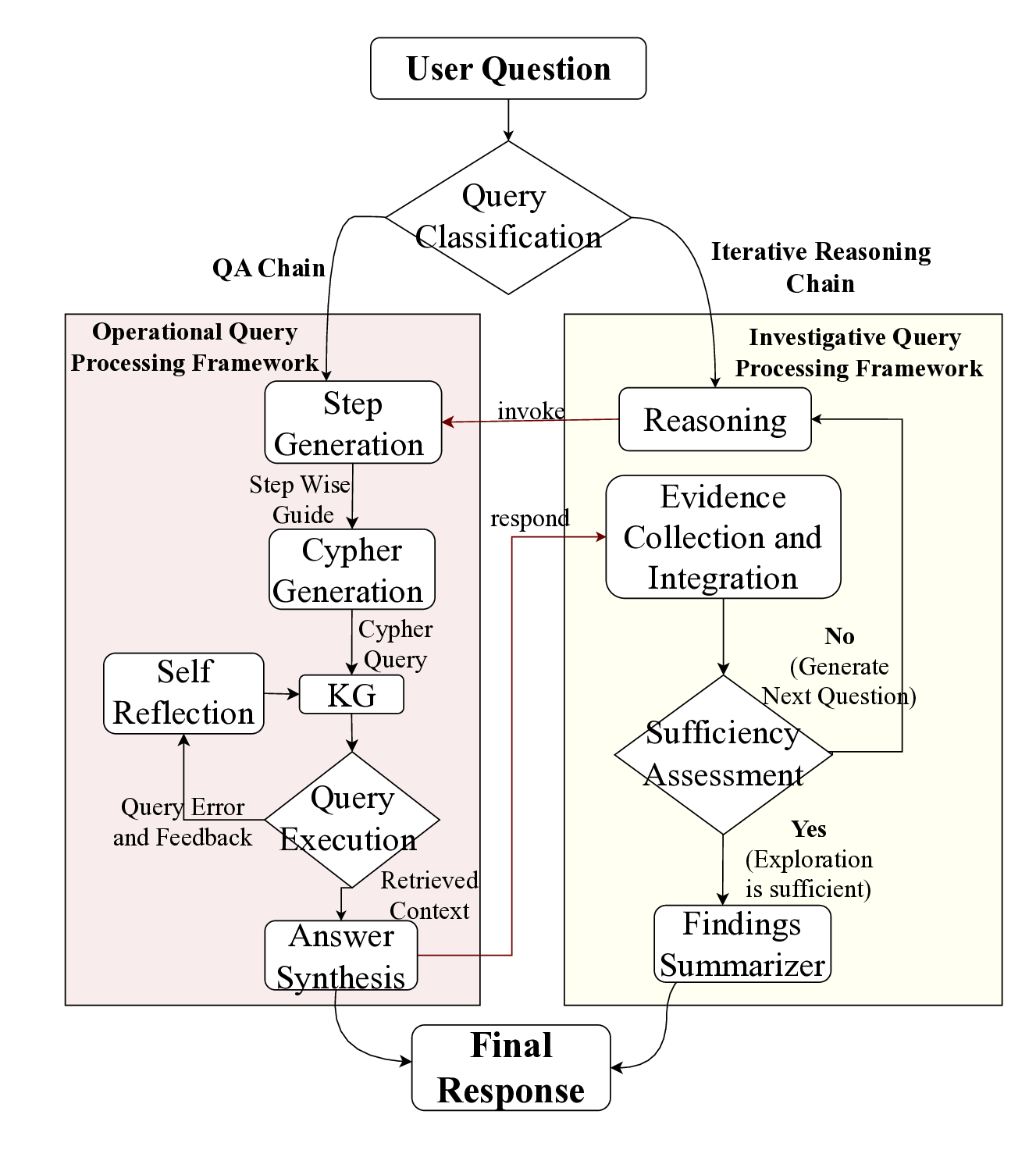
Manufacturing planners face complex operational challenges that require seamless collaboration between human expertise and intelligent systems to achieve optimal performance in modern production environments. Traditional approaches to analyzing simulation-based manufacturing data often create barriers between human decision-makers and critical operational insights, limiting effective partnership in manufacturing planning. Our framework establishes a collaborative intelligence system integrating Knowledge Graphs and Large Language Model-based agents to bridge this gap, empowering manufacturing professionals through natural language interfaces for complex operational analysis. The system transforms simulation data into semantically rich representations, enabling planners to interact naturally with operational insights without specialized expertise. A collaborative LLM agent works alongside human decision-makers, employing iterative reasoning that mirrors human analytical thinking while generating precise queries for knowledge extraction and providing transparent validation. This partnership approach to manufacturing bottleneck identification, validated through operational scenarios, demonstrates enhanced performance while maintaining human oversight and decision authority. For operational inquiries, the system achieves near-perfect accuracy through natural language interaction. For investigative scenarios requiring collaborative analysis, we demonstrate the framework's effectiveness in supporting human experts to uncover interconnected operational issues that enhance understanding and decision-making. This work advances collaborative manufacturing by creating intuitive methods for actionable insights, reducing cognitive load while amplifying human analytical capabilities in evolving manufacturing ecosystems.
💡 Deep Analysis
📄 Full Content
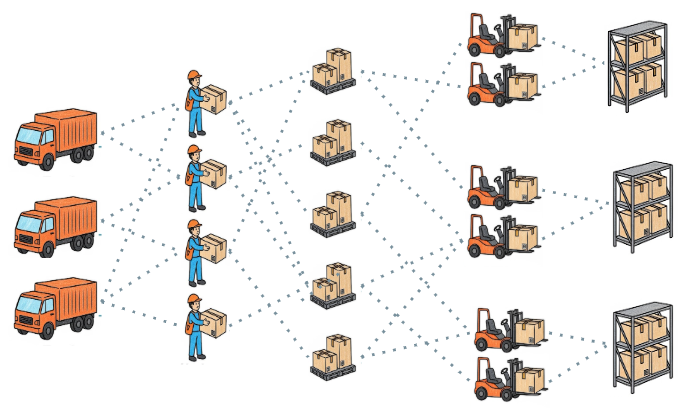
Modern manufacturing systems represent complex ecosystems where human expertise and advanced technology must work in seamless partnership to achieve optimal performance. As Industry 4.0 and smart manufacturing initiatives transform production environments, the challenge of effective human-machine collaboration has become paramount (Zhong et al. 2017a;Fragapane et al. 2022). Human decision-makers in manufacturing planning bring irreplaceable domain knowledge, contextual understanding and adaptive problem-solving capabilities, while AI systems offer computational power, pattern recognition and data processing at scale. However, realizing the full potential of this partnership requires bridging the gap between human cognitive processes and complex technological systems, particularly in the analysis of intricate operational data. Manufacturing facilities, including warehouses, distribution centers and production floors, are characterized by sophisticated interactions between personnel, automated equipment, processes and physical layouts (de Koster, Le-Duc, and Roodbergen 2007; Lee et al. 2017;Gu, Goetschalckx, and Mcginnis 2007) . The complexity of these human-machine collaborative environments demands decision support systems that can interpret vast amounts of operational data while remaining accessible and interpretable to human planners. Discrete Event Simulation (DES) has emerged as a fundamental tool for modeling these systems (Banks 2005;Law, Kelton, and Kelton 2000), enabling stakeholders to evaluate performance, test design alternatives and understand system dynamics. However, a critical challenge persists: how can human decision-makers effectively collaborate with AI systems to extract actionable insights from the voluminous and highly granular output data that DES generates? Traditional approaches to simulation analysis often create barriers between human expertise and technological capabilities. Conventional methods, frequently reliant on manual inspection of aggregate statistics (Law, Kelton, and Kelton 2000) or development of custom scripts tailored to specific simulation outputs, are not only time-intensive and errorprone but also limit the ability of human planners to engage in meaningful collaboration with AI systems. These approaches fail to leverage the complementary strengths of human intuition and machine computation, often requiring specialized technical expertise that creates silos between operational planners and analytical tools. As manufacturing environments become increasingly complex and dynamic, there is an urgent need for human-centric AI systems that can facilitate effective collaboration between human decisionmakers and advanced analytical capabilities. The emergence of Artificial Intelligence (AI) in manufac-turing and logistics (Ivanov, Dolgui, and Sokolov 2019;Zhong et al. 2017a;Drissi Elbouzidi et al. 2023) presents unprecedented opportunities to create collaborative intelligence systems that augment rather than replace human expertise. However, realizing these opportunities requires addressing fundamental challenges in human-AI interaction: How can AI systems interpret user intentions while managing procedural uncertainties? How can humans and machines engage in bidirectional learning? How can collaborative partnerships be designed to achieve mutually beneficial goals in evolving manufacturing ecosystems? To address these human-centric manufacturing challenges, our work proposes a novel framework that integrates Knowledge Graphs (KGs) (Hogan et al. 2021) and Large Language Model (LLM)s (Zhao et al. 2023;Pan et al. 2023) to enable effective human-AI collaboration in manufacturing planning through natural language interfaces for complex operational analysis. Our approach recognizes that the core challenge is not merely technical analysis, but rather creating systems that facilitate meaningful partnership between human planners and AI capabilities. The foundation of our human-centric approach lies in transforming complex data generated by DES into semantically rich Knowledge Graphs that both humans and AI systems can effectively utilize. By representing simulation output as graphs, we enable the intricate dependencies and flows within manufacturing systems to be explicitly captured and collaboratively explored by human planners and AI agents. While KGs are increasingly applied to analyze real-world industrial and supply chain data for enhanced visibility and risk management (Noy et al. 2019;Kosasih et al. 2024), their application to creating human-AI collaborative interfaces for simulation analysis remains relatively unexplored. Building upon this structured representation, our framework employs LLM-based agents to create intuitive natural language interfaces that allow human planners to engage in collaborative analysis without requiring specialized technical expertise. This approach democratizes access to complex analytical capabilities, enabling operations analysts, industrial