Title: Exploration vs. Fixation: Scaffolding Divergent and Convergent Thinking for Human-AI Co-Creation with Generative Models
ArXiv ID: 2512.18388
Date: 2025-12-20
Authors: ** - Chao Wen – Max Planck Institute for Software Systems, Germany - Tung Phung – Max Planck Institute for Software Systems, Germany - Pronita Mehra – MindAntix, USA - Sumit Gulwani – Microsoft, USA - Tomohiro Nagashima – Saarland Informatics Campus, Saarland University, Germany - Adish Singla – Max Planck Institute for Software Systems, Germany **
📝 Abstract
Generative AI has begun to democratize creative work, enabling novices to produce complex artifacts such as code, images, and videos. However, in practice, existing interaction paradigms often fail to support divergent exploration: users tend to converge too quickly on early ``good enough'' results and struggle to move beyond them, leading to premature convergence and design fixation that constrains their creative potential. To address this, we propose a structured, process-oriented human-AI co-creation paradigm including divergent and convergent thinking stages, grounded in Wallas's model of creativity. To avoid design fixation, our paradigm scaffolds both high-level exploration of conceptual ideas in the early divergent thinking phase and low-level exploration of variations in the later convergent thinking phrase. We instantiate this paradigm in HAIExplore, an image co-creation system that (i) scaffolds divergent thinking through a dedicated brainstorming stage for exploring high-level ideas in a conceptual space, and (ii) scaffolds convergent refinement through an interface that externalizes users' refinement intentions as interpretable parameters and options, making the refinement process more controllable and easier to explore. We report on a within-subjects study comparing HAIExplore with a widely used linear chat interface (ChatGPT) for creative image generation. Our findings show that explicitly scaffolding the creative process into brainstorming and refinement stages can mitigate design fixation, improve perceived controllability and alignment with users' intentions, and better support the non-linear nature of creative work. We conclude with design implications for future creativity support tools and human-AI co-creation workflows.
💡 Deep Analysis
📄 Full Content
Exploration vs. Fixation: Scaffolding Divergent and Convergent Thinking for
Human-AI Co-Creation with Generative Models
CHAO WEN, Max Planck Institute for Software Systems, Germany
TUNG PHUNG, Max Planck Institute for Software Systems, Germany
PRONITA MEHROTRA, MindAntix, USA
SUMIT GULWANI, Microsoft, USA
TOMOHIRO NAGASHIMA, Saarland Informatics Campus, Saarland University, Germany
ADISH SINGLA, Max Planck Institute for Software Systems, Germany
Generative AI has begun to democratize creative work, enabling novices to produce complex artifacts such as code, images, and videos.
However, in practice, existing interaction paradigms often fail to support divergent exploration: users tend to converge too quickly on
early “good enough” results and struggle to move beyond them, leading to premature convergence and design fixation that constrains
their creative potential. To address this, we propose a structured, process-oriented human-AI co-creation paradigm including divergent
and convergent thinking stages, grounded in Wallas’s model of creativity. To avoid design fixation, our paradigm scaffolds both
high-level exploration of conceptual ideas in the early divergent thinking phase and low-level exploration of variations in the later
convergent thinking phrase. We instantiate this paradigm in HAIExplore, an image co-creation system that (i) scaffolds divergent
thinking through a dedicated brainstorming stage for exploring high-level ideas in a conceptual space, and (ii) scaffolds convergent
refinement through an interface that externalizes users’ refinement intentions as interpretable parameters and options, making the
refinement process more controllable and easier to explore. We report on a within-subjects study comparing HAIExplore with a
widely used linear chat interface (ChatGPT) for creative image generation. Our findings show that explicitly scaffolding the creative
process into brainstorming and refinement stages can mitigate design fixation, improve perceived controllability and alignment with
users’ intentions, and better support the non-linear nature of creative work. We conclude with design implications for future creativity
support tools and human-AI co-creation workflows.
Additional Key Words and Phrases: Large Language Models, Creativity Support, Human-AI Co-Creation, Divergent Thinking, Design
Fixation
1
Introduction
Generative AI has fundamentally democratized content creation, enabling novices to produce artifacts such as code,
images, and videos that previously required professional expertise and complex tools [12, 15, 22, 32, 34, 44, 45]. However,
most existing interfaces are optimized for productivity rather than open-ended creativity tasks. Prior studies have found
that, when humans collaborate with generative AI for design work, they typically follow a “slot machine” workflow,
where users iteratively tweak prompts to converge to a single result [47]. This workflow can lead to premature
convergence and design fixation, where users settle on the first “good enough” result rather than exploring the broader
space of ideas [42, 47]. Furthermore, when refining these “good enough” results, design fixation often persists, as users
typically obtain a single refined result instead of branching into and exploring alternative variations that may lead
to better outcomes. This refinement process is further exacerbated by the “gulf of envisioning,” where users struggle
to translate their high-level intentions into the precise prompts required by generative AI models, constraining the
refinement process to local, trial-and-error adjustments [41, 58].
Preprint. Corresponding author: Chao Wen .
1
arXiv:2512.18388v1 [cs.HC] 20 Dec 2025
2
Wen et al.
Recent works have attempted to mitigate design fixation and premature convergence by developing creativity-support
tools to explicitly embed structured exploration into the human-AI co-creation process [20, 42, 44, 50]. These systems
either generate multiple outputs or surface dimensions of the design space to avoid design fixation. However, they
still fall short in fully supporting the multi-stage non-linear nature of creative processes and in helping users develop
transferable prompting and steering strategies.
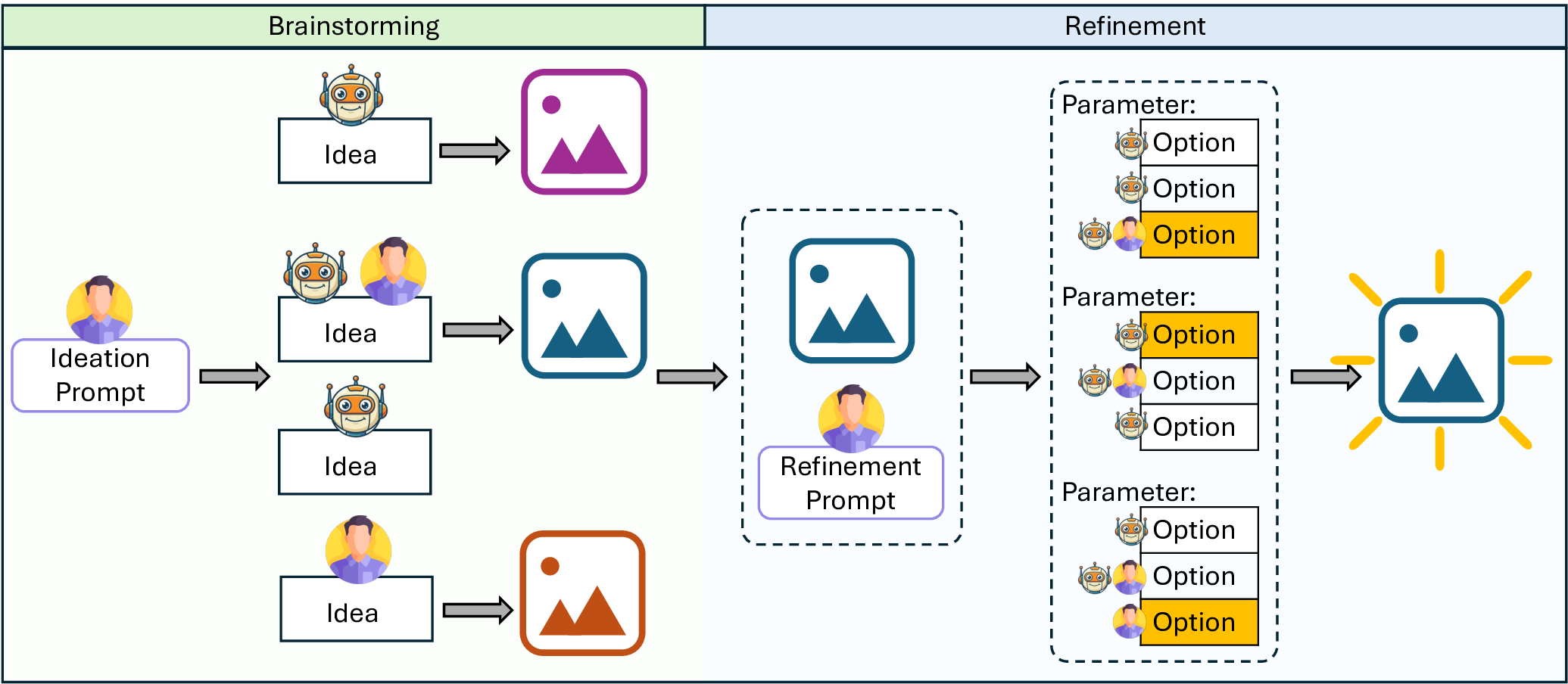
To address these limitations, we reframe human-AI co-creation through a process-oriented lens grounded in Wallas’s
four-stage model of the creative process. Wallas’s model describes creativity as unfolding in four stages – preparation,
incubation, illumination, and verification [48]. In this model, preparation and incubation are oriented toward exploration
and the generation of multiple possibilities, often associated with divergent thinking, while illumination and verification
emphasize evaluation and refinement and are associated with convergent thinking [25]. Motivated by this, we introduce
a human-AI co-creation paradigm that structures interaction into two stages: brainstorming and refinement. The
brainstorming stage (divergent