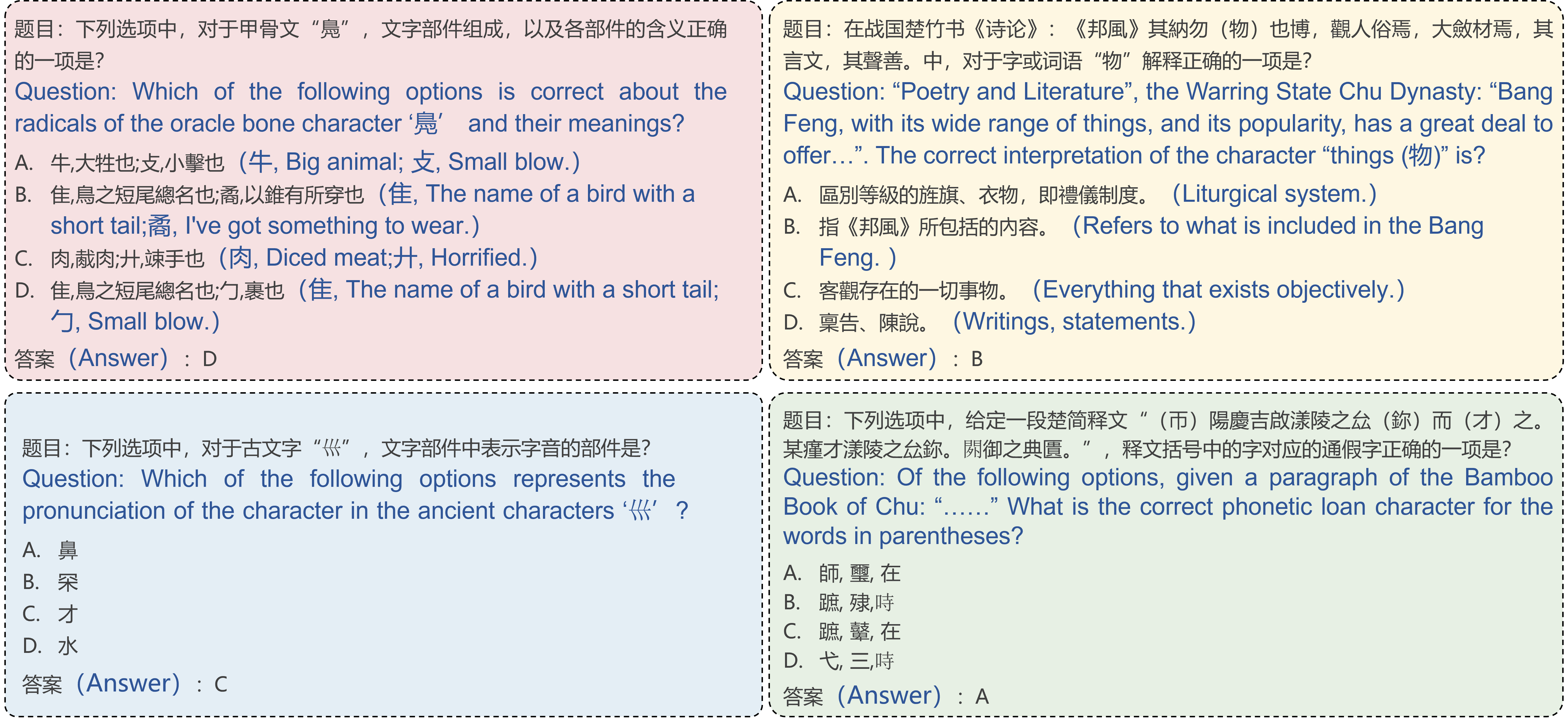
📝 Original Info Title: AncientBench: Towards Comprehensive Evaluation on Excavated and Transmitted Chinese CorporaArXiv ID: 2512.17756Date: 2025-12-19Authors: Zhihan Zhou, Daqian Shi, Rui Song, Lida Shi, Xiaolei Diao, Hao Xu📝 Abstract Comprehension of ancient texts plays an important role in archaeology and understanding of Chinese history and civilization. The rapid development of large language models needs benchmarks that can evaluate their comprehension of ancient characters. Existing Chinese benchmarks are mostly targeted at modern Chinese and transmitted documents in ancient Chinese, but the part of excavated documents in ancient Chinese is not covered. To meet this need, we propose the AncientBench, which aims to evaluate the comprehension of ancient characters, especially in the scenario of excavated documents. The AncientBench is divided into four dimensions, which correspond to the four competencies of ancient character comprehension: glyph comprehension, pronunciation comprehension, meaning comprehension, and contextual comprehension. The benchmark also contains ten tasks, including radical, phonetic radical, homophone, cloze, translation, and more, providing a comprehensive framework for evaluation. We convened archaeological researchers to conduct experimental evaluations, proposed an ancient model as baseline, and conducted extensive experiments on the currently best-performing large language models. The experimental results reveal the great potential of large language models in ancient textual scenarios as well as the gap with humans. Our research aims to promote the development and application of large language models in the field of archaeology and ancient Chinese language.
💡 Deep Analysis
📄 Full Content AncientBench: Towards Comprehensive Evaluation on Excavated and
Transmitted Chinese Corpora
Zhihan Zhou1,2, Daqian Shi2,3, Rui Song1,2, Lida Shi2,4, Xiaolei Diao*1,2,5, Hao Xu*1,2
1College of Computer Science and Technology, Jilin University
2Key Laboratory of Ancient Chinese Script, Culture Relics and Artificial Intelligence, Jilin University
3Digital Environment Research Institute, Queen Mary University of London
4School of Artificial Intelligence, Jilin University
5Department of Information Engineering and Computer Science, University of Trento
{zhzhou25, shild21}@mails.jlu.edu.cn, d.shi@qmul.ac.uk, {songrui, xuhao}@jlu.edu.cn, xiaolei.diao@unitn.it
Abstract
Comprehension of ancient texts plays an important role in
archaeology and understanding of Chinese history and civ-
ilization. The rapid development of large language models
needs benchmarks that can evaluate their comprehension of
ancient characters. Existing Chinese benchmarks are mostly
targeted at modern Chinese and transmitted documents in an-
cient Chinese, but the part of excavated documents in ancient
Chinese is not covered. To meet this need, we propose the
AncientBench, which aims to evaluate the comprehension of
ancient characters, especially in the scenario of excavated
documents. The AncientBench is divided into four dimen-
sions, which correspond to the four competencies of ancient
character comprehension: glyph comprehension, pronuncia-
tion comprehension, meaning comprehension, and contextual
comprehension. The benchmark also contains ten tasks, in-
cluding radical, phonetic radical, homophone, cloze, trans-
lation, and more, providing a comprehensive framework for
evaluation. We convened archaeological researchers to con-
duct experimental evaluations, proposed an ancient model as
baseline, and conducted extensive experiments on the cur-
rently best-performing large language models. The experi-
mental results reveal the great potential of large language
models in ancient textual scenarios as well as the gap with
humans. Our research aims to promote the development and
application of large language models in the field of archaeol-
ogy and ancient Chinese language.
Introduction
As one of the most spoken languages in the world, Chinese
has received extensive attention in recent years in the field
of natural language processing (NLP). As an important part
of the Chinese language, ancient Chinese carries extremely
rich historical and cultural information, and its study is of
great significance for the traceability of Chinese history, the
protection of cultural heritage, and the development of his-
torical linguistics. However, traditional ancient Chinese re-
search methods are highly dependent on the researcher’s
memory and linguistic intuition, which is often inefficient
*Corresponding authors
Copyright © 2026, Association for the Advancement of Artificial
Intelligence (www.aaai.org). All rights reserved.
Figure 1: Comparison of excavated documents with trans-
mitted documents. (a) Bamboo Book of Chu, excavated doc-
uments. (b) Silk Books, excavated documents. (c) Book of
Poetry, transmitted documents.
and difficult to deal with large-scale corpus systematically,
limiting the breadth and depth of research.
With the rapid development of artificial intelligence tech-
nology, especially large language models (LLMs), ancient
Chinese research is gradually stepping towards a new
paradigm of data-driven and model-supported. LLMs have
demonstrated excellent generalization ability in natural lan-
guage understanding and natural language generation, and
have shown great potential in text analysis, language struc-
ture modeling, and so on. In order to systematically evalu-
ate the capability of these models, academics have gradually
constructed a series of standardized evaluation systems, such
as MMLU(Hendrycks et al. 2021a), BIG-bench(Srivastava
et al. 2022), and HELM(Bommasani, Liang, and Lee 2023),
etc., which have become important tools for measuring the
general language intelligence of models. This technological
trend offers new opportunities for ancient Chinese process-
ing, especially in understanding difficult ancient texts.
In the Chinese context, based on its linguistic character-
istics and application requirements, a series of benchmarks
have emerged to evaluate the capability of Chinese LLMs,
such as CLUE(Xu et al. 2020a), CMMLU(Li et al. 2024),
arXiv:2512.17756v1 [cs.CL] 19 Dec 2025
and MMCU(Zeng 2023), etc. Most of these benchmarks
cover a wide range of domains in Chinese scenarios, such
as language comprehension, logical reasoning, instruction
execution, etc., which promote the evaluation and iterative
optimization of Chinese language models. In recent years,
some datasets related to ancient Chinese have also appeared,
e.g., ACLUE(Zhang and Li 2023) and WYWEB(Zhou et al.
2023). However, the tasks related to ancient Chinese in such
benchmarks are scarce, mostly limited to syntax parsing,
with no unified evaluation criteria, making
📸 Image Gallery
Reference This content is AI-processed based on open access ArXiv data.