Title: Gutenberg-Richter-like relations in physical systems
ArXiv ID: 2512.17615
Date: 2025-12-19
Authors: K. Duplat, G. Varas, O. Ramos
📝 Abstract
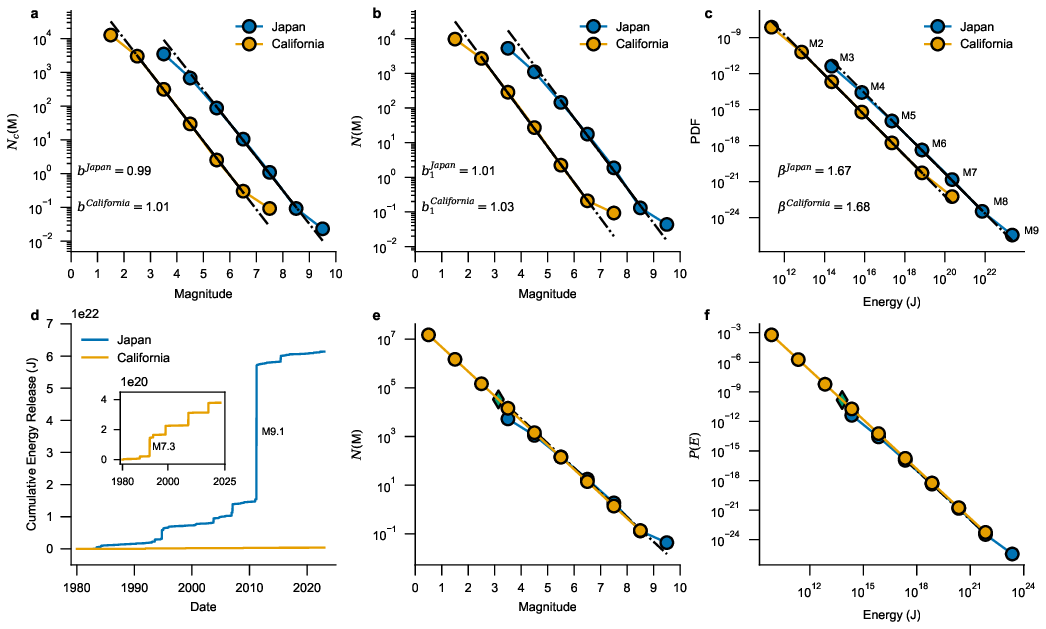
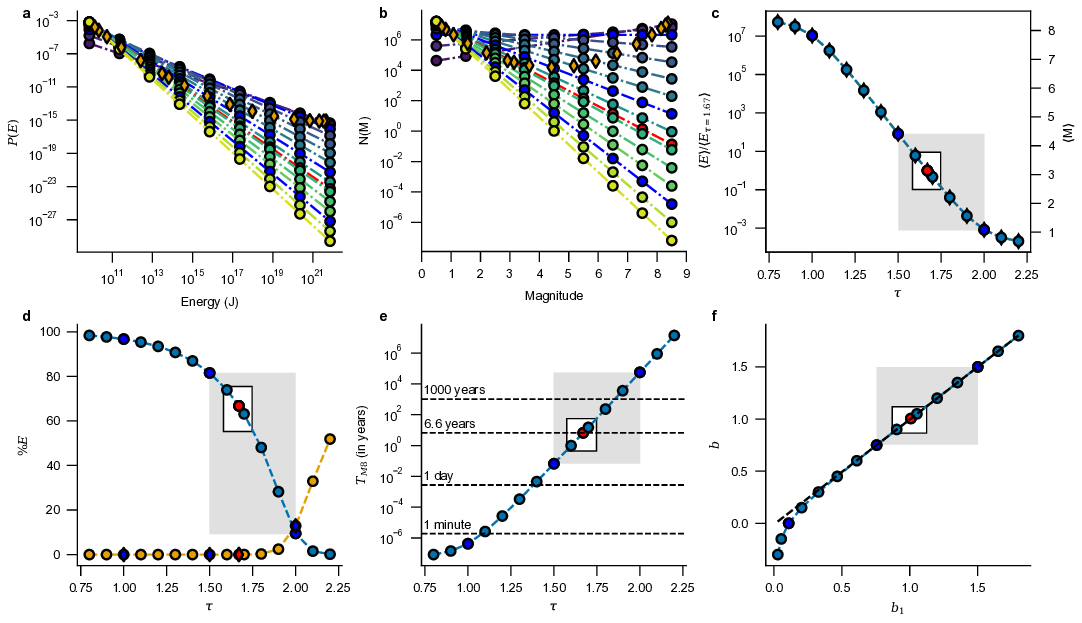
We analyze regional earthquake energy statistics from the Southern California and Japan seismic catalogs and find scale-invariant energy distributions characterized by an exponent $τ\simeq 1.67$. To quantify how closely scale-invariant dynamics with different exponent values resemble real earthquakes, we generate synthetic energy distributions over a wide range of $τ$ under conditions of constant activity. Earthquake-like behavior, in a broad sense, is obtained for $1.5 \leqslant τ< 2.0$. When energy variations are further restricted to be within a factor of ten relative to real earthquakes, the admissible range narrows to $1.58 \leqslant τ\leqslant 1.76$. We identify the physical mechanisms governing the dynamics in the different regimes: fault dynamics characterized by a balance between slow energy accumulation and release through scale-free events in the earthquake-like regime; externally supplied energy relative to a slowly driven fault for $τ< 1.5$; and dominance of small events in the energy budget for $τ> 2$
💡 Deep Analysis
📄 Full Content
Gutenberg-Richter-like relations in physical systems
K. Duplat,1 G. Varas,2 and O. Ramos1, ∗
1Institut Lumi`ere Mati`ere, UMR5306 Universit´e Lyon 1-CNRS, Universit´e de Lyon 69622 Villeurbanne, France.
2Instituto de F´ısica, Pontificia Universidad Cat´olica de Valparaiso (PUCV), Avenida Universidad 330, Valparaiso, Chile.
(Dated: December 22, 2025)
We analyze regional earthquake energy statistics from the Southern California and Japan seismic catalogs
and find scale-invariant energy distributions characterized by an exponent τ ≃1.67. To quantify how closely
scale-invariant dynamics with different exponent values resemble real earthquakes, we generate synthetic energy
distributions over a wide range of τ under conditions of constant activity. Earthquake-like behavior, in a broad
sense, is obtained for 1.5 ⩽τ < 2.0. When energy variations are further restricted to be within a factor of ten
relative to real earthquakes, the admissible range narrows to 1.58 ⩽τ ⩽1.76. We identify the physical mecha-
nisms governing the dynamics in the different regimes: fault dynamics characterized by a balance between slow
energy accumulation and release through scale-free events in the earthquake-like regime; externally supplied
energy relative to a slowly driven fault for τ < 1.5; and dominance of small events in the energy budget for
τ > 2.
I.
INTRODUCTION
In many dissipative phenomena, including earthquakes [1],
granular faults [2–7], sandpiles [8–10] and subcritical rup-
ture [11–16], energy is slowly accumulated and then released
through sudden events of all sizes, typically following power-
law distributions. The scale-invariant nature of these events
motivated theoreticians to draw on the formalism of phase
transitions [17, 18]. Yet this raises a fundamental question:
in natural systems, how is the fine-tuning of the order param-
eter required to reach criticality achieved? [17] The idea of
a critical point acting as an attractor of the dynamics, intro-
duced by the Self-Organized Criticality (SOC) in 1987 [18],
offered a compelling and elegant answer.
Although SOC’s ambitious claims [19] and the absence of
a unified theoretical framework attracted criticism [20, 21],
the conceptual power of the idea galvanized leading figures
in statistical physics [22, 23] and propelled its application to
fields as diverse as seismology [24], neuroscience [25], and
even financial markets [26].
Earthquakes were the most familiar, well-studied, and ar-
guably the most relevant of these phenomena, and thus they
quickly became the reference point for interpreting scale-
invariant behavior. Regardless of the value of the power-law
exponent τ in the event-size distribution P(s) ∼s−τ, the
underlying interpretation remained the same: events occur
across all scales, with numerous small ones and rare, catas-
trophic ones that dominate the total energy release.
In the 1990s, most laboratory experiments and earthquake
catalogs lacked the precision needed to confront or guide the-
oretical developments. Reported b-values in the Gutenberg-
Richter (GR) law spanned a wide range [27], and no clear
consensus existed on how to define an avalanche in a way that
allowed meaningful comparison between theoretical or simu-
lated τ exponents and those extracted from real data.
From a theoretical standpoint, much of the effort focused
on determining the value of τ and classifying avalanches into
∗osvanny.ramos@univ-lyon1.fr
universality classes [28–32]. However, the extent to which
the underlying dynamics differ across these classes was rarely
examined, and they were often implicitly assumed to reflect
the same earthquake-like behavior described above.
With the ultimate goal of understanding the precise physi-
cal scenario associated with a given exponent value, we begin
by examining how avalanche sizes must be defined in order to
compare them consistently. We then turn to the statistics of
actual earthquakes, and finally analyze the different scenarios
that arise when the exponent τ of the earthquake-size distri-
bution is varied.
II.
AVALANCHE DEFINITION
A central goal of this article is to clarify the physical scenar-
ios associated with particular exponent values. As expected,
however, different definitions of avalanche size lead to dis-
tinct event distributions [33]. Consider a power law of the
form P(s) =
1
N s−τ1, where N is a normalization constant.
The variable s can be expressed as s = sDA
l
, where sl is the
linear extent of the avalanche and DA its fractal dimension.
Using this relation we obtain:
P(s)ds = P(sl)dsl
(1)
1
N s−τ1 DA
l
dA sDA−1
l
dsl = P(sl)dsl
(2)
P(sl) = DA
N s−τ2
l
, where τ2 = (τ1 −1)DA + 1.
(3)
Thus, the same underlying process can be described by two
power laws, P(s) and P(sl), characterized by different expo-
nents, τ1 and τ2. Which definition should be considered the
“correct” one? In the context of critical phenomena, event size
is conventionally defined in terms of the event’s volume in an
n-dimensional space [32, 34, 35]