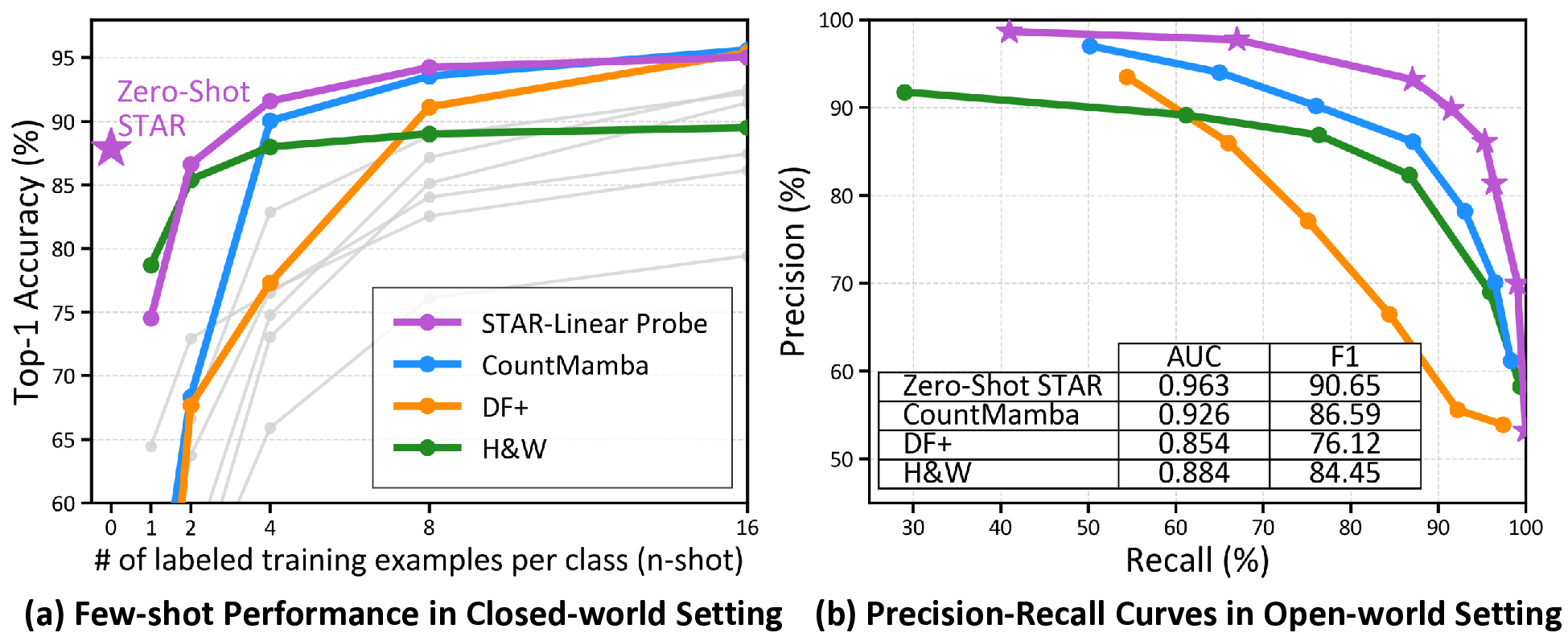
Modern HTTPS mechanisms such as Encrypted Client Hello (ECH) and encrypted DNS improve privacy but remain vulnerable to website fingerprinting (WF) attacks, where adversaries infer visited sites from encrypted traffic patterns. Existing WF methods rely on supervised learning with site-specific labeled traces, which limits scalability and fails to handle previously unseen websites. We address these limitations by reformulating WF as a zero-shot cross-modal retrieval problem and introducing STAR. STAR learns a joint embedding space for encrypted traffic traces and crawl-time logic profiles using a dual-encoder architecture. Trained on 150K automatically collected traffic-logic pairs with contrastive and consistency objectives and structure-aware augmentation, STAR retrieves the most semantically aligned profile for a trace without requiring target-side traffic during training. Experiments on 1,600 unseen websites show that STAR achieves 87.9 percent top-1 accuracy and 0.963 AUC in open-world detection, outperforming supervised and few-shot baselines. Adding an adapter with only four labeled traces per site further boosts top-5 accuracy to 98.8 percent. Our analysis reveals intrinsic semantic-traffic alignment in modern web protocols, identifying semantic leakage as the dominant privacy risk in encrypted HTTPS traffic. We release STAR's datasets and code to support reproducibility and future research.
As modern HTTPS evolves, traditional protocol-visible identifiers such as Server Name Indication (SNI) and DNS queries are increasingly concealed by mechanisms like Encrypted Client Hello (ECH) [1] and encrypted DNS [2]. This shift limits the effectiveness of conventional web inference techniques that rely on such metadata [3]. However, even when both payloads and headers are fully encrypted, traffic traces still reveal structural patterns-such as packet sizes, timing, and burst behaviors-that reflect the underlying resource structure of websites [4]. Website fingerprinting (WF) approaches [5]- [10] exploit these residual features to infer the site being visited, without requiring access to any plaintext identifiers. In this context, WF has emerged as one of the few remaining passive techniques for web-level inference under full encryption. 1 https://github.com/2654400439/STAR-Website-Fingerprinting Existing WF approaches, however, face fundamental limitations that hinder their scalability and practicality for real-world deployment. Specifically: (i) Traffic drift. Website content evolves dynamically over time [11], necessitating frequent recollection of labeled traffic data and retraining of models; (ii) Limited recognition capability. Current supervised learning-based approaches can only identify previously known websites, lacking the ability to generalize to newly emerging sites. These challenges significantly restrict the applicability of WF in operational settings.
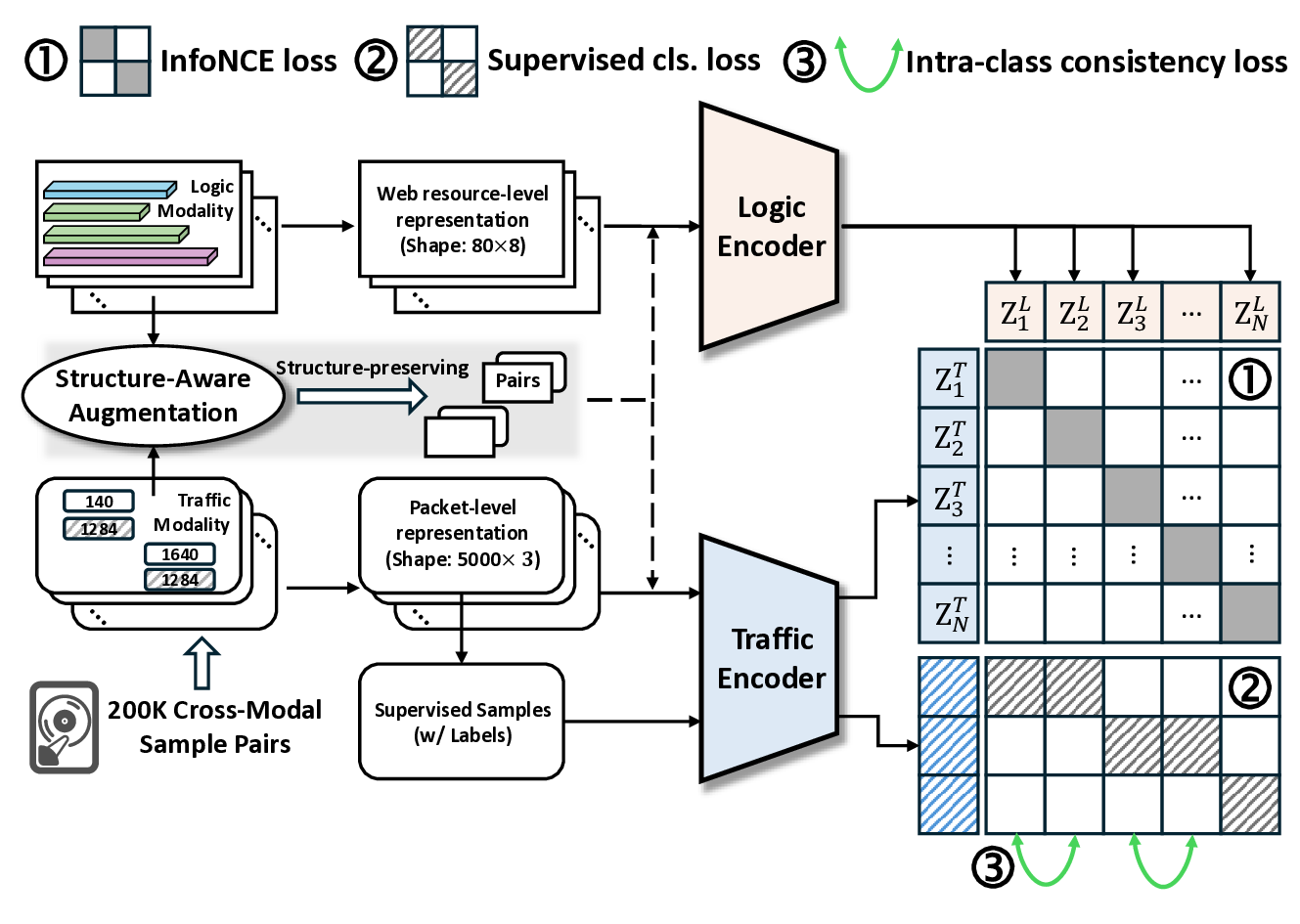
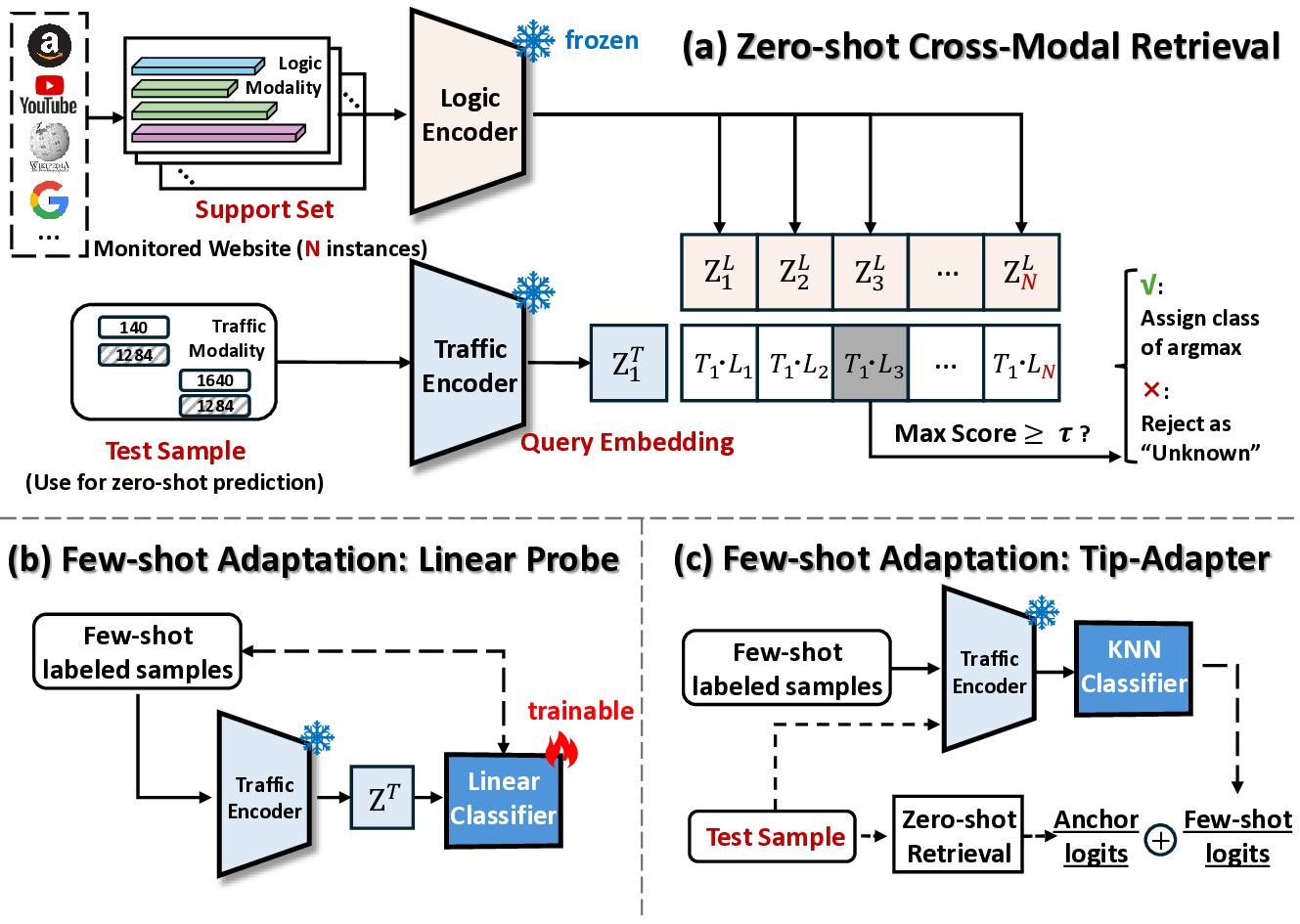
To address these limitations, we introduce a novel approach that jointly exploits traffic modality features and logical modality features to enable scalable and generalizable WF against previously unseen websites. Logical modality features (e.g., URI lengths, response sizes, and protocol versions) can be automatically extracted through large-scale web crawling, capturing resource-level attributes that describe a website’s semantic structure. By mapping both traffic modality features and logical modality features into a shared embedding space, we construct a large-scale website fingerprint database grounded in logical representations. Consequently, the task of identifying a website from unseen traffic can be reformulated as a cross-modal retrieval problem, wherein traffic modality features are matched to the most semantically relevant logical modality features stored in the fingerprint database.
We instantiate this formulation through STAR (Semantic-Traffic Alignment and Retrieval), a dual-encoder architecture that jointly embeds logic and traffic modalities into a unified latent space. STAR is trained on over 150K automatically collected logic-traffic pairs using a contrastive learning objective, with additional auxiliary losses to improve intra-class consistency and discriminability. To further enhance robustness against website evolution, we introduce a structureaware data augmentation mechanism that perturbs both modalities in a semantically consistent manner. During inference, STAR retrieves the most semantically aligned logic profile for an encrypted traffic sample, using cosine similarity in the shared embedding space. This design enables zero-shot classification of encrypted traces with no prior access to traffic from target websites.
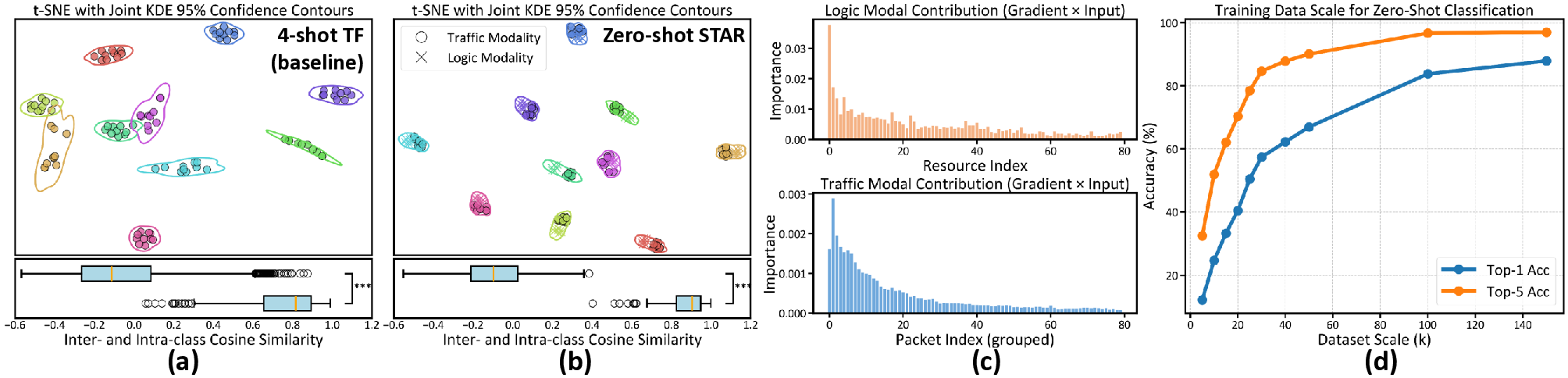
Beyond the system design, we also conduct a systematic investigation into why semantic-traffic alignment is possible. We identify three core alignment anchors-on the request side, response side, and transport protocol-each capturing a consistent mapping between traffic features and high-level website structures ( §III-B). These anchors stem from the inherent design of modern web protocols (e.g., header compression, layered transport) and serve as empirical foundations for learning cross-modal associations, further supported by modality-level analyses of discriminability, stability, and crossmodal correlation ( §V-C). Together, these findings not only validate the design rationale behind STAR, but also provide foundational evidence that cross-modal modeling is both feasible and effective for fingerprinting encrypted web traffic. In summary, our contributions are as follows:
• We formalize zero-shot website fingerprinting under HTTPS as a cross-modal retrieval task, removing the need for per-site traffic collection and supporting generalization to unseen websites. • We present STAR, the first dual-modality system that aligns crawl-time semantic logic with encrypted traffic traces through contrastive learning and structure-aware augmentation. to facilitate future research on semantic inference under encrypted protocols [12]. These results highlight the feasibility of zero-shot trafficbased identification and demonstrate that semantic leakage, rather than header visibility, now constitutes the principal privacy risk in the encrypted web.
Website fingerprinting (WF) infers a user’s visited website by analyzing features of encrypted traffic-such as packet lengths, directions, and timing patterns. Introduc
This content is AI-processed based on open access ArXiv data.