Workload Characterization for Branch Predictability
Reading time: 5 minute
...
📝 Original Info
Title: Workload Characterization for Branch Predictability
ArXiv ID: 2512.15827
Date: 2025-12-17
Authors: FNU Vikas, Paul Gratz, Daniel Jiménez
📝 Abstract
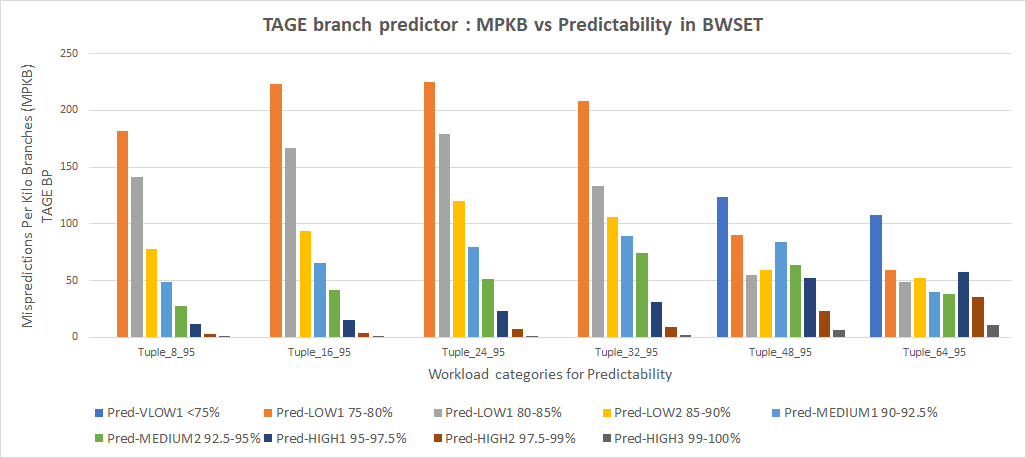
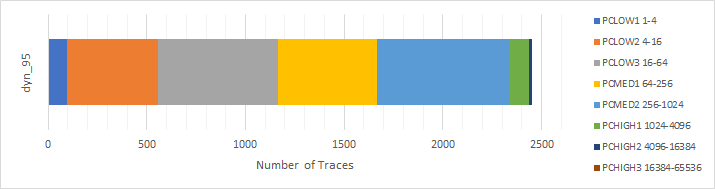
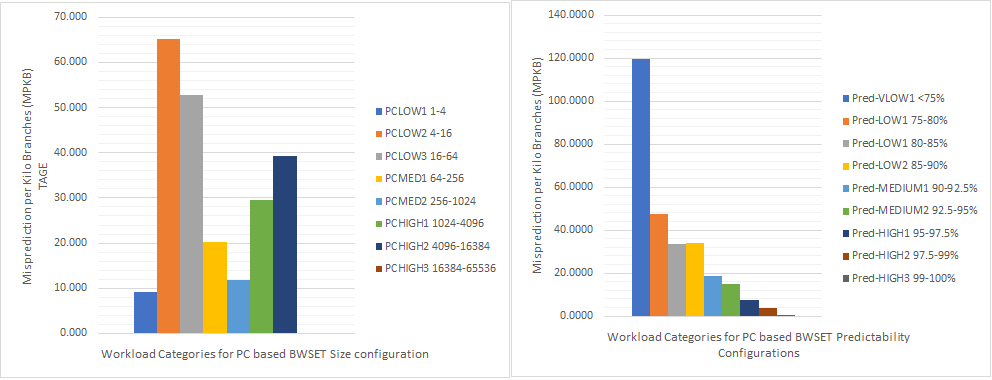
Conditional branch prediction predicts the likely direction of a conditional branch instruction to support ILP extraction. Branch prediction is a pattern recognition problem that learns mappings between a context to the branch outcome. An accurate predictor reduces the number of instructions executed on the wrong path resulting in an improvement of performance and energy consumption. In this paper, we present a workload characterization methodology for branch prediction. We propose two new workload-driven branch prediction accuracy identifiers -- branch working set size and branch predictability. These parameters are highly correlated with misprediction rates of modern branch prediction schemes (e.g. TAGE and perceptron). We define the branch working set of a trace as a group of most frequently occurring branch contexts, i.e. the 3-part tuple of branch address, and associated global and local history. We analyze the branch working set's size and predictability on a per-trace basis to study its relationship with a modern branch predictor's accuracy. We have characterized 2,451 workload traces into seven branch working set size and nine predictability categories after analyzing their branch behavior. We present further insights into the source of prediction accuracy and favored workload categories for modern branch predictors.
💡 Deep Analysis
📄 Full Content
Workload Characterization for Branch Predictability
Vikas
Texas A&M University
Email - vikas.dce2016@gmail.com
Paul Gratz
Texas A&M University
Daniel A. Jim´enez
Texas A&M University
Abstract—Conditional branch prediction predicts the likely
direction of a conditional branch instruction to support ILP ex-
traction. Branch prediction is a pattern recognition problem that
learns mappings between a context to the branch outcome. An
accurate predictor reduces the number of instructions executed
on the wrong path resulting in an improvement of performance
and energy consumption. In this paper, we present a workload
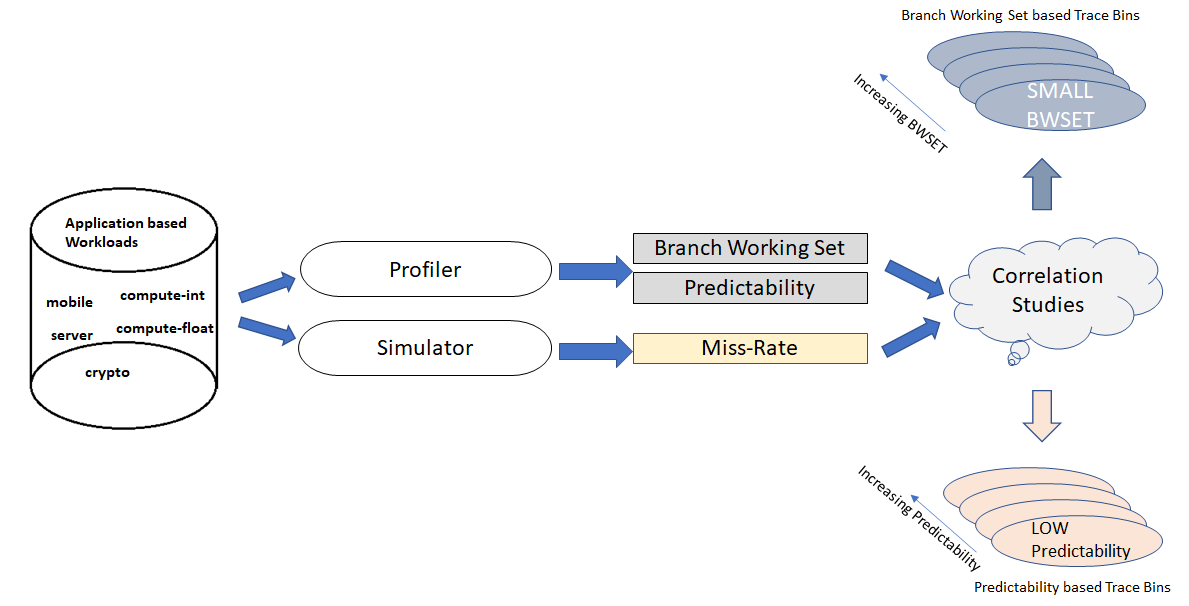
characterization methodology for branch prediction. We propose
two new workload-driven branch prediction accuracy identifiers
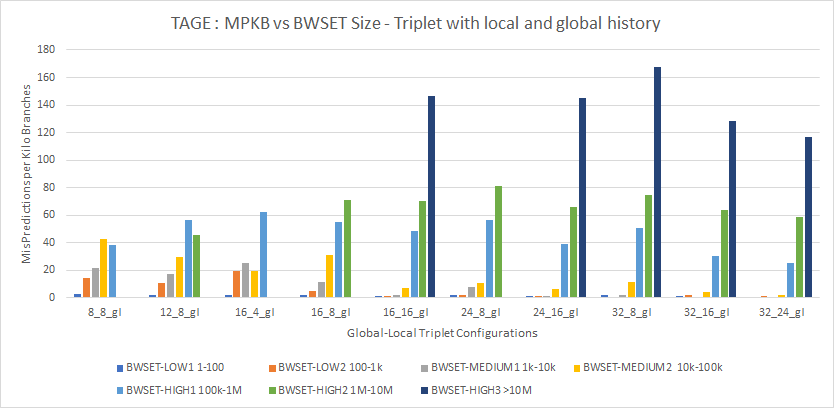
– branch working set size and branch predictability. These
parameters are highly correlated with misprediction rates of
modern branch prediction schemes (e.g. TAGE and perceptron).
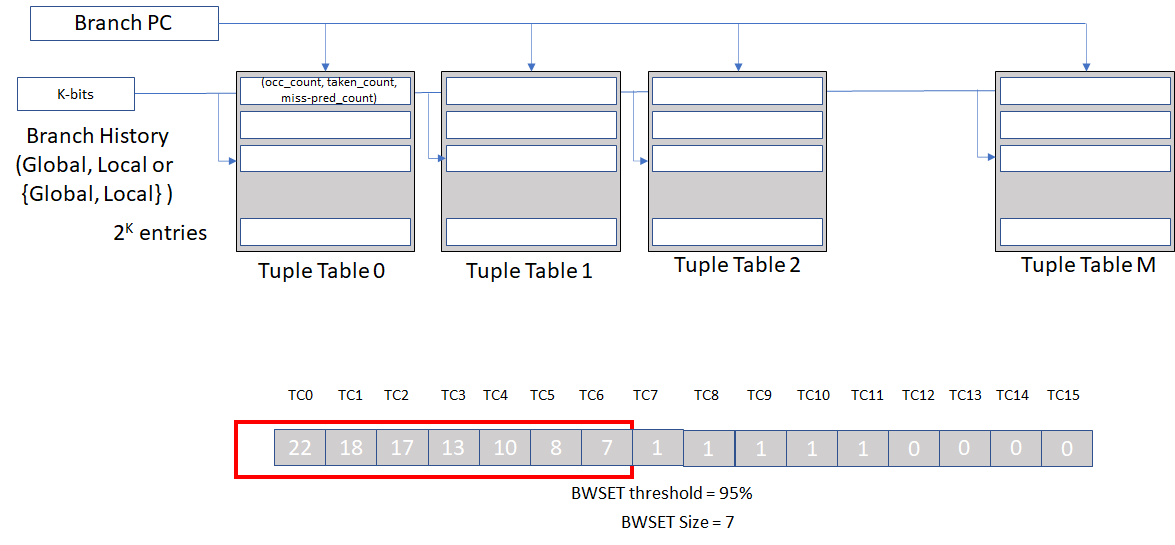
We define the branch working set of a trace as a group of
most frequently occurring branch contexts, i.e., the 3-part tuple
of branch address, and associated global and local history. We
analyze the branch working set’s size and predictability on a
per-trace basis to study its relationship with a modern branch
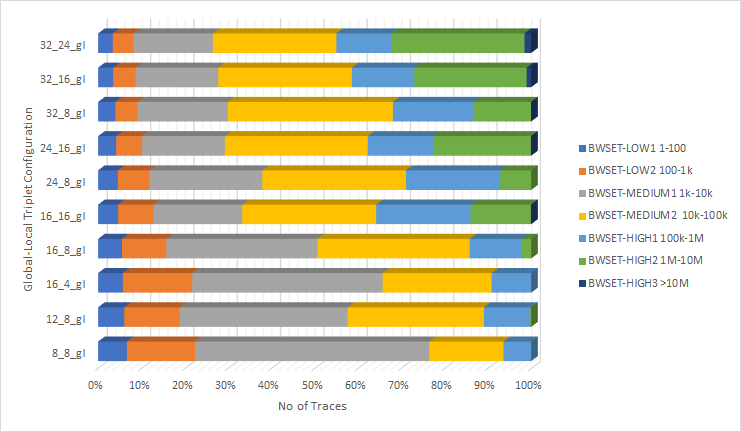
predictor’s accuracy. We have characterized 2,451 workload
traces into seven branch working set size and nine predictability
categories after analyzing their branch behavior. We present
further insights into the source of prediction accuracy and
favored workload categories for modern branch predictors.
Index Terms—branch prediction, working set, predictability
I. INTRODUCTION
Branch prediction is a primary contributor to performance
in modern processors. Programs have multiple branch in-
structions that can change the direction of the program flow.
Branch outcomes are unknown for many cycles. However, the
processor must be continually fed to exploit the instruction-
level parallelism present in a program. Thus, branch predictors
are employed to predict the branch outcome and improve the
flow of instructions through the pipeline. Branch prediction
leads to instructions being speculatively executed on the
predicted path. If the predict is correct, execution continues
uninterrupted. Otherwise, the pipeline must be flushed to get
rid of wrong-path instructions. Based on pipeline depth and
instruction window size, a branch misprediction can lead to
large penalties resulting in wasted time and energy.
An ideal branch predictor would remember the behavior
of all previous branches and the relationships between those
branches to the current branch to give very low mispre-
diction rates. However, a modern branch predictor with a
*Note: This manuscript is an archival version of work conducted as part
of the author’s 2020 Master’s thesis at Department of ECEN, Texas A&M
University, College Station, TX under the supervision of Professors Paul Gratz
and Daniel A. Jim´enez. This submission reflects the same technical content
as the manuscript previously submitted to IISWC 2020 and ISPASS 2021. All
research in this submission was performed entirely during the author’s time
as a graduate student at Texas A&M University. No part of this work was
conducted at, funded by, or related to the author’s current employer.
limited hardware budget does not always have high accu-
racy. Mispredictions can occur due to multiple reasons – too
many independent branch contexts to remember within the
restricted hardware budget, no recognizable pattern, or the
patterns rooted too deeply in history. Misprediction rate and
the associated penalty determine the impact on a processor’s
performance. Much previous work has precisely quantified this
misprediction penalty [1]. However, to the best of our knowl-
edge, there have been very few attempts to analyze the mispre-
diction rate patterns in workloads and form a branch prediction
based workload-characterization methodology. We note that
past Championship Branch Prediction (CBP) competitions
compare the designs for their performance in application-based
workloads groups. This type of comparison serves the purpose
of finding out an overall superior branch predictor. However,
it gives us no further insight into the relationship between a
predictor’s accuracy and branch characteristics of a workload,
and whether a design prefers a particular branch distribution.
Applications are evolving at a rapid pace so it is imperative
that we understand a workload’s inherent branch behavior and
predictability to estimate the scope of improvement in the
current state of the art in branch predictor designs. Further, a
deeper understanding of the sources of branch misprediction
could point to new directions in branch prediction.
In this work, we show that a branch predictor’s accuracy
can be judged by identifying and studying a suitable subset
of branch contexts in the workload, called the branch working
set (BWSET). We note that a tuple of a branch instruction’s
program counter (PC) and prior branch