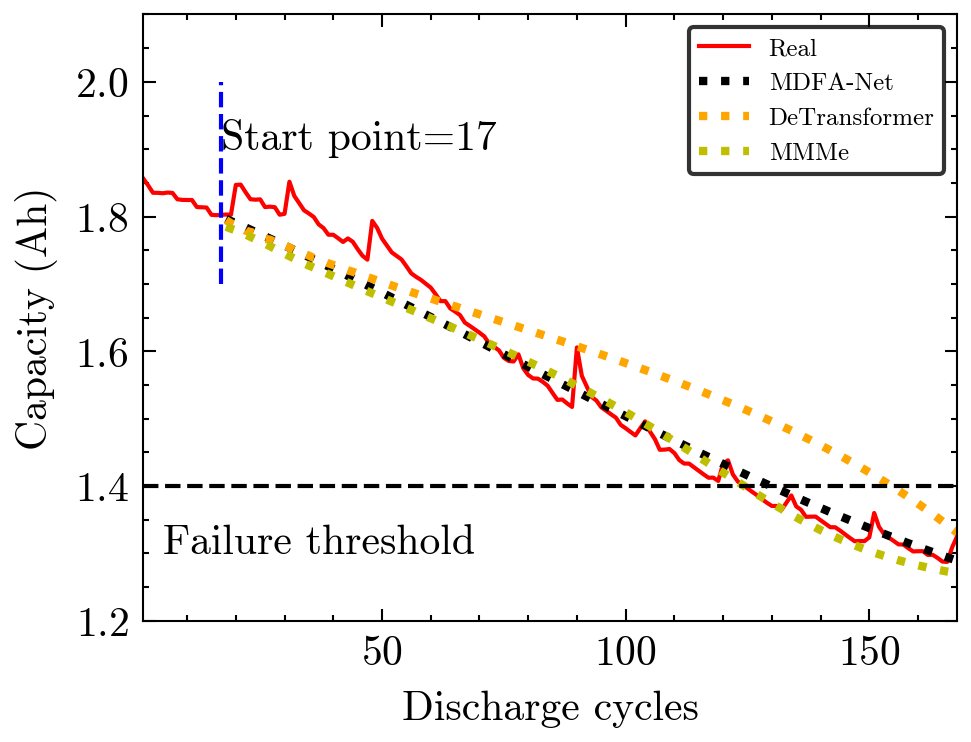
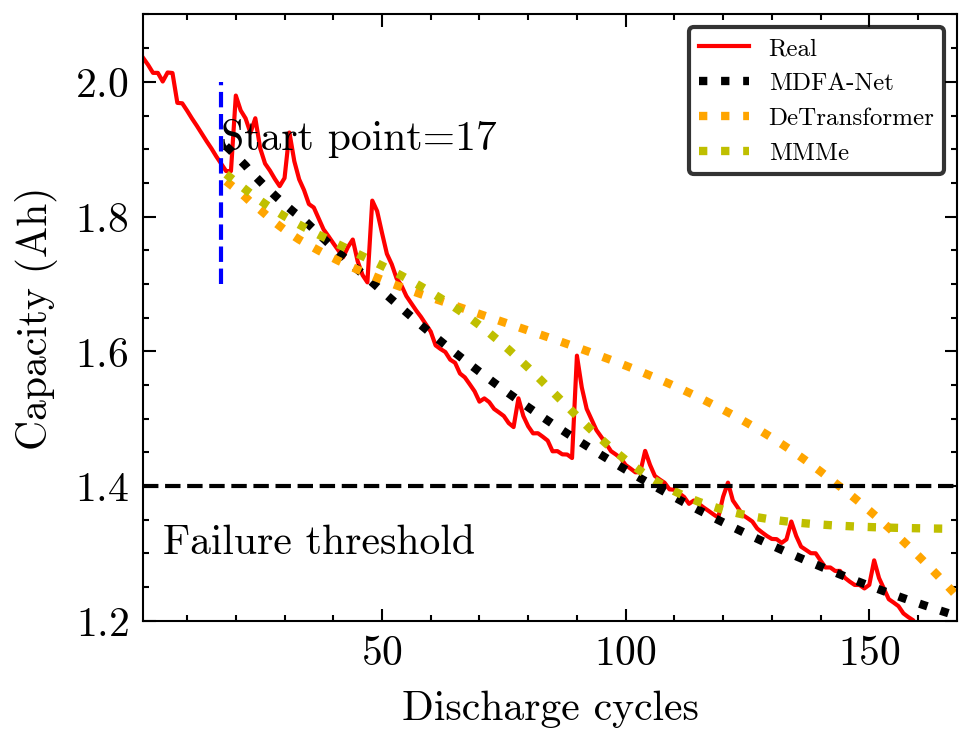
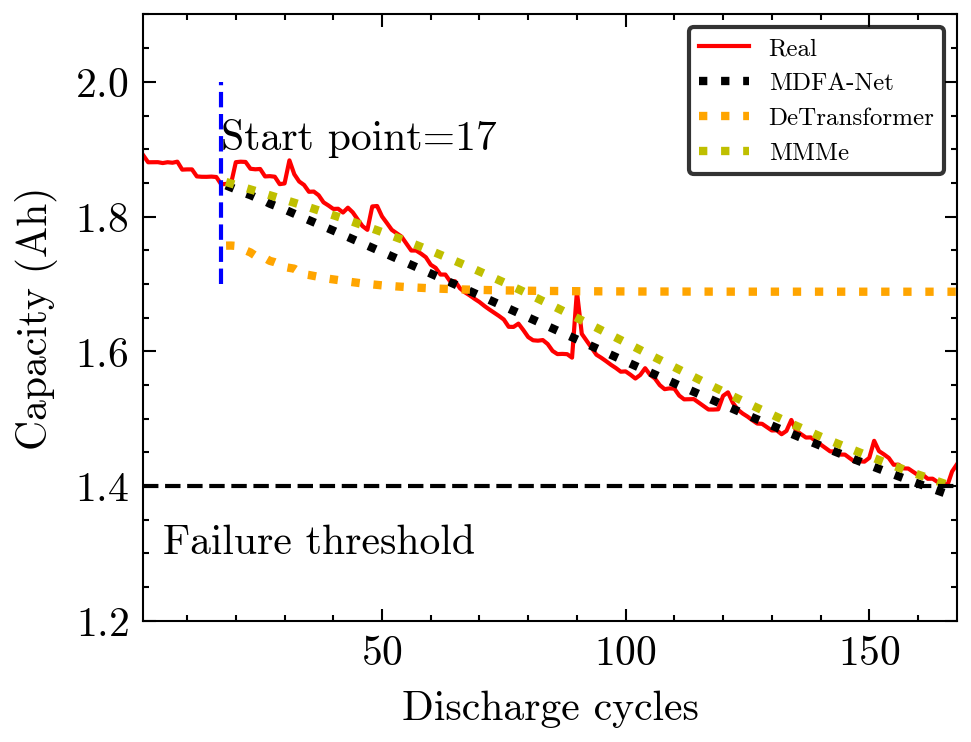
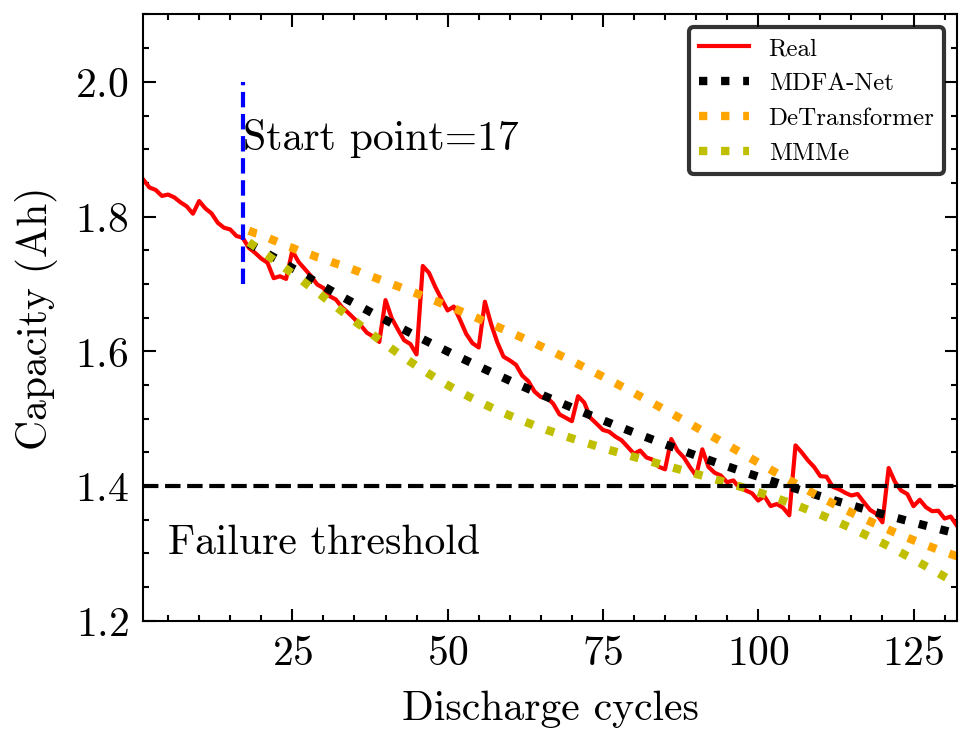
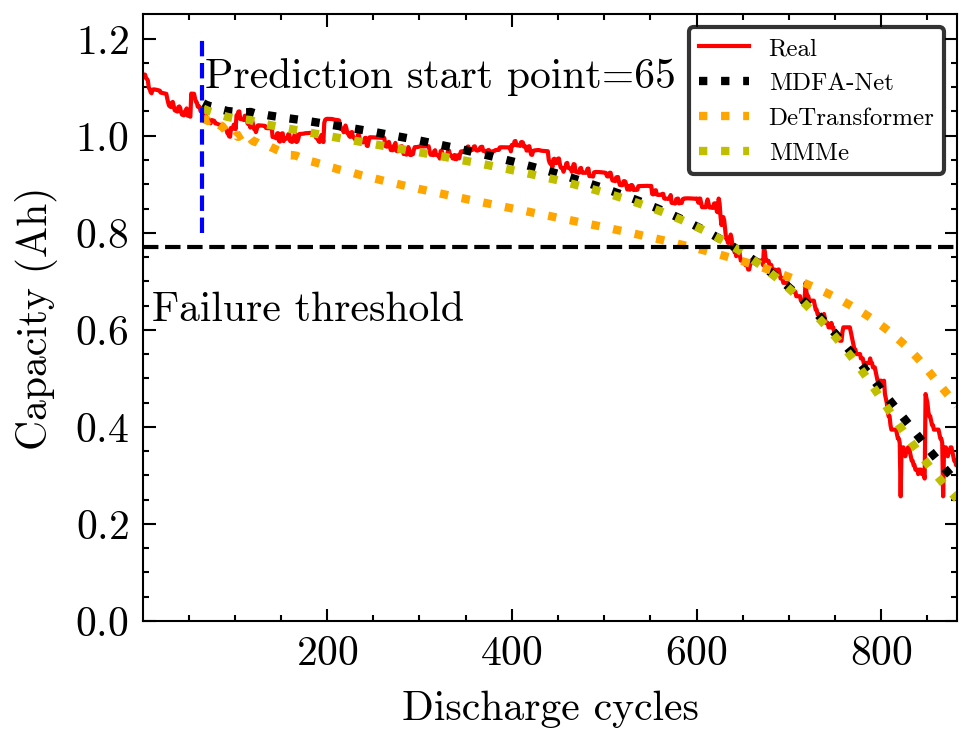
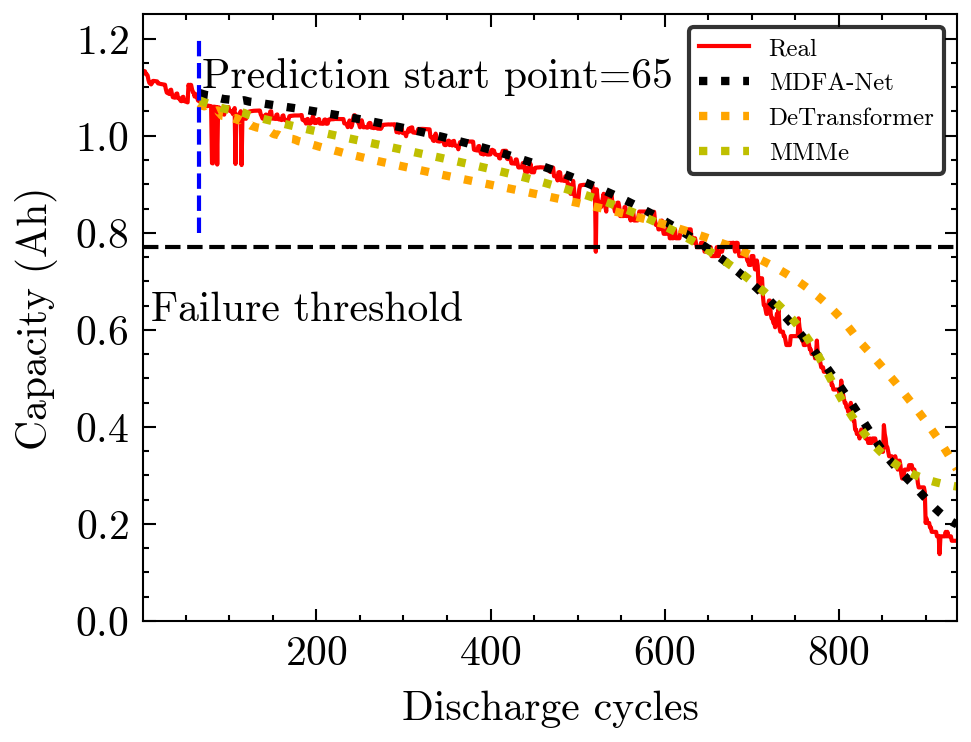
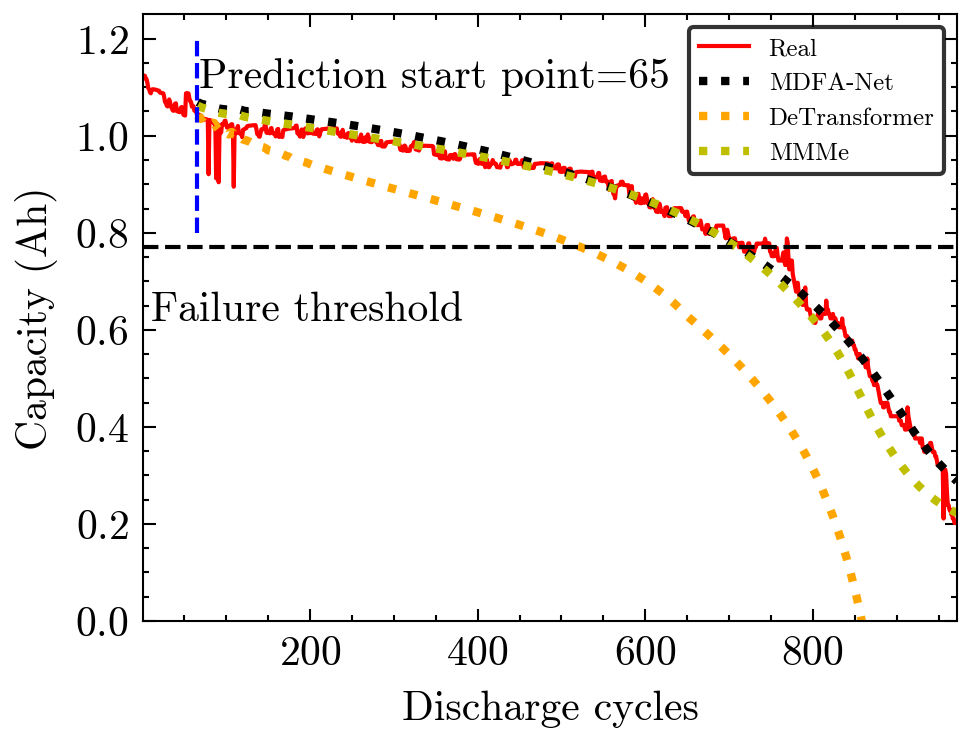
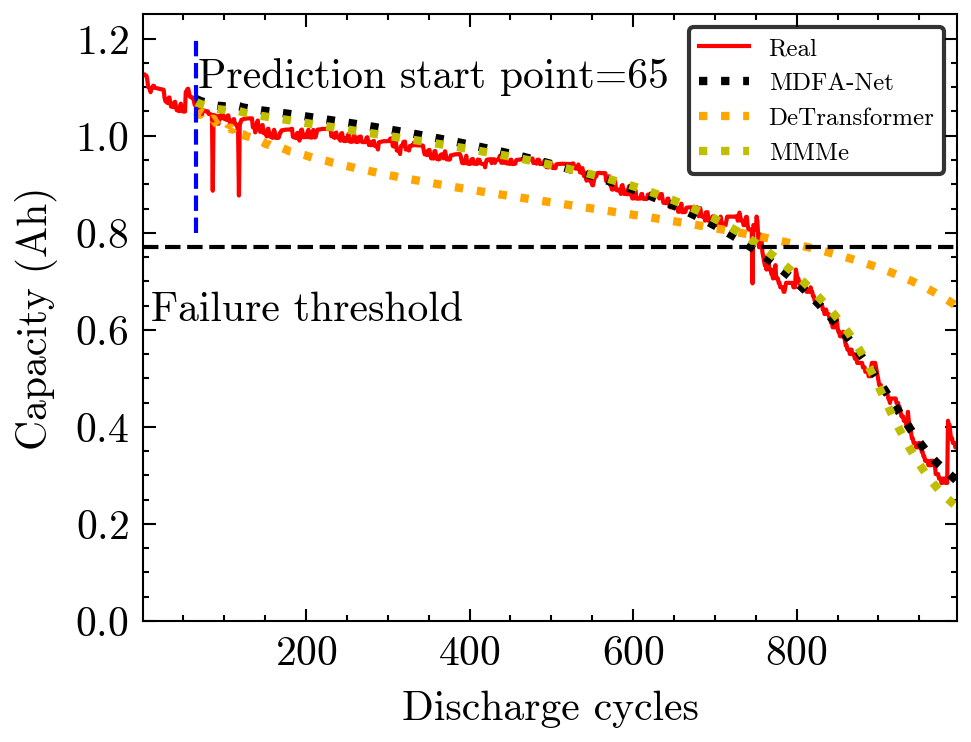
Targeted maintenance strategies, ensuring the dependability and safety of industrial machinery. However, current modeling techniques for assessing both local and global correlation of battery degradation sequences are inefficient and difficult to meet the needs in real-life applications. For this reason, we propose a novel deep learning architecture, multiscale dual-path feature aggregation network (MDFA-Net), for RUL prediction. MDFA-Net consists of dual-path networks, the first path network, multiscale feature network (MF-Net) that maintains the shallow information and avoids missing information, and the second path network is an encoder network (EC-Net) that captures the continuous trend of the sequences and retains deep details. Integrating both deep and shallow attributes effectively grasps both local and global patterns. Testing conducted with two publicly available Lithium-ion battery datasets reveals our approach surpasses existing top-tier methods in RUL forecasting, accurately mapping the capacity degradation trajectory.
Lithium-ion batteries (LIBs) are core to electric vehicles, stationary storage, and portable electronics [1,2,3,4,5,6,7,8,9,10,11,12,13,14,15]. Their capacity, however, degrades with cycling, making accurate remaining useful life (RUL) prediction essential for safety, reliability, and cost-effective maintenance [16,17,18,19,20,21,22,23,24,25,26,27].
Existing approaches fall into three families [28,29,30,31,32,33,34,35,36]. Direct measurement (e.g., OCV, Coulomb counting) infers stateof-health (SOH) from current/voltage/impedance, but often requires long rest periods, suffers from integration drift, and is costly to deploy broadly [37,38,39,40,41,42,43,44,45]. Model-based methods capture physicochemical degradation (e.g., SEI growth, active-material loss, plating) and can yield mechanistic insight, yet they require strong assumptions and struggle to generalize across usage profiles [46,47,48,49,50,51,52]. Data-driven methods bypass explicit physics by mapping routine measurements to SOH/RUL via machine learning and deep networks [53,54,55,56,57,58,59,60,61,62,63,64,65]. Despite progress, two issues persist: (i) difficulty modeling both long-term global dependencies and fine-grained local patterns in degradation signals, and (ii) single-path architectures that are vulnerable to noise and information loss along the feature pipeline.
To address these gaps, we propose a Multiscale Dual-path Feature Aggregation Network (MDFA-Net) for LIB RUL forecasting. MDFA-Net separates representation learning into two complementary paths and then fuses them adaptively. The first path (MF-Net) emphasizes information preservation via dense connections and multiscale processing at the input to retain global trends while exposing multi-resolution cycles. The second path (EC-Net) couples CNN and Transformer blocks to jointly capture local context and content-based long-range interactions. A lightweight fusion module with position-enhanced attention assigns data-dependent weights to features from both paths, mitigating interference and highlighting degradation-relevant cues.
Our contributions are threefold:
• We introduce MDFA-Net, a dual-path deep architecture tailored to LIB RUL forecasting that jointly captures global trends and local irregularities under noise and operating variations.
• We design MF-Net with dense connectivity and multiscale inputs for information-preserving, low-loss feature extraction, and EC-Net that integrates CNN (local) with Transformer (global) modeling for robust cross-scale dependencies.
• We develop a position-enhanced attention fusion that adaptively weights features from the two paths, improving robustness and focusing on degradation-informative components. Experiments on NASA and CALCE datasets demonstrate consistent gains over strong data-driven baselines in RUL estimation.
We formulate RUL prediction for lithium-ion batteries (LIBs) and present MDFA-Net, a dual-path architecture that aggregates multi-scale local cues and global dependencies with a lightweight fusion head.
MDFA-Net consists of two paths (Fig. 1): (i) a Multi-scale Feature path (MF-Net) built upon dense connectivity to preserve and reuse features under scarce data; (ii) an Encoding path (EC-Net) that couples self-attention (global interactions) with depthwise-separable convolution (local patterns). Path outputs are concatenated and projected:
We inject relative positional information before self-attention to preserve temporal ordering. A final linear head yields the RUL prediction.
2.1.1. Path I: Multi-scale Feature Network (MF-Net) MF-Net (Fig. 2) stacks a multi-scale stem with densely connected blocks to maintain stable gradients and high feature reuse. The stem applies parallel 1×1, 3×3, 5×5, 7×7 convolutions to capture short/medium/long temporal contexts, then compresses with a 1×1 projection [66,67,68,69]. Dense concatenation across blocks preserves original and newly formed features with minimal overhead.
EC-Net (Fig. 3) adopts an Attention-FFN-Conv-FFN layout to first model long-range interactions, then enhance local selectivity via depthwiseseparable convolution, followed by non-linear refinement: This split ordering can be viewed as a Lie-Trotter style alternation between interaction (attention) and convection-like local transport (convolution), offering a practical balance between global coherence and local sharpness.
We evaluate MDFA-Net on two public LIB datasets and compare against recent RUL predictors. We also analyze design choices via ablations.
We use cyclic-test capacity datasets from NASA and CALCE, which exhibit diverse operating profiles and local variations [70,71,72,73]. Following common practice, the end-of-life (EOL) is set to 70% nominal capacity (1.40Ah for NASA; 0.77Ah for CALCE). We adopt a leave-one-out protocol: one cell is used for testing and the remaining cells for training. Baselines. We compare with: (1) RNN/CNN-only [74,75]; (2) enhanced RNN/CNN [76,77]; (3) hybrid/aging-aware mo
This content is AI-processed based on open access ArXiv data.