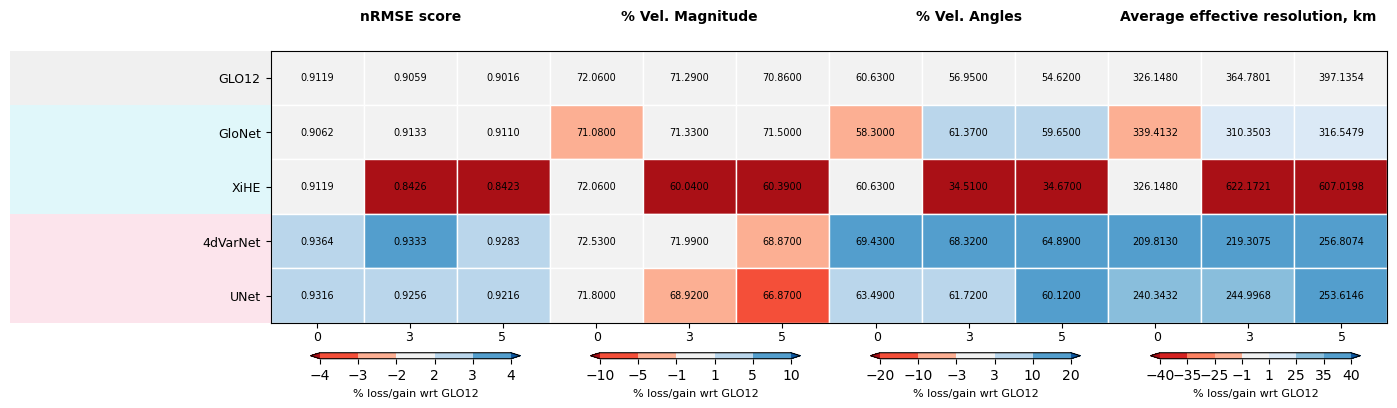
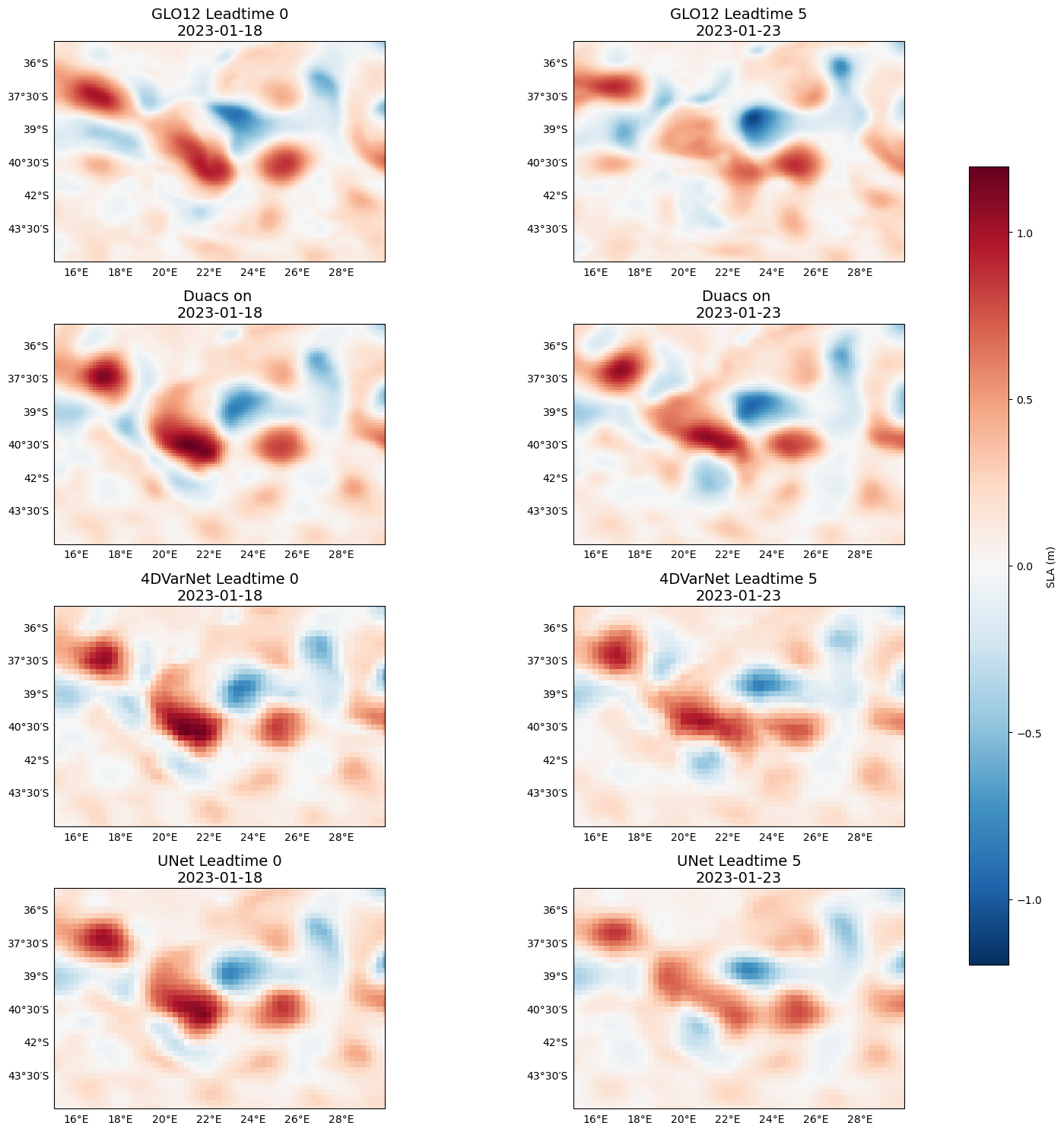
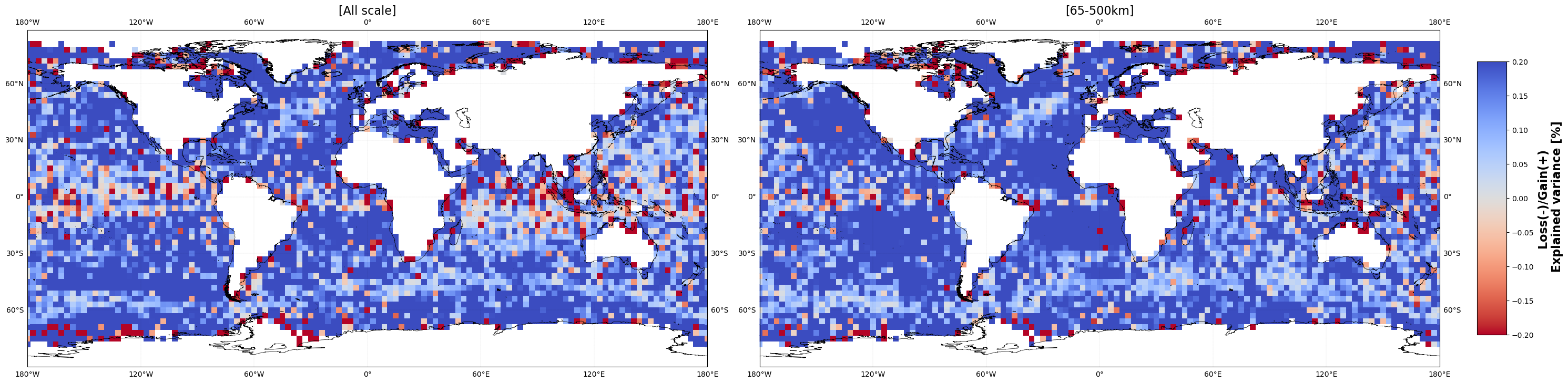
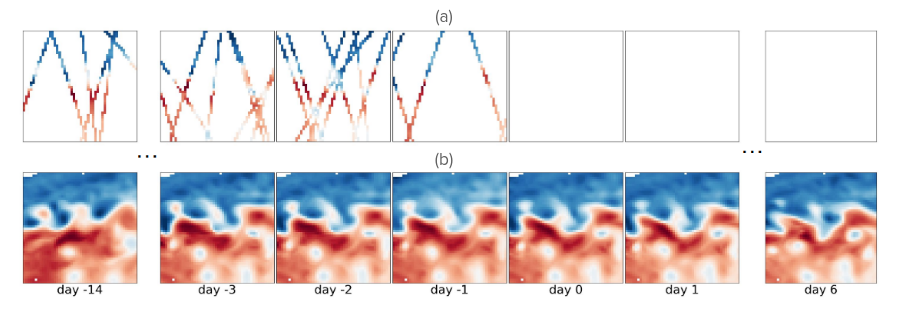
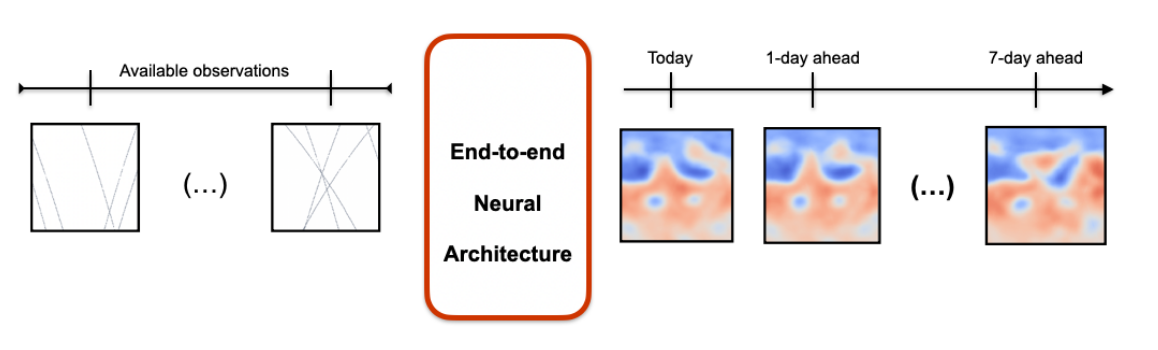
We present an end-to-end deep learning framework for short-term forecasting of global sea surface dynamics based on sparse satellite altimetry data. Building on two state-of-the-art architectures: U-Net and 4DVarNet, originally developed for image segmentation and spatiotemporal interpolation respectively, we adapt the models to forecast the sea level anomaly and sea surface currents over a 7-day horizon using sequences of sparse nadir altimeters observations. The model is trained on data from the GLORYS12 operational ocean reanalysis, with synthetic nadir sampling patterns applied to simulate realistic observational coverage. The forecasting task is formulated as a sequence-to-sequence mapping, with the input comprising partial sea level anomaly (SLA) snapshots and the target being the corresponding future full-field SLA maps. We evaluate model performance using (i) normalized root mean squared error (nRMSE), (ii) averaged effective resolution, (iii) percentage of correctly predicted velocities magnitudes and angles, and benchmark results against the operational Mercator Ocean forecast product. Results show that end-to-end neural forecasts outperform the baseline across all lead times, with particularly notable improvements in high variability regions. Our framework is developed within the OceanBench benchmarking initiative, promoting reproducibility and standardized evaluation in ocean machine learning. These results demonstrate the feasibility and potential of end-to-end neural forecasting models for operational oceanography, even in data-sparse conditions.
The short-term forecasting of the ocean is of key interest for a variety of applications, including among others offshore operations (Le Traon et al., 2019), maritime traffic routing (Davidson et al., 2009), ocean extremes (Hobday et al., 2016), sampling strategies of scientific surveys. State-of-the-art operational systems rely on data assimilation schemes (Lellouche et al., 2018) to combine a physical model of the ocean dynamics with different observation sources, usually both in situ and satellite-derived observations. The resulting short-term ocean forecasts typically involve an estimation of the current observation given past available observations. The physical model then propagates the state over the targeted time horizon, typically over a week. Numerous studies support the relevance of the operational ocean forecasting schemes, but also reveal significant uncertainty levels (Lellouche et al., 2013).
Recently, neural forecasting schemes have emerged as appealing solutions for ocean dynamics, with striking examples for short-term ocean forecasting (Wang et al., 2024;El Aouni et al., 2025;Cui et al., 2025). These neural schemes involve emulators of the physical model, trained from reanalysis datasets. These schemes now reach state-of-the-art forecasting performance for short-term ocean forecasts and can even outperform data-assimilation-based systems for specific case-studies and metrics (El Aouni et al., 2025). While those neural forecasting schemes emerge, the characteristics of ocean observing systems may however question whether one should also address uncertainties in the estimation of initial state by data assimilation schemes. Satellite-derived observations, such as the sea surface height (SSH) and sea surface temperature (SST), involve large sampling gaps, which prevent data assimilation schemes to recover fine-scales dynamics, typically below one or two hundred kilometers for sea surface currents (Ballarotta et al., 2019). The sampling of the interior of the ocean by ARGO floats or moorings is obviously even scarcer. Optimal interpolation has long been the reference approach to deliver gap-free observation-based products, but end-to-end neural mapping schemes (Beauchamp et al., 2021;Febvre et al., 2024;Martin et al., 2023Martin et al., , 2024) have shown a great potential to better exploit sparse observation datasets and improve the reconstruction of ocean processes.
This study explores how end-to-end neural schemes could contribute to improved short-term ocean forecasts through the direct exploitation of sparse ocean observation datasets. Following the above-mentioned advances in neural interpolation schemes, we state the short-term forecasting of ocean states as an end-to-end neural mapping problem from gappy observations to the targeted ocean forecasts. As demonstration testbed, we focus on SSH forecasts, as SSH is a key signature of global ocean circulation and it is associated with sparse satellite altimetry observations (Ducet et al., 2000). Adapting a state-of-the-art neural mapping scheme (Fablet et al., 2021;Febvre et al., 2023), we do not only adapt the 4DVarNet scheme, but also introduce the state-of-the-art UNet architecture for the forecasting task. Our approach integrates both neural architectures to predict sea surface height from sparse satellite observations. Numerical experiments, conducted with a one-year of real satellite altimetry dataset, demonstrate the potential of these deep learning models to significantly enhance short-term ocean forecasts, compared to the state-of-the-art data-assimilation-based methods. We discuss further these findings towards the evolution of neural ocean forecasting approaches.
This paper is organized as follows. Section 2 provides a brief introduction to short-term ocean forecasting. We present the proposed deep learning approach in Section 3. Section 3.3 describes the considered dataset and benchmark an we report our results in Section 4. Section 5 discusses our main findings with respect to the state-of-the-art.
Operational forecasting systems for the earth systems rely on data assimilation schemes (Lahoz and Schneider, 2014;Buizza et al., 2018). They state the short-term forecasting of a state of interest as a two-step process. The analysis step solves an initial condition problem and the forecasting comes to propagate the initial condition over the targeted forecasting window using the physical dynamical model. Such assimilation-based systems leverage state-of-the-art general circulation models and data assimilation schemes. GLO12 ocean forecasting system (Lellouche et al., 2018) falls into this category. It combines NEMO ocean model (Madec et al., 2015) with a Kalman assimilation scheme (Brasseur and Verron, 2006) to deliver 10-day global forecasts at 1/12 • resolution, providing both hourly and daily averages based on different observation datasets (mainly satellite altimetry, satellite-derived SST and ARGO float data). While represen
This content is AI-processed based on open access ArXiv data.