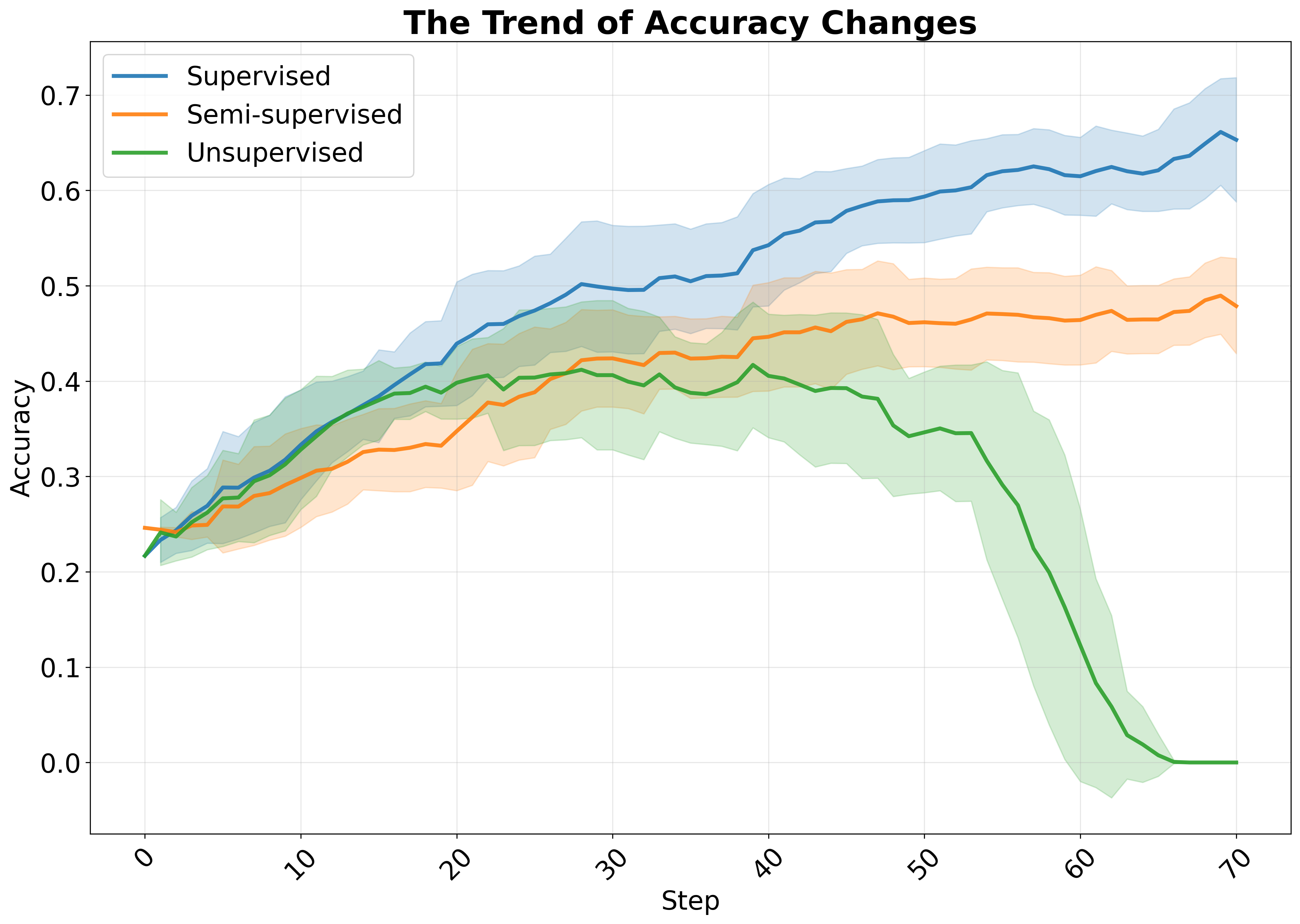
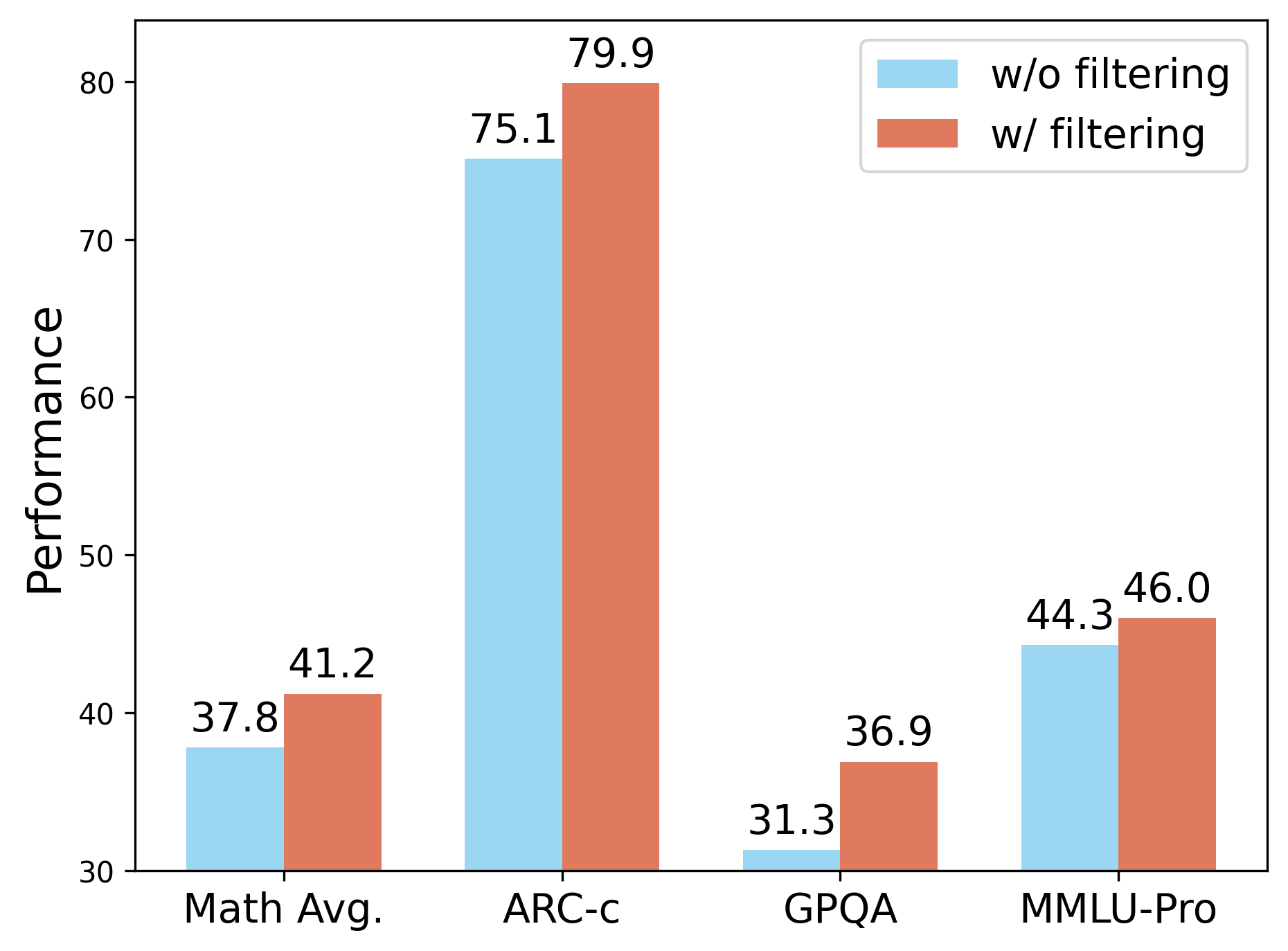
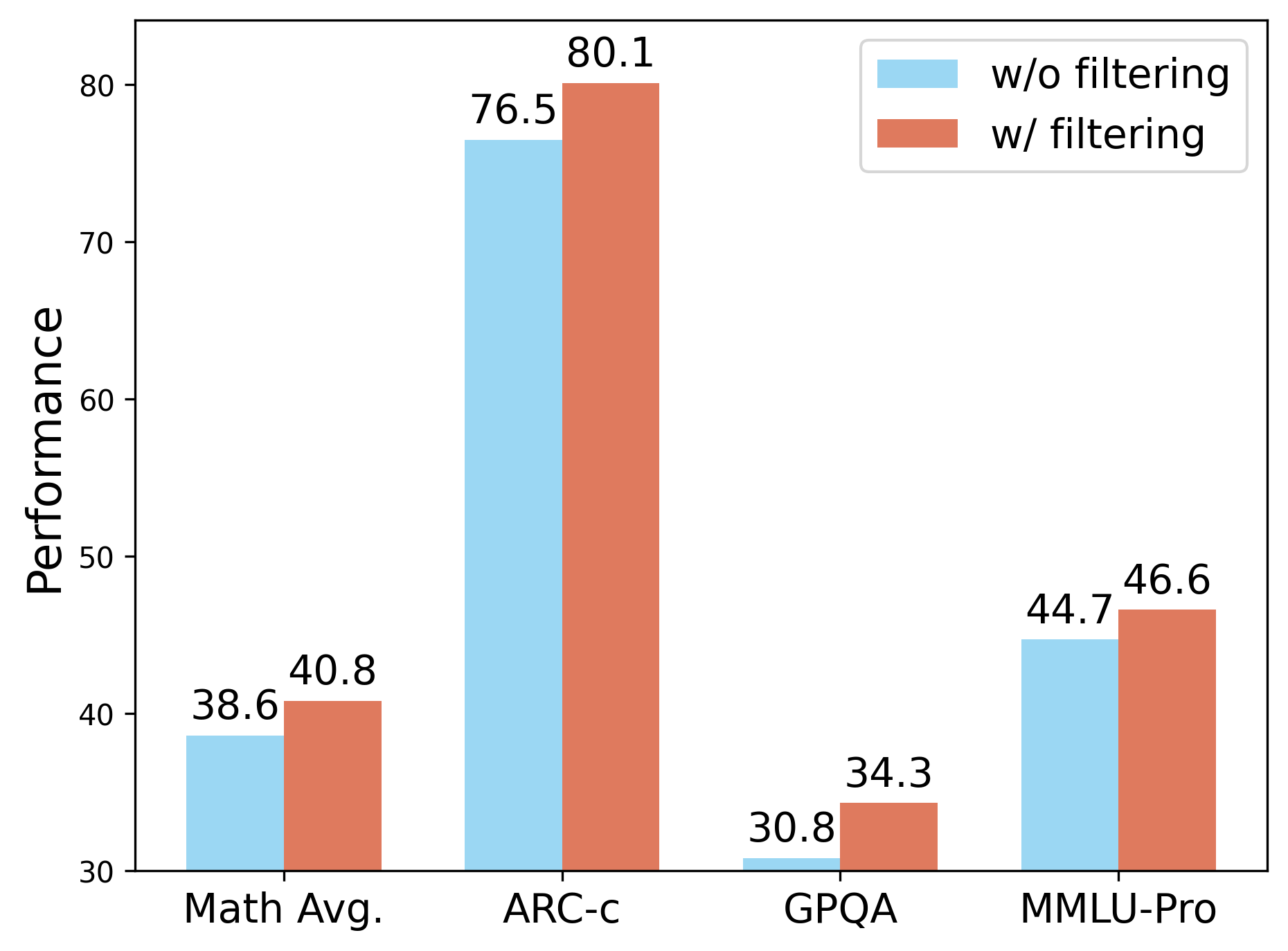
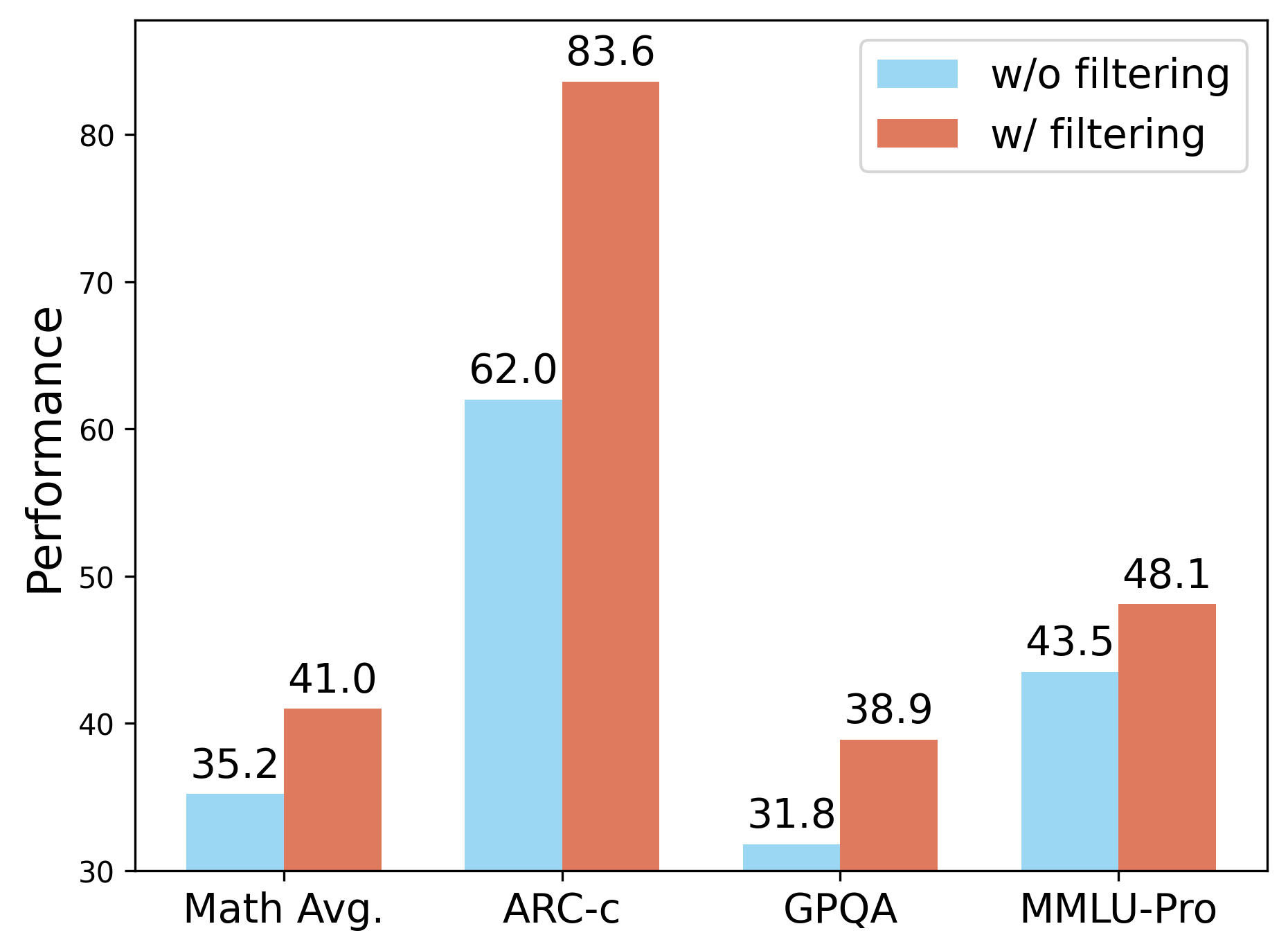
Reinforcement learning with verifiable rewards (RLVR) has proven effective in training large reasoning models (LRMs) by leveraging answer-verifiable signals to guide policy optimization, which, however, suffers from high annotation costs. To alleviate this problem, recent work has explored unsupervised RLVR methods that derive rewards solely from the model's internal consistency, such as through entropy and majority voting. While seemingly promising, these methods often suffer from model collapse in the later stages of training, which may arise from the reinforcement of incorrect reasoning patterns in the absence of external supervision. In this work, we investigate a novel semi-supervised RLVR paradigm that utilizes a small labeled set to guide RLVR training on unlabeled samples. Our key insight is that supervised rewards are essential for stabilizing consistency-based training on unlabeled samples, ensuring that only reasoning patterns verified on labeled instances are incorporated into RL training. Technically, we propose an effective policy optimization algorithm, TraPO, that identifies reliable unlabeled samples by matching their learning trajectory similarity to labeled ones. Building on this, TraPO achieves remarkable data efficiency and strong generalization on six widely used mathematical reasoning benchmarks (AIME24/25, AMC, MATH-500, Minerva, and Olympiad) and three out-of-distribution tasks (ARC-c, GPQA-diamond, and MMLU-pro). With only 1K labeled and 3K unlabeled samples, TraPO reaches 42.6% average accuracy, surpassing the best unsupervised method trained on 45K unlabeled samples (38.3%). Notably, when using 4K labeled and 12K unlabeled samples, TraPO even outperforms the fully supervised model trained on the full 45K labeled samples on all benchmarks, while using only 10% of the labeled data. The code is available via https://github.com/ShenzhiYang2000/TRAPO.
The reinforcement learning with verifiable rewards (RLVR), pioneered by DeepSeek-R1 (Guo et al., 2025), has significantly advanced the development of large reasoning models (LRMs). In typical RLVR (Shao et al., 2024;Liu et al., 2025;Yu et al., 2025;Zheng et al., 2025), questions from a training corpus are fed into an LRM, which then generates multiple reasoning paths (rollouts) per input. Rewards are computed based on verifiable rules: most commonly, whether the final answer in a response matches the ground-truth label. By leveraging such an answer-verifiable structure, RLVR enables reward assignment through group-based advantage estimation, guiding the model to explore reasoning paths that lead to the correct final answer.
However, when scaling to large corpora, the reliance of this reward paradigm on gold-standard labels incurs (Right) TRAPO scaling law: performance improves consistently with increasing sample sizes and varying annotation ratios. We only show the changes with a sample size at a 25% annotation rate in the figure; for other specific results, please see Table 12.
prohibitively high annotation costs, making it difficult to generalize to specialized domains where groundtruth answers are scarce or expensive to obtain, such as medicine and finance (Wang et al., 2024b). To address this challenge, recent work has explored unsupervised RLVR methods (Zhang et al., 2025a;Zhao et al., 2025;Agarwal et al., 2025;Li et al., 2025a;Zuo et al., 2025;Zhang et al., 2025a) that aim to eliminate dependence on external supervision directly. These approaches are grounded in the observation that LRMs have already internalized substantial knowledge during pretraining (Ye et al., 2025); thus, the goal shifts from learning factual correctness to eliciting latent reasoning capabilities through self-guided exploration. In this framework, rewards are computed based on intrinsic signals such as self-certainty (Zhao et al., 2025), entropy (Agarwal et al., 2025), or majority voting (Zuo et al., 2025), to encourage high-confidence and consistent outputs. Despite their promise, these unsupervised methods often fail to capture valid reasoning patterns and tend to reinforce incorrect consensus, leading to severe performance degradation in late training. This drawback can be attributed to the absence of external ground truth: the reward signal becomes self-reinforcing and prone to reinforcing systematic biases, leading to a degenerate feedback loop.
𝑜 ! " … 𝑜 # "
ground-truth answer 𝒂 𝒊 Supervised RLVR Unsupervised RLVR
ground-truth answer 𝒂 𝒊 reliable pseudo-answer 𝒂 4 𝒊 Semi-supervised RLVR (Ours) Analogous to human learning, unsupervised RLVR resembles a student solving problems based solely on current beliefs, treating the most confident answer as the ground truth. When incorrect, repeated reinforcement of the same reasoning path entrenches errors, leading to failure on both the current and related tasks. To break this vicious cycle, humans typically learn from a few well-solved examples with verified solutions to establish a correct conceptual foundation, then generalize via analogical reasoning. Therefore, we hypothesize that LRMs possess a similar property: a small number of verifiable labeled samples can enable LRMs to generalize patterns from larger amounts of unlabeled corpora. Inspired by this process, we propose a Semi-supervised RLVR (SS-RLVR) paradigm that takes advantage of a small set of labeled examples to anchor the reward signal, guiding the model toward reliable reasoning patterns and allowing more robust self-improvement. confidence, but suffer from limited applicability due to dependency on external resources (Bi et al., 2025). In contrast, internal methods leverage model-internal signals, such as output probabilities (Plaut et al., 2024), semantic entropy (Kuhn et al., 2023), hidden representations (Wang et al., 2024a), or reward changes (Li et al., 2025b) to estimate data quality in a label-free manner. Nevertheless, such metrics do not reflect the fundamental characteristics of data that are most beneficial for model learning. In this work, we go beyond superficial indicators by probing the intrinsic learning dynamics of the data, thereby identifying unlabeled instances that genuinely contribute to effective and robust model training.
In this section, we present our semi-supervised reinforcement learning paradigm, which uses limited labeled data to guide reliable policy learning on large-scale unlabeled data. In Section 3.1, we discuss the limitations of supervised and unsupervised RLVR, and highlight the motivation for semi-supervised RLVR. In Section 3.2, we explore the bridge between labeled and unlabeled data, propose a trajectory-based method to select reliable rewards and provide theoretical analysis on generalization.
Supervised RLVR. In traditional RLVR, we assume access to a large labeled dataset D l = {(q i , y i )} N l i=1 , where each sample consists of a question q i and its corres
This content is AI-processed based on open access ArXiv data.