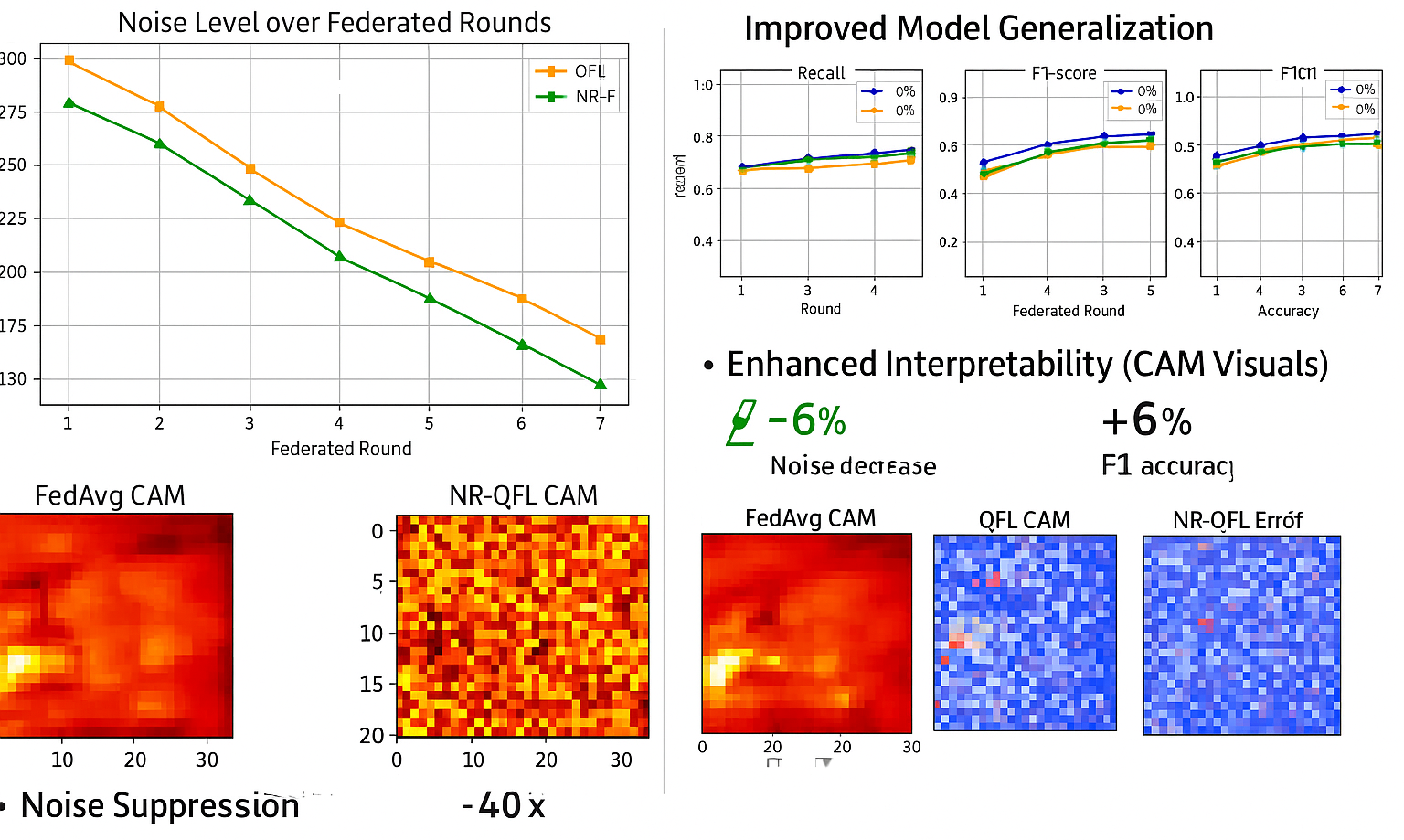
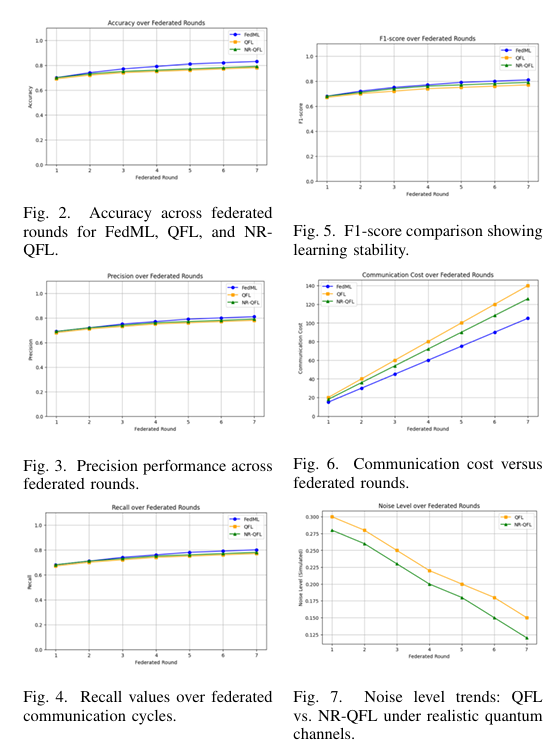
Advanced Driver Assistance Systems (ADAS) increasingly employ Federated Learning (FL) to collaboratively train models across distributed vehicular nodes while preserving data privacy. Yet, conventional FL aggregation remains susceptible to noise, latency, and security constraints inherent to real-time vehicular networks. This paper introduces Noise-Resilient Quantum Federated Learning (NR-QFL), a hybrid quantum-classical framework that enables secure, low-latency aggregation through variational quantum circuits (VQCs) operating under Noisy Intermediate-Scale Quantum (NISQ) conditions. The framework encodes model parameters as quantum states with adaptive gate reparameterization, ensuring bounded-error convergence and provable resilience under Completely Positive Trace-Preserving (CPTP) dynamics. NR-QFL employs quantum entropy-based client selection and multi-server coordination for fairness and stability. Empirical validation shows consistent convergence with reduced gradient variance, lower communication overhead, and enhanced noise tolerance under constrained edge conditions. The framework establishes a scalable foundation for quantum-enhanced federated learning, enabling secure, efficient, and dynamically stable ADAS intelligence at the vehicular edge.
Federated Learning (FL) [1] has emerged as a key paradigm for privacy-preserving, distributed model training in Advanced Driver Assistance Systems (ADAS) [2]. ADAS rely on realtime learning from diverse and sensitive vehicular data generated at the edge, where centralized collection is limited by bandwidth, latency, and privacy constraints. FL enables each vehicle's Electronic Control Unit (ECU) [3] to train local models and share only parameter updates, thereby reducing data exposure and communication overhead. However, vehicular FL remains challenged by non-IID data, unreliable network connectivity, and strict latency and safety requirements that complicate convergence and scalability.
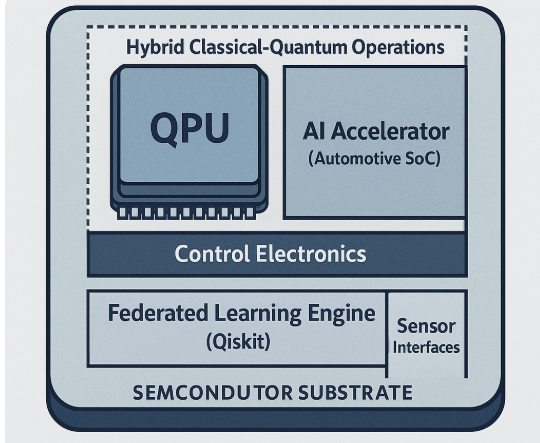
Recent advances in embedded AI computing have expanded the capabilities of edge-based ADAS systems. Platforms such as NVIDIA Jetson [4] and Google Edge TPU [5] accelerate deep-learning inference using reduced-precision arithmetic and hardware pipelining. Neuromorphic processors [6] inspired by spiking neural networks perform asynchronous event-driven computation, while AI System-on-Chips (SoCs) [7] combine CPUs, GPUs, and NPUs for energy-efficient multi-sensor fusion and perception. Despite this progress, classical FL aggregation remains vulnerable to noise accumulation, delayed synchronization, and security breaches during parameter exchange.
Parallel developments in quantum computing [12] provide a promising alternative for achieving secure and efficient aggregation. Quantum computation exploits superposition, entanglement, and interference to perform probabilistic transformations that accelerate optimization and sampling tasks beyond classical capabilities. Hybrid quantum-classical algorithms [13] combine parameterized quantum circuits (PQCs) with classical optimization, enabling computational advantages even on noisy, near-term devices. Quantum communication protocols such as Quantum Key Distribution (QKD) also offer information-theoretic security, a feature highly relevant for vehicular networks that demand strong privacy guarantees.
Noisy Intermediate-Scale Quantum (NISQ) devices [12] represent the current generation of quantum processors capable of executing low-depth, variational quantum circuits (VQCs) that tolerate moderate noise. These systems, although constrained in qubit count and fidelity, can serve as probabilistic aggregators within FL pipelines by leveraging quantum randomness and interference for secure, noise-resilient model fusion [16]. Integrating NISQ-enabled aggregation with FL can thus address three persistent bottlenecks in ADAS learning:
Federated Learning (FL) has emerged as a cornerstone for decentralized model training in safety-critical domains such as Advanced Driver Assistance Systems (ADAS). Foundational frameworks like FedAvg enable distributed optimization without raw data exchange but suffer from non-IID data distributions, communication delays, and unstable convergence in vehicular networks. Recent surveys highlight that ADAS-oriented FL must address multimodal sensor data, synchronization latency, and privacy-preserving aggregation under dynamic conditions. While edge-AI accelerators and neuromorphic processors have advanced on-board perception and inference, they do not inherently mitigate issues of model drift and security during federated aggregation.
Parallel progress in Quantum Federated Learning (QFL) explores the integration of quantum computation into federated pipelines to enhance privacy and communication efficiency. Recent studies have shown that variational quantum circuits and quantum noise-mitigation methods can achieve secure aggregation and faster convergence under limited qubit conditions. However, most QFL frameworks remain theoretical, lacking adaptation for real-time vehicular constraints. The proposed Noise-Resilient Quantum Federated Learning (NR-QFL) framework builds upon this foundation by introducing mathematically grounded noise tolerance and experimentally validated robustness on simulated NISQ systems-bridging quantum-enhanced learning with the practical demands of ADAS.
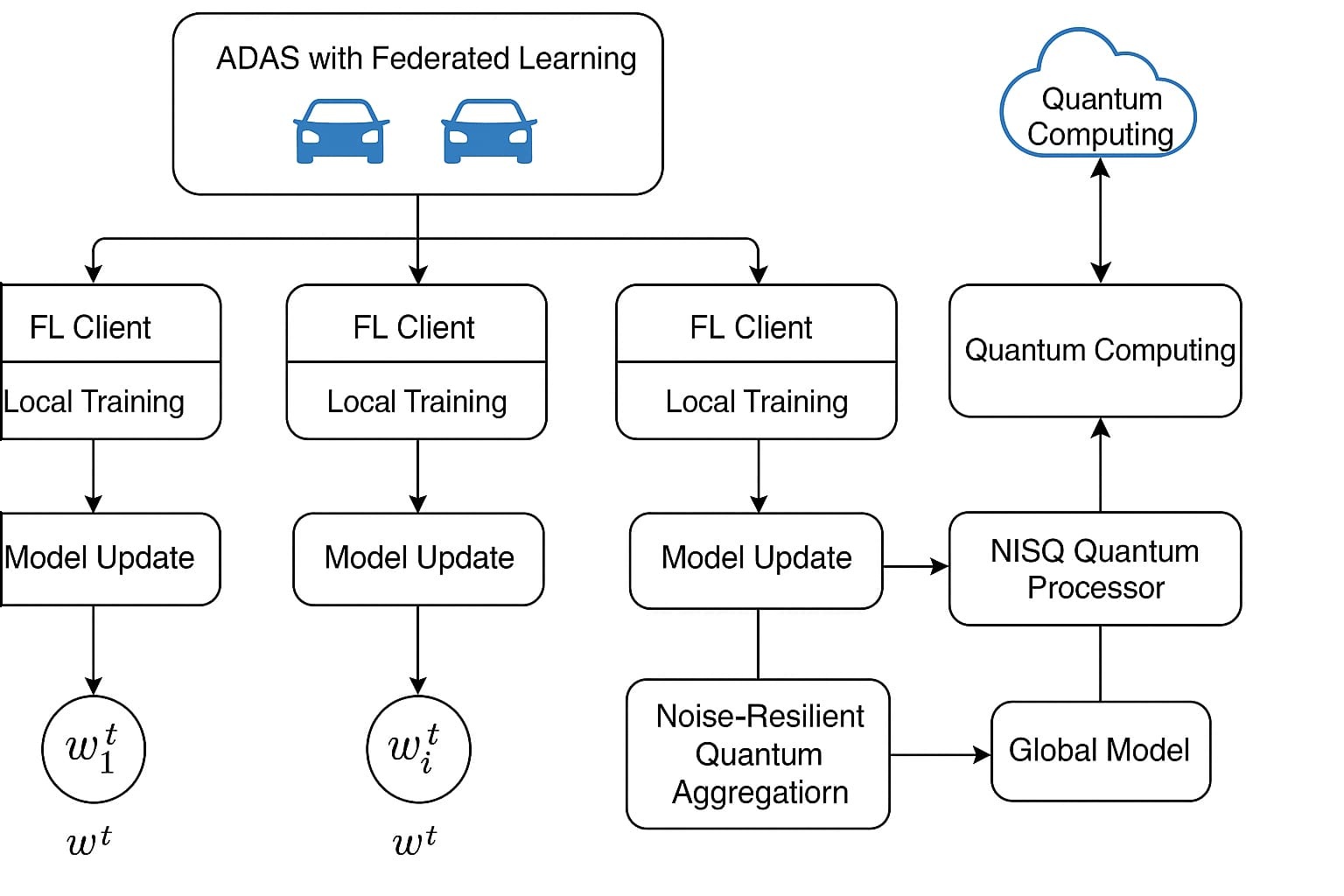
The proposed framework embeds a noise-resilient quantum aggregation protocol within a Federated Learning (FL) system for Advanced Driver Assistance Systems (ADAS), addressing privacy, robustness, and latency challenges through Noisy Intermediate-Scale Quantum (NISQ) computation. It leverages hybrid quantum-classical coordination with variational circuits for secure aggregation, ensuring real-time performance and hardware feasibility under vehicular edge constraints.
As shown in Fig. 1, the architecture comprises three layers: (i) Client vehicles with ADAS sensors and onboard processors, (ii) a quantum-enabled aggregation server, and (iii) a secure communication interface. Each client trains locally on sensor data (camera, LiDAR, radar) and transmits encrypted model updates. The NISQ-based server replaces classical averaging with a variational quantum aggregation mechanism using quantu
This content is AI-processed based on open access ArXiv data.