Title: A Multi-Axial Mindset for Ontology Design Lessons from Wikidata’s Polyhierarchical Structure
ArXiv ID: 2512.12260
Date: 2025-12-13
Authors: Ege Atacan Doğan, Peter F. Patel-Schneider
📝 Abstract
Traditional ontology design emphasizes disjoint and exhaustive top-level distinctions such as continuant vs. occurrent, abstract vs. concrete, or type vs. instance. These distinctions are used to structure unified hierarchies where every entity is classified under a single upper-level category. Wikidata, by contrast, does not enforce a singular foundational taxonomy. Instead, it accommodates multiple classification axes simultaneously under the shared root class entity. This paper analyzes the structural implications of Wikidata's polyhierarchical and multi-axial design. The Wikidata architecture enables a scalable and modular approach to ontology construction, especially suited to collaborative and evolving knowledge graphs.
💡 Deep Analysis
📄 Full Content
A Multi-Axial Mindset for Ontology Design:
Lessons from Wikidata’s Polyhierarchical
Structure
Ege Atacan Do˘gan, Peter F. Patel-Schneider
Julius-Maximilians-Universit¨at W¨urzburg, egeatacandogan@gmail.com
Independent Researcher, pfpschneider@gmail.com
Abstract. Traditional ontology design emphasizes disjoint and exhaus-
tive top-level distinctions such as continuant vs. occurrent, abstract vs.
concrete, or type vs. instance. These distinctions are used to structure
unified hierarchies where every entity is classified under a single upper-
level category. Wikidata, by contrast, does not enforce a singular foun-
dational taxonomy. Instead, it accommodates multiple classification axes
simultaneously under the shared root class entity. This paper analyzes
the structural implications of Wikidata’s polyhierarchical and multi-axial
design. The Wikidata architecture enables a scalable and modular ap-
proach to ontology construction, especially suited to collaborative and
evolving knowledge graphs.
Keywords: Wikidata · Ontology · Multi-Axial Classification · Polyhierarchy ·
Knowledge Graph Architecture
1
Introduction
Ontology design has traditionally adhered to disjoint and exhaustive top-level
distinctions, such as continuant/occurrent, or abstract/concrete. These distinc-
tions are what we call the primary split of the ontology. Foundational on-
tologies like BFO, DOLCE, and SUMO then extend this top-level split to a
tree-shaped upper ontology grounded mostly in binary oppositions.
Wikidata, by contrast, adopts a structurally different approach. Rather than
committing to a single primary split, it organizes knowledge using multiple clas-
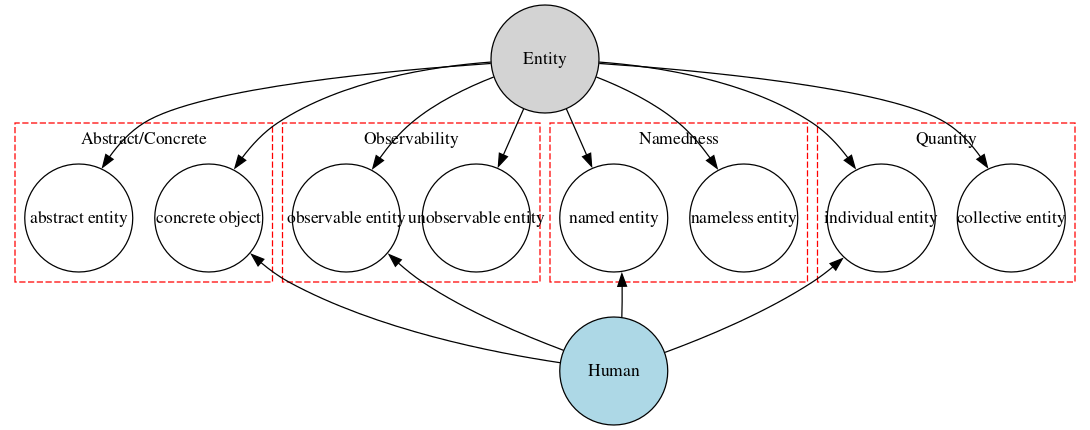
sification axes simultaneously. The root class entity (Q35120) serves as the
starting point for several conceptually distinct and sometimes overlapping trees,
such as the abstract/concrete axis, the individual/collective axis, and the ob-
servable/unobservable axis. These axes consist of mutually disjoint and complete
(exhaustive) classes. However, a given class in one axis is not disjoint with a class
in another axis. While having many direct subclasses under entity may seem
0 This paper was prepared with assistance from ChatGPT-4. The model supported
drafting, structuring, and refining arguments. All interpretations and conclusions
remain the responsibility of the authors.
arXiv:2512.12260v1 [cs.AI] 13 Dec 2025
2
E. A. Do˘gan, Peter F. Patel-Schneider
odd compared to the sparseness of other foundational ontologies, this can work
well in Wikidata’s flexible structure.
This paper presents a structural analysis of Wikidata’s ontology and intro-
duces the concept of a multi-axial mindset for ontology design. We argue that
the core difference lies in the architectural design: Wikidata accommodates mul-
tiple orthogonal classification axes, permitting non-exclusive categorizations at
all levels of the hierarchy. This allows entities and classes to participate in sev-
eral high-level taxonomies simultaneously, in contrast to foundational ontologies
that impose a single primary split.
2
Top-Level Ontological Distinctions
A primary split in an ontology is the initial, high-level division that structures the
class hierarchy in the ontology. It defines the most fundamental categories under
which all other entities are subsumed. These splits are typically exhaustive and
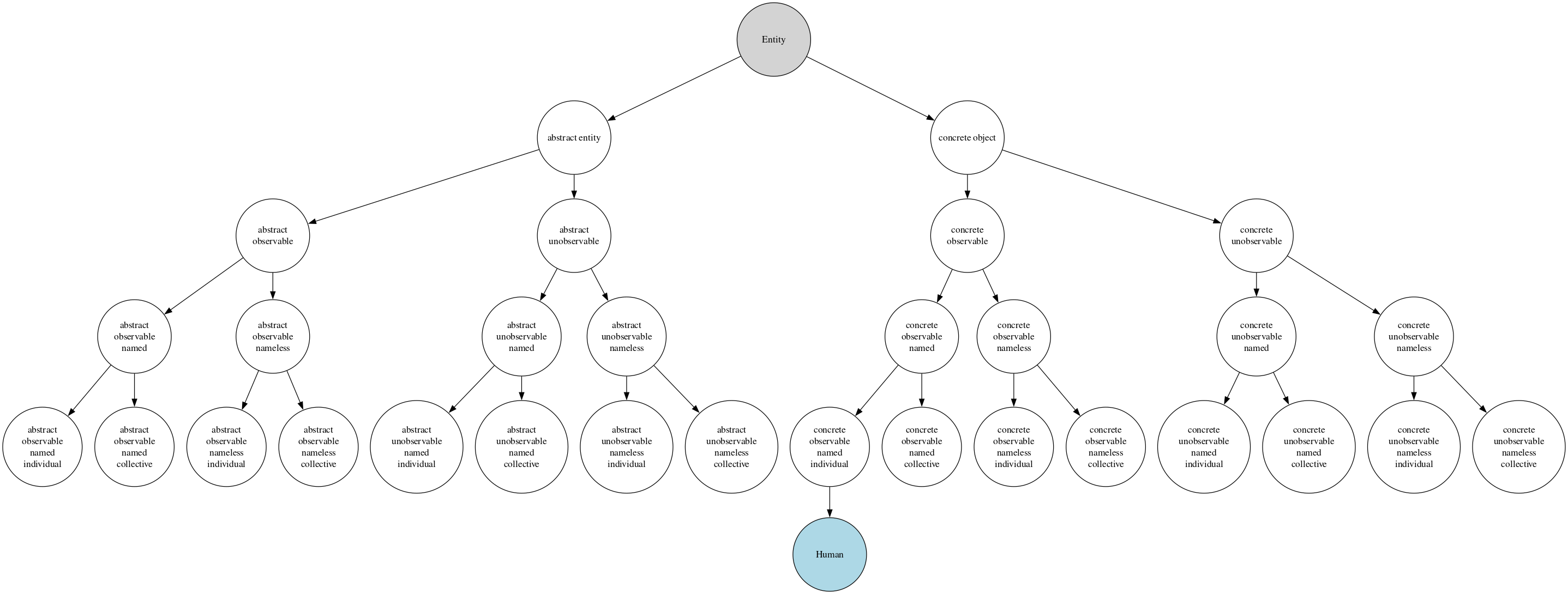
disjoint: every entity is expected to fall under exactly one branch, and no entity
should belong to more than one. The choice of primary split reflects philosophical
assumptions about the nature of reality, such as whether time, materiality, or
identity is foundational. Logically, any distinction within an ontology can be a
primary split, even a trivial one such as apples/non-apples, although the intuitive
understanding of classification makes this approach non-sensical. Therefore, all
primary splits should have a philosophical basis.
Foundational ontologies such as BFO [1], DOLCE [8], SUMO [9], UFO [4]1,
and Cyc [5] structure their class hierarchies according to disjoint and exhaustive
top-level distinctions. These distinctions are meant to be the primary split of
said ontology. Wikidata, by contrast, supports a flexible, multi-axial design in
which such distinctions coexist as overlapping, non-exclusive axes under a shared
root class: entity (Q35120).
Table 1 compares key ontologies along their primary splits.
Table 1. Comparison of Top-Level Ontological Distinctions
Ontology Primary Split(s)
BFO
Continuant / Occurrent
DOLCE
Endurant / Perdurant / Quality / Abstract
SUMO
Physical / Abstract
UFO
Type / Individual
Cyc
Individual Object / Intangible / Represented Thing
These ontologies are based on a classification such that every entity belongs
to exactly one subclass at almost all splits. Classification thus generally proceeds
1 UFO has 3 other axes than given in the table, but Type/Individual is the one handled
at the first split under “thing”.
Multi-Axial Ontology Design in Wikidata
3
through mutually exclusive branche