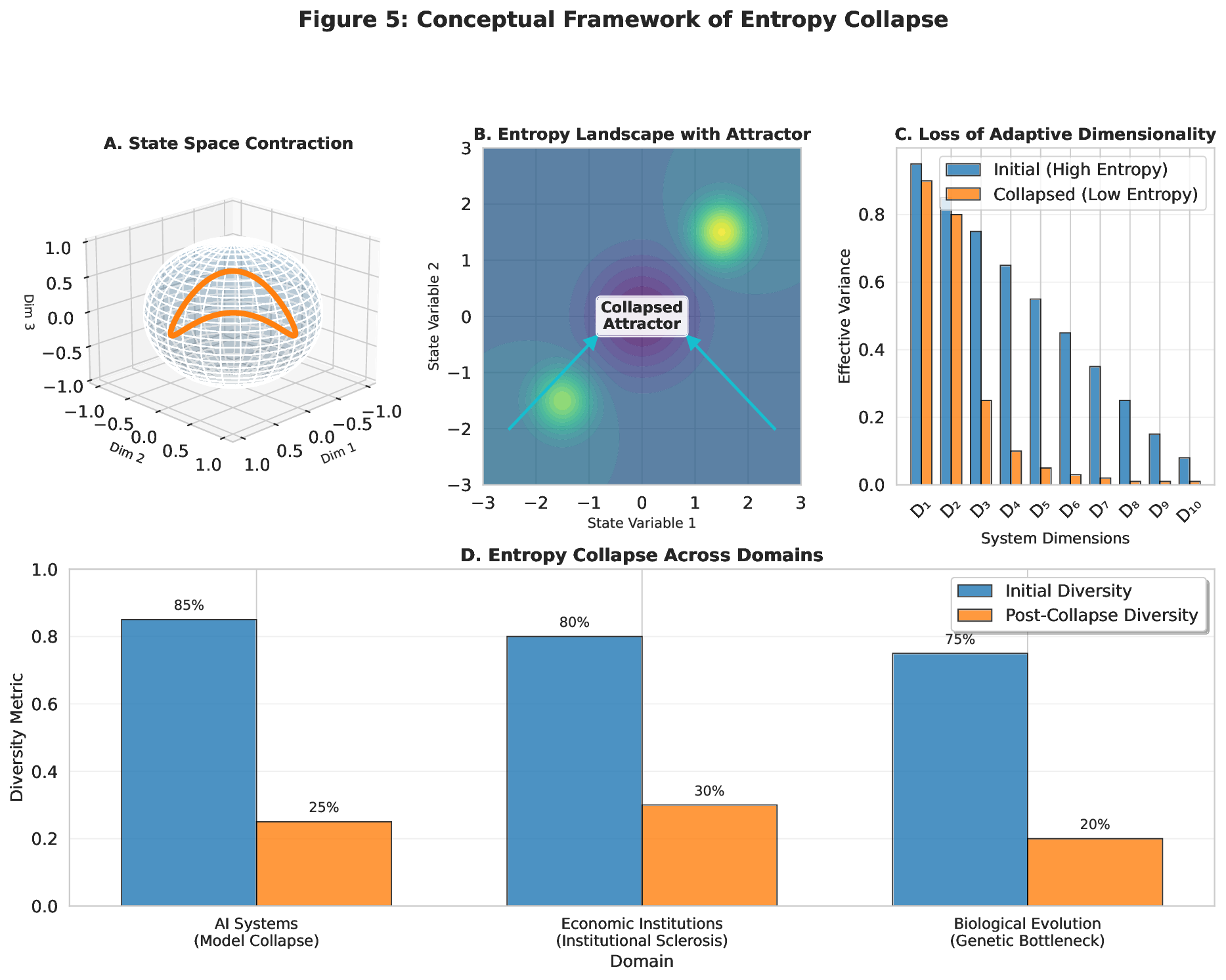
Title: Entropy Collapse: A Universal Failure Mode of Intelligent Systems
ArXiv ID: 2512.12381
Date: 2025-12-13
Authors: Truong Xuan Khanh, Truong Quynh Hoa
📝 Abstract
Intelligent systems are widely assumed to improve through learning, coordination, and optimization. However, across domains -- from artificial intelligence to economic institutions and biological evolution -- increasing intelligence often precipitates paradoxical degradation: systems become rigid, lose adaptability, and fail unexpectedly.
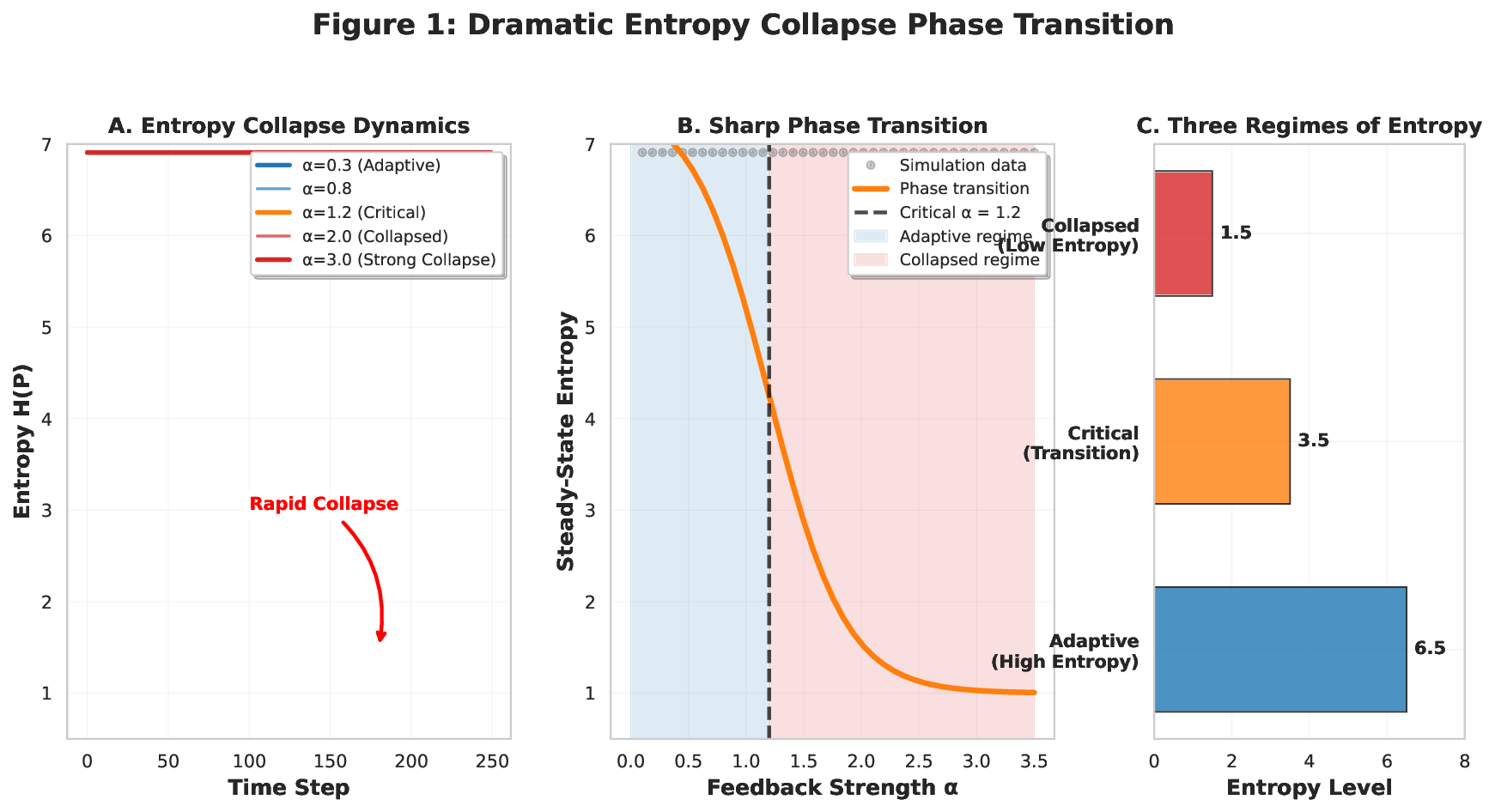
We identify \emph{entropy collapse} as a universal dynamical failure mode arising when feedback amplification outpaces bounded novelty regeneration. Under minimal domain-agnostic assumptions, we show that intelligent systems undergo a sharp transition from high-entropy adaptive regimes to low-entropy collapsed regimes. Collapse is formalized as convergence toward a stable low-entropy manifold, not a zero-entropy state, implying a contraction of effective adaptive dimensionality rather than loss of activity or scale.
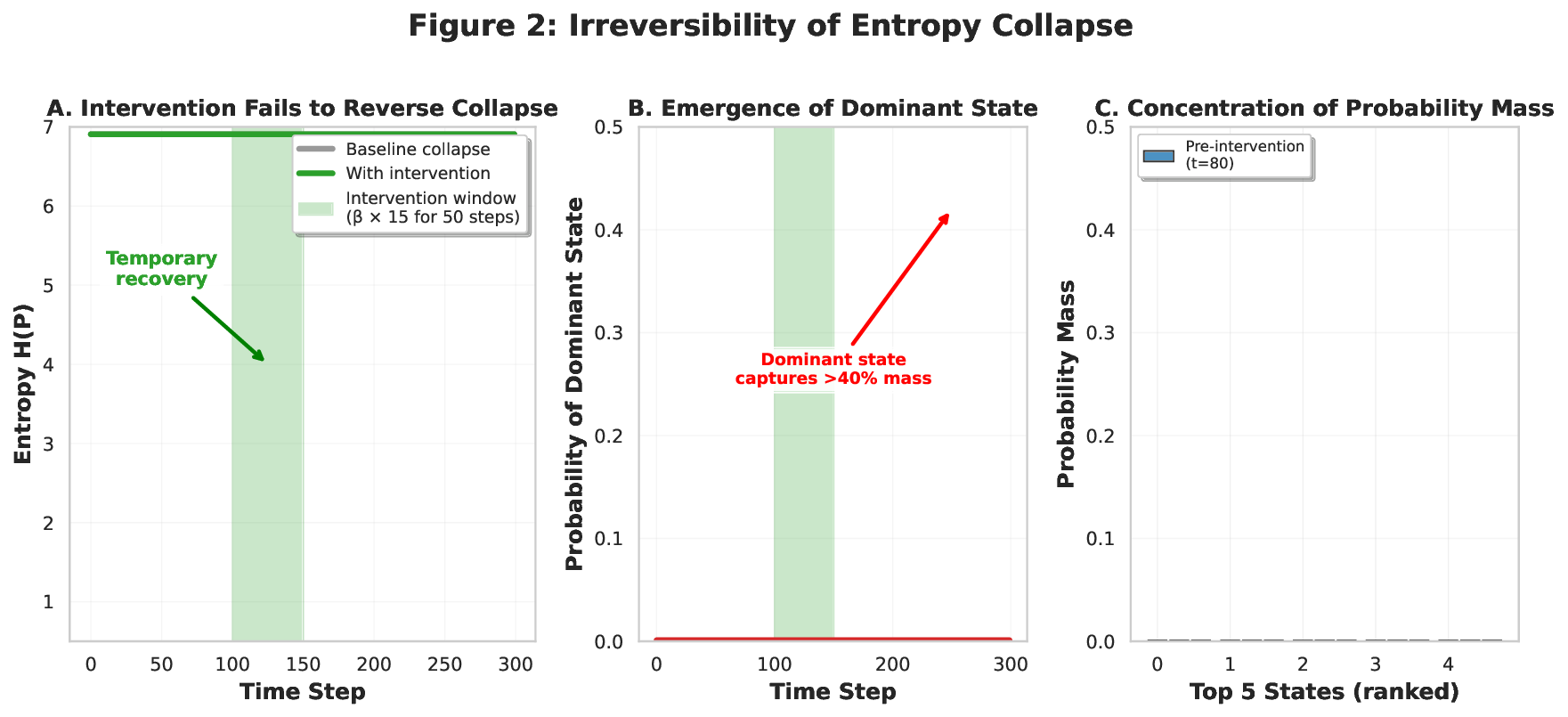
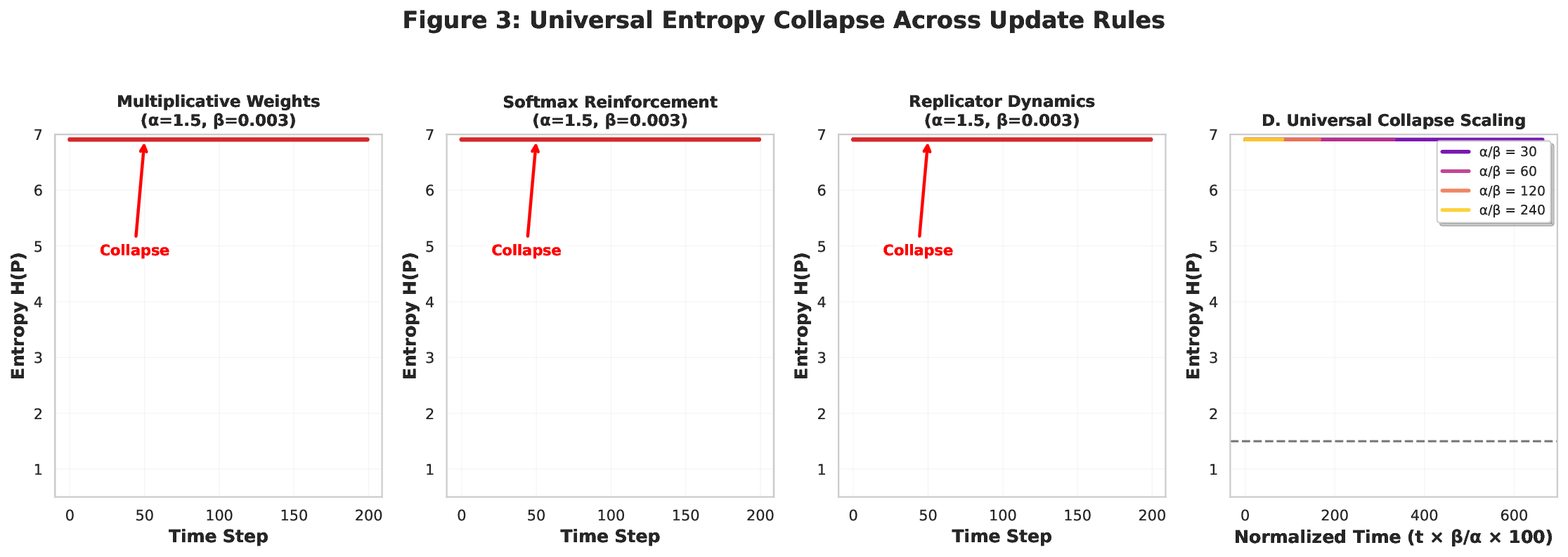
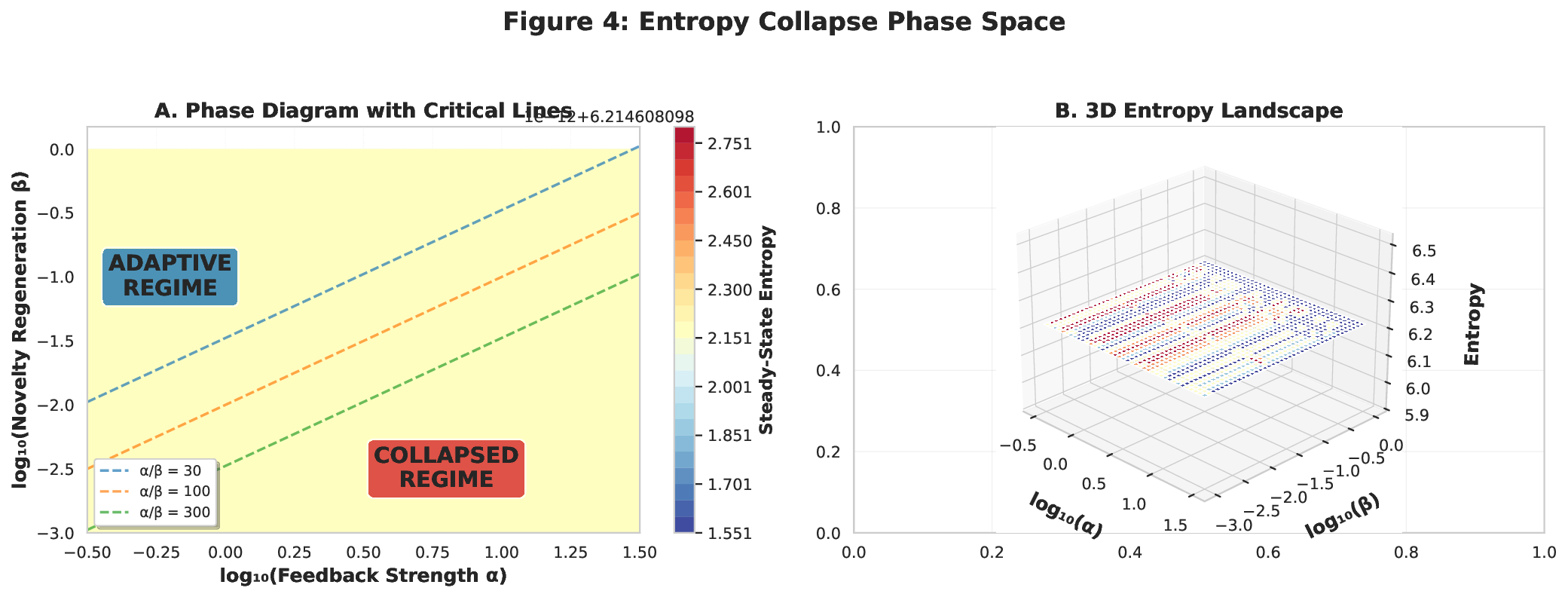
We analytically establish critical thresholds, dynamical irreversibility, and attractor structure and demonstrate universality across update mechanisms through minimal simulations. This framework unifies diverse phenomena -- model collapse in AI, institutional sclerosis in economics, and genetic bottlenecks in evolution -- as manifestations of the same underlying process.
By reframing collapse as a structural cost of intelligence, our results clarify why late-stage interventions systematically fail and motivate entropy-aware design principles for sustaining long-term adaptability in intelligent systems.
\noindent\textbf{Keywords:} entropy collapse; intelligent systems; feedback amplification; phase transitions; effective dimensionality; complex systems; model collapse; institutional sclerosis
💡 Deep Analysis
📄 Full Content
Entropy Collapse: A Universal Failure Mode of
Intelligent Systems
Truong Xuan Khanh1,*, Truong Quynh Hoa1
1H&K Research Studio, Clevix LLC, Hanoi, Vietnam
*Corresponding author: khanh@clevix.vn
06 December 2025
Abstract
Intelligent systems are widely assumed to improve through learning, coordination,
and optimization. However, across domains—from artificial intelligence to economic
institutions and biological evolution—increasing intelligence often precipitates para-
doxical degradation: systems become rigid, lose adaptability, and fail unexpectedly.
We identify entropy collapse as a universal dynamical failure mode arising when
feedback amplification outpaces bounded novelty regeneration. Under minimal domain-
agnostic assumptions, we show that intelligent systems undergo a sharp transition from
high-entropy adaptive regimes to low-entropy collapsed regimes. Collapse is formalized
as convergence toward a stable low-entropy manifold, not a zero-entropy state, implying
a contraction of effective adaptive dimensionality rather than loss of activity or scale.
We analytically establish critical thresholds, dynamical irreversibility, and attrac-
tor structure and demonstrate universality across update mechanisms through minimal
simulations. This framework unifies diverse phenomena—model collapse in AI, institu-
tional sclerosis in economics, and genetic bottlenecks in evolution—as manifestations
of the same underlying process.
By reframing collapse as a structural cost of intelligence, our results clarify why late-
stage interventions systematically fail and motivate entropy-aware design principles for
sustaining long-term adaptability in intelligent systems.
Keywords: entropy collapse; intelligent systems; feedback amplification; phase transi-
tions; effective dimensionality; complex systems; model collapse; institutional sclerosis
1
Introduction
Intelligence is commonly associated with adaptability, optimization, and long-term improve-
ment. From machine learning systems that refine internal representations through training
LeCun et al. (2015), to economic institutions that coordinate rational agents Arthur (1994),
to biological populations shaped by natural selection Holland (1992), intelligent systems are
expected to become more robust as they scale and learn.
1
arXiv:2512.12381v1 [cs.AI] 13 Dec 2025
Empirical evidence increasingly contradicts this expectation Shumailov et al. (2023);
Alemohammad et al. (2024). Large-scale learning systems degrade when trained on self-
generated data. Social and economic systems converge towards rigid coordination patterns
that resist innovation Watts and Strogatz (1998). Biological populations lose genetic di-
versity and adaptive capacity despite short-term fitness advantages Gould (1996). These
phenomena are typically studied in isolation and attributed to domain-specific causes such
as data bias, incentive misalignment, or environmental stress.
In this work, we argue that these failures share a common structural origin. We iden-
tify a universal dynamical mechanism—entropy collapse—through which intelligent systems
transition from high-entropy adaptive regimes to low-entropy rigid regimes as feedback ampli-
fication overwhelms the system’s bounded capacity to regenerate novelty. Crucially, entropy
collapse arises endogenously from the very mechanisms that enable intelligence, including
learning, coordination, and optimization.
By collapse, we do not mean entropy approaching zero or the cessation of system activity.
Instead, collapse corresponds to convergence toward a stable low-entropy manifold in the
state space of the system.
Within this manifold, limited variability and local dynamics
may persist, yet the effective dimensionality of adaptation of the system is fundamentally
constrained. As a result, systems can continue to scale in size, time, or output while becoming
increasingly brittle to novel conditions.
This perspective reframes collapse not as an anomaly or design failure but as a structural
cost of intelligence. This explains why many intelligent systems appear stable or performant
even as their long-term adaptive capacity deteriorates, and why late-stage interventions often
fail to restore genuine diversity or flexibility Scheffer et al. (2009).
The objective of this paper is not to introduce a domain-specific model but to establish
entropy collapse as a universal failure mode of intelligent systems. We formalize the minimal
conditions under which collapse arises, characterize its dynamical structure, and demonstrate
its robustness through minimal simulations. Finally, we interpret the well-known failures in
artificial intelligence, economic coordination, and biological evolution as manifestations of
the same underlying entropy-driven process.
2
The Entropy Collapse Claim
2.1
Core Claim
The central claim of this paper is the following:
Entropy Collapse Claim. Entropy collapse is a universal failure mode for intelligent
systems, which arises when feedback a