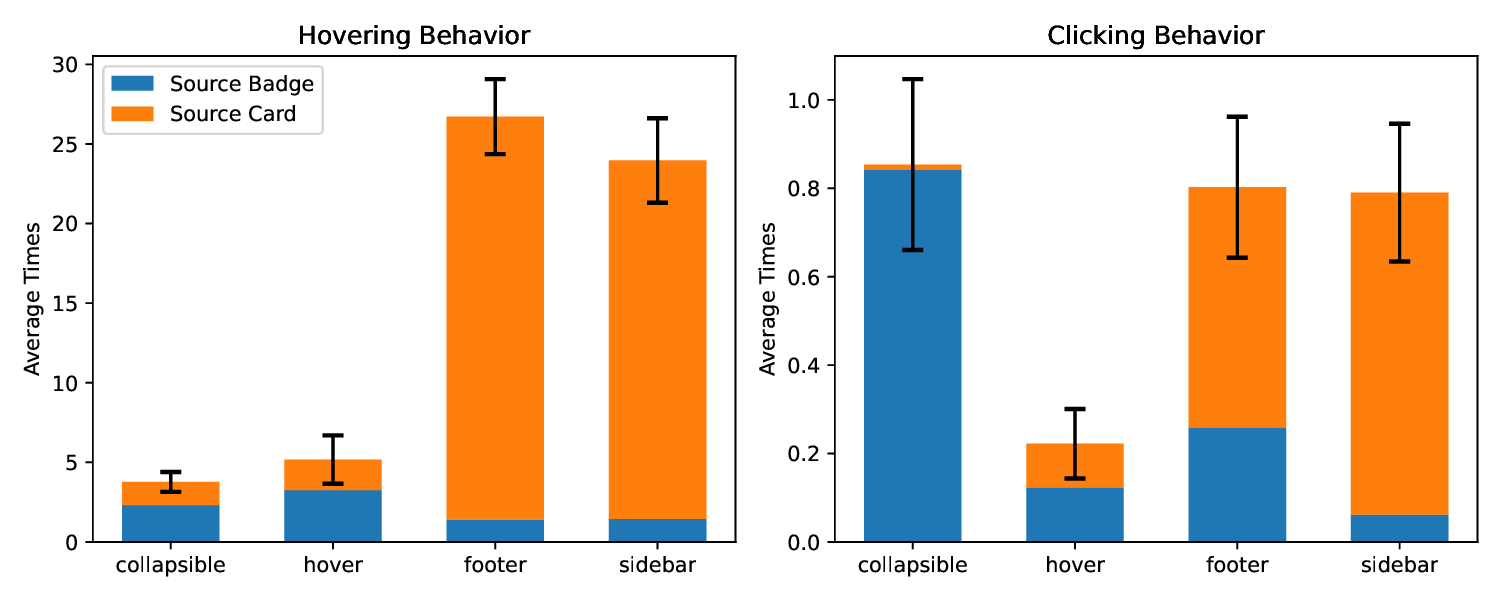
📝 Original Info Title: Not All Transparency Is Equal: Source Presentation Effects on Attention, Interaction, and Persuasion in Conversational SearchArXiv ID: 2512.12207Date: 2025-12-13Authors: Jiangen He, Jiqun Liu📝 Abstract Conversational search systems increasingly provide source citations, yet how citation or source presentation formats influence user engagement remains unclear. We conducted a crowdsourcing user experiment with 394 participants comparing four source presentation designs that varied citation visibility and accessibility: collapsible lists, hover cards, footer lists, and aligned sidebars.High-visibility interfaces generated substantially more hovering on sources, though clicking remained infrequent across all conditions. While interface design showed limited effects on user experience and perception measures, it significantly influenced knowledge, interest, and agreement changes. High-visibility interfaces initially reduced knowledge gain and interest, but these positive effects emerged with increasing source usage. The sidebar condition uniquely increased agreement change. Our findings demonstrate that source presentation alone may not enhance engagement and can even reduce it when insufficient sources are provided.
💡 Deep Analysis
📄 Full Content Not All Transparency Is Equal: Source Presentation Effects on
Attention, Interaction, and Persuasion in Conversational Search
Jiangen He
The University of Tennessee
Knoxville, TN, USA
jiangen@utk.edu
Jiqun Liu
The University of Oklahoma
Norman, OK, USA
jiqunliu@ou.edu
Abstract
Conversational search systems increasingly provide source cita-
tions, yet how citation or source presentation formats influence
user engagement remains unclear. We conducted a crowdsourc-
ing user experiment with 394 participants comparing four source
presentation designs that varied citation visibility and accessibil-
ity: collapsible lists, hover cards, footer lists, and aligned sidebars.
High-visibility interfaces generated substantially more hovering
on sources, though clicking remained infrequent across all condi-
tions. While interface design showed limited effects on user experi-
ence and perception measures, it significantly influenced knowl-
edge, interest, and agreement changes. High-visibility interfaces
initially reduced knowledge gain and interest, but these positive ef-
fects emerged with increasing source usage. The sidebar condition
uniquely increased agreement change. Our findings demonstrate
that source presentation alone may not enhance engagement and
can even reduce it when insufficient sources are provided.
CCS Concepts
• Information systems →Search interfaces; • Human-centered
computing →User studies.
Keywords
conversational search, large language models, source citation, cred-
ibility, transparency, information seeking, attitude change
ACM Reference Format:
Jiangen He and Jiqun Liu. 2018. Not All Transparency Is Equal: Source
Presentation Effects on Attention, Interaction, and Persuasion in Conversa-
tional Search. In Proceedings of Make sure to enter the correct conference title
from your rights confirmation email (Conference acronym ’XX). ACM, New
York, NY, USA, 5 pages. https://doi.org/XXXXXXX.XXXXXXX
1
Introduction
Conversational search and large-language-model (LLM)–enabled
intelligent assistants are reshaping how people seek, judge, and
use information. Within the field of human-computer interaction
and retrieval (HCIR), decades of research show that interaction de-
sign, sense-making, and credible source use are central to effective
Permission to make digital or hard copies of all or part of this work for personal or
classroom use is granted without fee provided that copies are not made or distributed
for profit or commercial advantage and that copies bear this notice and the full citation
on the first page. Copyrights for components of this work owned by others than the
author(s) must be honored. Abstracting with credit is permitted. To copy otherwise, or
republish, to post on servers or to redistribute to lists, requires prior specific permission
and/or a fee. Request permissions from permissions@acm.org.
Conference acronym ’XX, Woodstock, NY
© 2018 Copyright held by the owner/author(s). Publication rights licensed to ACM.
ACM ISBN 978-1-4503-XXXX-X/2018/06
https://doi.org/XXXXXXX.XXXXXXX
search [13, 17, 20, 27]. In particular, user evaluation studies further
demonstrate that the interface is not a neutral conduit: presenta-
tion choices modulate attention, implicit feedback, and verification
behaviors [2, 8, 10]. In parallel, credibility research in information
science establishes that users apply heuristics and strategies sensi-
tive to cues exposed by the interface [14, 22, 25, 28]. For LLM-based
systems, transparency features, such as explanations, provenance,
and citations, are repeatedly recommended to support scrutiny and
appropriate trust [6, 16, 19]. Yet, real-world studies of generative
search caution that users often do not meaningfully inspect sources
even when citations are provided, risking shallow verification, mis-
trust, and homogenized exposure [4, 11, 23]. Together, these strands
indicate that source-presentation design is a first-order determinant
of credible, accountable conversational and generative interactions.
Despite significant progress, two gaps persist. First, most work
examines transparency at a conceptual or system-level (e.g., “pro-
vide citations”) rather than as a precise interface variable whose
visibility and accessibility can be manipulated and measured. We
lack controlled evidence isolating how concrete presentation for-
mats (e.g., inline hover cards vs. footers vs. side panels) affect micro-
behaviors such as hovering, clicking, and revisiting sources—the
very behaviors through which users enact scrutiny and build cred-
ibility judgments [2, 9, 10]. Second, prior studies often stop at
global perceptions (e.g., trust, satisfaction, engagement) without
connecting interface-induced behaviors to downstream knowledge
and attitude change [26], which are outcomes long recognized in
information-seeking and persuasion research [5, 7, 22, 25]. Closing
these gaps is crucial for both research and practice: it sharpens
theories linking interface affordances, attention, and cr
📸 Image Gallery
Reference This content is AI-processed based on open access ArXiv data.