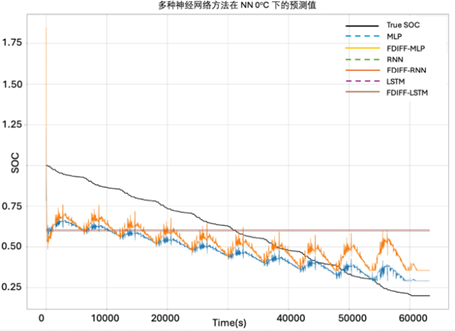
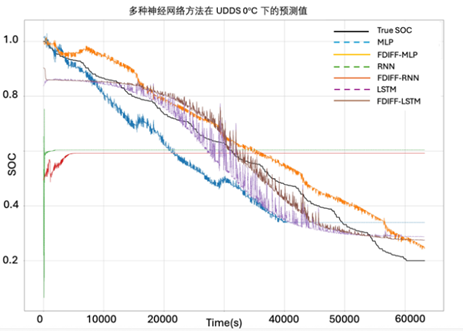
Accurate estimation of the State of Charge (SOC) is critical for ensuring the safety, reliability, and performance optimization of lithium-ion battery systems. Conventional data-driven neural network models often struggle to fully characterize the inherent complex nonlinearities and memory-dependent dynamics of electrochemical processes, significantly limiting their predictive accuracy and physical interpretability under dynamic operating conditions. To address this challenge, this study proposes a novel neural architecture termed the Fractional Differential Equation Physics-Informed Neural Network (FDIFF-PINN), which integrates fractional calculus with deep learning. The main contributions of this paper include: (1) Based on a fractional-order equivalent circuit model, a discretized fractional-order partial differential equation is constructed. We propose embedding the residual term of the fractional-order dynamic equation into the loss function of a neural network as a physical regularization constraint, thereby integrating the mechanistic model with a deep learning architecture. This dual-driven paradigm retains the data-driven model's ability to represent high-dimensional features while capturing the battery's non-ideal polarization behavior and historical dependencies by incorporating the long-range temporal correlation prior knowledge embedded within the fractionalorder differential operator. This significantly enhances the physical consistency of the model for battery SOC estimation, providing a novel solution for high-accuracy, high-robustness battery state estimation. (2) Comparative experiments were conducted using a dynamic charge/discharge dataset of Panasonic 18650PF batteries under multi-temperature conditions (from -10 • C to 20 • C). The performance of the FDIFF-PINN method was validated across various operating conditions, physical weighting coefficients, initial weight settings, and fractional-order parameters. Parameter tuning was performed under specific conditions. Results demonstrate that the proposed hybrid modeling method exhibits significant improvement over traditional data-driven methods under low-temperature and steady-state conditions, with the Mean Squared Error stabilized below 3% under specific operating conditions. The experiment, utilizing modeling with a single-parameter operator, verifies the excellent fitting capability of fractional-order equivalent circuit modeling for practical electrochemical systems.
💡 Deep Analysis
📄 Full Content
Article
Fractional Differential Equation Physics-Informed
Neural Network and Its Application in Battery State
Estimation
Lujuan Dang 1* and Zilai Wang 1
1
School of Artificial Intelligence, Xi’an Jiaotong University, Xi’an 710049, China
*
Correspondence: danglj@xjtu.edu.cn
Abstract
Accurate estimation of the State of Charge (SOC) is critical for ensuring the safety, reliability, and
performance optimization of lithium-ion battery systems. Conventional data-driven neural network
models often struggle to fully characterize the inherent complex nonlinearities and memory-dependent
dynamics of electrochemical processes, significantly limiting their predictive accuracy and physical
interpretability under dynamic operating conditions. To address this challenge, this study proposes
a novel neural architecture termed the Fractional Differential Equation Physics-Informed Neural
Network (FDIFF-PINN), which integrates fractional calculus with deep learning. The main contri-
butions of this paper include: (1) Based on a fractional-order equivalent circuit model, a discretized
fractional-order partial differential equation is constructed. We propose embedding the residual term
of the fractional-order dynamic equation into the loss function of a neural network as a physical
regularization constraint, thereby integrating the mechanistic model with a deep learning architecture.
This dual-driven paradigm retains the data-driven model’s ability to represent high-dimensional
features while capturing the battery’s non-ideal polarization behavior and historical dependencies by
incorporating the long-range temporal correlation prior knowledge embedded within the fractional-
order differential operator. This significantly enhances the physical consistency of the model for
battery SOC estimation, providing a novel solution for high-accuracy, high-robustness battery state
estimation. (2) Comparative experiments were conducted using a dynamic charge/discharge dataset
of Panasonic 18650PF batteries under multi-temperature conditions (from -10◦C to 20◦C). The per-
formance of the FDIFF-PINN method was validated across various operating conditions, physical
weighting coefficients, initial weight settings, and fractional-order parameters. Parameter tuning was
performed under specific conditions. Results demonstrate that the proposed hybrid modeling method
exhibits significant improvement over traditional data-driven methods under low-temperature and
steady-state conditions, with the Mean Squared Error stabilized below 3% under specific operating
conditions. The experiment, utilizing modeling with a single-parameter operator, verifies the excellent
fitting capability of fractional-order equivalent circuit modeling for practical electrochemical systems.
Keywords: Differential equation-informed neural networks; State estimation; State of charge (SOC);
Fractional order RC equivalent circuit model
1. Introduction
1.1. Research Background and Basic Concepts
As the global energy structure undergoes deep adjustment and carbon neutrality goals are
advanced, the energy industry is transitioning from a traditional fossil-fuel-dominated system to a
clean, intelligent, and sustainable architecture. Due to technological advancements, decarbonization
initiatives, the establishment of smart grid concepts, and the rapid growth in renewable resource usage,
energy concepts are evolving worldwide. With the increasing global demand for power generation and
arXiv:2512.12285v1 [cs.LG] 13 Dec 2025
2 of 16
the widespread use of diesel, gasoline, and various fossil fuels leading to greenhouse gas emissions
like carbon dioxide and global warming, nations are planning to reduce carbon emissions to achieve
carbon neutrality and expand the use of new energy. Lithium-ion batteries, due to their high energy
density, long cycle life, and low self-discharge rate, have become the core energy storage carriers for
electric vehicles (EVs), renewable energy systems, and portable electronic devices [1,2].
Batteries rarely operate under ideal conditions; their performance is influenced by temperature
fluctuations, repeated charge/discharge cycles, aging processes, and operating stresses. These factors
make it difficult to accurately assess the internal state of the battery without sophisticated estima-
tion processes, which are crucial for monitoring battery performance and predicting behavior under
dynamic environments. Key parameters for battery state estimation include: State of Charge (SOC),
quantifying remaining energy capacity relative to total capacity; State of Health (SOH), assessing
overall aging and capacity fade; and Remaining Useful Life (RUL), predicting the life termination
threshold. Failure to accurately estimate these key parameters makes efficient battery management
impossible, potentially triggering abnormal conditions such as overcharge, deep discharge, or over-
heating. These failure modes not only significantly shorten battery cycle life but may also in