Adversarially Probing Cross-Family Sound Symbolism in 27 Languages
Reading time: 5 minute
...
📝 Original Info
Title: Adversarially Probing Cross-Family Sound Symbolism in 27 Languages
ArXiv ID: 2512.12245
Date: 2025-12-13
Authors: Anika Sharma, Tianyi Niu, Emma Wrenn, Shashank Srivastava
📝 Abstract
The phenomenon of sound symbolism, the non-arbitrary mapping between word sounds and meanings, has long been demonstrated through anecdotal experiments like Bouba Kiki, but rarely tested at scale. We present the first computational cross-linguistic analysis of sound symbolism in the semantic domain of size. We compile a typologically broad dataset of 810 adjectives (27 languages, 30 words each), each phonemically transcribed and validated with native-speaker audio. Using interpretable classifiers over bag-of-segment features, we find that phonological form predicts size semantics above chance even across unrelated languages, with both vowels and consonants contributing. To probe universality beyond genealogy, we train an adversarial scrubber that suppresses language identity while preserving size signal (also at family granularity). Language prediction averaged across languages and settings falls below chance while size prediction remains significantly above chance, indicating cross-family sound-symbolic bias. We release data, code, and diagnostic tools for future large-scale studies of iconicity.
💡 Deep Analysis
📄 Full Content
Adversarially Probing Cross-Family Sound Symbolism in 27 Languages
Anika Sharma
Tianyi Niu
Emma Wrenn
Shashank Srivastava
University of North Carolina at Chapel Hill
Abstract
The phenomenon of sound symbolism, the non-
arbitrary mapping between word sounds and
meanings, has long been demonstrated through
anecdotal experiments like Bouba–Kiki, but
rarely tested at scale. We present the first com-
putational cross-linguistic analysis of sound
symbolism in the semantic domain of size. We
compile a typologically broad dataset of 810
adjectives (27 languages × 30 items), each
phonemically transcribed and validated with
native-speaker audio. Using interpretable clas-
sifiers over bag-of-segment features, we find
that phonological form predicts size semantics
above chance even across unrelated languages,
with both vowels and consonants contributing.
To probe universality beyond genealogy, we
train an adversarial scrubber that suppresses
language identity while preserving size signal
(also at family granularity). Language predic-
tion averaged across languages and settings
falls below chance while size prediction re-
mains significantly above chance, indicating
cross-family sound-symbolic bias. We release
data, code, and diagnostic tools for future large-
scale studies of iconicity.
1
Introduction
If you were watching a superhero movie called
Lamonians vs. Grataks: The Phoneme Accords,
chances are you’d already be rooting for the La-
monians because they sound like they would be
nicer. In a 2009 Guardian article, linguist David
Crystal posed a thought experiment: when asked
to judge two fictional alien races, most people in-
stinctively sided with the Lamonians, drawn to the
soft consonants (/l/, /m/, /n/) and long vowels
and diphthongs that give the name its gentle, lik-
able tone (Crystal, 2009). This phenomenon in
which specific sounds systematically convey partic-
ular meanings is known as sound symbolism, and it
challenges the long-standing linguistic assumption
that form and meaning are entirely arbitrary. But
how can we be sure such intuitions reflect univer-
sal cognitive principles, rather than simply shared
linguistic history? This paper introduces a method
designed to answer this question.
Sound symbolism is most familiar in ono-
matopoeia, words like buzz or crash that imitate
real-world sounds. It also manifests systematically
across languages: in Yucatec Maya, vowel length
signals event duration (Guen, 2013); in Swedish,
the prefix pj- marks pejoration (Åsa Abelin, 1999);
and in Japanese, consonants in food mimetics re-
flect perceived crispness (Raevskiy et al., 2023).
Despite evidence from individual languages,
identifying cross-linguistic sound symbolism re-
mains methodologically difficult because of two
issues. First, identifying universal patterns is diffi-
cult because phonological similarities may reflect
shared ancestry or areal contact rather than true
sound symbolism. Second, phonological invento-
ries differ: some languages lack certain sounds,
which obscures potential effects. Yet, the question
of cross-linguistic sound symbolism carries signifi-
cance beyond theoretical linguistics. It may reveal
cognitive universals in perception, improve cross-
lingual transfer in low-resource NLP, and guide
data-driven brand naming in commercial applica-
tions (Motoki et al., 2023).
In this work, we investigate whether sound sym-
bolism for size holds across typologically diverse
languages by testing if adjectives meaning “small”
and “large” consistently share phonological fea-
tures, regardless of language family. Our approach
includes an adversarial setup designed to isolate po-
tentially universal sound-symbolic patterns while
controlling for language-specific influences. Our
contributions are:
• A cross-linguistic dataset of 800+ size adjectives
(30 per language) from 27 languages from 13 lan-
guage families, phonemically transcribed in IPA
and validated through native speaker recordings
arXiv:2512.12245v1 [cs.CL] 13 Dec 2025
to capture contrastive phonological distinctions.
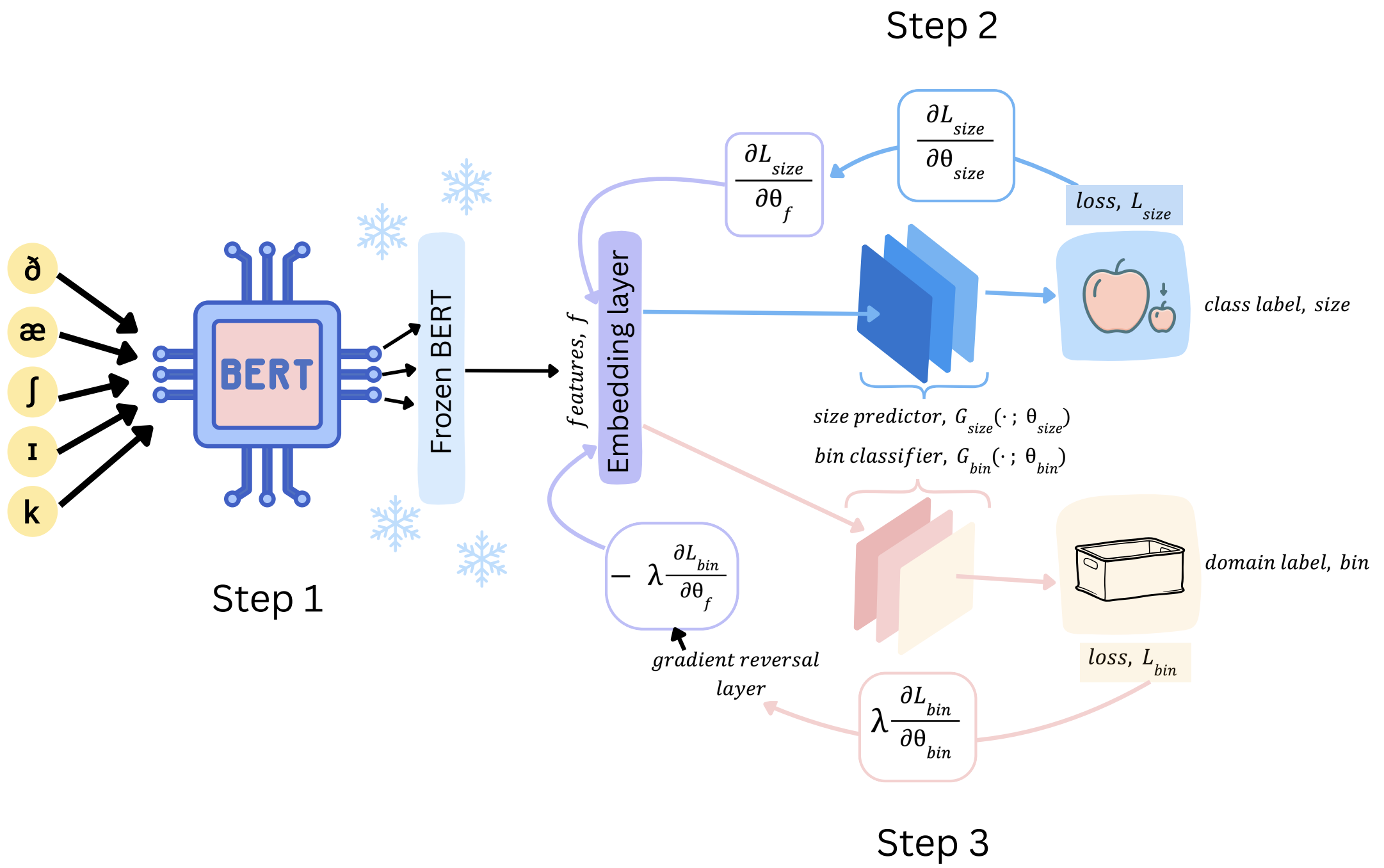
• An adversarial framework using gradient rever-
sal (Ganin and Lempitsky, 2015) to suppress
language-family signals while retaining semantic
structure. The model maintains above-chance
size classification (54.4%) while reducing lan-
guage identification to at chance (34.0%) offering
a new approach to disentangle universal patterns
from genealogical relatedness.
• Evidence that while vowels like /a/, /i/, and /o/
confirm traditional size-symbolism patterns, con-
sonants—particularly voiced fricatives like /Q/
and /H/—also contribute to size prediction across
diverse language families, expanding beyond a
purely vowel-centric account.
2
Related Works
The classical view in linguistics considers the form–
meaning link arbitrary (Saussure, 2011), with ex-
ceptions in iconicity or sound symbolism. Founda-
tional experiments show that listeners map phono-
logical form to perceived magnitude; for exam-
ple, Sapir (1929) found reliab