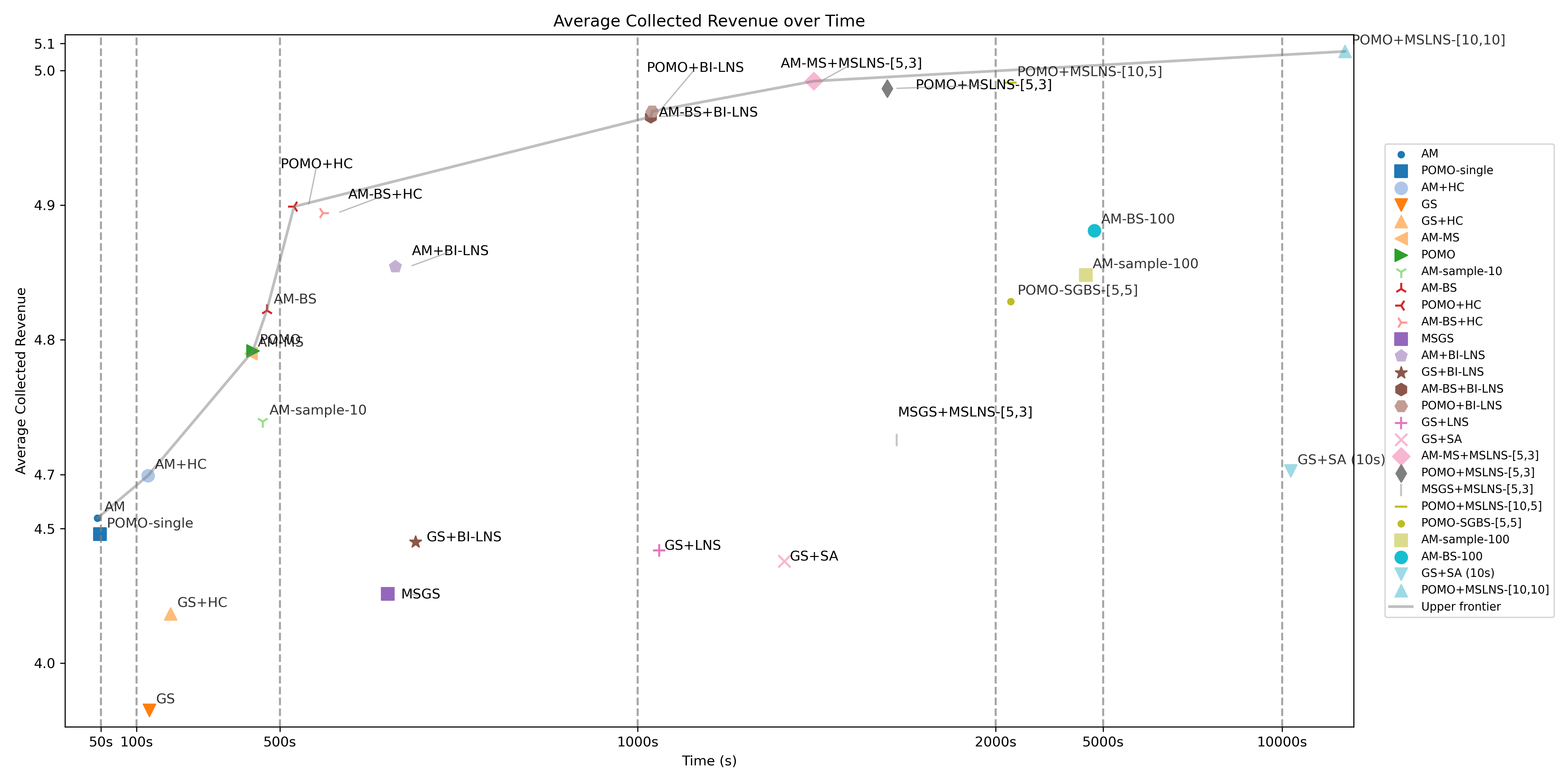
Online Freight Exchange Systems (OFEX) play a crucial role in modern freight logistics by facilitating real-time matching between shippers and carrier. However, efficient combinatorial bundling of transporation jobs remains a bottleneck. We model the OFEX combinatorial bundling problem as a multi-commodity one-to-one pickup-and-delivery selective traveling salesperson problem (m1-PDSTSP), which optimizes revenue-driven freight bundling under capacity, precedence, and route-length constraints. The key challenge is to couple combinatorial bundle selection with pickup-and-delivery routing under sub-second latency. We propose a learning--accelerated hybrid search pipeline that pairs a Transformer Neural Network-based constructive policy with an innovative Multi-Start Large Neighborhood Search (MSLNS) metaheuristic within a rolling-horizon scheme in which the platform repeatedly freezes the current marketplace into a static snapshot and solves it under a short time budget. This pairing leverages the low-latency, high-quality inference of the learning-based constructor alongside the robustness of improvement search; the multi-start design and plausible seeds help LNS to explore the solution space more efficiently. Across benchmarks, our method outperforms state-of-the-art neural combinatorial optimization and metaheuristic baselines in solution quality with comparable time, achieving an optimality gap of less than 2\% in total revenue relative to the best available exact baseline method. To our knowledge, this is the first work to establish that a Deep Neural Network-based constructor can reliably provide high-quality seeds for (multi-start) improvement heuristics, with applicability beyond the \textit{m1-PDSTSP} to a broad class of selective traveling salesperson problems and pickup and delivery problems.
Trucking is the backbone of freight transportation in many countries. In recent years, Online Freight Exchange Systems (OFEX) platforms (e.g., Trans.eu and Uturn in Europe; Full Truck Alliance in China; Convoy, Coyote Logistics and Uber Freight in the United States) have become a common marketplace for shippers and carriers to connect and arrange services (Fazi and Fransoo 2025). These digital platforms facilitate seamless freight matching, real-time monitoring, and payment processing between shippers and carriers. By lowering search and transaction costs, these platforms assist in shippers reducing transport expenses and enable carriers, especially small operators, to find profitable backhauls, thereby reducing empty kilometers and improving market efficiency.
Beyond functioning as digital marketplaces, OFEX platforms have compelling economic incentives to integrate sophisticated algorithms to automate freight matching and optimize load allocation by analyzing comprehensive market data, carrier capacities, and demand patterns. By bundling shipments and recommending route-level assignments, these platforms can enable carriers to assemble feasible, profitable bundles of loads, thereby increasing revenue, equipment utilization, and ultimately driving a more efficient and profitable freight ecosystem.
Designing freight bundling algorithms for OFEX platforms remains understudied and highly challenging. OFEX markets are computationally centralized yet informationally decentralized: key information (e.g., future commitments) is private; loads and availability arrive asynchronously; and each shipment is exclusive (awarded to at most one carrier in each lane). In practice, platforms must recommend real-time backhaul and add-on bundles to many independent carriers under streaming arrivals and exclusivity, creating conflicts when similar bundles are provided to multiple carriers. Consequently, bundling couples combinatorial selection with pickup-and-delivery routing (an NP-hard problem even in static settings) while platforms operate under sub-second latency constraints that preclude exact methods during live allocation. This calls for low-latency bundling algorithms that jointly enforce pickup-and-delivery feasibility, equipment compatibility, and carrier-level preferences within a rolling horizon.
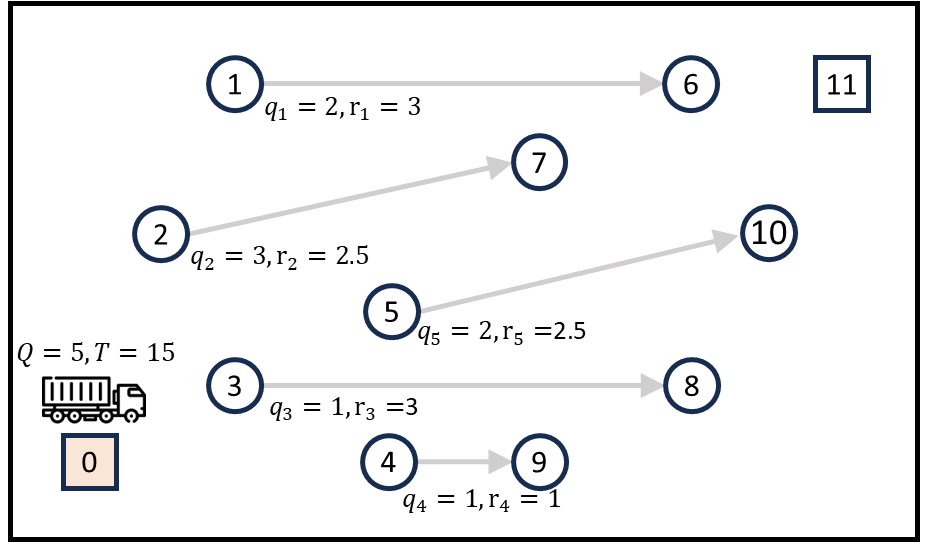
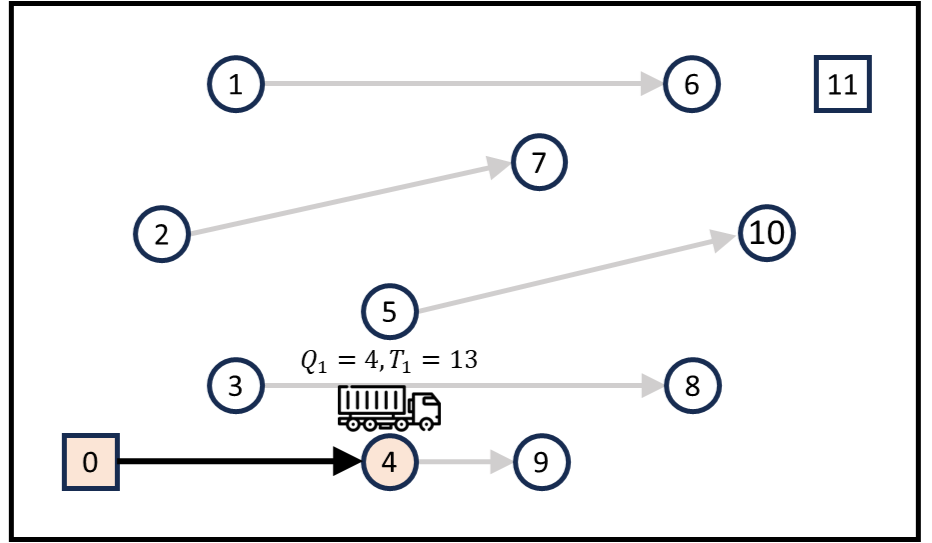
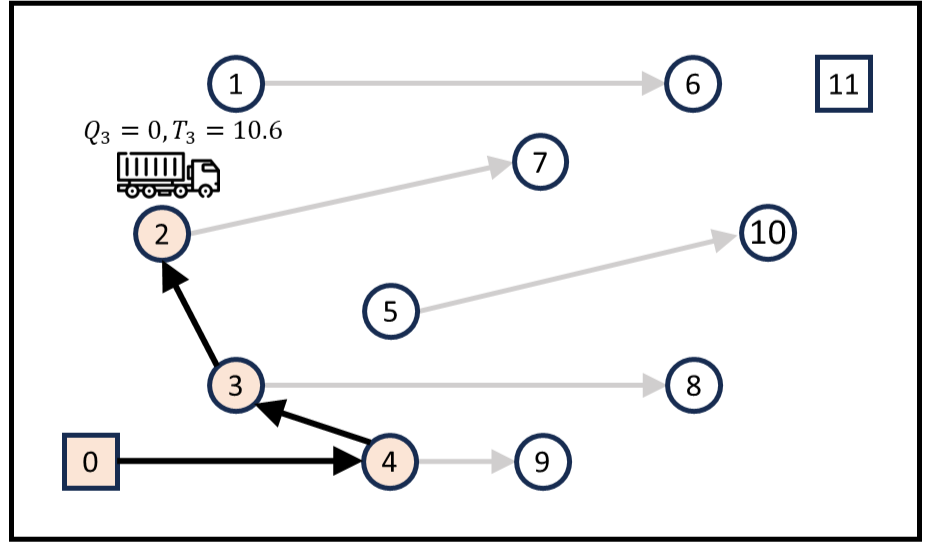
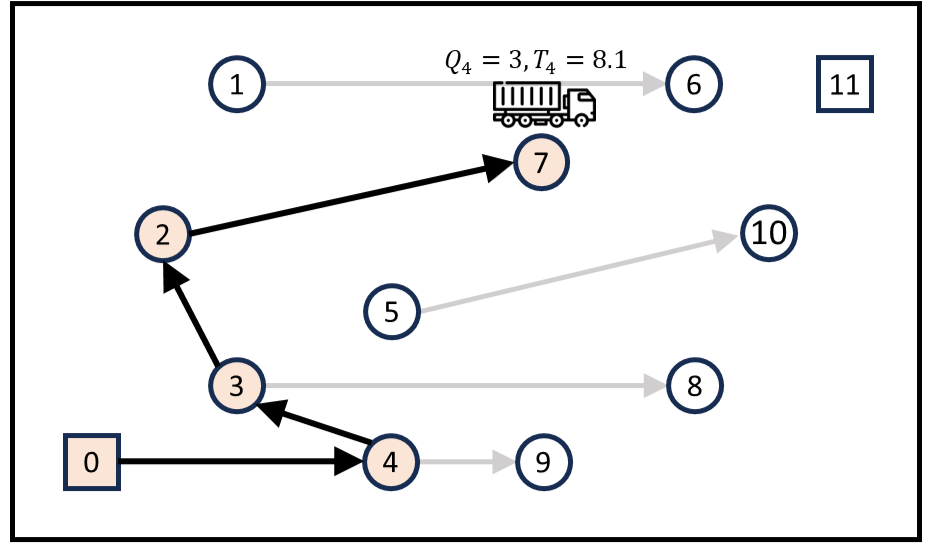
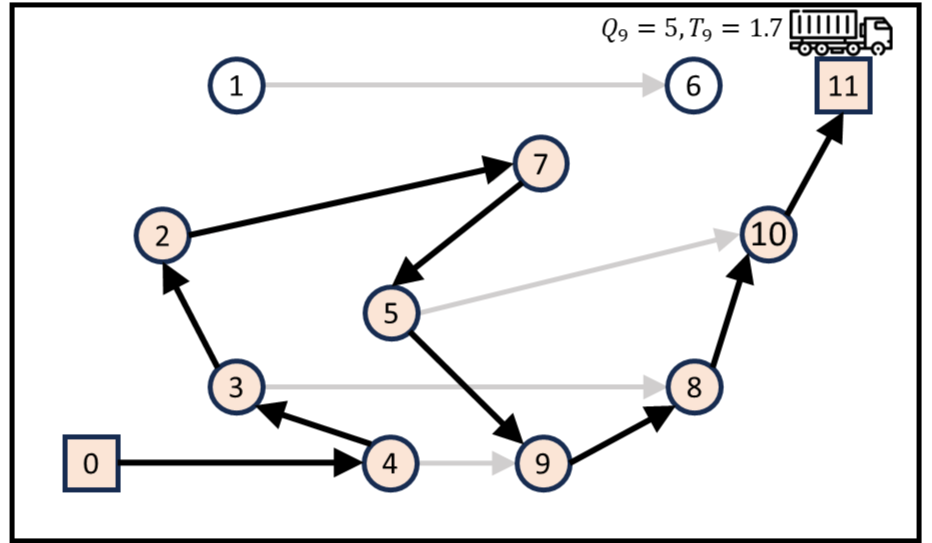
We model the OFEX combinatorial bundling problem as a multi-commodity one-to-one pickup-and-delivery selective traveling salesperson problem (m1-PDSTSP ), a selective variant of the pickup-and-delivery traveling salesperson problem (PDTSP) in which each request has exactly one pickup node and one delivery node; requests are heterogeneous in size and value; and a single vehicle serves only a subset of requests subject to capacity and route-length constraints. The objective is to maximize revenue over all feasible pickup-and-delivery completions.
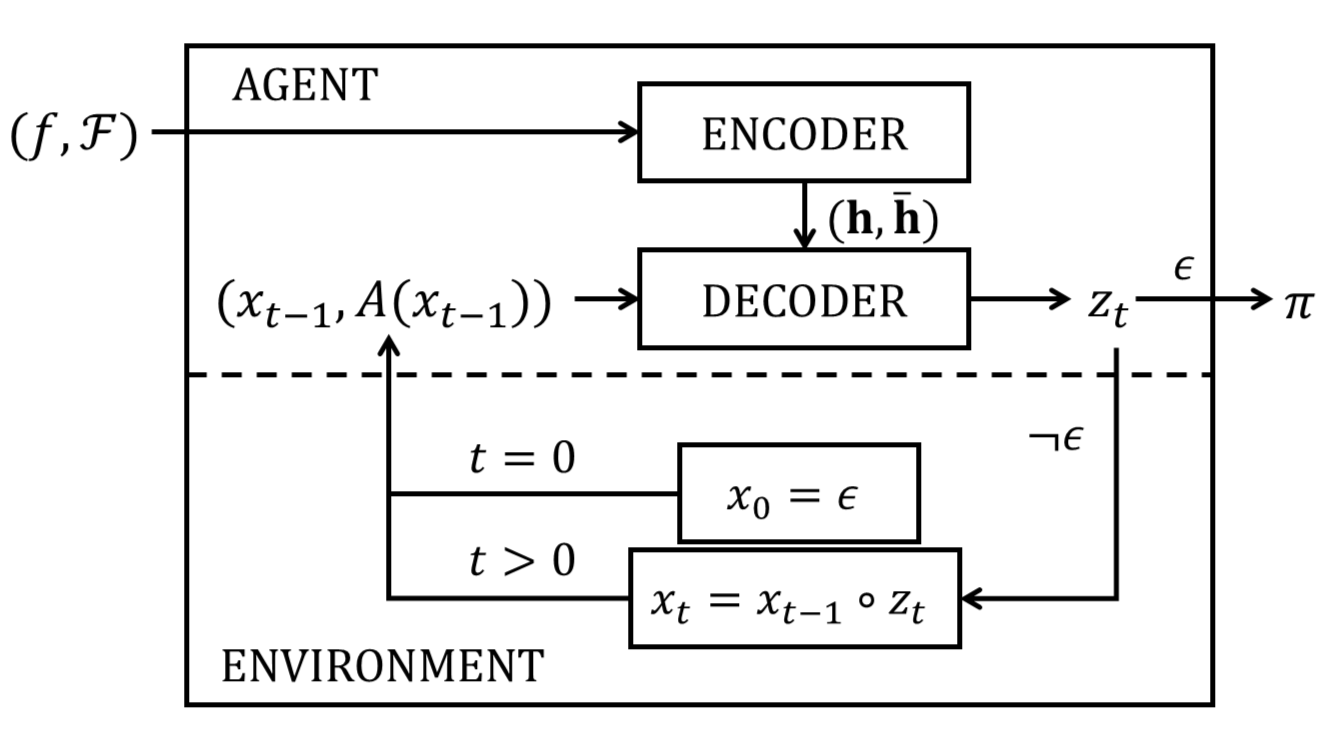
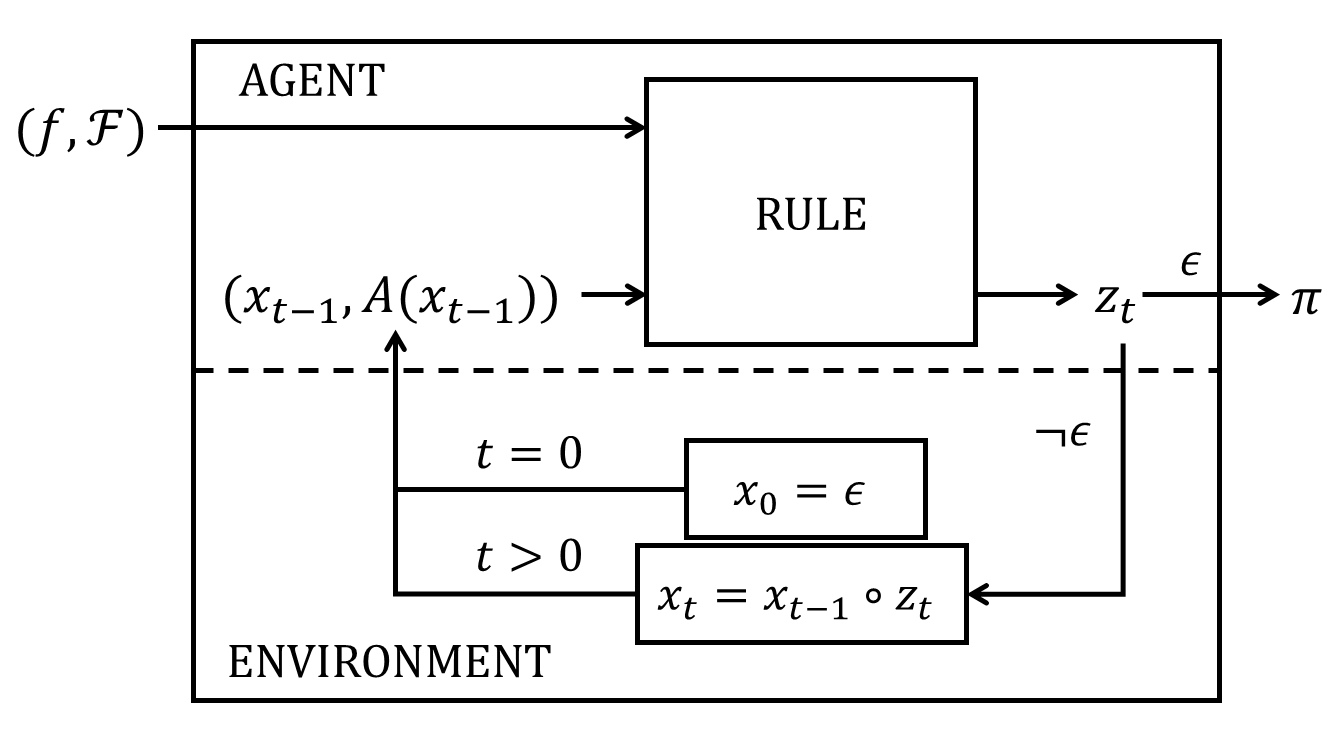
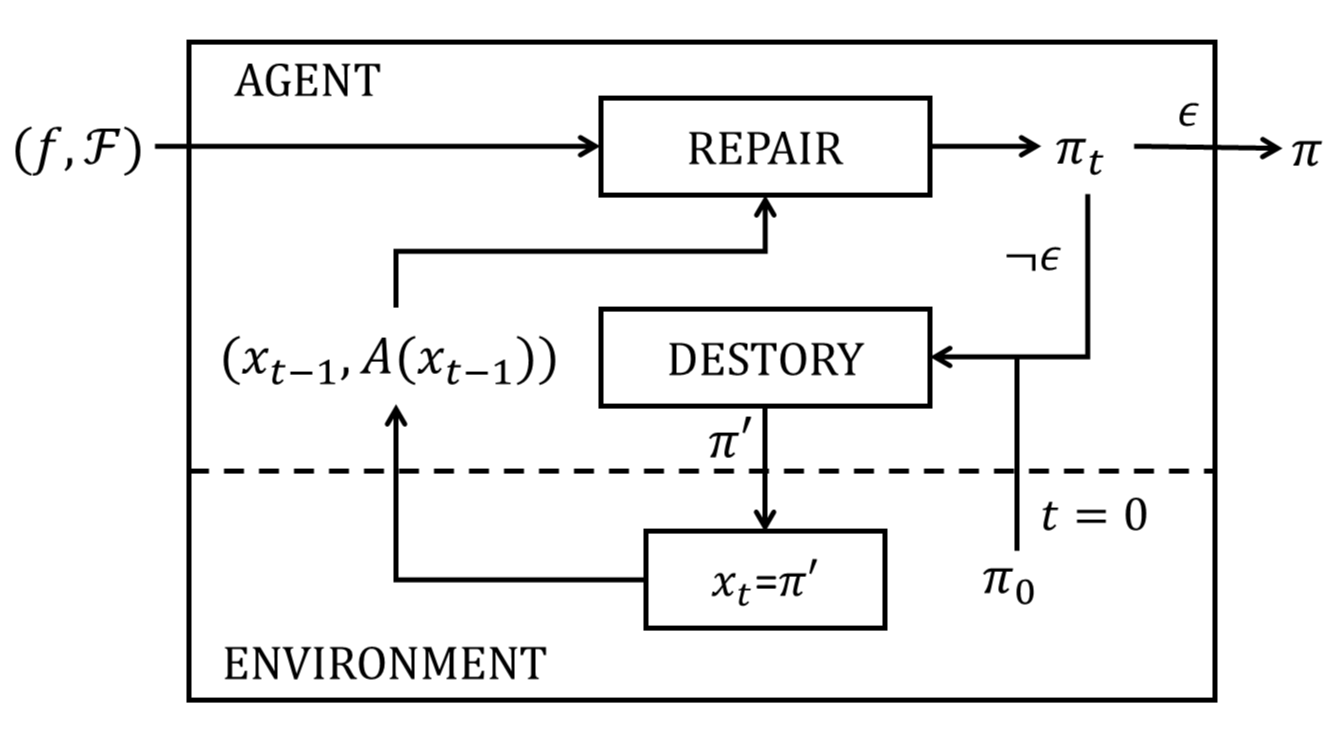
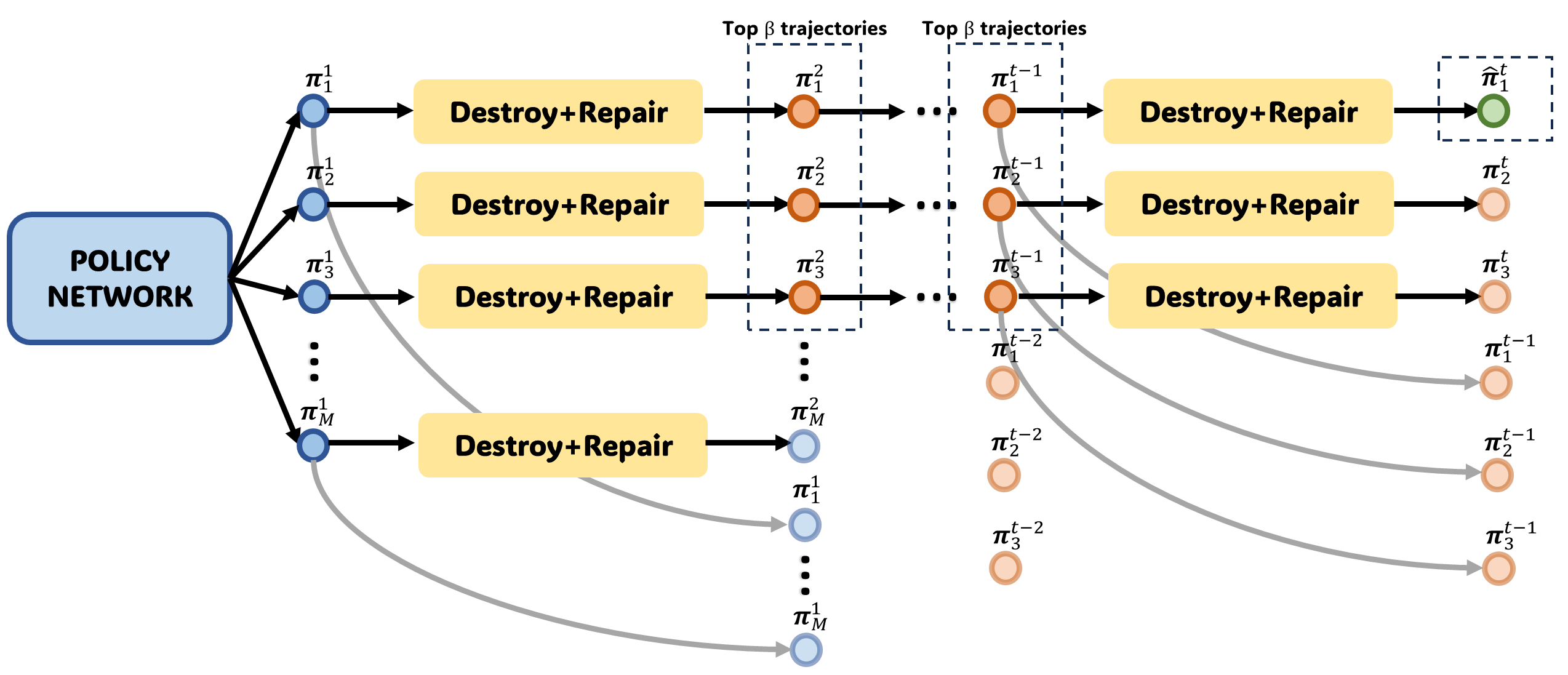
To meet real-time constraints, we adopt a rolling-horizon snapshot approach: although the market evolves continuously, the platform repeatedly solves static instances for a timescale shorter than market changes. To deliver high-quality bundles rapidly, we propose a learning-accelerated hybrid search algorithmic pipeline that combines the strengths of learning-based constructive heuristics with the robustness of improvement heuristics. Specifically, we develop the deep learning (DL)-accelerated Multi-Start Large Neighborhood Search (MSLNS) for the m1-PDSTSP, which leverages the Transformer neural network (Vaswani et al. 2017) and an innovative multi-start improvement heuristics. The Transformerbased policy scores and assembles requests into a feasible route-level bundle, producing plausible seed solutions rapidly that already respect pickup-and-delivery precedence, capacity, and route-length limits. These seeds are then refined by MSLNS, which provides diversification (multi-start + softmax-biased removal + adaptive destroy sizes) and intensification (improve with feasibility checks) to escape local optima and reduce the remaining optimality gap. To formalize the construction phase, we model the Transformer decoding process as a deterministic Markov Decision Process (MDP).
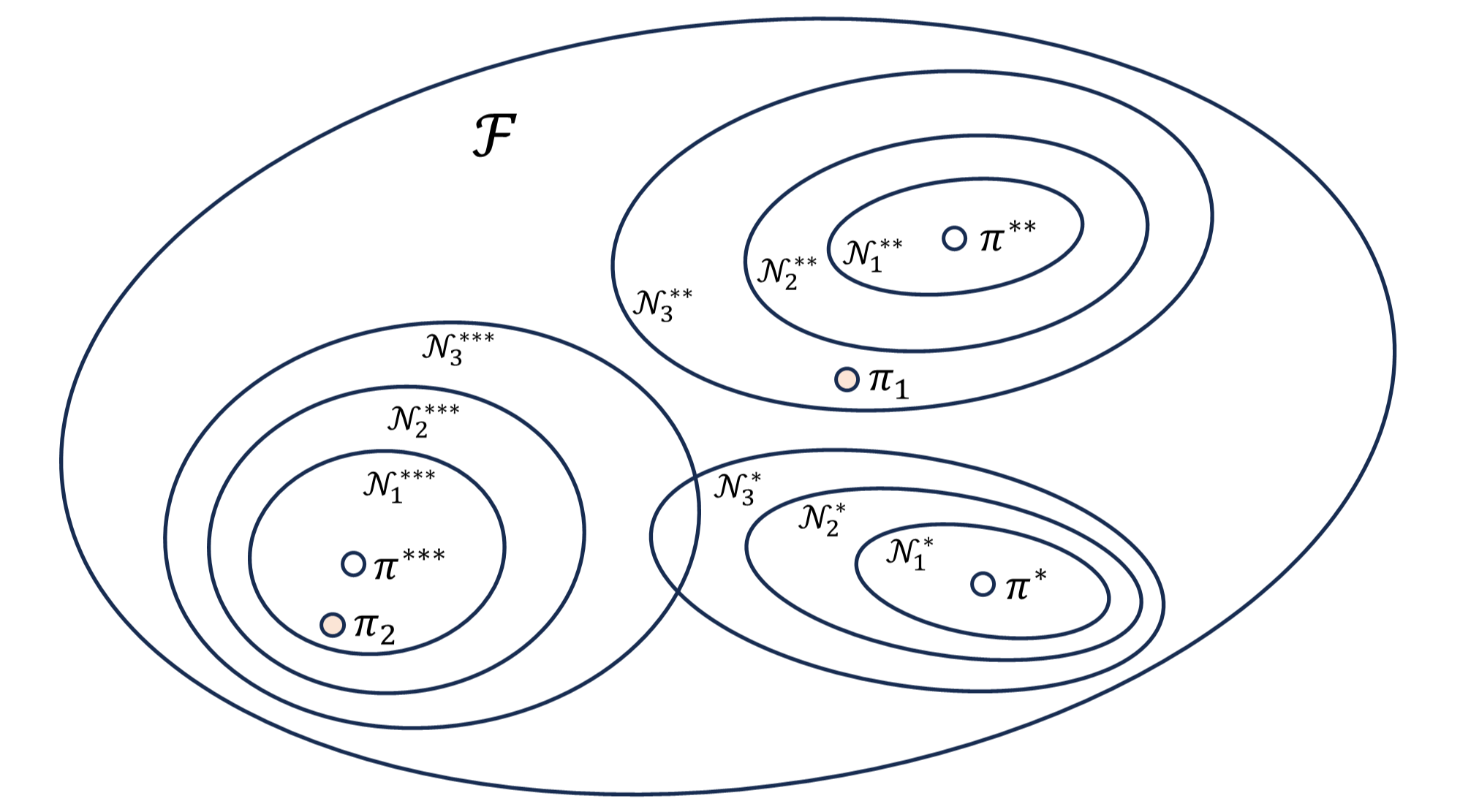
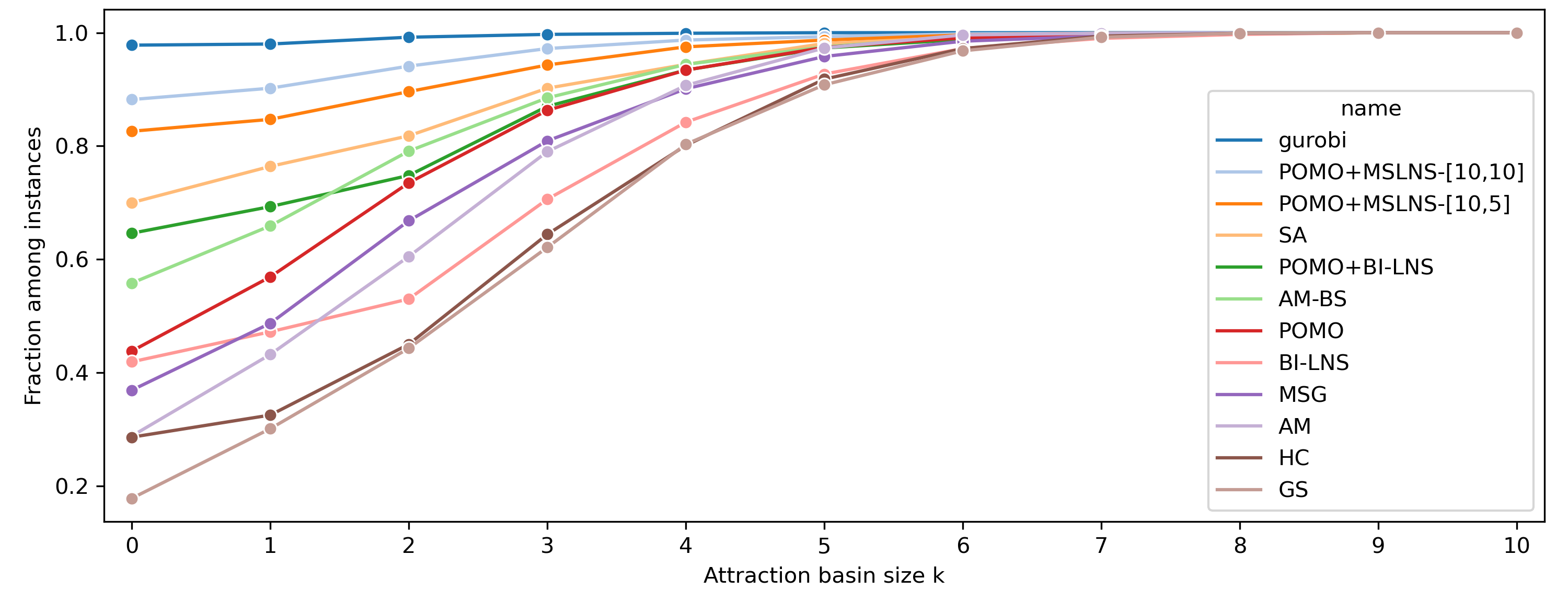
We elucidate the algorithmic rationale behind the hybrid pipeline and the design of MSLNS by analyzing attraction basins in neighborhood-based search, demonstrating how high-quality initializations and multi-start strategies accelerate convergence to superior local optima. Classical metaheuristics typically rely on random or greedy constructions to generate initial solutions, which often correspond to low-quality attractors located far from basins of superior local optima. As a result, substantial exploration (often requiring large neighborhood search) is needed, leading to higher computational cost and poor performance under tight latency constraints, as faced in the m1-PDSTSP. By contrast, our neural constructor is empirically shown to rapidly produce high-quality seeds that position the search close to pro
This content is AI-processed based on open access ArXiv data.