📝 Original Info Title: TriFlow: A Progressive Multi-Agent Framework for Intelligent Trip PlanningArXiv ID: 2512.11271Date: 2025-12-12Authors: ** - Yuxing Chen, The University of Sydney, Sydney, Australia (yche0009@uni.sydney.edu.au ) - Basem Suleiman*†, University of New South Wales, Sydney, Australia (b.suleiman@unsw.edu.au ) - Qifan Chen, The University of Sydney, Sydney, Australia (qifan.chen@sydney.edu.au ) *Corresponding author †Also affiliated with The University of Sydney **📝 Abstract Real-world trip planning requires transforming open-ended user requests into executable itineraries under strict spatial, temporal, and budgetary constraints while aligning with user preferences. Existing LLM-based agents struggle with constraint satisfaction, tool coordination, and efficiency, often producing infeasible or costly plans. To address these limitations, we present TriFlow, a progressive multi-agent framework that unifies structured reasoning and language-based flexibility through a three-stage pipeline of retrieval, planning, and governance. By this design, TriFlow progressively narrows the search space, assembles constraint-consistent itineraries via rule-LLM collaboration, and performs bounded iterative refinement to ensure global feasibility and personalisation. Evaluations on TravelPlanner and TripTailor benchmarks demonstrated state-of-the-art results, achieving 91.1% and 97% final pass rates, respectively, with over 10x runtime efficiency improvement compared to current SOTA.
💡 Deep Analysis
📄 Full Content TriFlow: A Progressive Multi-Agent Framework for Intelligent
Trip Planning
Yuxing Chen
The University of Sydney
Sydney, Australia
yche0009@uni.sydney.edu.au
Basem Suleiman∗†
University of New South Wales
Sydney, Australia
b.suleiman@unsw.edu.au
Qifan Chen
The University of Sydney
Sydney, Australia
qifan.chen@sydney.edu.au
Abstract
Real-world trip planning requires transforming open-ended user
requests into executable itineraries under strict spatial, temporal,
and budgetary constraints while aligning with user preferences.
Existing LLM-based agents struggle with constraint satisfaction,
tool coordination, and efficiency, often producing infeasible or
costly plans. To address these limitations, we present TriFlow, a
progressive multi-agent framework that unifies structured reason-
ing and language-based flexibility through a three-stage pipeline of
retrieval, planning, and governance. By this design, TriFlow progres-
sively narrows the search space, assembles constraint-consistent
itineraries via rule–LLM collaboration, and performs bounded it-
erative refinement to ensure global feasibility and personalisation.
Evaluations on TravelPlanner and TripTailor benchmarks demon-
strated state-of-the-art results, achieving 91.1% and 97% final pass
rates, respectively, with over 10 × runtime efficiency improvement
compared to current SOTA.
CCS Concepts
• Information systems →Information systems applications;
Decision support systems.
Keywords
Agent System, Trip Planning, Route Recommendation
ACM Reference Format:
Yuxing Chen, Basem Suleiman, and Qifan Chen. 2026. TriFlow: A Progressive
Multi-Agent Framework for Intelligent Trip Planning. In Proceedings of
Proceedings of the ACM Web Conference 2026 (WWW Companion ’26). ACM,
New York, NY, USA, 4 pages. https://doi.org/XXXXXXX.XXXXXXX
1
Introduction
Real-world trip planning is a complex task that combines natu-
ral language understanding, spatiotemporal constraint satisfaction,
and multi-objective optimisation. Users often describe their travel
goals in open-ended and ambiguous language (e.g., “fun places,”
∗Basem Suleiman is the corresponding author.
†Basem Suleiman also with The University of Sydney
Permission to make digital or hard copies of all or part of this work for personal or
classroom use is granted without fee provided that copies are not made or distributed
for profit or commercial advantage and that copies bear this notice and the full citation
on the first page. Copyrights for components of this work owned by others than the
author(s) must be honored. Abstracting with credit is permitted. To copy otherwise, or
republish, to post on servers or to redistribute to lists, requires prior specific permission
and/or a fee. Request permissions from permissions@acm.org.
WWW Companion ’26, Abu Dhabi, United Arab Emirates
© 2026 Copyright held by the owner/author(s). Publication rights licensed to ACM.
ACM ISBN 978-1-4503-XXXX-X/26/04
https://doi.org/XXXXXXX.XXXXXXX
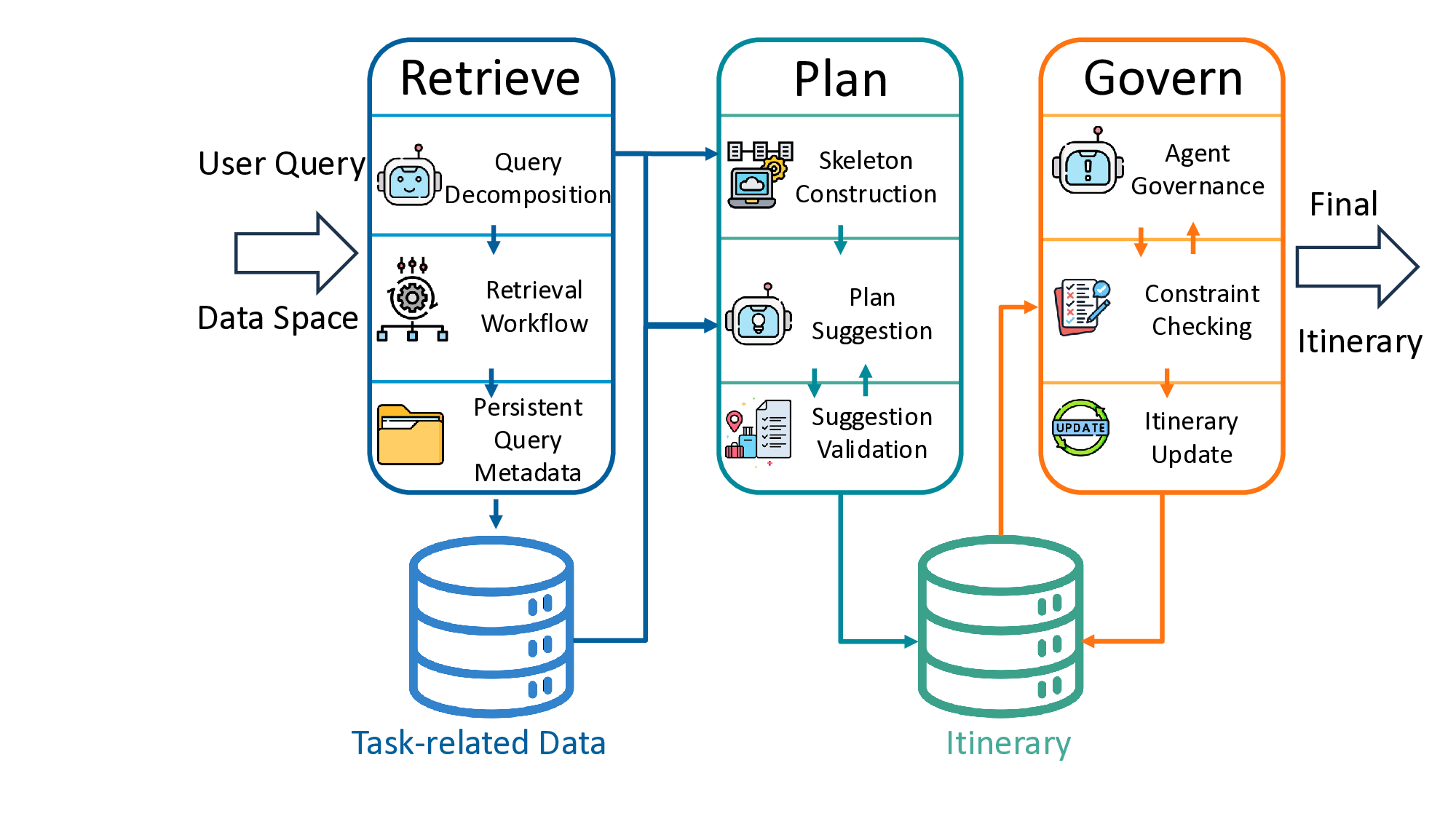
Retrieve
Plan
Govern
User Query
Data Space
Query
Decomposition
Final
Itinerary
Retrieval
Workflow
Persistent
Query
Metadata
Task-related Data
Itinerary
Skeleton
Construction
Plan
Suggestion
Suggestion
Validation
Agent
Governance
Constraint
Checking
Itinerary
Update
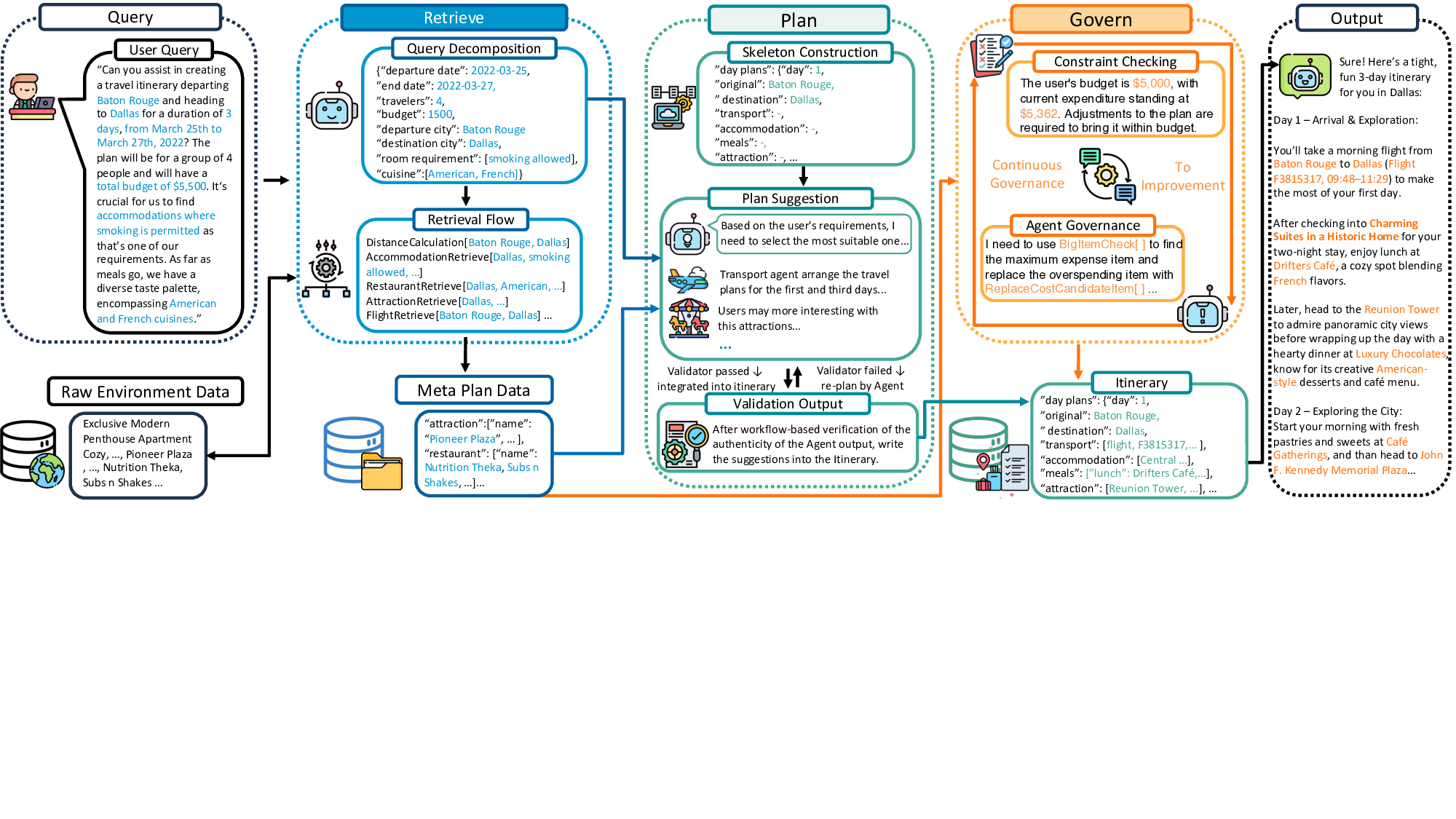
Figure 1: Three-stage progressive architecture of TriFlow.
“local food”), while executable itineraries must satisfy strict opera-
tional, temporal, spatial, and budgetary constraints. Despite rapid
progress under the emerging “LLM Agent + Tools” paradigm, exist-
ing systems still struggle with real-world deployment. LLM-based
agents that rely on tool generation often suffer from hallucinations,
violate real-world constraints, and incur high token costs [5, 6].
These limitations hinder both feasibility and personalisation.
Recent research has addressed these challenges through both
benchmarking and methodological advances. New benchmarks
such as TravelPlanner and TripTailor expand task scale, POI cover-
age, and verifiable metrics, exposing a persistent gap between hard-
constraint satisfaction and human-level experiential quality [5, 6].
Methodologically, neuro-symbolic and optimisation-coupled frame-
works translate natural-language intents into computable struc-
tures [3], while multi-agent and “generate–verify–retrieve” sys-
tems enhance coordination and constraint checking through co-
operative reasoning [2]. Personalisation-oriented studies explore
lightweight user modelling and preference elicitation to improve
alignment [1, 4]. However, these works often evolve independently,
lacking an integrated design that jointly ensures orchestration ro-
bustness and cost efficiency. To bridge these gaps, we propose
TriFlow, a progressive multi-agent framework for intelligent trip
planning that unifies structured reasoning and flexible natural lan-
guage understanding. TriFlow is built upon three principles: (1) a
staged retrieval–planning–governance pipeline that progressively
maps user requests into denoised structured intermediates, na
📸 Image Gallery
Reference This content is AI-processed based on open access ArXiv data.