Multi-Intent Spoken Language Understanding: Methods, Trends, and Challenges
Reading time: 5 minute
...
📝 Original Info
Title: Multi-Intent Spoken Language Understanding: Methods, Trends, and Challenges
ArXiv ID: 2512.11258
Date: 2025-12-12
Authors: Di Wu¹²†, Ruiyu Fang²†, Liting Jiang¹†, Shuangyong Song²†, Xiaomeng Huang², Shiquan Wang², Zhongqiu Li², Lingling Shi², Mengjiao Bao², Yongxiang Li²* (liyx25@chinatelecom.cn), Hao Huang¹³* (huanghao@xju.edu.cn) ¹ Xinjiang University, School of Computer Science and Technology ² China Telecom Corp Ltd., Institute of Artificial Intelligence (TeleAI) ³ Joint International Research Laboratory of Silk Road Multilingual Cognitive Computing, Urumqi, China † 공동 1저자 (동등 기여) —
📝 Abstract
Multi-intent spoken language understanding (SLU) involves two tasks: multiple intent detection and slot filling, which jointly handle utterances containing more than one intent. Owing to this characteristic, which closely reflects real-world applications, the task has attracted increasing research attention, and substantial progress has been achieved. However, there remains a lack of a comprehensive and systematic review of existing studies on multi-intent SLU. To this end, this paper presents a survey of recent advances in multi-intent SLU. We provide an in-depth overview of previous research from two perspectives: decoding paradigms and modeling approaches. On this basis, we further compare the performance of representative models and analyze their strengths and limitations. Finally, we discuss the current challenges and outline promising directions for future research. We hope this survey will offer valuable insights and serve as a useful reference for advancing research in multi-intent SLU.
💡 Deep Analysis
📄 Full Content
Multi-Intent Spoken Language Understanding:
Methods, Trends, and Challenges
Di Wu1,2†, Ruiyu Fang2†, Liting Jiang1†, Shuangyong Song2†,
Xiaomeng Huang2, Shiquan Wang2, Zhongqiu Li2, Lingling Shi2,
Mengjiao Bao2, Yongxiang Li2*, Hao Huang1,3*
1School of Computer Science and Technology, Xinjiang University.
2Institute of Artificial Intelligence (TeleAI), China Telecom Corp Ltd.
3Joint International Research Laboratory of Silk Road Multilingual
Cognitive Computing, Urumqi, China.
*Corresponding author(s). E-mail(s): liyx25@chinatelecom.cn;
huanghao@xju.edu.cn;
†These authors contributed equally to this work.
Abstract
Multi-intent spoken language understanding (SLU) involves two tasks: multiple
intent detection and slot filling, which jointly handle utterances containing more
than one intent. Owing to this characteristic, which closely reflects real-world
applications, the task has attracted increasing research attention, and substantial
progress has been achieved. However, there remains a lack of a comprehensive
and systematic review of existing studies on multi-intent SLU. To this end, this
paper presents a survey of recent advances in multi-intent SLU. We provide an in-
depth overview of previous research from two perspectives: decoding paradigms
and modeling approaches. On this basis, we further compare the performance
of representative models and analyze their strengths and limitations. Finally,
we discuss the current challenges and outline promising directions for future
research. We hope this survey will offer valuable insights and serve as a useful
reference for advancing research in multi-intent SLU.
Keywords: Multiple intent detection, Slot filling, Joint training
1
arXiv:2512.11258v1 [cs.CL] 12 Dec 2025
1 Introduction
Spoken Language Understanding (SLU) typically involves two core tasks: intent detec-
tion and slot filling [1]. The former identifies the request underlying goal, while the
latter extracts entities related to that goal from the utterance. As a key component
of task-oriented dialogue systems, SLU enables systems to interpret user input and
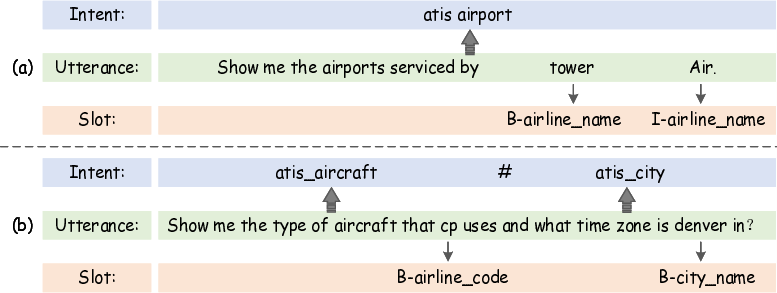
respond appropriately. As shown in Fig. 1(a), given the user utterance “Show me the
airports serviced by tower Air”, the intent is “atis airport”, and the corresponding
slot annotations are “O O O O O O B-airline name I-airline name”.
Show me the type of aircraft that cp uses and what time zone is denver in?
B-airline_code B-city_name
atis_aircraft # atis_city
Slot:
Utterance:
Intent:
(b)
Show me the airports serviced by tower Air.
B-airline_name I-airline_name
atis airport
Slot:
Utterance:
Intent:
(a)
Show me the type of aircraft that cp uses and what time zone is denver in?
B-airline_code B-city_name
atis_aircraft # atis_city
Slot:
Utterance:
Intent:
(b)
Show me the airports serviced by tower Air.
B-airline_name I-airline_name
atis airport
Slot:
Utterance:
Intent:
(a)
Fig. 1 Examples from the SLU dataset. (a) shows a single-intent SLU sample, while (b) presents a
multi-intent SLU sample. For clarity, slot labels marked as “O” are omitted.
In real-world scenarios, a single utterance may express multiple intents, about 52%
of utterances in Amazon’s internal dataset contain multiple intents [2]. For instance,
as shown in Fig. 1(b), the user utterance “Show me the type of aircraft that cp uses
and what time zone is denver in?” conveys multiple intents (“atis aircraft#atis city”)
with corresponding slot annotations “O O O O O O O B-airline code O O O O O O
B-city name O”.
Although multi-intent SLU shares a similar objective with single-intent SLU,
namely predicting intents and slot labels from utterances, it poses unique challenges.
Multi-intent utterances often comprise multiple clauses, making it difficult for single-
intent models to capture all semantic dependencies [3–7]. The challenges mainly arise
from two aspects: 1. Complex decoding mechanisms. Single-intent SLU mod-
els usually encode an utterance into a single sentence-level representation for intent
prediction, which limits their ability to distinguish multiple co-occurring intents. 2.
Increased interaction complexity between intent and slot features. As illus-
trated in Fig. 1, intent detection and slot filling are interdependent. However, in
multi-intent utterances, cross-clause interference exacerbates the difficulty of modeling
this interaction effectively.
Recognizing the importance of multi-intent SLU for building more capable dialogue
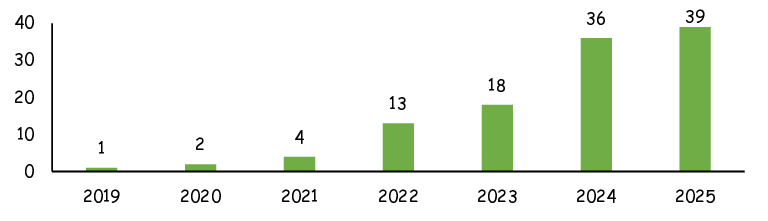
systems, researchers have made significant progress in recent years. The number of
2
related publications has grown stea