Title: TreeVQA: A Tree-Structured Execution Framework for Shot Reduction in Variational Quantum Algorithms
ArXiv ID: 2512.12068
Date: 2025-12-12
Authors: Yuewen Hou, Dhanvi Bharadwaj, Gokul Subramanian Ravi
📝 Abstract
Variational Quantum Algorithms (VQAs) are promising for near- and intermediate-term quantum computing, but their execution cost is substantial. Each task requires many iterations and numerous circuits per iteration, and real-world applications often involve multiple tasks, scaling with the precision needed to explore the application's energy landscape. This demands an enormous number of execution shots, making practical use prohibitively expensive. We observe that VQA costs can be significantly reduced by exploiting execution similarities across an application's tasks. Based on this insight, we propose TreeVQA, a tree-based execution framework that begins by executing tasks jointly and progressively branches only as their quantum executions diverge. Implemented as a VQA wrapper, TreeVQA integrates with typical VQA applications. Evaluations on scientific and combinatorial benchmarks show shot count reductions of $25.9\times$ on average and over $100\times$ for large-scale problems at the same target accuracy. The benefits grow further with increasing problem size and precision requirements.
💡 Deep Analysis
📄 Full Content
Quantum computers are gradually transitioning from nearterm noisy intermediate-scale quantum (NISQ) systems [49], which feature at most a few hundred qubits with limited coherence times and high gate error rates, to intermediate-term Early Fault-Tolerant (EFT) systems [23,30], expected to host thousands of qubits and employ limited forms of quantum error correction to reduce error rates. These systems will be unable to run long-term quantum applications [25,59], which demand millions of qubits, full fault tolerance, and the ability to execute billions of quantum operations [47]. Despite these limitations, the community remains optimistic that near-and intermediate-term devices can deliver practically useful quantum advantage in key domains such as optimization [15], physics [36], and chemistry [48].
One promising class of algorithms with potential feasibility and utility before full fault tolerance is Variational Quantum Algorithms (VQAs). Their inherent robustness [65] to noise allows them to deliver useful results even without fullfledged quantum error correction. VQAs have broad applicability, including estimating the energies of molecules [48] 1 TreeVQA is open source at https://github.com/isaachyw/TreeVQA
. and approximating solutions to optimization problems such as MaxCut [15]. These hybrid algorithms combine a quantum circuit with parameterized angles (ansatz) with a classical optimizer. Through an iterative feedback loop, the VQA explores the solution space and converges to the problem’s “ground state”, representing the optimal solution.
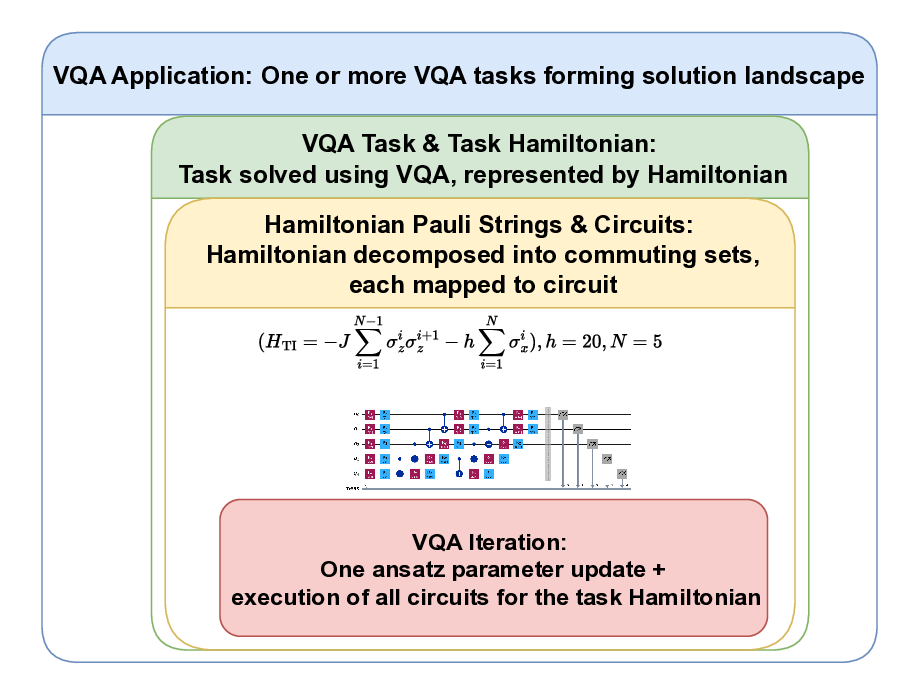
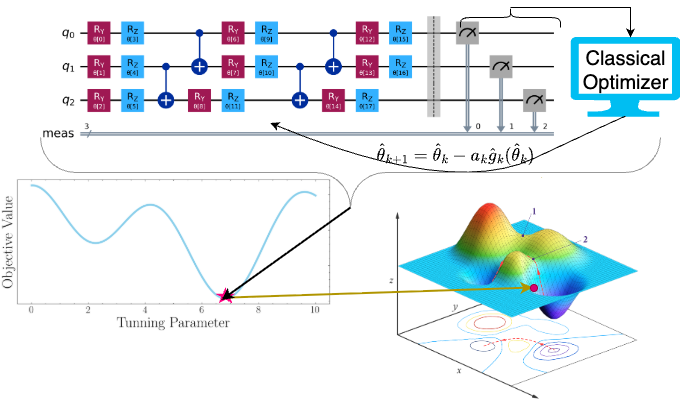
Before delving into VQA details and our proposed work, we introduce key terminology for context: (i) VQA Application: An application typically composed of one or more VQA tasks. When multiple tasks are involved, their solutions are combined to construct a solution landscape relevant to the application; (ii) VQA Task and Task Hamiltonian: A VQA task is solved using a VQA to find its ground-state solution and is mathematically represented by a Hamiltonian; (iii) Hamiltonian Pauli String and Circuit: For a specific VQA task, its Hamiltonian consists of multiple Pauli strings, which can be grouped into sets that fully commute within a set but not across sets. Each set corresponds to a quantum circuit (using the same ansatz but different measurement bases); (iv) VQA Iteration: For a specific VQA task, this is a single instance of ansatz parameter updates, as determined by the classical optimizer, followed by the execution of circuits associated with the task Hamiltonian. Fig. 1 illustrates this terminology.
While VQAs hold promise, their execution faces significant hurdles, the most critical being the enormous number of ‘shots’ (executions) required for any real-world application. This challenge arises from three factors: a VQA tasks are inherently iterative, often requiring thousands of iterations to explore the solution landscape of complex quantum problems, a process further complicated by device noise; b For practical applications such as chemistry, task Hamiltonians contain thousands of Pauli terms, resulting in a large number of circuits per iteration; and c While the above challenges were associated with individual tasks, real-world applications typically comprise thousands of VQA tasks, whose collective ground states define the application’s solution landscape. Together, these factors drive the total number of circuit executions into the billions for practical VQA applications, making time and resource costs a show-stopper.
Prior research, both specific to VQA and otherwise, has contributed to both reducing and exacerbating total shot costs, depending on their primary goal. For instance, on the one hand, classical initialization methods [51,57,58] can help reduce the number of VQA iterations, although their success is often limited and problem dependent. On the other hand, error mitigation strategies such as ZNE [19,34], PEC [3], measurement error mitigation [13], and more, all enormously increase the shot counts. The key takeaway is that, despite prior strategies or because of them, the cost of execution shots is still extremely high and deserves attention.
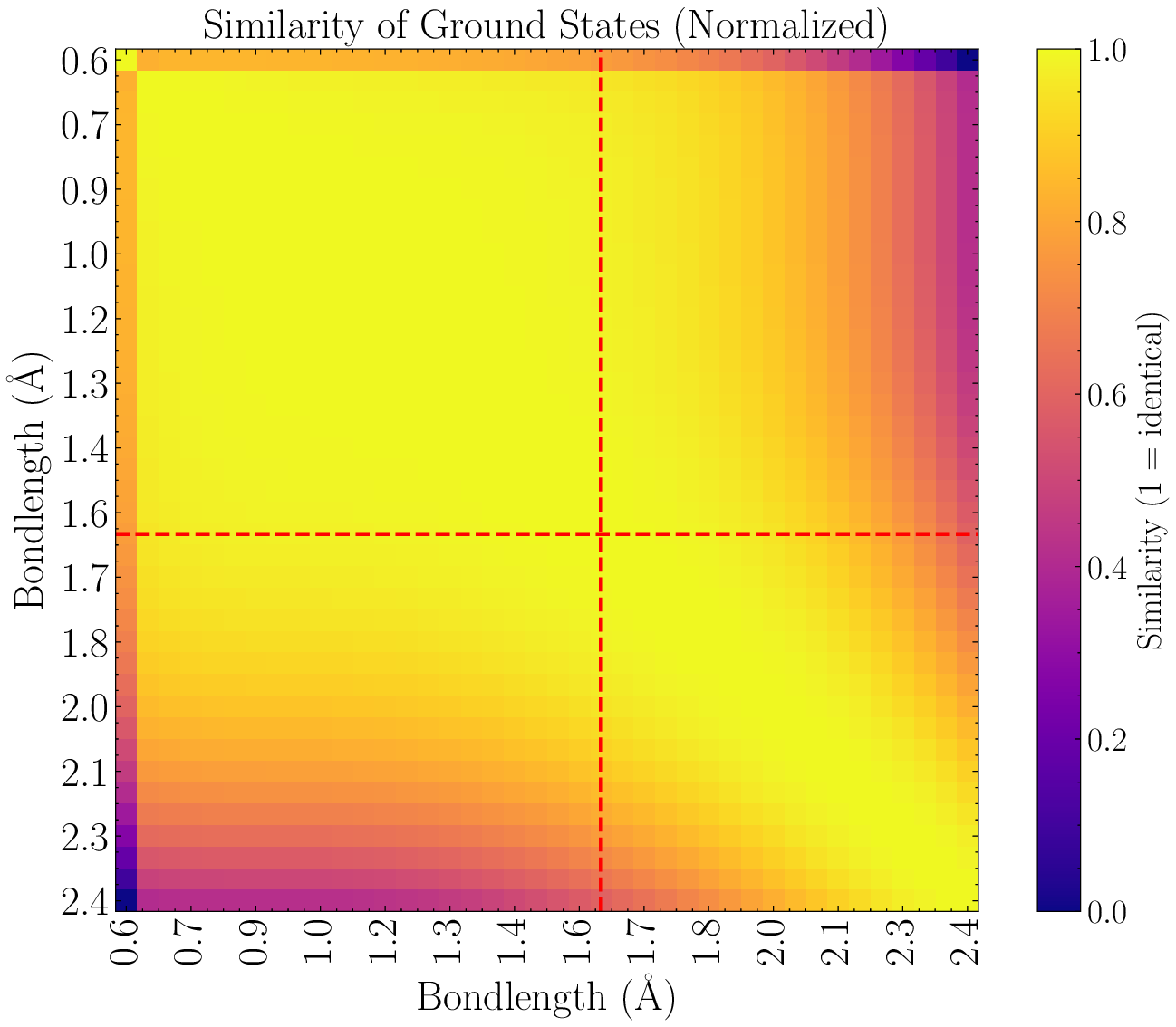
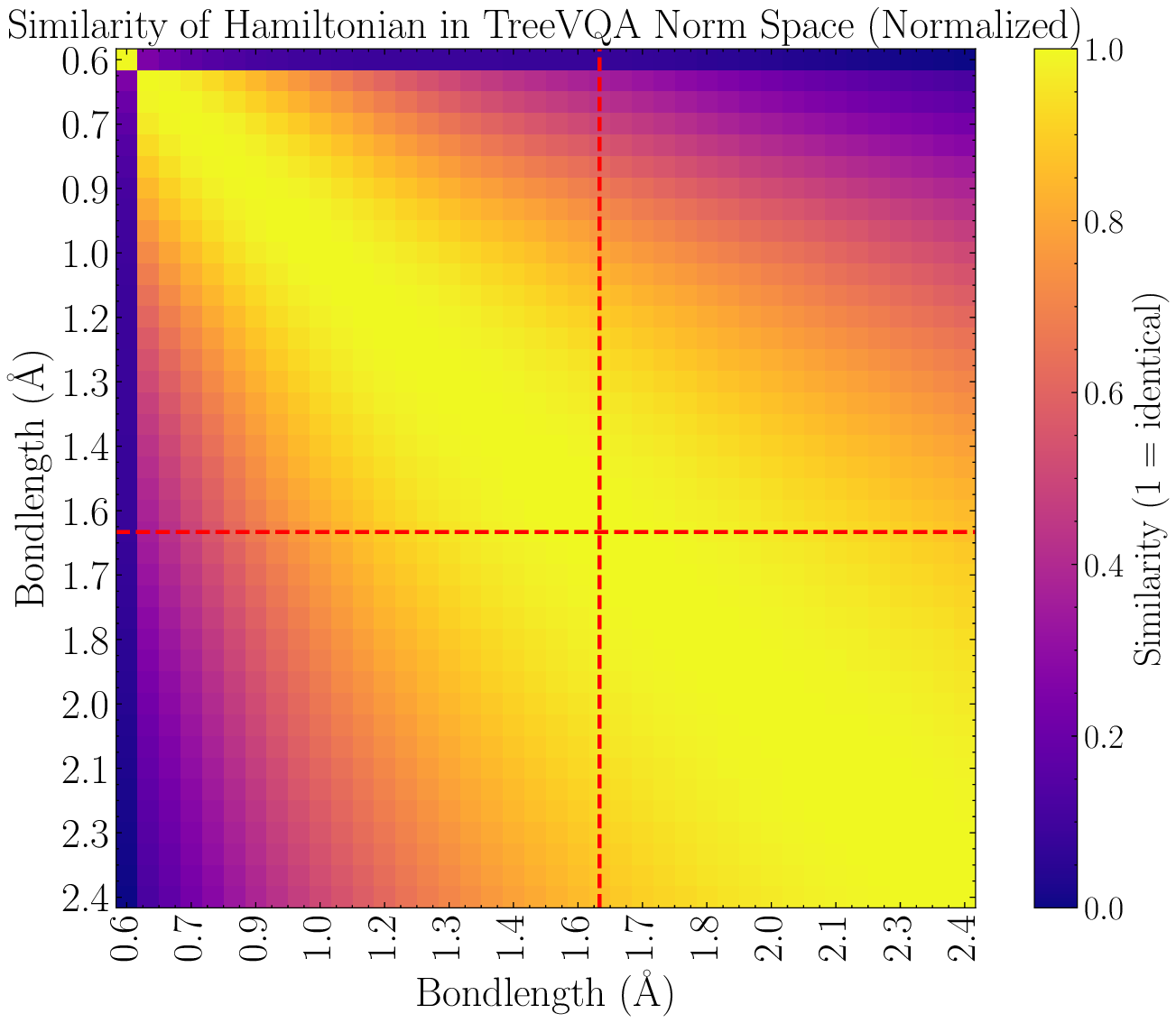
In this work, we make the novel observation that many VQA tasks within an application are highly similar. In particular, the solutions to these tasks (i.e., the quantum states corresponding to their ground states) often exhibit significant overlap. The key idea is that, while these solutions are distinct enough to require individual evaluation for constructing the high-precision solution landscape demanded by the application, their substantial overlaps create an opportunity to share quantum executions across tasks as they iterate toward their respective solutions. By reusing large portions of the VQA process, the total cost of quantum execution can be reduced dramatically.
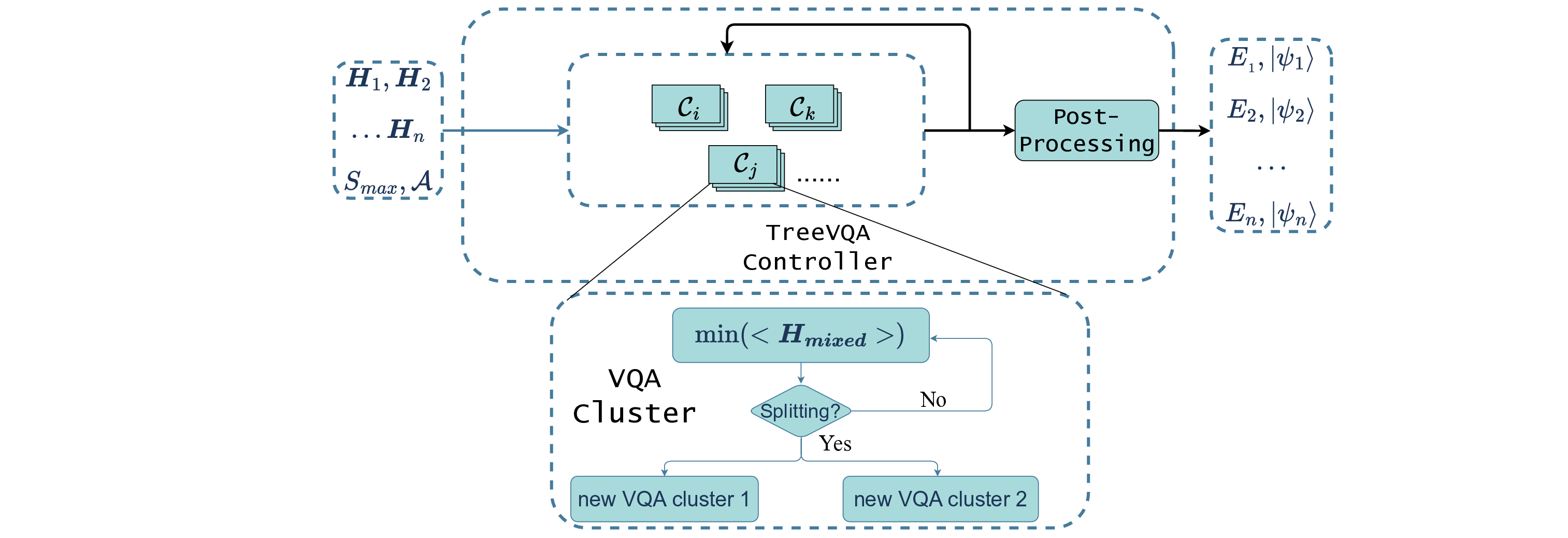
Based on this insight, we propose TreeVQA, a tree-based execution framework that begins by executing all application VQA tasks as