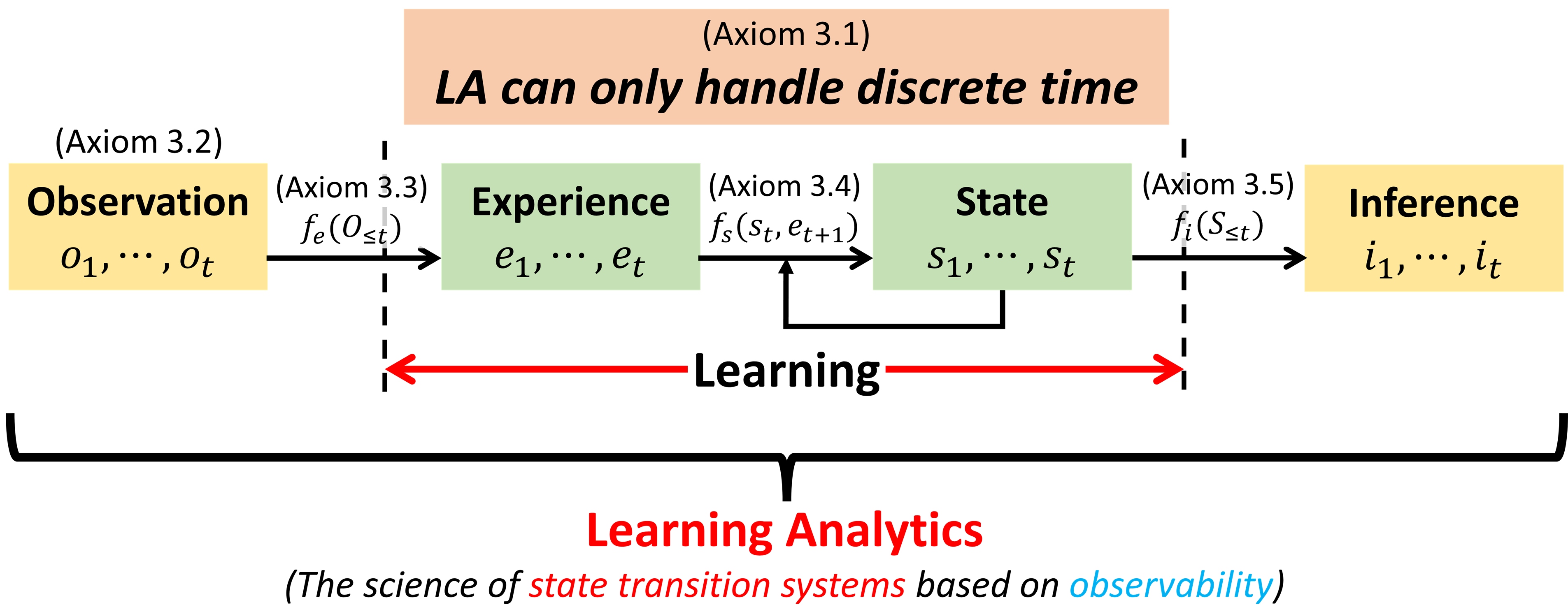
Learning Analytics (LA) has rapidly expanded through practical and technological innovation, yet its foundational identity has remained theoretically under-specified. This paper addresses this gap by proposing the first axiomatic theory that formally defines the essential structure, scope, and limitations of LA. Derived from the psychological definition of learning and the methodological requirements of LA, the framework consists of five axioms specifying discrete observation, experience construction, state transition, and inference. From these axioms, we derive a set of theorems and propositions that clarify the epistemological stance of LA, including the inherent unobservability of learner states, the irreducibility of temporal order, constraints on reachable states, and the impossibility of deterministically predicting future learning. We further define LA structure and LA practice as formal objects, demonstrating the sufficiency and necessity of the axioms and showing that diverse LA approaches -- such as Bayesian Knowledge Tracing and dashboards -- can be uniformly explained within this framework. The theory provides guiding principles for designing analytic methods and interpreting learning data while avoiding naive behaviorism and category errors by establishing an explicit theoretical inference layer between observations and states. This work positions LA as a rigorous science of state transition systems based on observability, establishing the theoretical foundation necessary for the field's maturation as a scholarly discipline.
💡 Deep Analysis
📄 Full Content
Defining the Scope of Learning Analytics: An
Axiomatic Approach for Analytic Practice and
Measurable Learning Phenomena
Kensuke Takii∗†
Changhao Liang∗
Hiroaki Ogata∗
December 2025
Abstract
Learning Analytics (LA) has rapidly expanded through practical and
technological innovation, yet its foundational identity has remained theo-
retically under-specified. This paper addresses this gap by proposing the
first axiomatic theory that formally defines the essential structure, scope,
and limitations of LA. Derived from the psychological definition of learn-
ing and the methodological requirements of LA, the framework consists
of five axioms specifying discrete observation, experience construction,
state transition, and inference.
From these axioms, we derive a set of
theorems and propositions that clarify the epistemological stance of LA,
including the inherent unobservability of learner states, the irreducibility
of temporal order, constraints on reachable states, and the impossibility of
deterministically predicting future learning. We further define LA struc-
ture and LA practice as formal objects, demonstrating the sufficiency and
necessity of the axioms and showing that diverse LA approaches—such
as Bayesian Knowledge Tracing and dashboards—can be uniformly ex-
plained within this framework. The theory provides guiding principles for
designing analytic methods and interpreting learning data while avoiding
naive behaviorism and category errors by establishing an explicit theoret-
ical inference layer between observations and states. This work positions
LA as a rigorous science of state transition systems based on observability,
establishing the theoretical foundation necessary for the field’s maturation
as a scholarly discipline.
Keywords:
Learning Analytics, Axiomatic Approach, Theoretical Foun-
dation, LA Structure, LA Practice, Design Principles
∗Academic Center for Computing and Media Studies, Kyoto University, Japan
†kensuke.takii96@gmail.com
1
arXiv:2512.10081v1 [cs.CY] 10 Dec 2025
1
Introduction
The proliferation of Information and Communication Technology (ICT) in ed-
ucational settings has led to an explosive increase in educational data, giving
rise to a new academic field: Learning Analytics (LA). With the goal of “un-
derstanding and optimizing learning and the environments in which it occurs,”
[12] LA has created numerous practical success stories: for example, retention
prediction [34, 24], identifying at-risk students [1], grade prediction [33], dash-
board construction [23], categorizing learner behavior patterns [27], and building
learner models [5, 38]. However, behind its remarkable success and development
in practice, LA has faced a fundamental problem: it lacked a theoretical foun-
dation [6, 36, 14].
The lack of a theoretical foundation has led LA to face the following issues.
First, it has been unable to clearly define what constitutes LA and what does
not among the diverse research on educational understanding and support [29,
16, 7]. As a result, the boundary between what can and cannot be understood
through LA has also become ambiguous [15, 32, 26]. Such ambiguity leads to
a regime that equates the observation of learning behavior derived from data
with the learner’s characteristics.
In other words, it overlooks the essential
complexity of the learning process and the fluidity of the learner’s internal state
[21]. This leads to machine behaviorism [22], which equates learning with the
control of mechanical actions.
Furthermore, there has been little discussion
about engaging with learning science, the traditional academic discipline for
understanding learning [28].
LA grew primarily through practice, while its
paradigms and academic identity remained ambiguous.
For the reasons stated above, a foundational theory is urgently needed for
LA. Specifically, it must be a theory that clearly defines “what is LA and what
is not LA?” It must be capable of encompassing and supporting diverse LA
practices. It should provide justification and explanation for existing LA prac-
tices, while offering suggestions for the design and interpretation of future LA
practices.
This study provides a theoretical foundation for LA through an axiomatic
approach.
The axiomatic method has a long tradition in mathematics and
theoretical science as a means to clarify the essential structure of a domain [37,
20]. Here, we derive five axioms from the psychological definition of the activity
of learning and the various conditions demanded by LA. We also demonstrate
that these axioms can fully account for the well-known characteristics of LA and
the philosophical demands placed on LA itself. The theoretical framework thus
constructed comprehensively explains existing LA and can provide insights for
future LA practice.
The contributions of this research are threefold: (1) it explicitly formalizes
for the first time the essential properties of LA that were previously known only
empirically; (2) it scientifically and p