Information-Dense Reasoning for Efficient and Auditable Security Alert Triage
Reading time: 5 minute
...
📝 Original Info
Title: Information-Dense Reasoning for Efficient and Auditable Security Alert Triage
ArXiv ID: 2512.08169
Date: 2025-12-09
Authors: ** - Guangze Zhao¹² - Yongzheng Zhang¹ - Changbo Tian² - Dan Xie³ - Hongri Liu⁴† - Bailing Wang⁴⁵† ¹ 하얼빈 공과대학, ² CHANG AN 통신기술㈜, ³ 중국과학기술대학, ⁴ 하얼빈 공과대학(위해)·청도 연구소, ⁵ 산동 산업네트워크보안 핵심연구소 † 공동 교신 저자: Hongri Liu (liuhr@hit.edu.cn), Bailing Wang (wbl@hit.edu.cn) **
📝 Abstract
Security Operations Centers face massive, heterogeneous alert streams under minute-level service windows, creating the Alert Triage Latency Paradox: verbose reasoning chains ensure accuracy and compliance but incur prohibitive latency and token costs, while minimal chains sacrifice transparency and auditability. Existing solutions fail: signature systems are brittle, anomaly methods lack actionability, and fully cloud-hosted LLMs raise latency, cost, and privacy concerns. We propose AIDR, a hybrid cloud-edge framework that addresses this trade-off through constrained information-density optimization. The core innovation is gradient-based compression of reasoning chains to retain only decision-critical steps--minimal evidence sufficient to justify predictions while respecting token and latency budgets. We demonstrate that this approach preserves decision-relevant information while minimizing complexity. We construct compact datasets by distilling alerts into 3-5 high-information bullets (68% token reduction), train domain-specialized experts via LoRA, and deploy a cloud-edge architecture: a cloud LLM routes alerts to on-premises experts generating SOAR-ready JSON. Experiments demonstrate AIDR achieves higher accuracy and 40.6% latency reduction versus Chain-of-Thought, with robustness to data corruption and out-of-distribution generalization, enabling auditable and efficient SOC triage with full data residency compliance.
💡 Deep Analysis
📄 Full Content
Information-Dense Reasoning for Efficient and
Auditable Security Alert Triage
Guangze Zhao1,2, Yongzheng Zhang1, Changbo Tian2, Dan Xie3, Hongri Liu4,†, Bailing Wang4,5,†
Abstract—Security Operations Centers face massive, heteroge-
neous alert streams under minute-level service windows, creating
the Alert Triage Latency Paradox: verbose reasoning chains
ensure accuracy and compliance but incur prohibitive latency
and token costs, while minimal chains sacrifice transparency and
auditability. Existing solutions fail: signature systems are brittle,
anomaly methods lack actionability, and fully cloud-hosted LLMs
raise latency, cost, and privacy concerns. We propose AIDR,
a hybrid cloud-edge framework that addresses this trade-off
through constrained information-density optimization. The core
innovation is gradient-based compression of reasoning chains to
retain only decision-critical steps—minimal evidence sufficient
to justify predictions while respecting token and latency budgets.
We demonstrate that this approach preserves decision-relevant
information while minimizing complexity. We construct compact
datasets by distilling alerts into 3–5 high-information bullets
(68% token reduction), train domain-specialized experts via
LoRA, and deploy a cloud-edge architecture: a cloud LLM
routes alerts to on-premises experts generating SOAR-ready
JSON. Experiments demonstrate AIDR achieves higher accuracy
and 40.6% latency reduction versus Chain-of-Thought, with
robustness to data corruption and out-of-distribution generaliza-
tion, enabling auditable and efficient SOC triage with full data
residency compliance.
Index Terms—Alert Triage, Chain of Draft, Cloud-Edge Col-
laboration, LLM for Security, SOC Automation
I. INTRODUCTION
Security Operations Centers (SOCs) [53, 34, 32] face an
unrelenting operational challenge: the continuous ingestion of
massive and highly heterogeneous alert streams. These data
sources—spanning endpoint detection and response (EDR)
systems [1], intrusion detection systems (IDS) [2], firewalls,
cloud telemetry, and diverse application logs—generate over-
whelming alert volumes that frequently reach thousands per
analyst team per day, completely saturating the typical 1–5
minute service window and leading to a pervasive operational
crisis known as alert fatigue [7]. This fatigue significantly
delays incident response and, critically, masks high-value
genuine threat signals within the noise. In practical terms,
numerous SOC teams report being chronically overwhelmed
by false positives and consequently unable to investigate a sub-
stantial fraction of incoming alerts, revealing a persistent and
1Harbin Institute of Technology. 2CHANG AN communication technol-
ogy Co., Ltd. 3University of Science and Technology of China. 4Harbin
Institute of Technology (Weihai) Qingdao Research Institute. 5Shandong
Key Laboratory of Industrial Network Security. †Co-corresponding authors:
Hongri Liu (liuhr@hit.edu.cn) and Bailing Wang (wbl@hit.edu.cn). This
work is supported by National Natural Science Foundation of China (NSFC)
(Grant No.62272129), Key R&D Program of Shandong Province (Grant
No.2023CXPT065).
critical gap between modern, advanced threat detection [47]
capabilities and the capacity for actionable, timely triage.
Conventional security triage approaches have consistently
struggled with this escalating operational load. Signature-
and rule-based Security Information and Event Management
(SIEM) [27] systems are fundamentally brittle to previously
unseen attack variants, demand continuous tuning, and fre-
quently inflate false positive rates as enterprise environments
evolve and existing rules drift out of sync with operational
baselines. Anomaly-based methods [51, 61] focus on flagging
statistical deviations rather than identifying confirmed threats,
making resulting actions uncertain and low-confidence while
exposing high sensitivity to concept drift in nonstationary
security data streams. Meanwhile, fully cloud-hosted Large
Language Model (LLM) [16, 18, 9, 10] triage solutions
introduce significant practical concerns despite their advanced
reasoning capabilities: end-to-end latency becomes a major
bottleneck in time-sensitive incident response [4, 26, 5], token
costs escalate at high daily alert volumes, and operation [39]
in regulated environments introduces insurmountable obstacles
related to data privacy, residency requirements, and secure
operations. Recent industry risk catalogs for LLM applica-
tions [14, 11, 36, 42] have explicitly highlighted these precise
issues, underscoring the urgent necessity for solutions that
balance advanced reasoning with compliance and operational
security requirements.
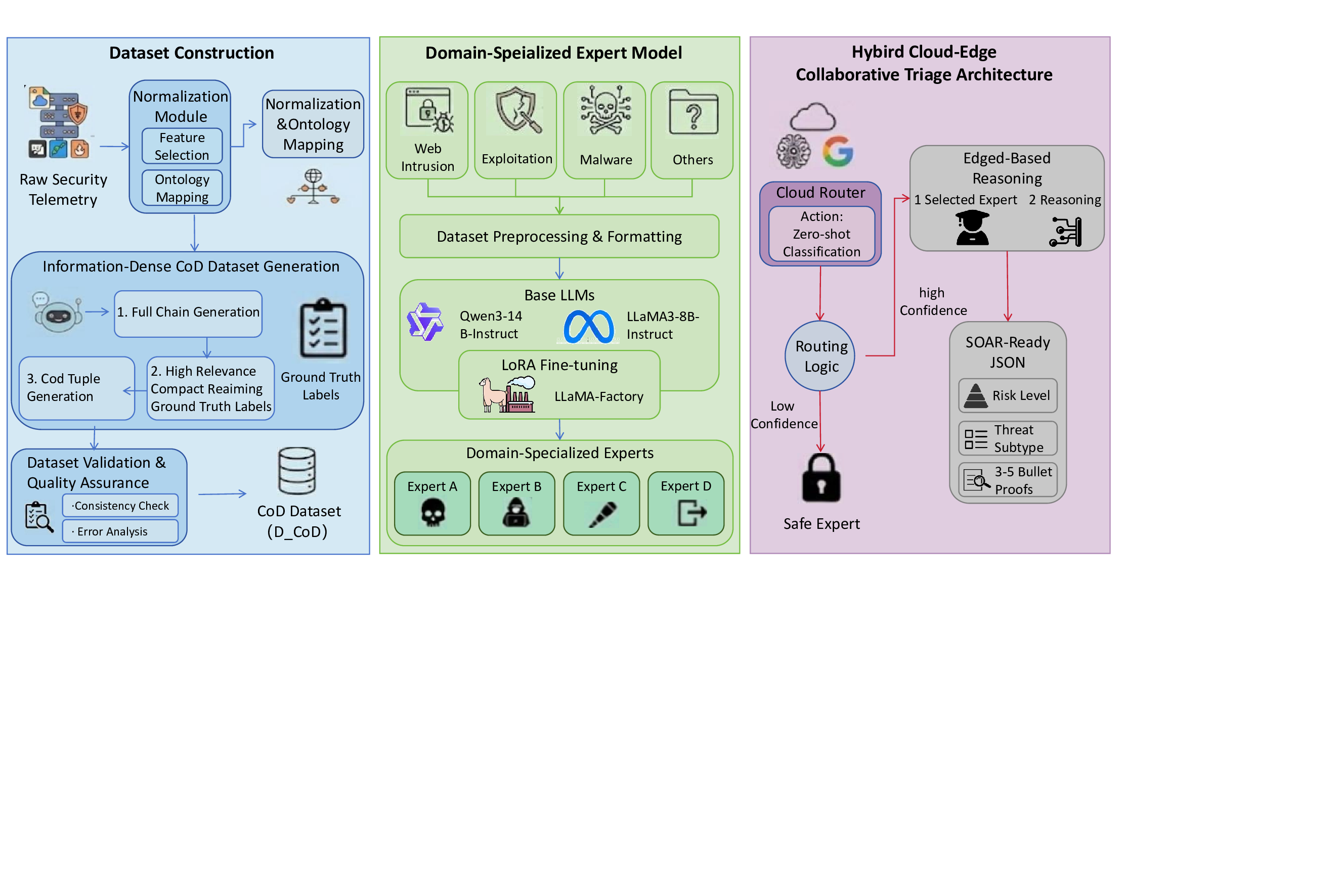
To address these challenges, we propose AIDR (Accuracy-
preserving Information-Dense Reasoning for alert forensics
and triage), as shown in Fig. 1, a Chain-of-Draft frame-
work that reformulates SOC alert triage. First, we ad-
dress a fundamental latency-accuracy trade-off in security
triage: verbose r